Birth in Royal Quarters
Born in the eastern palace in Thang Long; witnessed the degradation of imperial power under Trinh tyranny from youth.
黎维祁
Le Duy Ky (黎维祁, 1765–1793), later renamed Le Duy Zhen and historically revered as Emperor Chieu Thong, was the twenty-fifth and final monarch of the Later Le Dynasty of Vietnam, as well as a naturalized royal bannerman of the Qing dynasty. He was the grandson of Emperor Le Hien Tong and the son of Crown Prince Le Duy Y. In the late eighteenth century, Vietnam was fractured by protracted civil warfare between the northern…
Le Duy Ky (黎维祁, 1765–1793), later renamed Le Duy Zhen and historically revered as Emperor Chieu Thong, was the twenty-fifth and final monarch of the Later Le Dynasty of Vietnam, as well as a naturalized royal bannerman of the Qing dynasty. He was the grandson of Emperor Le Hien Tong and the son of Crown Prince Le Duy Y. In the late eighteenth century, Vietnam was fractured by protracted civil warfare between the northern Trinh lords and the southern Nguyen lords. Following the eruption of the Tay Son rebellion in the south, commander Nguyen Hue swept northward to overthrow Trinh clan domination. In 1786, upon the death of Le Hien Tong, Le Duy Ky ascended the imperial throne, adopting the reign title Chieu Thong the following year. Shortly after his accession, renewed Tay Son offensives captured Thang Long (modern Hanoi), forcing Le Duy Ky into exile in the northern wilderness. In 1788, he dispatched his mother and envoys to Guangxi to plead for military intervention from his suzerain, the Qing dynasty. The Qianlong Emperor dispatched Viceroy of Liangguang Sun Shiyi and Provincial Military Commander Xu Shiheng with an expeditionary army to liberate Thang Long, officially investing Le Duy Ky as King of Annam. However, during the lunar New Year festivities in early 1789, Nguyen Hue launched a surprise counter-offensive (the Battle of Ngoc Hoi-Dong Da), routing the Qing forces and compelling Le Duy Ky to flee across the border into China. Opting for pragmatic regional stability, the Qianlong Emperor recognized Nguyen Hue as the legitimate sovereign of Annam and resettled Le Duy Ky in Beijing, granting him a third-rank official title and enrolling his clan into the Bordered Yellow Banner of the Chinese Martial (Hanjun) Banners. In October 1793, Le Duy Ky passed away in Beijing from grief and illness at age twenty-nine, being interred with ducal honors outside Dongzhimen. His remains were repatriated to Vietnam in 1804 and interred at the Ban Thach Mausoleum, with the Nguyen dynasty granting him the posthumous title Emperor Man.
Born in the eastern palace in Thang Long; witnessed the degradation of imperial power under Trinh tyranny from youth.
Elevated as sovereign following the death of his grandfather Le Hien Tong and the collapse of the Trinh lords.
Formally inaugurated the Chieu Thong era; fled Thang Long when Tay Son forces under Vu Van Nham took the capital.
Retreated to Lang Giang and dispatched his mother to Zhennanguan in Guangxi to appeal to the Qing dynasty for aid.
Restored to Thang Long following the capture of the city by Sun Shiyi's army; formally invested as King of Annam.
Routed during Nguyen Hue's New Year surprise assault; fled with retreating Qing troops into Guangxi.
Relocated to Beijing after the Qianlong Emperor recognized Nguyen Hue; enrolled into the Qing Hanjun Banner nobility.
Passed away from illness in his Beijing residence on the 12th day of the ninth month; buried with ducal honors outside Dongzhimen.
Le Duy Ky was born in 1765 (the 26th year of the Canh Hung reign in Vietnam, corresponding to the 30th year of the Qianlong reign in the Qing empire) in the royal palace at Thang Long. Throughout the seventeenth and eighteenth centuries, the Later Le emperors functioned as figurehead sovereigns under the military dictatorship of the Trinh clan, who governed northern Vietnam (Dang Ngoai) as hereditary lords. Le Duy Ky's father, Crown Prince Le Duy Y, attempted to assert sovereign authority against the Trinh dictatorship, resulting in his persecution and execution by Trinh Sam. The infant Le Duy Ky was subsequently imprisoned for over a decade, surviving under severe privation until Trinh clan infighting led to his release.
In 1786, the Tay Son peasant movement in southern Vietnam under the three brothers Nguyen Nhac, Nguyen Lu, and Nguyen Hue achieved sweeping military breakthroughs. Raising the banner of "Supporting the Le and Destroying the Trinh," Nguyen Hue led an expeditionary force northward, crushing Trinh resistance and occupying Thang Long, effectively terminating more than two centuries of Trinh rule. In July 1786, the ailing Emperor Le Hien Tong passed away. Adhering to dynastic legitimacy, Nguyen Hue oversaw the accession of imperial grandson Le Duy Ky to the throne. The following year, the young monarch proclaimed the reign title "Chieu Thong."
Upon assuming power, Le Duy Ky sought to rebuild monarchical authority and break free from regional military factions. He posthumously elevated his murdered father to Emperor Huu Tong and revived the triennial metropolitan examinations in Thang Long to rally the allegiance of northern Confucian literati. However, lacking an independent military establishment, he was forced to rely on former general Nguyen Huu Chinh to maintain palace security.
Nguyen Huu Chinh's authoritarian conduct provoked the hostility of the Tay Son leadership in the south. In November 1787, Nguyen Hue dispatched his generals Vu Van Nham and Ngo Van So to invade the north. Nguyen Huu Chinh was captured and executed, while Le Duy Ky fled Thang Long under nightfall with a small royal retinue, seeking refuge in the rugged karst mountains of Kinh Bac and Lang Giang. In early 1788, Nguyen Hue marched to Thang Long to reorganize northern administration and sent emissaries inviting the monarch to return. Terrified of assassination, Le Duy Ky remained in concealment, leaving the royal court completely disbanded.
Refusing to surrender his ancestral inheritance, Le Duy Ky concluded that his fragmented loyalist followers could never overcome the formidable Tay Son armies without external assistance. In May 1788, he escorted his mother, Empress Dowager Man, his royal consort, and his infant son Le Duy Thuyen to the Sino-Vietnamese border. Entering Zhennanguan Pass in Guangxi, the imperial family presented an urgent petition to Qing Viceroy of Liangguang Sun Shiyi, begging the suzerain Qing court to dispatch an army to punish the Tay Son rebels and restore the legitimate Le dynasty.
Sun Shiyi immediately forwarded the petition to the imperial throne. The Qianlong Emperor viewed the crisis through the lens of Confucian tributary ethics: the Later Le dynasty had been a loyal vassal of China for over a century, and celestial justice required the empire to restore legitimate dynasties overthrown by rebellious subjects. In August 1788, the Qianlong Emperor appointed Sun Shiyi as supreme commander, with Guangxi Provincial Military Commander Xu Shiheng and Regional Commander Zhang Chaolong directing vanguard formations. A Qing expeditionary force of over 10,000 veterans from Guangdong and Guangxi advanced across the border in three columns.
The Qing army achieved rapid initial successes, sweeping through enemy river fortifications at Thi Cau and the Phu Luong River. In late November 1788, Sun Shiyi entered Thang Long without significant resistance as Tay Son forces under Ngo Van So staged a tactical withdrawal southward to Tam Diep. Le Duy Ky reentered his ancestral palace amidst kneeling crowds. Delivering the imperial edict and a gold-gilt seal from the Qianlong Emperor, Sun Shiyi formally invested Le Duy Ky as King of Annam, temporarily restoring the Later Le dynasty.
Following his restoration, Le Duy Ky lacked the administrative foresight to consolidate his fragile position. Instead of pardoning adversaries to broaden his political base, he unleashed vengeful purges against officials who had collaborated with the Tay Son, alienating northern scholars. Furthermore, having few troops of his own, his regime depended entirely on Sun Shiyi's imperial army, which was encamped across the Red River. Blinded by early victories, Sun Shiyi grew negligent, allowing defensive vigilance to lapse as his officers prepared for the upcoming lunar New Year festivities.
In the south, upon learning of the Qing occupation of Thang Long, Nguyen Hue proclaimed himself Emperor Quang Trung in Hue, assembling a massive army of over 100,000 troops and hundreds of war elephants to march northward. During the lunar New Year celebration in early 1789, Nguyen Hue launched a surprise winter blitzkrieg against the Qing perimeter, overrunning the outer fortifications at Ngoc Hoi and Dong Da in a nocturnal assault. General Xu Shiheng and Regional Commander Zhang Chaolong fell in desperate hand-to-hand combat. Panic swept the Qing encampments, and thousands drowned as the Red River pontoon bridge collapsed under the retreating mob. Sun Shiyi severed the remaining pontoon ropes and retreated north, while Le Duy Ky scrambled across the river in a skiff, fleeing in terror alongside retreating Qing soldiers into Guangxi.
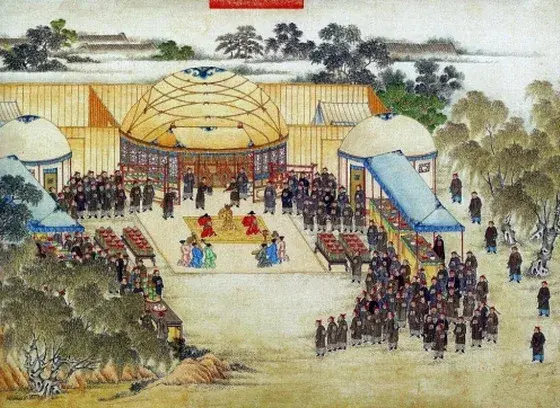
Upon arriving in Guangxi, Le Duy Ky submitted weeping memorials begging the Qing court to dispatch another grand army to reconquer his kingdom. However, the Qianlong Emperor recognized that the Tay Son regime was militarily formidable and enjoyed broad popular support, whereas the Later Le dynasty had exhausted its mandate. In May 1789, Nguyen Hue dispatched his nephew Nguyen Quang Hien to the Mountain Resort in Chengde to offer submission, apologies, and annual tributary gifts. Realizing that a protracted jungle war would serve no strategic purpose, the Qianlong Emperor accepted the overture and invested Nguyen Hue (under the name Nguyen Quang Binh) as the legitimate King of Annam.
To ensure regional peace and provide an honorable retreat for the displaced monarch, the Qianlong Emperor ordered Le Duy Ky, his family, and his remaining ministers to be escorted to Beijing. Welcoming them with imperial magnanimity, the emperor granted Le Duy Ky a third-rank official civil title, enrolled the royal Le clan into the Bordered Yellow and Plain White Banners of the Chinese Martial (Hanjun) Banners, and provided a permanent residence in Dongzhimen alongside generous monthly stipends. Deprived of all hope of restoration, Le Duy Ky succumbed to chronic melancholia. On October 16, 1793 (12th day of the ninth month of Qianlong 58), he passed away in his Beijing residence at the age of twenty-nine. The Qianlong Emperor granted ducal funeral honors, decreeing his burial outside Dongzhimen.
In 1802, following the rise of the Nguyen dynasty under Gia Long, the Tay Son regime was destroyed. In 1804, with the permission of the Jiaqing Emperor, Le Duy Ky's remains were repatriated to Vietnam and reinterred within the ancestral royal tombs near Ban Thach Mausoleum. In 1884, the Nguyen court conferred upon him the posthumous title Emperor Man.
Le Duy Ky stands in East Asian historiography as the final reigning emperor of the Later Le Dynasty of Vietnam (1428–1789), one of the longest-ruling imperial lineages in Southeast Asian history. Founded by the national hero Le Loi following the expulsion of the Ming administration, the dynasty endured for 361 years, fostering classical Confucian literature, legal codification, and administrative centralization. Ascending the throne amidst insurmountable domestic upheavals and foreign interventions, Le Duy Ky strove to preserve his ancestral house, but the structural decay of the court and the ascendance of the Tay Son revolution rendered restoration impossible. His flight into exile marked the definitive end of the classical medieval order in Vietnam.
Le Duy Ky's appeal to Beijing formed the direct catalyst for the Sino-Vietnamese War of 1788–1789, the final military enterprise celebrated in the Qianlong Emperor's "Ten Great Campaigns." This conflict represented the most extensive direct military deployment undertaken by the Qing empire into Southeast Asia during the High Qing era. Sun Shiyi's swift advance and the subsequent disaster at Dong Da underscored the inherent complexities of traditional tributary protectorate obligations when confronting rapid domestic revolutions in vassal states, ultimately prompting the Qing court to adopt a pragmatic policy of recognizing de facto authority on its southern frontiers.
Following his flight into Chinese territory, Le Duy Ky and his royal entourage were permanently integrated into the imperial Qing administrative and social structure. By ordering the royal family and their retainers to be enrolled in the prestigious Bordered Yellow Banner of the Hanjun Banners, the Qianlong Emperor established a dedicated institutional hereditary unit for foreign royal exiles. Providing permanent estates, official salaries, and intermarriage privileges within banner society, this naturalization preserved the bloodline and historical memory of the Later Le royalty within metropolitan Qing culture for over a century.
The fall of Le Duy Ky and the subsequent demise of the Tay Son created the political vacuum that enabled Nguyen Phuc Anh to establish the unified Nguyen Dynasty in 1802. In 1804, the newly established Nguyen court requested the repatriation of Le Duy Ky's remains from Beijing, an overture warmly accepted by the Jiaqing Emperor. The honorable repatriation of the deceased monarch bridged historical resentments between northern and southern Vietnamese factions and formalized the enduring tributary relationship between the Qing Empire and the Nguyen Dynasty, ensuring regional frontier peace throughout the nineteenth century.
FIGURES ASSOCIATED WITH THIS DYNASTY