Humble Birth
Born on the twenty-third day of the first month into an impoverished gentry household in Xincheng, Hangzhou, demonstrating early literary mastery.
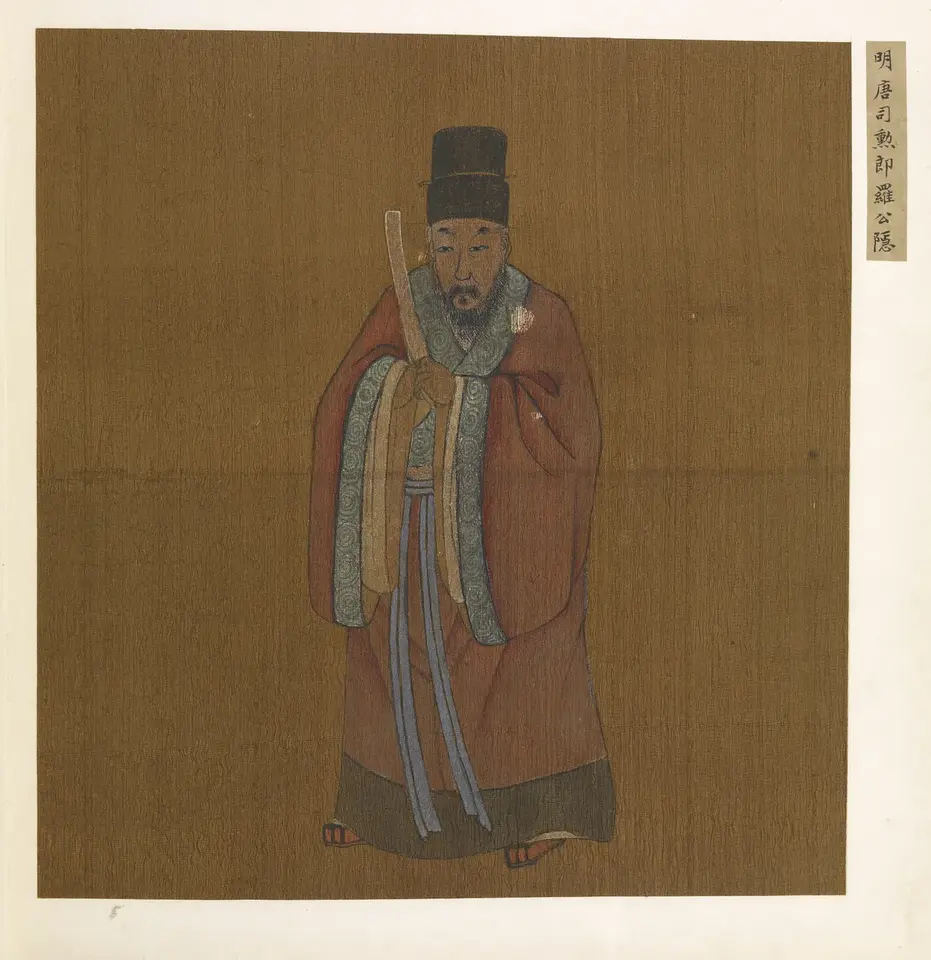
罗隐
Luo Yin (罗隐, 833–910), original name Luo Heng (罗横), courtesy name Zhaojian (昭谏), was an eminent writer, philosopher, and supreme master of satirical prose during the Late Tang and Five Dynasties periods, originating from Xincheng in Hangzhou (modern Fuyang District, Hangzhou, Zhejiang). Endowed with extraordinary literary brilliance from boyhood, he possessed lofty ambitions for statecraft; however, living amidst the terminal…
Luo Yin (罗隐, 833–910), original name Luo Heng (罗横), courtesy name Zhaojian (昭谏), was an eminent writer, philosopher, and supreme master of satirical prose during the Late Tang and Five Dynasties periods, originating from Xincheng in Hangzhou (modern Fuyang District, Hangzhou, Zhejiang). Endowed with extraordinary literary brilliance from boyhood, he possessed lofty ambitions for statecraft; however, living amidst the terminal decay of the Tang dynasty and possessing an unbending, caustic temperament, his biting poetic satires incensed influential aristocrats. Beginning with his first examination journey to Chang'an in 859, he suffered over ten consecutive examination failures across more than two decades—a tragic ordeal remembered in literary history as the Ten Failures—prompting him to defiantly change his personal name to "Yin" (meaning "the Recluse"). During decades of impoverished wandering, Luo Yin composed his epoch-making five-volume satirical essay collection Book of Slander (Chanshu) and the two-volume philosophical masterwork Book of Two Concordances (Liangtong Shu), while his seven-character verses earned empire-wide renown for their cold historical reinterpretations and accessible yet piercing social critiques. In 887, at age fifty-five, Luo Yin entered the service of Qian Liu, the founder of the Wu-Yue kingdom, who recognized his exceptional talents and appointed him successively as Magistrate of Qiantang, Recording Secretary of the Zhenhai Army, Section Chief in the Ministry of Personnel, and Palace Remonstrance Official. Following Zhu Wen's usurpation of the Tang throne to establish the Later Liang dynasty in 907, Luo Yin remained unyieldingly loyal to the fallen dynasty, passionately urging Qian Liu to launch a punitive northern expedition and spurning an official summons from the usurper court. Characterized by plainspoken diction and devastating analytical force, his writings inaugurated a brilliant new epoch of satirical essay and philosophical verse in classical Chinese literature.
Born on the twenty-third day of the first month into an impoverished gentry household in Xincheng, Hangzhou, demonstrating early literary mastery.
Traveled from Nankang to Chang'an to take the imperial civil examinations, paying homage to Chancellor Bai Minzhong in Jiangling, but failed to pass.
Completed his five-volume satirical prose masterpiece Book of Slander while enduring prolonged neglect in Chang'an.
Appointed Assistant Magistrate of Hengyang under Surveillance Commissioner Yu Gui in Hunan, but soon resigned to return east.
Re-encountered the courtesan Yunying during his eastward journey, composing his immortal quatrain To Courtesan Yunying.
Disillusioned after failing the imperial examinations more than ten times over twenty years, he formally changed his name to Luo Yin to symbolize permanent withdrawal.
Sought refuge from the Huang Chao Rebellion under Prefect Dou Yu of Chizhou, residing in a country villa at Mount Jiuhua to write philosophical treatises.
Entered the service of Hangzhou Prefect Qian Liu at age fifty-five, appointed Magistrate of Qiantang and Editorial Assistant.
Drafted the imperial thanksgiving memorial for the golden-inscribed Iron Voucher granted by Emperor Zhaozong to Qian Liu.
Passionately urged Qian Liu to raise armies against Zhu Wen after the fall of Tang, refusing an appointment as Grandee Remonstrant from the Later Liang.
Served as Palace Remonstrance Official and Vice Commissioner of Salt and Iron Transport, passing away on the thirteenth day of the twelfth month at age seventy-seven.
Luo Yin was born on February 16, 833, in Xincheng, Hangzhou. His family belonged to a lineage without bureaucratic influence or ancestral wealth, living in modest circumstances. Nevertheless, Luo Yin exhibited precocious intellectual brilliance from his earliest years. Before reaching his twentieth year, he had achieved encyclopedic command over the Confucian classics and dynastic histories, developing extraordinary rhetorical dexterity. Endowed with an uninhibited and fiercely independent character, he embraced the conviction that literature must actively criticize political abuses and rectify social injustice.
In his youth, Luo Yin, alongside his kinsmen Luo Ye and Luo Qiu, was celebrated across western Zhejiang as one of the Three Luos of Jiangzuo. Aspiring to transform his humble status and implement structural reforms across the empire, Luo Yin resolved to enter civil administration through the competitive Jinshi examinations. In the winter of 859, at age twenty-seven, he obtained official examination accreditation from Nankang in Jiangxi and embarked upon the arduous westward journey to Chang'an. Passing through Jiangling, he secured an audience with former Chancellor Bai Minzhong, who was profoundly impressed by his swift eloquence. Arriving in the capital for the spring examinations, Luo Yin failed to pass due to his lack of powerful aristocratic patrons.
This initial failure marked the beginning of two agonizing decades of frustration. Between 860 and 878, Luo Yin wandered ceaselessly between Chang'an, Hezhong, Xiazhou, Jinzhou, and Bianzhou, seeking modest secretarial appointments in regional military commissions to sustain himself while studying for successive triennial examinations. However, the late Tang examination system was thoroughly corrupt, dominated by nepotism, bribery, and aristocratic connections. Luo Yin's rugged appearance, uncompromising pride, and penchant for biting satire alienated court grandees.
During the Xiantong era, Chancellor Linghu Tao admired his poetic genius; yet when Linghu Tao's son passed the examination and Luo Yin sent a congratulatory verse, the Chancellor remained reluctant to sponsor him at court, intimidated by Luo Yin's sharp tongue. Between 862 and 867, trapped in poverty in Chang'an and witnessing the opulence of court favorites contrasted with starving commoners, Luo Yin channeled his outrage into his celebrated five-volume satirical prose collection, the Book of Slander. In his preface, he declared that the collection was written during sleepless nights by one wounded by slander, living among corrupt customs, unable to rectify the sovereign or assist friends.
In 871, following another examination failure, Luo Yin accepted an appointment as Assistant Magistrate of Hengyang under Hunan Surveillance Commissioner Yu Gui, but soon resigned, weary of clerical monotony. Traveling east through Zhongling in 872, he encountered the imperial courtesan Yunying, whom he had met a decade earlier. When Yunying playfully asked why he remained an unranked scholar, Luo Yin composed his famous quatrain To Courtesan Yunying: "Drunkenly parting at Zhongling over ten springs ago, I behold Yunying light as a dancer once again. I have yet to achieve fame, while you remain unwed; perhaps we are simply both inferior to others."
By 878, Luo Yin had sat for the civil examinations more than ten times without success. The grotesque injustice of the bureaucratic system extinguished his remaining hopes. In profound bitterness, he abandoned the examination halls forever and changed his personal name from Luo Heng to Luo Yin, openly announcing his eternal withdrawal from the contaminated politics of the capital.
In the late Qianfu era, the catastrophic Huang Chao Rebellion swept across central China, shattering the Tang administrative apparatus. By 880, as rebel forces severed northern transport routes, Luo Yin's travel plans were disrupted. Facing starvation and violence, he sought refuge in southern Anhui, where he was warmly received by Dou Yu, the Prefect of Chizhou, who held scholars in high regard.
Prefect Dou constructed a secluded country villa at the foot of scenic Mount Jiuhua, inviting Luo Yin, his kinsmen Luo Ye and Luo E, and poets Du Xunhe and Zhang Qiao to reside there in safety. During his years of tranquil retirement at Mount Jiuhua, shielded from civil war, Luo Yin experienced rare spiritual solace. He roamed through bamboo groves, conversed with the Chan poet-monk Chumo, and systematically organized his political and philosophical reflections. It was during this period that he composed his profound philosophical treatise, the two-volume Book of Two Concordances, which synthesized Confucian ethics and Daoist metaphysics into an integrated philosophy of statecraft. In 883, as regional instability expanded, Luo Yin departed Chizhou and subsequently served in Runzhou under Zhou Bao, Military Commissioner of Zhenhai.
In 887, Military Commissioner Zhou Bao fell victim to a mutiny, leaving the Lower Yangtze region fragmented among rival warlords. At age fifty-five, having endured decades of displacement, Luo Yin made the decisive choice of his life: traveling south to Hangzhou to enter the service of Qian Liu.
Although Qian Liu had risen from the ranks of military commoners, he possessed exceptional administrative acumen and sought talented scholars to consolidate his regional authority. Recognizing Luo Yin's immense literary prestige and moral integrity, Qian Liu welcomed him with extraordinary honor, appointing him Magistrate of Qiantang and soon promoting him to Editorial Assistant. As magistrate, Luo Yin governed with pragmatism and compassion, repairing dikes, reducing oppressive taxes, and fostering agricultural rehabilitation, enabling the war-weary population of Qiantang to recover.
In 893, when Qian Liu was appointed Military Commissioner of Zhenhai, laying the institutional foundation for the autonomous kingdom of Wu-Yue, he appointed Luo Yin as Recording Secretary of the military commission, entrusting him with confidential state correspondence. In 897, Emperor Zhaozong rewarded Qian Liu's loyalty in crushing regional rebellions by bestowing a gold-inscribed Iron Voucher of imperial privilege. Luo Yin was commissioned to draft the official thanksgiving memorial, the Memorial Thanking the Bestowal of the Iron Voucher. The document exhibited magnificent classical diction, seamlessly uniting profound reverence for the Tang imperial house with the legitimate dignity of Wu-Yue regional governance, winning universal admiration across the empire.
In 900, Luo Yin advanced to Observation Judge of the Zhenhai Army. In 904, when Qian Liu wished to recruit the retired chancellor and recluse Wu Qi to government service, he dispatched Luo Yin as his special envoy. Navigating mountain torrents and trekking through rugged forests to reach Ruian, Luo Yin successfully persuaded Wu Qi to emerge from retirement. In 906, Luo Yin was appointed Section Chief in the Ministry of Personnel and Judicial Judge of Zhenhai.
In 907, warlord Zhu Wen murdered the last Tang emperor and established the Later Liang dynasty in Kaifeng, terminating nearly three centuries of Tang rule. Confronted with this dynastic rupture, Qian Liu chose a pragmatic policy of tributary submission to ensure the territorial preservation of Wu-Yue. However, the elderly Luo Yin was incandescent with rage. Demonstrating unyielding dynastic loyalty, he forcefully petitioned Qian Liu: "Your Highness has received imperial favor from the Tang house for three generations! Now the traitor Zhu Wen has committed regicide and usurpation, outraging heaven and humanity. Your Highness ought to mobilize loyalist troops, unite regional commissioners, and lead a northern punitive expedition! Even if we cannot restore the imperial house, we should establish an independent empire south of the Yangtze rather than bow down before a regicidal bandit!"
Although geopolitical realities prevented Qian Liu from adopting an aggressive offensive strategy, he held Luo Yin's heroic loyalty in the highest esteem. Seeking to conciliate southern intellectuals, Zhu Wen issued an imperial edict summoning Luo Yin to Kaifeng to serve as Grandee Remonstrant of the fourth rank. Luo Yin adamantly spurned the offer, refusing to serve an illegitimate usurper.
In 908, Qian Liu memorialized the throne to appoint Luo Yin as Palace Remonstrance Official. In 909, Luo Yin was appointed Vice Commissioner of Salt and Iron Transport, overseeing the financial logistics and commodity trade of Wu-Yue. On January 26, 910, Luo Yin passed away peacefully in Qiantang at the age of seventy-seven. Deeply grieved, Qian Liu personally supervised his funerary rites and interred him with honors beneath the Western Hills of Hangzhou.
In Chinese literary history, Luo Yin's five-volume Book of Slander represents an epochal masterpiece of critical realism and satirical literature. While late Tang prose was heavily dominated by decorative parallelism and escapist aestheticism, the Book of Slander functioned as an uncompromising weapon of political critique against ruling-class decadence. In his moving preface, Luo Yin described the work as the product of nocturnal torment by an alienated intellectual living among corrupt mores, unable to rectify his sovereign or rescue his companions.
Spanning over sixty analytical essays, historical parables, and satirical vignettes, the compilation tackled state oppression, administrative corruption, and imperial hypocrisies. In Words of Heroes, analyzing the cynical slogans of Xiang Yu and Liu Bang, he unmasked the fraudulent rhetoric of dynastic legitimacy, declaring that conquerors were merely glorified thieves who executed petty pilferers while stealing whole kingdoms. In Rescuing the Two Emperors of Xia and Shang, he presented an incisive reversal of historical orthodoxy, demonstrating that while tyrants Jie and Zhou were openly wicked, their overt notoriety served as a permanent warning, whereas sanctimonious rulers who secretly impoverished their people inflicted far greater damage.
In allegorical pieces such as The Efficacy of Dragons and The Meaning of Master Meng, he utilized mythological motifs to excoriate the imperial monopoly on salt, iron, copper, and tea, exposing the ruthless economic exploitation visited upon commoners. In Events of the Jiazi Year, he refuted the misogynistic fallacy that political collapse was caused by female influence, demonstrating remarkable intellectual progressivism. Written in razor-sharp classical prose unencumbered by artificial ornamentalism, Luo Yin's essays established a model of satirical literature celebrated by modern masters such as Lu Xun.
Beyond satirical essays, Luo Yin made seminal contributions to Chinese political philosophy. Composed during his seclusion at Mount Jiuhua, the two-volume Book of Two Concordances represented an ambitious attempt to integrate Confucian moral governance with Daoist dialectical metaphysics to formulate a coherent doctrine of peaceful statecraft.
The treatise comprises ten thematic chapters: Nobility and Baseness, Strength and Weakness, Loss and Benefit, Reverence and Neglect, Generosity and Parsimony, Order and Chaos, Gain and Loss, Authenticity and Falsehood, Similarity and Difference, and Love and Hatred. The architectural symmetry of the work is consummate: the five chapters of the first volume examine the ruler's self-cultivation, with each chapter culminating in an authoritative quotation from the Daodejing of Laozi; the five chapters of the second volume investigate institutional governance, with each chapter concluding with a canonical passage from the Analects of Confucius.
Throughout the work, Luo Yin applied sophisticated dialectical reasoning. He demonstrated that nobility is determined by virtue rather than hereditary status; that genuine strength resides in benevolence rather than violent coercion; and that dynastic stability depends entirely upon fiscal moderation and compassionate restraint. Synthesizing Confucian ethical goals with Daoist dialectical methods, the Book of Two Concordances remains a distinguished contribution to Chinese intellectual history.
In poetry, Luo Yin was a preeminent master of the seven-character verse during the late Tang, frequently grouped alongside Pi Rixiu, Lu Guimeng, and Du Xunhe as a leader of the realist school. However, Luo Yin's verses possessed a cold, uncompromising sharpness that surpassed his contemporaries.
His historical and reflective poems are renowned for their bold reversals of conventional wisdom. In his celebrated quatrain Xi Shi, he wrote: "The rise and fall of states have their own appointed times; why should the men of Wu bitterly blame Xi Shi? If Xi Shi possessed the power to overthrow the state of Wu, who was responsible when the state of Yue fell in its turn?" With incisive logical precision, the verse dismantled centuries of misogynistic scapegoating that blamed dynastic collapse on imperial consorts. In Choubi Relay Station, he condensed the laws of historical contingency and mortal limitation into the couplet: "When fortune arrives, heaven and earth unite their strength; when destiny departs, even heroes are stripped of freedom." In The Pit of Burned Books, he mocked Qin Shi Huang's tyrannical suppression of learning: "The Ancestral Dragon calculated his affairs with utter perversity, truly believing that burning the classics would keep his subjects alive." In the Yuan dynasty compilation The Marrow of Regulated Verse, eight of Luo Yin's historical quatrains were selected, attesting to his preeminence in this genre.
Luo Yin's allegorical verses on nature and common life achieved timeless popularity through their transparent diction, subtle humor, and deep compassion for the working poor.
His quatrain Bees remains one of the most famous poems in the Chinese language: "Whether on flat plains or jagged mountain peaks, every trace of boundless scenery is occupied by them. After gathering nectar from hundreds of blossoms to make honey, for whose toil is it made, and for whose sweetness?" Using the image of bees whose labor is expropriated by others, the poem delivered a devastating critique of parasitic social elites. In Snow, he directly attacked aristocratic complacency: "All proclaim it an omen of an abundant harvest; but what of the harvest itself? There are freezing poor in Chang'an; for them, such omens should not be too plentiful."
In his magnificent seven-character regulated verse The Yellow River, he mocked the superstition of auspicious portents: "Do not pour donkey-hide gelatin into this stream; the intentions of Heaven here are truly difficult to divine. If it is to reach the Silver River, it must wind and bend; having barely emerged from Kunlun, it is already turbid. The Han founder's oath reduced robes to narrow ribbons; the immortal's raft tracking the stars was light and frail. Who will still be alive after three thousand years? Why trouble yourself to report that the waters are clear!" Furthermore, his famous couplet in Self-Consolation—"When winning, sing aloud; when losing, let it cease; sorrow and resentment are endlessly vast. While there is wine today, get drunk today; when sorrow comes tomorrow, grieve tomorrow"—provided enduring psychological comfort to generations of disenfranchised intellectuals.
Luo Yin's extensive travels across ten provinces enriched his poetry with historical gravity, transforming his travel verses into an authentic poetic chronicle (shishi) of dynastic collapse. Visiting border fortresses, battlefields, and deserted palaces, he documented the devastation of civil war with unblinking realism.
In his sequence Four Poems on the Imperial Flight to Shu in the Xinchou Year, composed when Emperor Xizong fled Chang'an before Huang Chao's forces, Luo Yin excoriated the cowardice of court nobles: "How dare one resent armored horses being abandoned as debris; what we lament is that unworthy men corrupted the pure court. Quietly I pity the nobles who find it so easy to save themselves; in peril I grieve that the martial founder's enterprise was so difficult." In Sending off Magistrate Wang to Suzhou, he recorded the desolation of Jiangnan ravaged by chronic militarism.
In depicting natural landscapes, Luo Yin combined grandeur with sorrow. In Ascending the City Tower of Xiazhou, he wrote: "Ten thousand leagues of mountains and rivers remain Tang territory; a thousand years of heroic spirits dwell among the heroes of Jin." In Mooring at Night in Yixing, drawing upon the legend of Zhou Chu slaying the dragon and tiger, he warned that human malevolence exceeded all wild beasts—a verse famously highlighted by Qian Zhongshu in Guanzhuibian. Luo Yin's poetry integrated cosmic majesty with moral fury, creating an unforgettable portrait of late imperial reality.
In an era of rampant fragmentation and bloodshed, Luo Yin's administrative service under Qian Liu made substantial contributions to the stability and prosperity of the Wu-Yue kingdom.
Serving as Magistrate of Qiantang and Judicial Judge of Zhenhai, Luo Yin assisted Qian Liu in executing policies of fiscal moderation, agricultural reclamation, and water conservancy, laying the economic foundation that transformed Hangzhou into the cultural capital of southeastern China. Luo Yin drafted all major diplomatic communications for the court, ensuring that the regime maintained moral legitimacy amidst predatory neighboring warlords. His successful mission to recruit former Chancellor Wu Qi brought valuable administrative expertise into the administration.
Above all, Luo Yin's conduct following Zhu Wen's usurpation cemented his historical standing as an exemplar of moral fortitude. Advocating northern military resistance and spurning imperial appointment from the Later Liang, Luo Yin demonstrated that the classical scholar's allegiance was bound to moral righteousness rather than political opportunism. Combining profound administrative acumen with incorruptible personal integrity, he remains celebrated as both a titan of literature and a heroic conscience of the late Tang.
FIGURES ASSOCIATED WITH THIS DYNASTY