Birth in Kucha
Born in the royal capital of Kucha; son of Indian noble Kumarayana and Kuchean royal princess Jiva.
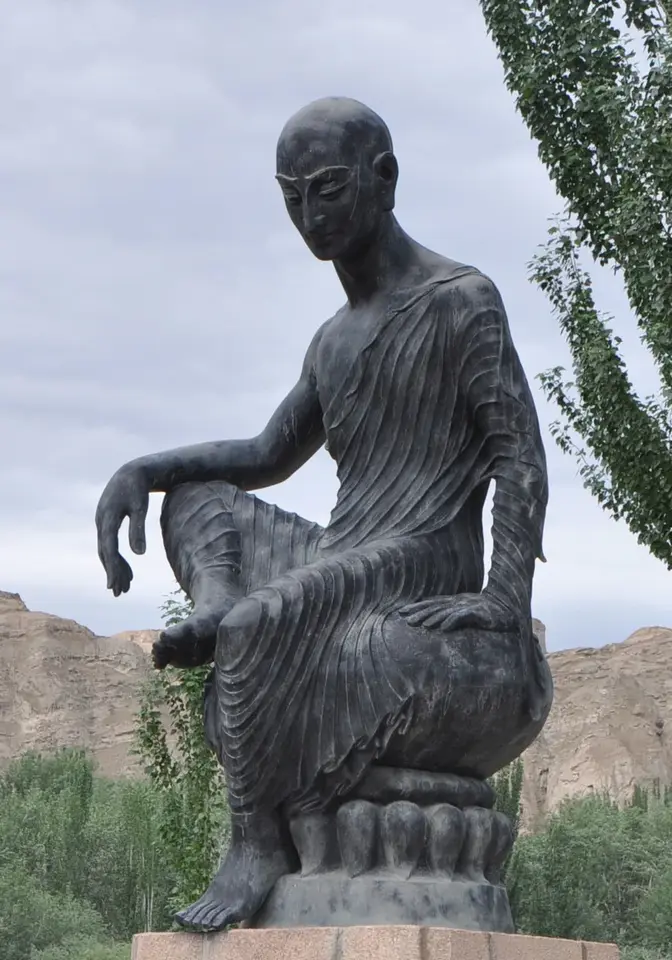
鸠摩罗什
Kumarajiva (鸠摩罗什, 344 – 413), Sanskrit name Kumārajīva, was a native of the ancient Oasis Kingdom of Kucha (modern Kuqa, Xinjiang). He was an illustrious Buddhist master, philosophical thinker, and the most renowned translator of Buddhist scriptures in Chinese history. Along with Paramartha, Xuanzang, and Amoghavajra, he is venerated as one of the "Four Great Translators of Chinese Buddhism," historically occupying the…
Kumarajiva (鸠摩罗什, 344 – 413), Sanskrit name Kumārajīva, was a native of the ancient Oasis Kingdom of Kucha (modern Kuqa, Xinjiang). He was an illustrious Buddhist master, philosophical thinker, and the most renowned translator of Buddhist scriptures in Chinese history. Along with Paramartha, Xuanzang, and Amoghavajra, he is venerated as one of the "Four Great Translators of Chinese Buddhism," historically occupying the foremost rank. Kumarajiva is also honored as the foundational patriarch of East Asian Madhyamaka philosophy and the Sanlun (Three Treatises) tradition. Born into an aristocratic lineage, Kumarajiva was the son of Kumarayana, an Indian noble who renounced high secular office, and Jiva, the younger sister of the King of Kucha. Ordained as a novice at age seven alongside his mother, Kumarajiva initially studied the Sarvastivada school of early Buddhism across Kashmir and Kashgar. In Kashgar, an encounter with the Mahayana master Suryasoma led to his profound conversion to the Madhyamaka doctrine of Nagarjuna. His fame soon resonated throughout the Western Regions. In 382, Emperor Fu Jian of Former Qin dispatched General Lu Guang with seventy thousand troops to conquer Kucha and escort Kumarajiva to Chang'an. Following Former Qin's collapse, Lu Guang established the regional Later Liang regime at Guzang (Liangzhou), keeping Kumarajiva detained under hardship for sixteen years. In 401, Emperor Yao Xing of Later Qin conquered Liangzhou, warmly welcomed Kumarajiva to Chang'an as National Teacher, and established an unprecedented national translation academy at Xiaoyao Garden. Over the next twelve years, assisted by hundreds of elite scholar-monks including Sengzhao, Daosheng, and Sengrui, Kumarajiva translated monumental Mahayana classics including the Lotus Sutra, Vimalakirti Nirdesa, Diamond Sutra, Amitabha Sutra, Pancavimsatisahasrika Prajnaparamita Sutra, along with the foundational treatises of Nagarjuna and Aryadeva (Mulamadhyamakakarika, Shatashastra, Dvadasamukha Shastra, and the hundred-volume Mahaprajnaparamita Upadesha). Diverging sharply from earlier literal or Daoist-syncretic translations, Kumarajiva's renditions achieved an unmatched harmony of doctrinal precision, fluent elegance, and poetic musicality. His translations shaped the doctrinal architecture of Chinese Mahayana Buddhism and exerted a transformative influence upon medieval East Asian philosophy and literature.
Born in the royal capital of Kucha; son of Indian noble Kumarayana and Kuchean royal princess Jiva.
Entered monastic life at age seven alongside his mother, reciting thousands of verses daily with exceptional intellect.
Traveled to Kashmir with his mother, mastering the Agamas and Sarvastivada Abhidharma under master Bandhudatta.
Studied in Kashgar under Yarkand prince Suryasoma, mastering Madhyamaka doctrines and dedicating himself to Mahayana.
Received full monastic vows in the royal palace of Kucha, lecturing widely to audiences across the Tarim Basin.
Emperor Fu Jian dispatched General Lu Guang with seventy thousand troops to conquer Kucha and escort Kumarajiva to Chang'an.
Lu Guang conquered Kucha and took Kumarajiva east; upon Fu Jian's death, Lu Guang established Later Liang, detaining Kumarajiva for sixteen years.
Emperor Yao Xing defeated Later Liang, welcoming Kumarajiva to Chang'an as National Teacher and establishing the Xiaoyao Garden translation bureau.
Presided over the imperial translation academy, producing landmark Chinese editions of the Amitabha Sutra, Diamond Sutra, and Lotus Sutra.
Passed away peacefully in Chang'an at age seventy; his tongue miraculously survived the cremation flames unscathed, confirming the accuracy of his translations.
Kumarajiva was born in 344 in Kucha, a flourishing Buddhist kingdom along the Northern Silk Road in the Tarim Basin. His father, Kumarayana, was born into a distinguished Indian aristocratic family who declined a hereditary prime ministership to pursue spiritual mendicancy, traveling across the Pamir Mountains to Kucha. Revering his erudition, the King of Kucha appointed Kumarayana court preceptor and bestowed upon him his brilliant twenty-year-old sister, Princess Jiva, who gave birth to Kumarajiva.
From early childhood, Kumarajiva displayed astonishing cognitive brilliance. In 350, having grown weary of worldly attachments, Princess Jiva resolved to enter monastic life; the seven-year-old Kumarajiva followed his mother, receiving novice ordination. Tutored in sacred literature, he memorized a thousand scriptural verses daily, comprehending both literal grammar and inner metaphysical significance.
Recognizing the limitations of regional Kuchean monastic scholarship, Princess Jiva escorted the nine-year-old youth across shifting sands and treacherous mountain passes to Kashmir, a celebrated center of Buddhist scholasticism. There, Kumarajiva studied under Bandhudatta, a master of the Sarvastivada school. Kumarajiva immersed himself in the Digha Agama, Majjhima Agama, and complex Abhidharma treatises. His razor-sharp analytical debating skills astounded both Buddhist scholars and non-Buddhist philosophers, establishing his fame across northern India.
In 356, Kumarajiva and his mother departed Kashmir to return eastward, stopping in Yarkand and Kashgar. In Kashgar, Kumarajiva broadened his learning beyond Buddhist scripture, studying the four Vedic scriptures, Sanskrit grammar, medicine, astronomy, and mathematics. During this period, he encountered the pivotal teacher of his life: Suryasoma, an imperial prince of Yarkand who had renounced the throne to champion Mahayana Madhyamaka philosophy.
Suryasoma expounded Nagarjuna's seminal treatises—the Mulamadhyamakakarika, Shatashastra, and Dvadasamukha Shastra—elucidating the core tenets of dependent origination and emptiness. Kumarajiva experienced a profound spiritual awakening, comparing his previous adherence to early Buddhist realism to mistaking base iron for pure gold. He abandoned Sarvastivada doctrines to dedicate his life to the Mahayana Prajnaparamita tradition. When his former Kashmir preceptor Bandhudatta subsequently journeyed to Kashgar, Kumarajiva systematically elucidated Madhyamaka philosophy to him, prompting the elderly teacher to convert to Mahayana, a celebrated episode in Buddhist history.
In 363, twenty-year-old Kumarajiva returned to Kucha, receiving full bhikshu ordination in the royal palace. Soon after, his mother departed for India to pursue advanced meditation, offering a solemn parting prophecy: "The profound dharma of the Mahayana must rely on your efforts to spread across the eastern lands of China, yet you will endure boundless tribulations on this path. Can you bear this burden?" Kumarajiva answered with resolve: "The bodhisattva path demands that one sacrifice life and limb for the benefit of all living beings. If the holy dharma can illuminate the eastern realms, I shall endure limitless agony with joy." Lecturing widely throughout Kucha, his assemblies drew tens of thousands, with Central Asian monarchs kneeling to form mounting steps for his dharma seat.
Kumarajiva's renown crossed the Gobi Desert to the Chinese heartland. Emperor Fu Jian of Former Qin, an ardent patron of classical scholarship and Buddhism, resolved to bring the master to the capital. In 382, Fu Jian dispatched General Lu Guang with seventy thousand troops on an expedition to the Western Regions. At an imperial banquet in the Daming Pavilion, Fu Jian instructed Lu Guang: "I have heard that in the west resides Master Kumarajiva, whose fathomless wisdom is revered by all. Upon subduing Kucha, dispatch him immediately by imperial post to Chang'an."
Lu Guang conquered Kucha and secured Kumarajiva. However, as an uncultured military commander lacking religious devotion, Lu Guang treated the young foreign monk with crude contempt. He forced Kumarajiva to drink alcohol and locked him in a chamber with a Kuchean princess, compelling him to break monastic celibacy. Kumarajiva bore these humiliations with ascetic forbearance.
In 385, while Lu Guang was returning with his army, news arrived that Chang'an had fallen and Fu Jian had been slain by Yao Chang. Lu Guang halted his march, establishing the independent Later Liang dynasty at Guzang in the Hexi Corridor, detaining Kumarajiva in Liangzhou for sixteen years. Throughout the internal bloodshed and political instability of Later Liang under Lu Guang and his successors, the court refused to allow Kumarajiva to proceed east.
Nevertheless, these sixteen years served as an indispensable preparatory phase for Kumarajiva. Immersed in northern Chinese society, he achieved total mastery of the Chinese language, literary syntax, phonetic cadences, and philosophical traditions of pre-Qin thinkers and Wei-Jin metaphysics. This immersion eradicated the linguistic barrier between Sanskrit and Chinese, laying the foundation for his future translation triumphs.
In 401, Emperor Yao Xing of Later Qin dispatched an army that defeated Later Liang and welcomed the long-awaited master to Chang'an. In the winter of that year, the fifty-eight-year-old Kumarajiva entered the capital. Yao Xing received him with state honors, designating him National Teacher and accommodating him in the prestigious Ximing Pavilion and Xiaoyao Garden.
Recognizing the cultural and moral power of Buddhist scriptures, Yao Xing sponsored a national translation academy at Xiaoyao Garden. The emperor personally held original Sanskrit palm-leaf manuscripts to assist in textual comparison, while Kumarajiva presided over the lectern. Hundreds of China's most erudite Buddhist scholars and literary stylists, including Sengzhao, Sengrui, Daosheng, and Huiyan, participated as verification assistants, polishers, and recording scribes. Kumarajiva expounded the Sanskrit original into Chinese, debating philosophical nuances with the assembly before finalizing the written text.
Between 401 and 413, the Xiaoyao Garden academy became the cultural epicenter of Asia. Kumarajiva translated foundational Mahayana scriptures including the Pancavimsatisahasrika Prajnaparamita Sutra, Lotus Sutra, Vimalakirti Nirdesa, Diamond Sutra, and Amitabha Sutra, alongside Nagarjuna's Three Treatises (Mulamadhyamakakarika, Shatashastra, Dvadasamukha Shastra) and the monumental hundred-volume Mahaprajnaparamita Upadesha. These masterpieces cleared away centuries of conceptual confusion generated by early Chinese attempts to analogize Buddhist concepts with Daoist terms, elevating Chinese Buddhist philosophy to sophisticated classical maturity.
On April 13, 413, Kumarajiva entered parinirvana at the Great Monastery of Chang'an at the age of seventy. On his deathbed, surrounded by weeping disciples, he made a solemn vow: "I was unworthy of the great task of translation, having rendered over three hundred volumes of scripture. If my translations contain no error and faithfully reflect the Buddha's true intent, then after my body is consumed by fire, may my tongue remain undamaged by the flames!"
His disciples performed the cremation outside Chang'an according to Buddhist rites. As the pyre burned down and his physical form was reduced to ash, his tongue remained intact, glowing like jade amidst the embers. Monks and laity wept in awe. A stupa was erected at Xiaoyao Garden (modern Caotang Temple in Xi'an) to enshrine the miraculous relic, standing as one of the most celebrated miracles in the history of world religion.
Kumarajiva marks a monumental watershed in the history of translation. Prior to his arrival, Chinese translations were either painfully literal or distorted by borrowed Daoist terminology. Kumarajiva pioneered the principle of conveying both doctrinal fidelity and elegant literary expression. Preserving the exact philosophical nuances of Sanskrit technical terms while tailoring the prose to the aesthetic cadence of classical Chinese, his translations of the Lotus Sutra, Diamond Sutra, and Vimalakirti Nirdesa became immortal literary classics cherished across East Asia.
Kumarajiva's greatest intellectual contribution was the systematic introduction of Indian Madhyamaka philosophy into East Asia. Translating Nagarjuna's Mulamadhyamakakarika, Dvadasamukha Shastra, and Aryadeva's Shatashastra, alongside the Mahaprajnaparamita Upadesha, he dismantled the reified metaphysical concepts of early schools, establishing the dialectical doctrine of dependent origination and emptiness. This framework catalyzed the emergence of the Sanlun, Tiantai, and Chan (Zen) traditions, providing the philosophical architecture that integrated Buddhism with traditional Chinese thought.
Operating with the patronage of Emperor Yao Xing, Kumarajiva's translation bureau at Xiaoyao Garden was the first highly organized, state-sponsored academic translation institution in Chinese history. With rigorous procedures including manuscript verification, oral explanation, collective debate, stylistic polishing, and final recording, it involved hundreds of participating scholars. This institutional model guaranteed unmatched quality and served as the administrative template for subsequent imperial translation academies under Xuanzang and Amoghavajra during the Tang Dynasty.
Kumarajiva was an incomparable teacher who nurtured thousands of exceptional scholars. His foremost disciples, celebrated as the "Four Sages" (Sengzhao, Daosheng, Sengrui, and Daoheng) and the "Ten Philosophers," formed the intellectual elite of medieval Chinese Buddhism. Sengzhao authored the Treatises of Sengzhao, fusing Prajna philosophy with Chinese literary elegance, while Daosheng pioneered the revolutionary doctrine of sudden enlightenment and universal Buddha-nature, paving the way for the Tang-Song Chan revolution.
FIGURES ASSOCIATED WITH THIS DYNASTY