Birth on Onon
Born on the Mongolian Plateau after his mother Borte was retrieved from Merkit captivity; Temujin embraced him as his eldest son.
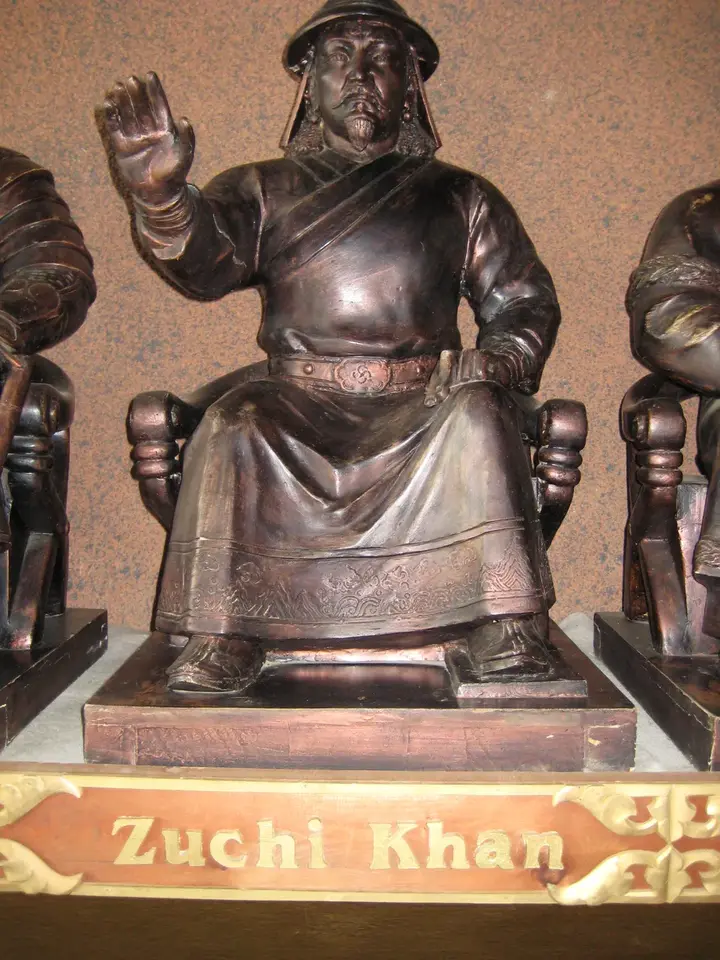
术赤
Jochi (术赤, 1181 – February 1227) was a prominent prince of the Borjigin clan, the eldest legitimate son of Genghis Khan (Temujin) and his principal wife Borte, and posthumously honored as Emperor Muzong of the Yuan Dynasty. In Mongolian, the name "Jochi" signifies an unexpected guest or visitor. Jochi was born during the turbulent early years of Temujin's rise, shortly after Borte was rescued from captivity by the Merkit…
Jochi (术赤, 1181 – February 1227) was a prominent prince of the Borjigin clan, the eldest legitimate son of Genghis Khan (Temujin) and his principal wife Borte, and posthumously honored as Emperor Muzong of the Yuan Dynasty. In Mongolian, the name "Jochi" signifies an unexpected guest or visitor. Jochi was born during the turbulent early years of Temujin's rise, shortly after Borte was rescued from captivity by the Merkit tribe. Although his second younger brother Chagatai and some rivals questioned his paternity, Genghis Khan treated him as his genuine eldest son with profound trust and high regard throughout his life. Possessing outstanding martial prowess, perseverance, and strategic leadership, Jochi rendered monumental contributions to the unification of the steppe and the empire's global expansion. In 1207, Jochi was entrusted with leading the Right Wing of the Mongol army north to subdue the "Forest Peoples" of Siberia, achieving the bloodless submission of the Oirats and Yenisei Kirghiz, earning immense praise from Genghis Khan. In subsequent campaigns against the Jurchen Jin dynasty and the western expedition against the Khwarazmian Empire, Jochi commanded the Right Wing along the lower Syr Darya, reducing numerous strategic strongholds. During the siege of Urgench, Jochi's desire to preserve the prosperous commercial metropolis for his assigned fief clashed sharply with Chagatai's destructive assault doctrine. During the contentious imperial succession debate, facing Chagatai's provocative insults, Jochi showed statesmanlike restraint and supported Genghis Khan's choice of Ogedei as heir apparent, averting internal civil war. Following the conquest, Genghis Khan granted Jochi all lands west of the Irtysh River, laying the foundation for the Ulus of Jochi (Golden Horde). In February 1227, Jochi succumbed to severe illness in his camp at the age of forty-six. In 1308, Emperor Wuzong of Yuan posthumously honored him as Emperor Daoning with the temple name Muzong.
Born on the Mongolian Plateau after his mother Borte was retrieved from Merkit captivity; Temujin embraced him as his eldest son.
At the founding of the Mongol Empire, Genghis Khan granted Jochi nine thousand households, ranking first among the imperial princes.
Led the Right Wing army to accept the peaceful surrender of the Oirats and Kirghiz tribes in Siberia without bloodshed.
Marched south with Genghis Khan, sweeping through Shanxi and Hebei prefectures and capturing vast herds of warhorses.
Led the Right Wing along the lower Syr Darya during the invasion of Khwarazm, reducing Jend, Sighnaq, and other key fortresses.
Besieged the Khwarazmian capital Urgench; reconciled command under Ogedei after strategic disagreements with Chagatai, capturing the city.
Genghis Khan partitioned the western territories, granting all grasslands west of the Irtysh River to Jochi to establish the Ulus of Jochi.
Stationed along the Irtysh River, pacifying Qipchaq tribes; unable to travel to the central court due to chronic illness.
Passed away from aggravated illness in his camp at the age of forty-six; Genghis Khan grieved deeply upon learning of false slander.
Emperor Wuzong of Yuan posthumously elevated Jochi as Emperor Daoning with the temple name Muzong, enshrining him in the Imperial Ancestral Temple.
Jochi was born in 1181 along the Onon River on the Mongolian Plateau. During the arduous early period of Temujin's rise, the Three Merkit tribes staged a night raid on Mount Burkhan Khaldun to avenge Yesugei's earlier capture of Hoelun. In the frantic retreat, Temujin's young bride Borte was captured by Merkit warriors and given to Chilger-Boko, the younger brother of their chieftain. Biding his time, Temujin secured military assistance from his blood brother Jamukha and Toghrul Khan of the Keraites, fielding twenty thousand elite horsemen to crush the Merkits and rescue Borte after nine months of captivity.
While being escorted back on the arduous journey to Temujin's camp, Borte gave birth to a male infant. Temujin took the newborn into his arms and named him Jochi, which translates as "guest" or "unexpected arrival" in Mongolian. Although rumors regarding his paternity persisted among rival steppe tribes, and his younger brother Chagatai would later exploit this grievance, Temujin demonstrated steadfast fatherly devotion, never doubting Jochi and raising him as his eldest legitimate heir. Accompanying his father on horseback across harsh landscapes from early childhood, Jochi developed an unyielding, resilient temperament and formidable martial skill.
In 1206, Temujin convened the Kurultai at the headwaters of the Onon River, assuming the title of Genghis Khan and proclaiming the Great Mongol Empire. During the grand apportionment of subjects and lands, Genghis Khan rewarded Jochi's filial piety and valor by awarding him nine thousand nomadic households. This vast allotment exceeded those given to Chagatai, Ogedei, and Tolui, and even surpassed that of the Khan's youngest brother Temuge Otchigin. Genghis Khan publicly stroked Jochi's back, declaring him the eldest of his sons, possessed of grave fortitude, capable of bearing the greatest responsibilities of state.
In 1207, Genghis Khan assigned Jochi the mission of leading the Right Wing forces north into the dense taiga forests of the Yenisei River basin and west of Lake Baikal to bring the "Forest Peoples" under imperial authority. Navigating treacherous wilderness and confronting fierce woodland tribes, Jochi demonstrated consummate diplomatic acumen alongside military deterrence. Without shedding blood or sacrificing a single warrior, he persuaded Quduqa Beki, chieftain of the Oirat, to surrender peacefully. He dispatched envoys deep into the Siberian interior, securing the submission of the Yenisei Kirghiz and neighboring chieftains, who presented tributary white horses and precious furs. Delighted by Jochi's expansion of several thousand li without casualty, Genghis Khan arranged a marriage alliance between the Oirat chief's daughter and Jochi's son, celebrating with an imperial feast.
During the full-scale Mongol assault against the Jurchen Jin dynasty launched in 1211, Jochi co-commanded the Right Wing army alongside Chagatai and Ogedei. Sweeping southward across the Taihang Mountains, their forces overran Tiande, Yunnai, Dongsheng, and Xuande, shattering the elite Jin garrisons around Datong and Taiyuan while seizing tens of thousands of warhorses, establishing a decisive strategic advantage for the Mongol conquests in Northern China.
In 1219, provoked by the execution of a Mongol diplomatic caravan by Inalchuq, the governor of Otrar, Genghis Khan unleashed a massive western campaign commanding two hundred thousand cavalrymen. While Chagatai and Ogedei were ordered to maintain the siege of Otrar, Genghis Khan instructed his eldest son Jochi to lead several tens of thousands of troops down the lower Syr Darya. Displaying brilliant maneuvering, Jochi rapidly captured key fortified cities including Sighnaq, Ashnas, and Jend, annihilating opposing garrisons and cutting off all defensive and withdrawal routes connecting northern Khwarazm to the Qipchaq steppe.
In the spring of 1221, Genghis Khan ordered Jochi, Chagatai, and Ogedei to combine their armies before Urgench, the ancient capital of the Khwarazmian Empire. During this grueling siege, deep doctrinal and political discord erupted between Jochi and Chagatai. Genghis Khan had designated northern Khwarazm as part of Jochi's post-war appanage; recognizing Urgench as an invaluable Silk Road commercial hub and manufacturing center, Jochi sought to preserve its magnificent structures and hundreds of thousands of skilled artisans by pursuing a policy of encirclement and negotiated surrender. Conversely, the aggressive and dogmatic Chagatai accused Jochi of hesitating out of selfish desire for plunder, insisting on breaching the city through relentless bombardment and diversion of the river to flood the defenses.
Their command impasse prolonged the siege for months and caused severe Mongol casualties. Enraged by the stalemate, Genghis Khan stripped both Jochi and Chagatai of overall field authority, designating the composed third son Ogedei as supreme commander. Under Ogedei's unified direction, the Mongol forces breached and captured Urgench. However, the subsequent burning of urban quarters and mass slaughter of inhabitants caused profound anguish to Jochi, transforming the personal and political rift with Chagatai into an irreversible enmity.
Prior to the departure of the western campaign in 1219, Genghis Khan had assembled his principal sons to determine the imperial successor upon the urging of Empress Yesui. When Genghis Khan asked Jochi for his view, Chagatai leaped forward in fury, shouting indignantly that the throne could never be bestowed upon an illegitimate son of Merkit blood. Jochi was consumed with rage, seized Chagatai by his collar, and retorted that their father had never disowned him, challenging Chagatai to a duel to the death on the spot.
As the brothers traded blows and drew their blades, younger brother Tolui and veteran commanders such as Bo'orchu intervened to separate them. Genghis Khan expressed deep distress, severely reprimanding Chagatai for his slanderous words and affirming before the assembly that Jochi remained his eldest legitimate son whose origins must never be questioned again. Nevertheless, recognizing that appointing either Jochi or Chagatai would inevitably plunge the empire into fraternal civil war, Genghis Khan facilitated a compromise. Jochi magnanimously yielded his claim, endorsing the temperate and generous Ogedei as Crown Prince, a decision Chagatai also accepted, thereby diffusing an existential political crisis.
Following the conclusion of the western expedition, Genghis Khan demarcated the domains of his sons in the Irtysh River basin. All pastoral lands extending westward from the Irtysh to wherever Mongol horses could reach were granted to Jochi, establishing the vast domain known to history as the Ulus of Jochi. Jochi settled his principal ordo along the Irtysh, extending protection over displaced Qipchaqs, rehabilitating pastoral commerce, and securing northern borders.
Decades of harsh campaigning in freezing climates inflicted severe physical deterioration upon Jochi, who suffered from acute rheumatic afflictions and debilitating spinal ailments. In 1224, when Genghis Khan led the main army eastward back to Mongolia and summoned Jochi to the imperial court, Jochi's worsening health prevented him from mounting a horse. He submitted formal memorials pleading his physical incapacity and dispatched tributary caravans of twenty thousand fine steeds and thousands of camels to honor his father.
In 1226, as Genghis Khan embarked on his final campaign against Western Xia, he issued strict orders for Jochi to join the imperial forces. Once more incapacitated, Jochi sent apologies for his absence. Hostile courtiers in Karakorum fabricated slanderous allegations, claiming that Jochi was feigning illness while openly hunting along the Irtysh, harboring seditious intentions of autonomy backed by his massive cavalry forces.
Provoked by these reports, Genghis Khan made secret preparations to lead an expedition westward to confront his eldest son. Before the imperial forces could march, however, an urgent messenger arrived from the Irtysh camp bearing shocking news: in February 1227, Crown Prince Jochi had passed away from aggravated disease in his encampment at the age of forty-six. Realizing that his devoted eldest son had indeed been bedridden and blameless, Genghis Khan was overcome with profound remorse and sorrow, weeping inconsolably on his couch and canceling court assemblies for several days. He ordered Jochi interred with highest imperial honors on the banks of the Irtysh River, confirming Jochi's sons as rightful heirs to the ulus. Jochi's second son Batu would subsequently lead the monumental western expedition across Eastern Europe, establishing the mighty Golden Horde. In 1308, Emperor Wuzong of Yuan posthumously bestowed upon Jochi the title of Emperor Daoning and the temple name Muzong.
In 1207, Jochi's leadership during the pacification of Siberian tribes west of Lake Baikal represented one of the most politically adept operations in early Mongol history. Confronting formidable taiga wilderness and fiercely independent populations, Jochi avoided indiscriminate bloodshed, combining military resolve with generous inducements to persuade major groups such as the Oirats and Yenisei Kirghiz to submit voluntarily. This operation pushed the northern frontiers of the empire toward the Arctic watershed and secured vital woodland resources and military manpower, highlighting Jochi's strategic vision as an imperial commander.
During the invasion of the Khwarazmian Empire, Jochi's Right Wing army demonstrated extraordinary offensive mobility. Driving rapidly down the lower Syr Darya, he systematically captured key strongholds such as Sighnaq and Jend, severing the defensive connections between Khwarazmian northern cities and their nomadic Qipchaq allies. By turning the enemy's strategic rear into an imperial logistics corridor, Jochi provided indispensable flank protection for Genghis Khan's decisive central strikes against Bukhara and Samarkand.
Jochi holds a singular position in Eurasian medieval history as the founder of the vast northern appanage that became the Golden Horde. Establishing his administrative base along the Irtysh River, Jochi implemented rehabilitative policies that integrated Qipchaq Turkic nomadic cavalry with Central Asian Muslim mercantile capital. This governance provided the demographic and financial foundation that enabled his sons Batu and Berke to conquer the Russian principalities and campaign beyond the Danube, reshaping the political map of Eastern Europe and Russia for centuries.
During the volatile succession dispute that preceded the Khwarazmian campaign, Jochi demonstrated remarkable self-restraint and devotion to imperial solidarity. Despite suffering egregious personal provocation regarding his birth from his younger brother Chagatai, Jochi subordinated personal ambition to the preservation of the empire. By endorsing Ogedei as the supreme successor, he forestalled fratricidal warfare among the sons of Genghis Khan, preserving the unity of the imperial Golden Family at a critical juncture in world history.
FIGURES ASSOCIATED WITH THIS DYNASTY