Birth in Haozhou
Born into an impoverished peasant family in Dingyuan, Haozhou; lost his father early and fled warlord strife with his mother, who died during their flight.
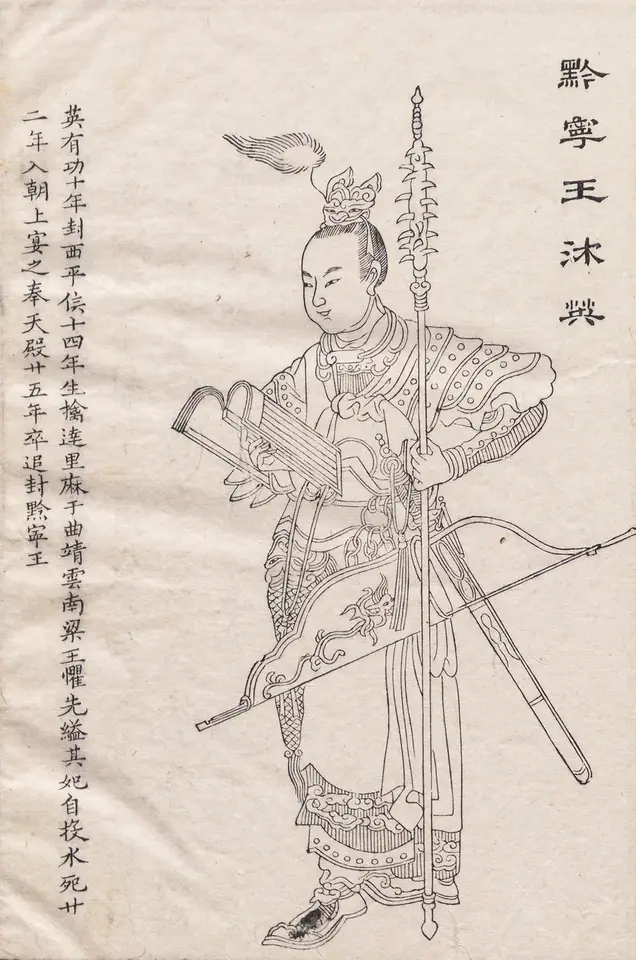
沐英
Mu Ying (沐英, 1345–1392), courtesy name Dunsu, was a native of Dingyuan in Haozhou (present-day Dingyuan County, Anhui). He was an illustrious founding general, master military strategist, and regional administrator of the Ming Dynasty, the adopted eldest son of Ming founder Zhu Yuanzhang, and the founder of the Mu clan, which guarded Yunnan hereditarily for more than 260 years. Orphaned and destitute as a small child, he was…
Mu Ying (沐英, 1345–1392), courtesy name Dunsu, was a native of Dingyuan in Haozhou (present-day Dingyuan County, Anhui). He was an illustrious founding general, master military strategist, and regional administrator of the Ming Dynasty, the adopted eldest son of Ming founder Zhu Yuanzhang, and the founder of the Mu clan, which guarded Yunnan hereditarily for more than 260 years. Orphaned and destitute as a small child, he was taken in at age eight by Zhu Yuanzhang and his wife Lady Ma (later Empress Ma), who adopted him, bestowed upon him the imperial surname Zhu, and nurtured him alongside their biological family. Educated in literary canons and tactical command, he was commissioned at eighteen as Guard Commander before the Throne to defend Zhenjiang, later distinguishing himself in the conquest of Fujian by capturing Chong'an and eighteen mountain redoubts. During early Hongwu years, he served as Vice Commissioner of the Chief Military Commission, governing central military logistics with exceptional efficiency. Beginning in 1377, Mu Ying was appointed Vice General and then General Who Conquers the West, leading campaigns across Tibet, Qinghai, and Sichuan to the Kunlun Mountains, expanding imperial borders by thousands of li, and leading a rapid desert march to capture the Northern Yuan Prince of the State Tuohuochi at Karakorum. For these exploits, he was ennobled as the Marquis of Xiping. In 1381, as Vice General Who Conquers the South, he co-led a force of three hundred thousand alongside Fu Youde and Lan Yu to conquer Yunnan, orchestrating the tactical diversion across the Baishi River to smash Liang Prince Bazalawarmi's hundred-thousand-strong host and seizing Dali across Mount Diancang. Emperor Taizu subsequently entrusted Mu Ying with the hereditary pacification of Yunnan. In Yunnan, he pioneered the three-tier volley fire technique to crush the massive elephant army of Si Lunfa at Dingbian, reclaimed over one million mu of arable land through military-civilian agricultural colonies, dredged the water system of Lake Dian, established Confucian schools, and pacified southwestern ethnic groups. In 1392, upon learning of the sudden death of Crown Prince Zhu Biao, he fell into despair, coughed blood, and died at age forty-eight. Zhu Yuanzhang mourned deeply, posthumously creating him Prince of Qianning with the posthumous title Zhaojing, granting burial on General Mountain near Nanjing, and enshrining him in the Imperial Ancestral Temple.
Born into an impoverished peasant family in Dingyuan, Haozhou; lost his father early and fled warlord strife with his mother, who died during their flight.
Wandered into Haozhou as an eight-year-old orphan; adopted by insurgent commander Zhu Yuanzhang and Lady Ma, who bestowed the surname Zhu and educated him.
Appointed Guard Commander before the Throne at eighteen to guard Zhenjiang; subsequently promoted to Guard Commander to defend the strategic outpost of Guangxin.
Led an assault through Fenshui Pass, took Chong'an, and conquered eighteen fortified strongholds; Zhu Yuanzhang formally ordered him to restore his original surname Mu.
Promoted to Vice Commissioner of the Chief Military Commission, adjudicating imperial military administration with flawless speed and earning high trust from the imperial couple.
Commissioned Vice General Who Conquers the West to campaign across Qinghai and Tibet to the Kunlun Mountains; ennobled as the Marquis of Xiping upon his triumphant return.
Led an expedition through the desert within seven days to surround Northern Yuan positions at Karakorum, capturing Prince of the State Tuohuochi and senior commanders.
Appointed Vice General Who Conquers the South; devised a tactical river diversion at the Baishi River to crush ten myriad defenders of the Yuan Prince of Liang.
Scaled precipitous crags of Mount Diancang to take Longshou and Longwei passes, capturing Duan Shi; coughed blood upon hearing of the passing of Empress Ma.
Assigned full military and civil command over Yunnan as the main expeditionary forces returned to the capital, establishing a long-term administrative seat.
Introduced the three-tier volley fire tactical formation to obliterate Si Lunfa's elephant cavalry and three-hundred-thousand horde, securing Yunnan's borders.
Overcome with grief over the sudden death of Crown Prince Zhu Biao, fell ill and passed away in Kunming on the seventeenth day of the sixth month at age forty-eight.
Mu Ying was born in the fourth year of the Zhizheng era of Toghon Temür of Yuan (1345) in Dingyuan, Haozhou (present-day Dingyuan County, Anhui). Born into an impoverished household, his father died while he was an infant, leaving him entirely in the care of his mother. In 1351, the Red Turban Rebellion erupted across the Huai River basin, triggering brutal military suppressions from the Yuan imperial court. Millions of displaced civilians fled through chaos and famine. The young Mu Ying joined the fleeing crowds with his mother, who tragically succumbed to starvation and exhaustion on the road, leaving him alone in the war-torn countryside.
In 1352, the eight-year-old destitute orphan wandered into the fortified city of Haozhou, where he caught the attention of the rising insurgent general Zhu Yuanzhang. Seeing that the ragged child possessed alert eyes and uncommon composure, Zhu Yuanzhang took pity on him and brought him to his quarters. At that time, Zhu Yuanzhang and his wife Lady Ma (the future Empress Ma) had no children of their own; they formally adopted Mu Ying as their eldest son, conferring upon him the imperial surname Zhu. Lady Ma washed and stitched his clothing and taught him basic literacy and classical reading, while Zhu Yuanzhang personally instructed him in horsemanship, archery, and tactical maneuvering. Mu Ying possessed rare mental agility and deep filial devotion, rapidly developing into an exceptionally capable young officer proficient in letters and military warfare.
In 1356, when Zhu Yuanzhang led a joint land and naval offensive against Jiqing (present-day Nanjing), twelve-year-old Mu Ying accompanied the expedition, attending to his adoptive father with tireless devotion. In 1362, eighteen-year-old Mu Ying was entrusted with independent military responsibilities as Guard Commander before the Throne, guarding the strategic outpost of Zhenjiang. Due to his strict discipline and tactical acumen, he was promoted to Guard Commander to defend the vital junction of Guangxin in Jiangxi.
In 1367, Zhu Yuanzhang dispatched armies to annex Fujian. Mu Ying led a western column through the precipitous Fenshui Pass, captured Chong'an, and methodically crushed eighteen fortified garrisons of the warlord Chen Youding along the Min River, taking rebel general Feng Gubao alive. Zhu Yuanzhang was overjoyed by his victory and issued an imperial rescript allowing him to reclaim his ancestral surname Mu, signifying that he had achieved great merit and earned the right to establish his own independent house. Mu Ying subsequently transferred his forces to Jianning, holding overall tactical control over Shaowu, Yanping, and Tingzhou guards to solidify the northern Fujian perimeter.
In 1370, following the founding of the Ming Dynasty, Emperor Taizu conferred upon Mu Ying the rank of General of the Guard of the State and appointed him Assistant Commissioner of the Chief Military Commission; the following year (1371), he was elevated to Vice Commissioner of the Chief Military Commission. As the empire's supreme command organ directing garrisons, provisions, and border deployments across the country, the Chief Military Commission handled endless streams of urgent memorials. Although barely in his late twenties, Mu Ying resolved tangled administrative affairs with swift precision and flawless judgment, making zero errors over seven years. Empress Ma praised his administrative talent to the throne, and Emperor Taizu placed immense trust in his military competence.
In 1376, Emperor Taizu ordered Mu Ying to ride imperial postal relays to inspect civil affairs and military defense throughout Shaanxi and Gansu, while training armies for future western campaigns. In the winter of that year, he was appointed Vice General Who Conquers the West under Deng Yu to subdue the Tibetan regions. In the spring of 1377, Deng Yu and Mu Ying advanced into the highlands of Qinghai and Sichuan across three routes, pressing all the way to the foot of the Kunlun Mountains, killing and capturing over ten thousand enemy troops and seizing more than one hundred thousand livestock. When Deng Yu passed away at Shouchun on the return march, Mu Ying took overall command and led the victorious troops home. Taizu awarded him the prestigious title of Meritorious Minister Assisting the Dynasty and Honoring Loyalty, promoted him to Grand Master for Glorious Happiness and Pillar of State, ennobled him as the Marquis of Xiping with an annual stipend of 2,500 shi, and granted hereditary succession iron certificates.
In 1378, Mu Ying was named General Who Conquers the West to lead forces against western tribes alongside Lan Yu. The Ming armies won an overwhelming victory at Tumen Gorge, took Taozhou, captured the paramount tribal leader Achangshina, and established fortified redoubts at Donglong Mountain, subduing the Seven Stations of Dogannaer and expanding imperial boundaries across thousands of li.
In 1380, Northern Yuan Prince of the State Tuohuochi entrenched himself at Karakorum, launching recurrent border raids. Emperor Taizu ordered Mu Ying to command cavalry out of Shaanxi. Mu Ying crossed the Yellow River from Yijinai Route, scaled the Helan Mountains, traversed shifting sand dunes, and reached Karakorum in seven days. He divided his forces into four columns, executing a surprise night encirclement with double pincer flanks and personal front cavalry charges. The Northern Yuan forces collapsed completely; Tuohuochi and Privy Councilor Aizu were captured alive. In 1381, Mu Ying rode through Gubeikou under Grand General Xu Da, capturing Gongzhushan and the four tribes of Quanning, and crossing the Luqu River to capture Northern Yuan commander Li Xuan.
In the ninth month of 1381, Emperor Taizu determined to eliminate the remaining Northern Yuan bastion in Yunnan, appointing Fu Youde as General Who Conquers the South, with Lan Yu and Mu Ying as Vice Generals leading three hundred thousand troops. The pacification and governance of Yunnan would prove to be Mu Ying's greatest lifetime achievement.
Advancing toward Qujing, the Yuan Prince of Liang, Bazalawarmi, dispatched Pingzhang Dali Ma with one hundred thousand veteran troops to defend the eastern bank of the Baishi River. Ming vanguards arrived amid dense fog; when the mist cleared, both armies confronted each other across the river. Fu Youde advocated an immediate river assault, but Mu Ying cautioned that direct crossing against entrenched positions on the opposite bluff would prove disastrous. Instead, Mu Ying staged an ostentatious river demonstration with war drums and banners, while secretly dispatching dozens of elite divers downstream to swim across the river and plant horns and war flags on high bluffs behind enemy lines. Believing their rear had been severed, Dali Ma's formations fell into pandemonium. Mu Ying instantly led amphibious assault troops across the river with long swords, backed by mounted heavy cavalry. Over ten thousand enemy soldiers fell, and Dali Ma was taken captive. Mu Ying released twenty thousand prisoners of war to return to their native villages, demonstrating imperial clemency. Terrified by the defeat, Prince Bazalawarmi fled Kunming and committed suicide in the wilderness, allowing Ming troops to enter Kunming without further bloodshed.
Ming armies then marched west to crush the Duan clan regime at Dali. Duan Shi relied on the natural barriers of Mount Diancang and Lake Erhai, barricading Longshou and Longwei passes. In 1382, Mu Ying and Lan Yu launched coordinated assaults: while Wang Bi pinned down Longshou Pass, Mu Ying personally spurred his horse across deep torrents to attack Longwei Pass, while elite commandos scaled the sheer precipices behind Mount Diancang to descend upon the garrison's rear. Duan Shi was captured, and Dali fell. In the following months, Mu Ying and Fu Youde crushed rebellions across Wusa and Dongchuan, establishing Bijie guard. When tribal leader Yang Ju surrounded Kunming with twenty myriad rebels while the main army was away, Mu Ying returned in a forced march, joined forces with the garrison commander, and routed the insurgents, stabilizing the entire southwest.
In 1383, with Yunnan pacified, Emperor Taizu recalled Fu Youde and Lan Yu to Nanjing, permanently designating Mu Ying to govern Yunnan. Taizu understood that stabilizing this remote, multi-ethnic borderland required a commander endowed with supreme prestige and exceptional civil-military acumen.
In 1388, Si Lunfa, the Pacification Commissioner of Luchuan-Pingmian, staged an open rebellion and incited hundreds of thousands of tribesmen to invade Moshalai. In 1389, Si Lunfa gathered three hundred thousand troops and marched on Dingbian, deploying one hundred armored war elephants as his vanguard. The elephants bore fortified wooden towers armed with heavy bamboo spear-launchers, trampling foot soldiers and horses alike. Facing this monstrous force, Mu Ying devised his renowned three-tier volley fire tactical formation.
Mu Ying deployed Divine Engine arquebuses and heavy siege crossbows in three consecutive ranks at the front of his line. Before the engagement, he commanded that retreat was forbidden. As the war elephants charged, the first rank fired simultaneously, creating terrifying thunder and smoke; the first rank then knelt to reload while the second stepped forward to fire, followed seamlessly by the third rank. This continuous, unbroken hail of fire arrows and musket balls terrified the elephants, causing them to wheel around and stampede wildly through their own ranks. Ming cavalry capitalized on the panic, encircling the enemy wings, slaying forty thousand insurgents, and capturing thirty-seven live elephants. The victory at Dingbian dismantled the Luchuan rebellion and established the earliest documented three-rank firearm salvo system in global military history.
Following the victory, Mu Ying implemented transformative development policies in Yunnan. He petitioned Emperor Taizu to approve massive military agricultural colonies, draining and dredging Lake Dian's river channels to prevent periodic flooding. Within a few years, more than one million mu of fertile farmland were brought under cultivation, yielding millions of shi of grain and liberating Yunnan from dependence on grain shipments from central China. He also founded Confucian schools across Yunnan's prefectures and counties, decreeing that native hereditary tribal chieftains must send their eldest heirs to study Chinese classics before inheriting titles. When Mu Ying visited Nanjing in 1389, Emperor Taizu hosted a lavish banquet in the Fengtian Palace, proclaiming warmly that Mu Ying was the sole reason he could sleep without anxiety over the southwest.
Mu Ying was renowned for his profound filial piety toward his adoptive parents, Emperor Taizu and Empress Ma, as well as his deep brotherhood with Crown Prince Zhu Biao. In the eighth month of 1382, when Empress Ma passed away in Nanjing, Mu Ying wept incessantly for days, fasted for three days, and coughed up blood from uncontrollable grief, which permanently compromised his constitution.
In the fifth month of 1392, Crown Prince Zhu Biao died unexpectedly. Having grown up together with the Crown Prince, Mu Ying was shattered by the news, weeping bitterly and suffering a relapse of his chronic ailments. On the seventeenth day of the sixth month of 1392, while attempting to process administrative documents at his official headquarters in Kunming, Mu Ying suffered a sudden stroke, resulting in paralysis. Despite intensive medical treatment, he passed away that evening at the age of forty-eight.
The news of his death plunged Yunnan into profound sorrow; officials, soldiers, monks, and tribal villagers wept openly in the streets. Emperor Taizu was overwhelmed with grief, canceling court audiences for days and ordering imperial escorts to bring his casket to Nanjing for an imperial burial on General Mountain in Jiangning. The court posthumously created him Prince of Qianning with the posthumous title Zhaojing, elevated him to Left Pillar of State and Right Senior Grand Councilor, and enshrined him in the Imperial Ancestral Temple. The Mu clan held the hereditary titles of Marquis of Xiping and Duke of Qian, governing Yunnan for twelve generations over 260 years in steadfast loyalty to the Ming Dynasty.
Mu Ying occupies a distinguished place in military technological history for his formulation of the three-tier volley fire formation during the Battle of Dingbian in 1389. This tactical innovation preceded the famous use of arquebus volley fire by Oda Nobunaga at the Battle of Nagashino by 186 years.
Faced with a massive charge of one hundred heavily armored war elephants from Luchuan, conventional bow strings and short-range weapons were incapable of breaking the momentum of the charging beasts. Recognizing that early firearms suffered from slow reloading times, Mu Ying arranged his gunners and crossbowmen into three staggered ranks: firing, readying, and loading. As the war elephants advanced, the ranks fired in continuous succession, creating an unceasing barrage of fire and projectiles. The deafening explosions and relentless fire pierced the armor of the beasts, causing them to turn in terror and trample their own infantry, enabling Ming cavalry to execute a decisive pincer rout. This engagement established an early paradigm for firearms coordination in world warfare.
During the campaign to conquer Yunnan in 1381, Mu Ying demonstrated consummate tactical brilliance. At the Battle of the Baishi River in Qujing, confronting Dali Ma's one-hundred-thousand-strong army entrenched across the water, Mu Ying refused a suicidal frontal amphibious crossing. Instead, he maintained a conspicuous force on the western bank to draw the enemy's attention, while secretly dispatching a contingent of elite divers to cross downstream and raise flags and sound trumpets on high bluffs behind the enemy. Convinced they had been encircled, the defending army broke formation, allowing Mu Ying to lead heavily armed shock troops across the river to achieve a decisive victory that precipitated the collapse of the Mongol Liang kingdom.
At the Battle of Dali, faced with the impregnable natural barriers of Lake Erhai and Mount Diancang, Mu Ying again combined diversionary pressure at Longshou Pass with a bold river crossing at Longwei Pass, while dispatching mountaineering commandos over the icy crests of Mount Diancang to attack the defenders from above. The two-pronged encirclement shattered the hereditary Duan regime and secured imperial integration across the entire southwest.
Upon assuming command of Yunnan, Mu Ying recognized that enduring stability required self-sufficient agrarian infrastructure rather than endless military occupation. At the time, maintaining several hundred thousand troops in Yunnan imposed crippling logistics costs on Huguang and Jiangxi.
In 1386, Mu Ying petitioned the court to introduce sweeping military-civilian agricultural colonies. Under his direction, garrison troops allocated seventy percent of their strength to farming and thirty percent to defense. He directed the dredging of Lake Dian and its six feeder rivers, building dikes and sluice gates to eliminate seasonal inundations in the Kunming basin. Within several years, over one million mu of arable land were reclaimed, accumulating millions of shi of grain in public granaries and ensuring complete fiscal and nutritional self-sufficiency for southwestern garrisons. The policy also facilitated the large-scale integration of inland immigrants into Yunnan, accelerating the region's agricultural transition.
Alongside economic development, Mu Ying regarded civil education as the bedrock of southwestern pacification. Under Yuan rule, local schools had deteriorated and native tribes remained largely alienated from Han administrative culture. Mu Ying founded the Yunnan Prefectural Academy in Kunming and established Confucian primary schools and community institutions across more than twenty administrative seats.
To encourage indigenous leaders to integrate into imperial governance, Mu Ying instituted a policy requiring hereditary chieftains to send their eldest sons to the provincial academy or the imperial directorate to study Confucian classics and imperial statutes before assuming chieftainships. Furthermore, he encouraged Central Plains customs, prohibited private blood feuds, and disseminated advanced spinning and weaving technologies. These institutions dissolved inter-ethnic tensions, fostering enduring cultural cohesion and transforming Yunnan into an integral cultural province of China.
FIGURES ASSOCIATED WITH THIS DYNASTY