Birth into an Illustrious Scholar-Gentry Lineage
Born in Anling, Fufeng; his grandfather had served as Colonel of Picked Cavalry, and his grand-aunt was Lady Ban.
班彪
Ban Biao (班彪; 3–54 CE), courtesy name Shupi, was a native of Anling, Fufeng (modern Xianyang, Shaanxi Province). He was an illustrious historian, political philosopher, and master essayist of the Eastern Han Dynasty, celebrated as the pioneer who established the standard architectural framework for dynastic histories (duandaishi) in imperial China. Originating from the prominent Fufeng Ban lineage, Ban was immersed in…
Ban Biao (班彪; 3–54 CE), courtesy name Shupi, was a native of Anling, Fufeng (modern Xianyang, Shaanxi Province). He was an illustrious historian, political philosopher, and master essayist of the Eastern Han Dynasty, celebrated as the pioneer who established the standard architectural framework for dynastic histories (duandaishi) in imperial China. Originating from the prominent Fufeng Ban lineage, Ban was immersed in classical scholarship from youth. Amid the chaos following the collapse of the Xin Dynasty and Gengshi regimes, he sought temporary refuge in Tianshui under regional warlord Wei Xiao. Witnessing Wei Xiao's secessionist ambitions, Ban composed the immortal philosophical treatise On the Mandate of Kings (Wangming Lun), arguing that sovereign authority is granted exclusively by Heaven and counseling loyalty to the Han restoration. Subsequently journeying to the Hexi Corridor to advise General Dou Rong, Ban played the decisive strategic role in orchestrating the peaceful submission of the five Hexi commanderies to Emperor Guangwu of the Eastern Han, securing the empire's northwestern frontiers. In 32 CE, Ban accompanied Dou Rong to Luoyang, entering the imperial administration as Assistant to the Minister over the Masses (Situ Yuan) and later serving as Magistrate of Wangdu County. Recognizing that Sima Qian's Records of the Grand Historian concluded during the reign of Emperor Wu and suffered from omissions, Ban devoted more than a decade to assembling archival documents and private memoirs, composing the sixty-five-chapter Sequel to the Records of the Grand Historian (Shiji Houzhuan). This pioneering work established the Western Han Dynasty as an autonomous historical entity, serving as the foundational draft from which his eldest son Ban Gu completed the Book of Han (Hanshu). He passed away in 54 CE while serving in Wangdu, leaving an illustrious domestic legacy that nurtured Ban Gu, Ban Chao, and Ban Zhao into an incomparable triumvirate of cultural and military giants.
Born in Anling, Fufeng; his grandfather had served as Colonel of Picked Cavalry, and his grand-aunt was Lady Ban.
Fleeing the devastation of Chang'an, sought refuge under Wei Xiao in Tianshui and composed On the Mandate of Kings.
Left Wei Xiao to join General Dou Rong in Hexi, serving as Chief Aide and orchestrating the commanderies' submission to the Eastern Han.
Accompanied Dou Rong to the imperial capital of Luoyang; appointed Assistant to the Minister over the Masses by Emperor Guangwu.
Began collecting archival records from Emperor Xuan through Wang Mang's reign, drafting sixty-five chapters of the Sequel.
Submitted a landmark border defense memorial advising the settlement and bureaucratic supervision of the surrendered Southern Xiongnu.
Served as Magistrate of Wangdu County, administering with equity; passed away in office, bequeathing his manuscripts to Ban Gu.
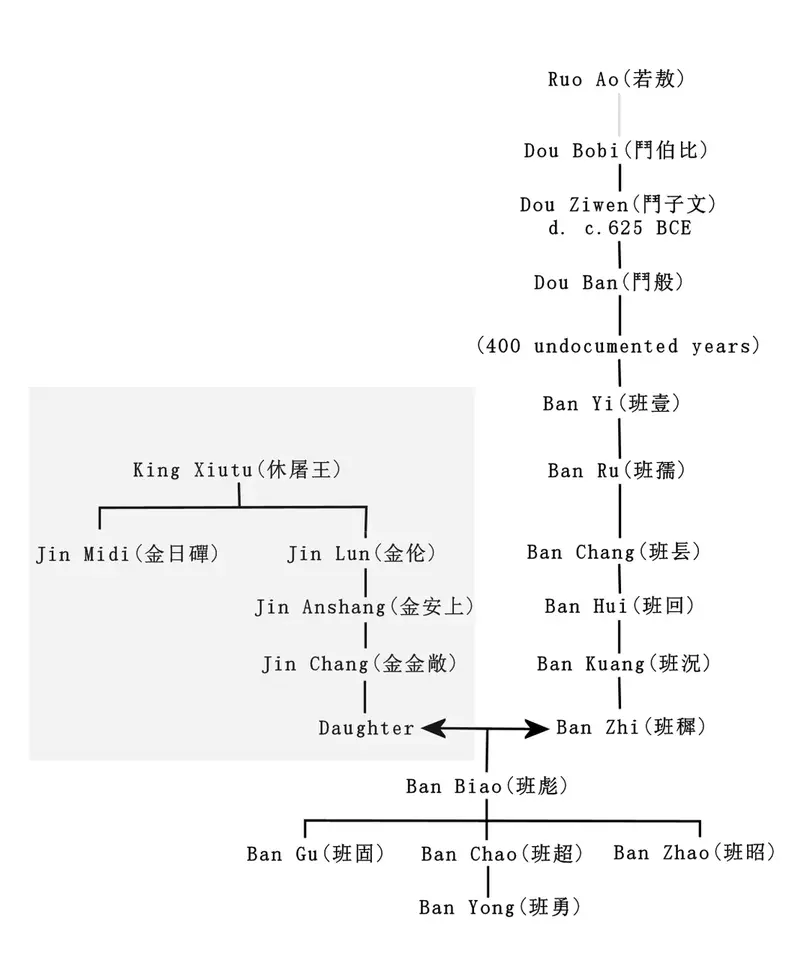
Ban Biao was born in 3 CE in Anling, Fufeng Commandery (modern Xianyang, Shaanxi Province), into one of the most prominent noble scholar-official families of the Han Dynasty. The Fufeng Ban lineage traced its ancestry back to Dou Ziwens, the legendary Prime Minister of Chu during the Spring and Autumn period. In the early Western Han, the family accumulated wealth through frontier livestock breeding before ascending into high imperial service. His grandfather Ban Kuang served as Colonel of Picked Cavalry under Emperor Cheng; his grand-aunt Lady Ban (Ban Jieyu) was a celebrated imperial consort renowned for her exquisite rhapsodies; and his father Ban Zhi served as Grand Administrator of Guangping, praised for unbending rectitude.
Surrounded by this domestic heritage of encyclopedic book collections and Confucian learning, Ban Biao exhibited precocious intellect and reflective gravity from childhood. Beyond mastering classical pre-Qin canons, he displayed deep curiosity regarding administrative institutions, astronomical calendars, and the historical records of the Western Han. As a youth, he earned renown across Guanzhong for his articulate eloquence and elegant literary compositions.
During the usurpation of Wang Mang's Xin Dynasty, observing the growing moral decay and destructive pedantry of the regime, Ban Biao steadfastly refused imperial appointment, maintaining strict seclusion in his family library and preserving his political integrity as an orthodox Han loyalist.
In 23 CE, peasant insurrections toppled Wang Mang's capital at Chang'an, and the Gengshi Emperor Liu Xuan entered the metropolitan region. However, the Gengshi regime swiftly dissolved into factional butchery, and the Red Eyebrow armies sacked Chang'an, reducing the ancient capital to ashes.
To shield his family from warfare, the young Ban Biao fled westward to Tianshui in Longyou. At that juncture, the local magnate Wei Xiao had assembled private armies, proclaiming himself General-in-Chief of the Western Han and welcoming prominent gentry refugees from Guanzhong. Wei Xiao received Ban Biao with lavish hospitality.
However, during their strategic consultations, Ban Biao discerned that despite his veneer of magnanimity, Wei Xiao lacked macroscopic vision and harbored treasonous ambitions of regional partition. Wei Xiao frequently compared himself to King Wen of Zhou and King Goujian of Yue, aspiring to carve out an independent kingdom. To dispel Wei Xiao's delusions, Ban Biao composed his celebrated philosophical treatise, On the Mandate of Kings (Wangming Lun). Grounding his arguments in the Spring and Autumn Annals and early Han history, Ban expounded that supreme monarchical rule is bestowed exclusively by Heaven through virtuous lineage, demonstrating that the Liu clan retained divine legitimacy. He urged Wei Xiao to submit to the emerging Han restoration, but Wei Xiao remained blinded by vanity.
Recognizing that Wei Xiao was destined for ruin, Ban Biao departed Tianshui in 29 CE, crossing arid wilderness to join General Dou Rong, commander of the five commanderies in the Hexi Corridor. Dou Rong had secured Hexi's borders, but remained torn between aligning with Liu Xiu, Wei Xiao, or Gongsun Shu.
Welcoming Ban Biao as his chief political counselor, Dou Rong appointed him General's Aide, entrusting him with all strategic correspondences. Ban Biao analyzed the imperial geopolitical landscape with lucid clarity. He asserted to Dou Rong that Liu Xiu had ascended from obscurity to restore the imperial capital at Luoyang, embodying the will of Heaven and humanity. He argued that Hexi, though prosperous, was an isolated western corridor; only by pledging unconditional loyalty to Emperor Guangwu could Dou Rong achieve enduring glory and preserve his clan.
Dou Rong adopted Ban Biao's strategy entirely, dispatching envoys to Luoyang to submit his commanderies to the Eastern Han. This submission severed Wei Xiao's western supply lines, tilting the balance of power decisively in Guangwu's favor and enabling the imperial army to pacify the northwest. In 32 CE, Ban Biao accompanied Dou Rong to Luoyang, where Emperor Guangwu warmly commended his strategic vision and appointed him Assistant to the Minister over the Masses.
Serving within the central bureaucracy, Ban Biao assisted successive Ministers over the Masses, including Ouyang She and Du Lin, drafting confidential state rescripts. Revered for his command of imperial precedent, high ministers consistently deferred to his counsel on complex statecraft dilemmas.
In court debates, Ban stood as a fearless advocate of Confucian rationalism. When contemporary scholar-officials embraced mystical apocryphal prophecies (chenwei) to flatter the throne, Ban submitted memorials insisting on classical canonical governance and rejecting supernatural omens. In 41 CE, he presented pragmatic recommendations regarding meritorious rewards and judicial leniency, earning the deep respect of Emperor Guangwu.
In 50 CE, severe droughts and swarms of locusts split the Xiongnu Confederation, and the Southern Xiongnu Chanyu Bi sent envoys pleading to submit to the Eastern Han. As court ministers debated whether to repel them, Ban Biao intervened with a masterly state memorial. Drawing on Emperor Xuan's handling of Huhanye Chanyu, he formulated a balanced policy of welcoming the tribes, settling them within inner commanderies, instituting a General of the Gentlemen of the Household to oversee them, and securing frontier fortifications. Guangwu adopted Ban Biao's policy in full, ushering in half a century of border peace and ethnic integration.
Beyond administrative service, Ban Biao dedicated his mature years to historical research. Sima Qian's Records of the Grand Historian ended abruptly during the reign of Emperor Wu, leaving a century of Western Han history—spanning Emperors Zhao, Xuan, Yuan, Cheng, Ai, and Ping through Wang Mang—unrecorded in any unified format.
Furthermore, upon critically analyzing Sima Qian's work, Ban identified profound conceptual flaws, observing that Sima Qian favored Daoist philosophy over Confucian rites, praised wandering swordsmen and merchants above moral sages, and incorporated superstitious folktales. To rectify these deficiencies, Ban began writing his Sequel to the Records of the Grand Historian (Shiji Houzhuan) in 41 CE, scouring imperial palace archives and private memoirs.
Over more than a decade of research, Ban drafted sixty-five chapters of annals, tables, treatises, and biographies. This work synthesized the history of the late Western Han, pioneering the conceptual model of treating a single dynasty as an autonomous historical unit. His Sequel established the definitive architectural blueprint that enabled his son Ban Gu to compile the monumental Book of Han.
In his twilight years, Ban Biao was appointed Magistrate of Wangdu County (modern Wangdu County, Hebei Province). Wangdu was a vital administrative hub troubled by unruly aristocratic clans and unequal taxation. Upon arrival, Ban curbed corrupt clans, equalized agricultural taxes, and fostered classical education, earning universal praise from commoners.
However, decades of intense scholarship and official burdens undermined his health. In 54 CE, Ban Biao passed away in his official residence in Wangdu at the age of fifty-one, deeply mourned by the local populace and interred in his ancestral tombs in Anling.
Though dying before his historical manuscripts could be fully printed, Ban Biao successfully transmitted his rigorous scholarship and moral integrity to his children. His eldest son Ban Gu inherited his drafts, spending twenty years completing the Book of Han; his second son Ban Chao renounced clerical writing to conquer the Western Regions, earning the title Marquess of Dingyuan; and his youngest daughter Ban Zhao completed the Book of Han tables and authored Lessons for Women (Nüjie). Through his patriarchal guidance, Ban Biao founded one of the most illustrious intellectual and military dynasties in Chinese history.
Ban Biao's preeminent contribution to historiography was his authorship of the sixty-five-chapter Sequel to the Records of the Grand Historian. Prior to Ban, Chinese historiography favored universal chronicles spanning multiple dynasties from antiquity downward.
Ban recognized that the Western Han, from its founding by Liu Bang to its overthrow by Wang Mang, formed a cohesive historical unit governed by its own internal institutional logic. In his Sequel, he discarded the unwieldy universal framework, establishing the dynastic format (duandaishi) that focused exclusively on a single dynasty. Comprising imperial annals, chronological tables, cultural treatises, and biographies, his work served as the direct structural foundation for Ban Gu's Book of Han, permanently establishing the dynastic format as the orthodox model for all subsequent official histories across two millennia.
During the interregnum warfare of the early first century CE, regional warlords carved up the empire, generating profound intellectual confusion. Confronting Wei Xiao's separatist pretenses in Tianshui, Ban Biao composed On the Mandate of Kings (Wangming Lun), erecting the philosophical foundation for the Eastern Han restoration.
Ban demonstrated that the rise and fall of dynasties is governed by cosmic moral order rather than military violence or cunning. He argued that the Han founder Liu Bang had secured the empire because of ancestral virtue, divine mandate, and human consensus, asserting that imperial authority cannot be seized through mere physical force. He dismissed contemporary rebel chieftains as common bandits doomed to destruction. On the Mandate of Kings provided an ideological justification for Liu Xiu's reunification campaigns, playing a crucial role in consolidating political cohesion during the Eastern Han restoration.
During the early Jianwu era, with Wei Xiao holding Longyou and Gongsun Shu entrenched in Sichuan, General Dou Rong's control of the Hexi Corridor represented the strategic pivot of the entire empire.
As Dou Rong's chief strategist, Ban Biao provided decisive geopolitical guidance. He drafted the official memorials pledging allegiance to Emperor Guangwu, persuaded local commandery administrators to support unification, and articulated a comprehensive grand strategy. The peaceful integration of Hexi severed the horse and grain supplies of western rebels, allowing Guangwu to pacify eastern China before conquering the northwest. Ban Biao's diplomatic and strategic mastery in Hexi was indispensable to the reunification of the Eastern Han Empire.
In 50 CE, when Southern Xiongnu Chanyu Bi submitted to the court, the imperial government was paralyzed by debate between isolationists and expansionists. Ban Biao submitted a visionary border memorial that resolved the impasse.
Analyzing two centuries of frontier history, he advocated settling the surrendered tribes within the inner commanderies under the supervision of an imperial envoy, while fortifying mountain passes and distributing grain relief to secure tribal loyalty. Emperor Guangwu implemented Ban Biao's strategy in full, establishing the post of General of the Gentlemen of the Household for the Xiongnu. This strategic framework maintained northern border security for fifty years and accelerated the historical assimilation between northern nomadic tribes and central Chinese culture.
While compiling his Sequel, Ban Biao composed Critical Evaluations of the Records of the Grand Historian (Shiji Pingyi), pioneering systematic historiographical criticism.
Maintaining rigorous analytical balance, Ban commended Sima Qian's narrative clarity, factual concision, and lucid style, but fearlessly exposed three fundamental flaws: an ideological bias elevating Daoist naturalism over Confucian canons; an ethical defect favoring wandering swordsmen and merchants over moral statecraft; and a methodological carelessness that recorded mythological exaggerations. By applying Confucian ethical standards and evidentiary scrutiny to ancient texts, Ban established the first systematic canons for historical evaluation in China.
Ban Biao was an extraordinary educator whose domestic mentorship created one of the greatest family legacies in world history. In his residences in Wangdu and Luoyang, he personally instructed his children in classical texts, archival research, and moral philosophy.
Under his guidance, his eldest son Ban Gu completed the Book of Han, securing enduring fame as an imperial historian; his second son Ban Chao renounced civilian scholarship to lead cavalry expeditions that conquered the thirty-six kingdoms of the Western Regions; and his daughter Ban Zhao completed the Book of Han tables and treatises, serving as imperial preceptor to the Empress Dowager. Ban Biao's intellectual and ethical pedigree established a familial paradigm that permanently enriched Chinese civilization.
FIGURES ASSOCIATED WITH THIS DYNASTY