Uprising in Di County
Following Chen Sheng's uprising, Tian Heng joined Tian Dan and Tian Rong in slaying the magistrate of Di County to re-establish Qi.
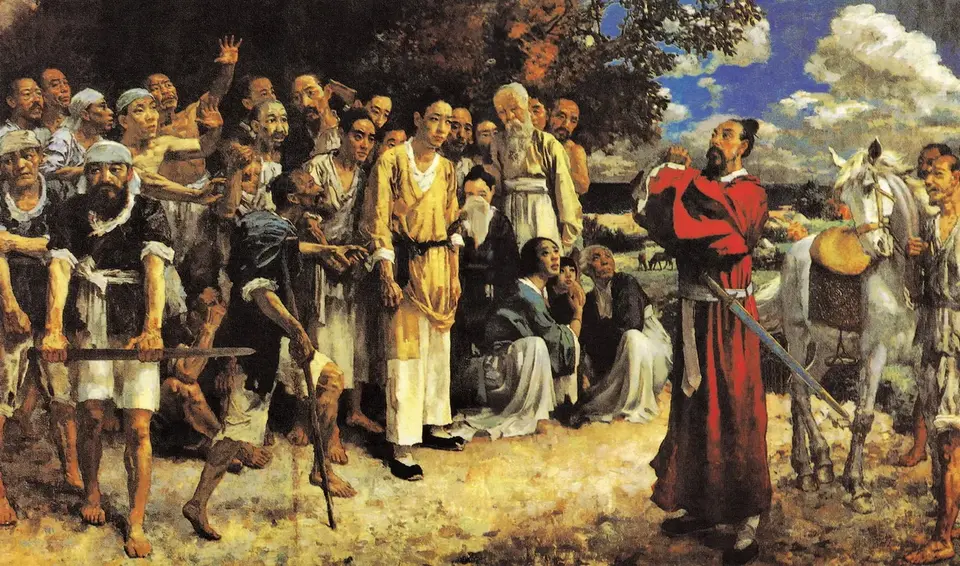
田横
Tian Heng (田横, ? – 202 BCE) was a native of Di County (present-day southeast of Gaoqing, Shandong) and a descendant of the royal lineage of the Warring States kingdom of Qi. He was a prominent insurgent leader during the late Qin and early Han periods, a major warlord resisting Western Chu, Chancellor of Qi, and the last King of Qi. Following the outbreak of the Dazexiang Uprising led by Chen Sheng and Wu Guang, Tian Heng…
Tian Heng (田横, ? – 202 BCE) was a native of Di County (present-day southeast of Gaoqing, Shandong) and a descendant of the royal lineage of the Warring States kingdom of Qi. He was a prominent insurgent leader during the late Qin and early Han periods, a major warlord resisting Western Chu, Chancellor of Qi, and the last King of Qi. Following the outbreak of the Dazexiang Uprising led by Chen Sheng and Wu Guang, Tian Heng joined his cousin Tian Dan and elder brother Tian Rong to execute the magistrate of Di County and raise troops to restore the state of Qi, with Tian Dan proclaiming himself King of Qi. After Tian Dan fell in combat against the Qin general Zhang Han at Dingtao, Tian Heng and Tian Rong reorganized the Qi forces and retreated to Dong'e. When Xiang Yu partitioned the empire into eighteen feudal kingdoms, he denied Tian Rong a royal title because Tian Rong had previously withheld military support from Chu. Enraged, Tian Rong rebelled against Western Chu, expelling the three kings Xiang Yu had installed in Qi. Xiang Yu led a punitive northern expedition, crushing the Qi army and slaying Tian Rong. In Chengyang, Tian Heng gathered tens of thousands of scattered Qi soldiers and waged fierce defensive warfare against Xiang Yu, bogging the main Chu army down in prolonged attrition and creating a vital strategic opening for Liu Bang, King of Han, to capture the Chu capital of Pengcheng. When Xiang Yu withdrew to rescue Pengcheng, Tian Heng seized the momentum to recapture Qi cities, enthrone Tian Guang (son of Tian Rong) as King of Qi, and assume the premiership, monopolizing civil and military governance. In the fourth year of the Han era (204 BCE), Liu Bang dispatched Li Yiji to negotiate peace with Qi. Tian Heng trusted Li Yiji's proposal and dismantled the frontier garrisons at Lixia. However, Han general Han Xin acted on the counsel of Kuai Tong and launched an unexpected assault on the relaxed Lixia encampment, advancing directly on the Qi capital Linzi. Convinced they had been betrayed, Tian Heng and King Tian Guang executed Li Yiji by boiling him alive and mounted separate lines of resistance. Chu general Long Ju marched to assist Qi, rendezvousing with Tian Guang at Gaomi. Han Xin flooded the Wei River to rout the Chu-Qi coalition, slaying Long Ju and capturing Tian Guang. Tian Heng proclaimed himself King of Qi and fought Han general Guan Ying at Ying County, but suffered defeat and fled south to seek refuge with Peng Yue in Liang. In the fifth year of Han (202 BCE), following Liu Bang's final triumph over Xiang Yu and his accession as emperor of the Han dynasty, Tian Heng refused to submit as a subject and led five hundred loyal retainers into exile on an island in the Eastern Sea (later named Tian Heng Island). Liu Bang sent envoys offering pardons and noble enfeoffment while threatening armed annihilation if he refused. Tian Heng accompanied the envoy toward Luoyang. Upon reaching Shixiang post station, thirty li from Luoyang, he reflected that having once stood as an independent sovereign on equal footing with the Han monarch, bowing before him as a captive would be unbearable humiliation, and that having killed Li Yiji, he could not bear facing Li Yiji's brother Li Shang in court. Tian Heng drew his sword and committed suicide. His two escorting retainers took their own lives beside his tomb after burying him, and the five hundred retainers remaining on the island drowned or killed themselves upon hearing of his death. The noble martyrdom of Tian Heng and his followers sent shockwaves throughout China, becoming an enduring emblem of moral integrity and unyielding virtue in Chinese historical memory.
Following Chen Sheng's uprising, Tian Heng joined Tian Dan and Tian Rong in slaying the magistrate of Di County to re-establish Qi.
Tian Dan died fighting Qin general Zhang Han at Linji; Tian Rong and Tian Heng rallied troops and retreated east to Dong'e.
Xiang Yu divided Qi territory among feudatories; Tian Heng aided Tian Rong in destroying the rival kings and recovering Qi.
Xiang Yu invaded Qi and killed Tian Rong; Tian Heng defended Chengyang, installed Tian Rong's son Tian Guang as King, and became Chancellor.
Han envoy Li Yiji negotiated peace, but Han Xin launched a surprise attack; Tian Heng boiled Li Yiji alive and mobilized troops to resist Han.
Following the defeat at Gaomi and capture of Tian Guang, Tian Heng took the throne of Qi, was routed by Guan Ying, and fled to Peng Yue.
After Liu Bang defeated Xiang Yu and founded the Han dynasty, Tian Heng retreated with five hundred retainers to an Eastern Sea island.
Summoned to the capital, committed suicide at Shixiang post station; five hundred retainers on the island committed suicide on the same day.
Tian Heng descended from the royal lineage of the ancient kingdom of Qi, one of the Seven Warring States. Following the unification of China by the Qin dynasty, the Qi royal house was forcibly dispossessed and dispersed among the populace. In the autumn of the first year of the Second Emperor of Qin (209 BCE), Chen Sheng and Wu Guang launched the Dazexiang Uprising, igniting armed rebellions across the realm. Tian Heng's cousin Tian Dan, accompanied by Tian Rong and Tian Heng, plotted an insurrection in Di County. Pretending to deliver an arrested servant to the county magistracy, they drew their concealed blades in the public court, slew the magistrate of Di County, and summoned the prominent local clans to proclaim the revival of Qi. The gathered assembly acclaimed Tian Dan as King of Qi, and the newly mobilized forces quickly swept through surrounding districts to restore the ancestral territory.
In the second year of the Second Emperor of Qin (208 BCE), the eminent Qin general Zhang Han led the main imperial expeditionary forces eastward, besieging King Wei Jiu of Wei at Linji. Tian Dan personally led elite Qi detachments to relieve Wei. During a midnight cavalry ambush orchestrated by Zhang Han, Tian Dan fell in fierce hand-to-hand combat. Tian Rong and Tian Heng gathered the remaining Qi forces and retreated eastward to hold Dong'e. Zhang Han pursued and invested Dong'e, but Chu commander Xiang Liang arrived with allied troops to shatter the Qin siege. Meanwhile, aristocrats in the Qi hinterland, presuming Tian Dan's line extinct, acclaimed Tian Jia (younger brother of the former King Jian of Qi) as their monarch, with Tian Jiao as chancellor and Tian Jian as general. Enraged by this usurpation, Tian Rong marched his victorious army back to Qi and routed Tian Jia, who fled to Western Chu, while Tian Jiao and Tian Jian escaped to Zhao. Tian Rong subsequently installed Tian Dan's son, Tian Shi, as King of Qi, with Tian Rong assuming the chancellorship and Tian Heng commanding the armed forces, successfully reasserting control over the realm.
In the first year of the Han era (206 BCE), Xiang Yu crushed the Qin dynasty and held court at Xianyang, dividing the realm among eighteen feudal lords. Bearing deep resentment against Tian Rong for having failed to march into Guanzhong to assist Xiang Liang, Xiang Yu intentionally partitioned Qi into three separate domains: he transferred Tian Shi to Jiaodong, installed the defected Qi general Tian Du as King of Qi, and made Tian An King of Jibei, leaving Tian Rong and Tian Heng completely unenfeoffed. Defying Chu hegemony, Tian Rong detained Tian Shi and formed an alliance with Chen Yu of Zhao to oppose Western Chu. Tian Rong dispatched Tian Heng at the head of the army to expel Tian Du and execute Tian An. When Tian Shi attempted to flee to Jiaodong out of fear of Xiang Yu, Tian Rong slew him, assumed the crown of Qi himself, and appointed Tian Heng as supreme commander over the reunited Qi territories.
In response, Xiang Yu personally led the elite Chu armies on a punitive campaign into Qi. Tian Rong was defeated and killed in battle. Xiang Yu advanced into the heart of Qi, leveling city walls, razing palaces, and slaughtering noncombatants and captives, which provoked widespread and furious popular resistance. Tian Heng assembled tens of thousands of scattered soldiers at Chengyang and established heavily fortified positions. Xiang Yu repeatedly assaulted Chengyang without success, locking both sides in brutal attrition. Seizing this critical strategic distraction, Liu Bang led a coalition of 560,000 allied soldiers to capture the Chu capital at Pengcheng. Compelled to disengage from Qi to save his homeland, Xiang Yu withdrew, allowing Tian Heng to swiftly launch a general counter-offensive that recovered all Qi territories. Tian Heng installed Tian Rong's son Tian Guang as King of Qi while serving as Chancellor, directing state policy and consolidating regional authority.
In the fourth year of the Han era (204 BCE), as the stalemate between Liu Bang and Xiang Yu dragged on at Xingyang, Liu Bang dispatched the renowned orator Li Yiji to Qi to negotiate an alliance, offering official enfeoffment in exchange for Qi's submission to Han. Recognizing the exhausted state of Qi after years of unrelenting warfare, Tian Heng accepted Li Yiji's terms, dispatched envoys to conclude peace with Han, and ordered Qi generals Hua Wushang and Tian Jie to dismantle defensive fortifications at Lixia (modern Jinan, Shandong), where troops celebrated with open banquets.
However, Han general Han Xin, who was marching toward Qi, adopted the advice of strategist Kuai Tong, arguing that since no official imperial ceasefire decree had arrived, Qi remained an enemy. Han Xin executed a daring crossing at Pingyuan Ford, launching a sudden strike against the defenseless Lixia camp. The Qi lines collapsed, and Han forces advanced straight toward Linzi. Shocked by the surprise attack, Tian Heng and King Tian Guang believed they had been duplicitously betrayed by Li Yiji. In towering fury, they threw Li Yiji into a boiling cauldron. King Tian Guang fled eastward to Gaomi, while Tian Heng withdrew to Boyang and dispatched messengers pleading for Chu intervention. Xiang Yu sent general Long Ju with 200,000 Chu troops to reinforce Qi. At Gaomi, Long Ju joined forces with Tian Guang. Exploiting the geography of the Wei River, Han Xin dammed the upper waters with sandbags, lured the Chu army across, and breached the dam, unleashing a torrent that cleaved the Chu formation in two. Han Xin launched a counter-attack, slaying Long Ju and capturing Tian Guang. Learning of Tian Guang's demise, Tian Heng proclaimed himself King of Qi at Boyang and rallied his remaining garrisons to confront pursuing Han forces under Guan Ying. The two armies clashed outside the walls of Ying County. Routed and broken, Tian Heng escaped with a handful of trusted followers southward into Liang to seek refuge with Peng Yue.
In the fifth year of the Han era (202 BCE), Liu Bang encircled and annihilated Xiang Yu at Gaixia, established the Han dynasty as emperor, and enfeoffed Peng Yue as King of Liang. Recognizing that the empire had achieved unity and knowing that he had once contended for dominion against Liu Bang and executed the imperial envoy Li Yiji, Tian Heng realized he could no longer find safety on the mainland. He gathered more than five hundred loyal followers and retainers and sailed into the Eastern Sea, establishing a refuge on an isolated island (subsequently revered as Tian Heng Island).
Following the consolidation of the empire, Liu Bang realized that the people of Qi still held deep reverence for the Tian brothers and that Tian Heng's towering influence among northern scholars and warriors represented a potential threat to Han frontier security. The emperor dispatched an imperial envoy across the waters to grant Tian Heng an amnesty and summon him to court. Tian Heng demurred, telling the envoy: "I previously executed Your Majesty's envoy Li Yiji by boiling. I now hear that his younger brother Li Shang serves as Chamberlain for the Palace Guard in the imperial court. Terrified of his vengeance, I dare not present myself. My sole petition is to be permitted to live as a humble commoner upon this distant island." When the envoy reported back, Liu Bang issued a stern imperial decree to Li Shang: "King Tian Heng of Qi is approaching the capital. Anyone who harms his retinue shall have their entire clan exterminated!" Liu Bang then dispatched an envoy bearing imperial credentials back to the island, delivering the imperial ultimatum: "If Tian Heng presents himself at court, he may receive a kingship at best or a marquisate at least; if he defies this summons, imperial armies will be dispatched to eradicate him and his men."
Pressured by these alternating inducements and threats, and refusing to see his five hundred retainers slaughtered by imperial troops, Tian Heng chose two retainers to accompany him in an official carriage toward Luoyang. When they arrived at Shixiang post station (beneath Mount Shouyang, modern Yanshi, Henan), thirty li from the capital, Tian Heng halted and informed the envoy: "When a subject appears before the Son of Heaven, he must properly bathe and attire himself." He took up lodging in the station. Tian Heng confidingly revealed his inner resolution to his two retainers: "Originally, I and King Liu of Han both stood facing south as independent monarchs of equal dignity. Today, he has risen to be the Son of Heaven, while I am reduced to a fugitive captive, kneeling face north in submission—this is an intolerable disgrace! Furthermore, I executed Li Yiji in a cauldron, and today I would be compelled to stand shoulder to shoulder in court with his brother Li Shang. Even if Lord Li refrains from action out of respect for the imperial decree, would my own conscience not burn with perpetual shame? Moreover, the reason His Majesty summons me is merely to view my countenance. With Luoyang only thirty li distant, my severed head carried on swift horseback will reach the court before decaying, allowing the emperor to inspect my visage."
With these words, Tian Heng turned toward the distant lands of Qi, sighed deeply, drew his sword, and severed his own throat. Before dying, he instructed his two retainers to carry his head alongside the imperial envoy to Luoyang. When Liu Bang was presented with Tian Heng's head, he wept and lamented: "Rising from coarse cloth, three brothers successively became kings—were they not truly men of transcendent virtue!" Liu Bang appointed both retainers as Han commandants and dispatched two thousand imperial soldiers to conduct a grand funeral for Tian Heng under the ceremonial protocols of a feudal king beneath Mount Shouyang.
Upon the conclusion of the burial rites, the two retainers dug graves on either side of Tian Heng's tomb, drew their swords, and committed suicide, falling into the pits beside their lord. Liu Bang was deeply shaken, acknowledging that Tian Heng and his followers were unparalleled paragons of loyalty and righteousness. Learning that five hundred retainers remained on the distant island, Liu Bang dispatched another envoy to summon them to court. When the five hundred retainers learned that Tian Heng had taken his own life at Shixiang to preserve his honor, overwhelmed by grief and fidelity, they all plunged into the sea or severed their throats on the island, with not a single individual consenting to live in servitude under the Han dynasty.
Throughout the turbulence of the late Qin era, Tian Heng dedicated his life to restoring the ancestral dominion of Qi. From the initial uprising in Di County where they slew the Qin magistrate, to rallying defeated remnants to defend Dong'e following the battle of Dingtao, Tian Heng and his brothers displayed steadfast martial resilience. In the aftermath of Xiang Yu's partition of Qi into three fiefs, Tian Heng supported Tian Rong in raising the banner of defiance, skillfully expelling Tian Du and executing Tian An to reunite the three Qi territories. Under the dire pressure of Xiang Yu's punitive campaign, Tian Heng mobilized tens of thousands of scattered soldiers to hold Chengyang, absorbing the brunt of the Chu army's main offensive. This defense not only revitalized the Qi state but also profoundly altered the geopolitical landscape of the early Chu-Han Contention.
In the fourth year of the Han era, Tian Heng and King Tian Guang were initially receptive to Li Yiji's peace overtures. However, the opportunistic assault executed by Han Xin and Kuai Tong destroyed that fragile diplomatic trust. Tian Heng's furious decision to boil Li Yiji alive expressed the sheer desperation and moral outrage of Qi, yet it permanently closed all channels of reconciliation with the burgeoning Han dynasty. In the ensuing catastrophic defeats at Gaomi and Ying County, Qi's military elite was destroyed, its kings and generals were captured or slain, and Tian Heng was driven into exile. This turn of events finalized the destruction of Qi as an independent power and paved the way for the Han dynasty's consolidation of eastern China.
Tian Heng's withdrawal to the sea after the founding of Han, followed by his suicide at Shixiang post station when confronted with Liu Bang's coercive summons, embodied an extraordinary pinnacle of aristocratic honor. Tian Heng refused to accept the debasement of submitting as a subject after having reigned as an independent monarch, while his moral remorse over the execution of Li Yiji precluded him from sharing court with Li Shang. The subsequent martyrdom of his two escorts beside his tomb and the collective suicide of the five hundred retainers on the island constituted an unparalleled epic of communal self-sacrifice in Chinese history. The legacy of "Tian Heng and His Five Hundred Retainers" endured across centuries as a beacon of uncompromising integrity and moral courage for Chinese scholars facing tyranny or dynastic fall.
FIGURES ASSOCIATED WITH THIS DYNASTY