Birth and Childhood
Born into an illustrious scholarly lineage in Wanliu Village, Linyi County, Jinan Prefecture, Shandong.
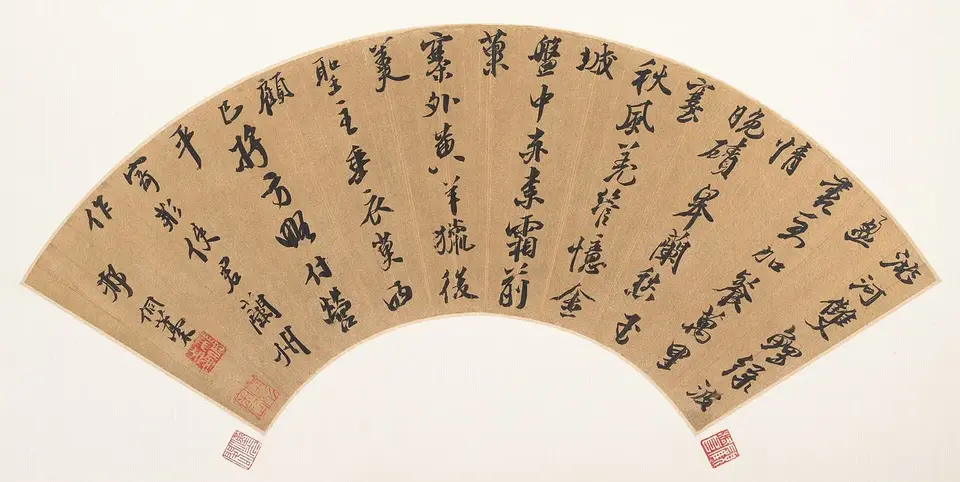
邢侗
Xing Tong (1551 – 1612), courtesy name Ziyuan, art name Zhiwu, and Daoist sobriquet Fangshan Daomin, was a native of Linyi County, Jinan Prefecture, Shandong (present-day Linyi County, Dezhou City, Shandong Province). A celebrated calligrapher, painter, connoisseur, and scholar during the Wanli reign of the Ming dynasty, he passed the imperial examinations as a jinshi in 1574, rising to Junior Minister of the Court of the…
Xing Tong (1551 – 1612), courtesy name Ziyuan, art name Zhiwu, and Daoist sobriquet Fangshan Daomin, was a native of Linyi County, Jinan Prefecture, Shandong (present-day Linyi County, Dezhou City, Shandong Province). A celebrated calligrapher, painter, connoisseur, and scholar during the Wanli reign of the Ming dynasty, he passed the imperial examinations as a jinshi in 1574, rising to Junior Minister of the Court of the Imperial Stud in Shaanxi. Precociously brilliant from youth, he gained fame across Qi and Lu for calligraphy as a boy. After entering officialdom, he served as magistrate of Nangong and Sanshui, praised for incorruptible administration and benevolent care for the people. Promoted to Assistant Surveillance Commissioner of Huguang, he petitioned to resign to care for his aging parents. Reappointed as Junior Minister of the Court of the Imperial Stud in the mid-Wanli reign, he soon resigned to return permanently to rural life. In his native Linyi, Xing constructed Ji Garden and Laiqin Hall, immersing himself in calligraphy, painting, and the engraving of model calligraphic rubbings for twenty-six years. His calligraphy initially emulated Wen Zhengming and Wang Chong, shifted in mid-career to Zhong Yao and Wang Xizhi, and achieved consummate maturity in his later years, particularly excelling in draft cursive and running cursive script. His compilation and engraving of the Laiqin Guan Tie was celebrated as the finest calligraphic compendium of the Ming dynasty. Xing was ranked alongside Dong Qichang, Mi Wanzhong, and Zhang Ruitu as one of the "Four Masters of the Late Ming," and stood as Dong Qichang's northern equal in the famous pairing "Xing of the North and Dong of the South." His ink works circulated throughout China and spread abroad to Korea, Ryukyu, and Japan.
Born into an illustrious scholarly lineage in Wanliu Village, Linyi County, Jinan Prefecture, Shandong.
Displaying precocious talent, wrote large characters at seven with vigorous brushwork, praised as a child prodigy.
At fourteen, read widely in classics; Education Commissioner Zou Anfu admired his regular script, admitting him to Luoyuan Academy in Jinan.
Selected as tribute student (bagong) and journeyed to Beijing, befriending scholars and passing the Shuntian provincial examination as juren.
Passed the jiaxu metropolitan examination as a jinshi; examiner Yu Shenxing favored his talents, appointing him Magistrate of Nangong.
Transferred to serve as Magistrate of Sanshui in Shaanxi with outstanding achievements, promoted to Assistant Surveillance Commissioner of Huguang.
Resigned official rank citing aging parents, constructing Ji Garden and Laiqin Hall in Linyi to dedicate himself to calligraphy and art.
Completed the selection and carving of the celebrated calligraphic compendium Laiqin Guan Tie, creating an intellectual sensation nationwide.
Summoned by imperial decree as Junior Minister of the Court of the Imperial Stud in Shaanxi, soon requesting retirement to return home.
Passed away from illness at Laiqin Hall in Ji Garden, Linyi, at the age of sixty-two.
Xing Tong was born in 1551 (the thirtieth year of the Jiajing reign) into an illustrious scholarly family in Wanliu Village, Linyi County, Jinan Prefecture, Shandong. The Xing lineage produced prominent figures across generations; his father Xing Ruyue was known for civic charity and generous famine relief. Precociously brilliant, Xing was able to write monumental characters with powerful, uninhibited brushwork at seven, celebrated by villagers as a child prodigy. At thirteen, he emulated Suzhou calligrapher Wang Chong, producing pure and dignified regular script. At fourteen, he had read through the family library. When Education Commissioner Zou Anfu inspected Jinan, he was astonished by Xing's Jin and Tang regular script, praising him as a rare talent and admitting him to Luoyuan Academy in Jinan, bringing him wide fame across Shandong.
In 1570 (the fourth year of the Longqing reign), the twenty-year-old Xing was selected as a senior tribute student (bagong) to travel to Beijing, where he formed friendships with eminent scholars and passed the Shuntian provincial examinations as a juren. In 1574 (the second year of the Wanli reign), Xing sat for the jiaxu metropolitan examinations, passing as a jinshi. Examiner Yu Shenxing (later Minister of Rites and Grand Academician) was struck by his essay, marveling that few talents north of the Huai River possessed such brilliance, accepting Xing as a favorite disciple. Yu mentored Xing with paternal affection, forming a thirty-year bond of artistic and scholarly friendship. Launching his career, Xing was appointed magistrate of Nangong County in Zhending Prefecture, South Zhili (modern Hebei).
Serving as magistrate of Nangong, Xing governed with incorruptibility and firm integrity, abolishing oppressive surcharges, punishing predatory gentry and clerks, encouraging agriculture, and establishing schools. Nangong was an essential transport post subject to heavy corvee labor; Xing personally audited tax registers, equalizing corvee burdens to give the peasantry relief. In his leisure hours, he directed the compilation of the Nangong Xianzhi and lectured students, inspiring scholarly learning. Recognized for administrative excellence, he was transferred to Sanshui County in Pingliang Prefecture, Shaanxi (modern Xunyi). Sanshui was impoverished and remote; Xing comforted displaced refugees, restored order, and built irrigation works, revitalizing the region.
In 1584 (the twelfth year of the Wanli reign), Xing was promoted to Assistant Surveillance Commissioner of Huguang for his outstanding record, tasked with judicial oversight. However, Xing was untrammeled and philosophical by nature, weary of bureaucratic maneuvering and mindful that his parents were over sixty with no one to attend them. He submitted an earnest memorial requesting retirement. The court granted his request, and Xing resigned from office to return to his native Linyi at thirty-six, embarking on a twenty-six-year artistic retirement.
Returning to his hometown, Xing expanded his ancestral farmland outside the walls of Linyi into a grand private estate, diverting the waters of the Ji River to surround twenty-six pavilions, naming the property "Ji Garden." Inside, he built an elegant studio named "Laiqin Hall" after Wang Xizhi's Laiqin Tie, using it to study classics, practice calligraphy, carve model rubbings, and entertain guests. Xing came from an affluent household and was naturally generous; Ji Garden was continuously filled with literati, poets, and Chan monks traveling between northern and southern China.
Xing spent his family fortune entertaining visitors with lavish feasts and vintage wine, exchanging poems in refined fellowship. He also provided generous relief to impoverished scholars and starving villagers, gradually dissipating his wealth until his family fortune declined in his later years. Yet Xing remained unperturbed, sitting contentedly in Laiqin Hall by his desk, burning incense, brewing tea, and studying ancient stone rubbings, finding joy in simple fare and scholar's robes. Reading continuously, he gathered scattered manuscripts and collated classical texts, his fame spreading across the nine provinces.
At Laiqin Hall, Xing poured his energies into collecting, authenticating, and carving ancient calligraphic masterpieces. Spending large sums to acquire authentic Jin, Tang, and Song manuscripts and rubbings, he observed that circulating editions of Wang Xizhi's works were corrupted with forgeries, resolving to carve an authoritative compilation. Between 1588 and 1592, he invited master stone carver Wu Yingqi and his son Wu Shiduan from Suzhou to reside at Laiqin Hall, spending years carving the renowned Laiqin Guan Tie. Upon publication, the work created a massive sensation among scholar-officials, who eagerly competed to acquire rubbings.
In 1600 (the twenty-eighth year of the Wanli reign), Emperor Wanli, hearing of his reputation, summoned Xing to serve as Junior Minister of the Court of the Imperial Stud in Shaanxi. Though Xing accepted the initial appointment, observing political decay, rising eunuch influence, and bitter factionalism, he realized reform was impossible. Pleading illness, he resigned to return to Linyi, declining all further official invitations. In 1612 (the fortieth year of the Wanli reign), Xing passed away peacefully in Laiqin Hall at sixty-two. Grieving citizens of Linyi erected ancestral shrines in his honor.
Xing Tong's calligraphy stood out in the late Ming art world, his artistic trajectory clearly dividing into early, middle, and late phases. In his early years, Xing emulated Wu School masters Wen Zhengming and Wang Chong. Wang Chong's regular script was pure, elegant, and ethereal, capturing the brush intent of Wang Xianzhi. Xing absorbed this subtle charm, establishing a classical foundation in Wei and Jin small regular script. Yet he did not remain confined to Wang Chong, noting in his inscriptions that Wang's writing, while untrammeled, lacked structural bone strength, striving to transcend the delicacy of later Wu School followers.
In his middle period, Xing's art achieved a fundamental leap. Spanning two decades from his jinshi success through his governance and retirement at Ji Garden, Xing committed himself to the aesthetic standard of emulating the Wei and Jin dynasties, taking the Two Wangs (Wang Xizhi and Wang Xianzhi) as supreme masters. To enrich his technique, he studied Zhong Yao, Suo Jing, Yu Shinan, Chu Suiliang, Yan Zhenqing, Li Yong, Mi Fu, and Zhao Mengfu, finding his ultimate spiritual anchor in Wang Xizhi's cursive script. In Laiqin Hall, he collected Song-Yuan rubbings and Tang traced manuscripts, practicing day and night, stripping away contemporary mannerisms to attain the robust antique vigor of Wei and Jin brushwork.
In his late years, Xing's calligraphy attained consummate harmony. His brushwork was decisive, vigorous, and agile, seamlessly alternating between square and round turns. His later letters and cursive hanging scrolls blended the archaic solemnity of Two Wangs draft cursive (zhangcao) with the flowing liberation of modern cursive (jincao), casting aside rigid imitation to create a natural, unconstrained style. Contemporaries acclaimed Dong Qichang and Xing Tong as "Dong of the South and Xing of the North," and foreign envoys from Ryukyu and Korea considered acquiring Xing's genuine brushwork the highest honor.
In painting, Xing possessed remarkable skill. Though renowned for calligraphy, his rare paintings captured the sparse, tranquil spirit of Yuan masters Ni Zan and Huang Gongwang. His landscapes, bamboo, and rocks were executed with sparse, calligraphic brushstrokes, achieving high aesthetic elegance. Surviving works like Acorus Calamus and Fist-Shaped Rock Fan employed dry brushwork to render rugged rock textures paired with green sweet flag, reflecting his aloof moral character, preserved in prominent museums worldwide.
Another historic contribution of Xing was directing the engraving of the celebrated model rubbing compendium Laiqin Guan Tie. From the mid-Ming onward, private and commercial rubbings proliferated, and circulating editions of ancient works like the Chunhua Ge Tie were severely corrupted by amateur carving and forgeries, misleading students. Xing resolved to restore classical purity, selecting authentic Jin and Tang rubbings centered on Tang traced copies of the Seventeen Tie (Shiqi Tie).
To ensure flawless carving, Xing engaged Suzhou's foremost stone carver Wu Yingqi and his son, spending years in meticulous execution. The resulting Laiqin Guan Tie captured microscopic nuances of brushwork with vivid clarity. Its Tang traced Seventeen Tie was acclaimed by posterity as the premier calligraphic rubbing of the Ming dynasty, hailed as a red banner across the realm. The collection purified circulating editions of Wang Xizhi's calligraphy, countering the erratic and frivolous calligraphic styles of the late Ming. Disciples Zhang Xin and fellow county native Wang Qia later engraved Laiqin Guan Zhenji, further propagating Xing's art.
Beyond his calligraphy, Xing was an accomplished bibliophile, historian, and scholar. During his magistrate tenures in Nangong and Sanshui, he directed the compilation of the Nangong Xianzhi. Retiring to Linyi, he was hired in 1588 to direct the compiling of the fifteen-volume Wuding Zhouzhi, a disciplined work of 100,000 words that became a model for Ming gazetteers. In 1591, at the invitation of Linyi Magistrate Liu Chengpei, he compiled the sixteen-volume Linyi Xianzhi, systematically recording the cultural geography of his home county.
Literarily, Xing composed poetry and prose in an archaic, dignified style reminiscent of Jian'an and Wei-Jin traditions, while his letters were conversational and emotionally candid. His collected poems and essays, titled Laiqin Guan Ji in twenty-nine volumes, were selected for inclusion in the Qing imperial Siku Quanshu for their literary and documentary value. His combined achievements in literature, historiography, and artistic theory established him as a paramount cultural titan of late Ming northern China.
FIGURES ASSOCIATED WITH THIS DYNASTY