Birth in Hunan
Born on October 25 in Liangtang, Shanhua County, into a respected scholarly family descended from Northern Song poet Huang Tingjian.
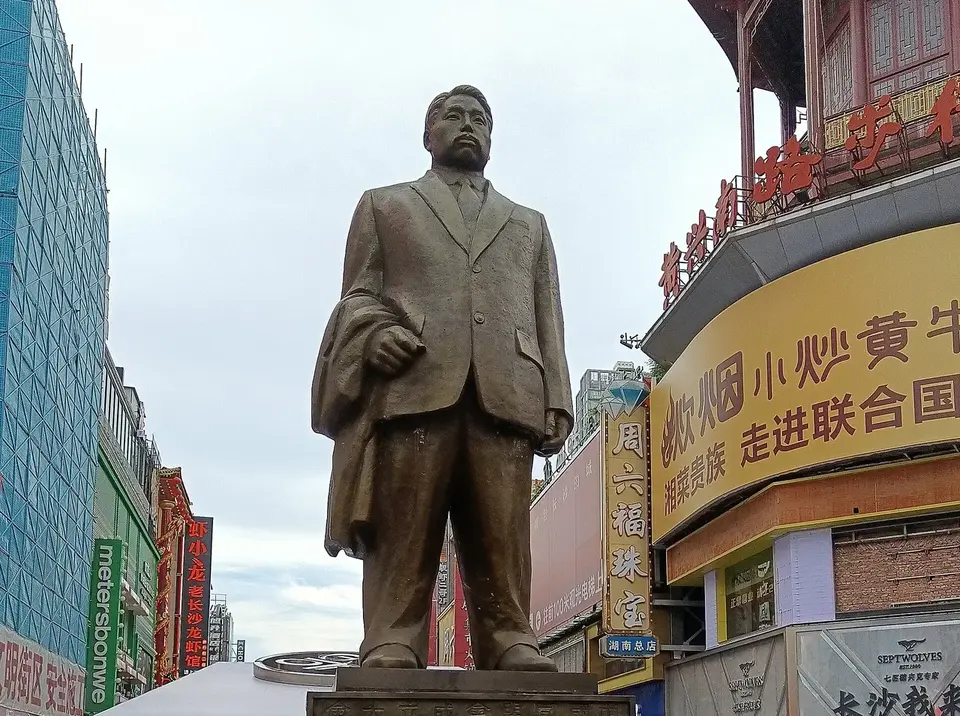
黄兴
Huang Xing (黄兴, October 25, 1874 – October 31, 1916), originally named Zhen, courtesy names Keqiang and Jinwu, art names Qingwu and Jingwu, was a native of Liangtang, Shanhua County, Changsha Prefecture, Hunan Province, and an eminent democratic revolutionary, military strategist, and founding father of the Republic of China. Revered alongside Sun Yat-sen as the dual pillars of the republican revolution, he was commonly…
Huang Xing (黄兴, October 25, 1874 – October 31, 1916), originally named Zhen, courtesy names Keqiang and Jinwu, art names Qingwu and Jingwu, was a native of Liangtang, Shanhua County, Changsha Prefecture, Hunan Province, and an eminent democratic revolutionary, military strategist, and founding father of the Republic of China. Revered alongside Sun Yat-sen as the dual pillars of the republican revolution, he was commonly commemorated in the collective phrase Sun-Huang. Educated at the Chengnan Academy in Changsha and the Lianghu Academy in Wuchang, he was selected to study in Japan, where he became dedicated to overthrowing the Qing autocracy. In 1904, he founded the Huaxinghui in Changsha, launching the first independent regional revolutionary society organized within mainland China. In 1905, Huang united with Sun Yat-sen in Tokyo to form the Tongmenghui (Chinese United League), serving as its director of general affairs and assuming executive responsibility for the league's operational and military planning. Between 1907 and 1911, he repeatedly crossed into southern China to plan and lead armed uprisings in Qinzhou, Fangcheng, Zhennanguan, Hekou, and Guangzhou. In the 1911 Second Guangzhou Uprising, he spearheaded an assault on the viceregal yamen, losing two fingers in close combat and earning the sobriquet the Eight-Fingered General. Following the outbreak of the Wuchang Uprising, he took command as wartime commander-in-chief, directing the grueling defense of Hanyang for over twenty days and buying indispensable time for southern provinces to declare independence. During the Nanjing Provisional Government, he served as minister of the army and chief of the general staff, and later as resident-general of Nanjing to oversee military demobilization. In 1913, he launched the Second Revolution as commander-in-chief of the Jiangsu Punitive Army against Yuan Shikai's autocratic usurpation. Following years of overseas exile and tireless mobilization for the National Protection War, he returned to Shanghai in 1916 and died of illness at forty-two. He was accorded a national funeral and interred on Mount Yuelu in Changsha.
Born on October 25 in Liangtang, Shanhua County, into a respected scholarly family descended from Northern Song poet Huang Tingjian.
Enrolled at the Lianghu Academy in Wuchang, studying both Confucian classics and Western science while absorbing democratic ideals.
Dispatched to the Hongwen Academy in Tokyo, where he co-founded the journal Youxue Yibian and organized student anti-Qing agitation.
Established the Huaxinghui in Changsha as its president; a planned uprising during Empress Dowager Cixi's birthday was betrayed, forcing him into exile.
Partnered with Sun Yat-sen in Tokyo to establish the Chinese United League, becoming its director of general affairs and operational chief.
Established operational bases in northern Vietnam and led combat operations in Qinzhou, Fangcheng, and Zhennanguan along the southern border.
Directed armed combat during the Hekou Uprising in Yunnan, commanding volunteer forces against superior Qing imperial armies.
Commanded the Yellow Flower Mound assault in April, losing two fingers; took supreme command of republican forces at Hanyang in November.
Appointed minister of the army and chief of the general staff in the Provisional Government, later supervising peaceful military demobilization as resident-general of Nanjing.
Mobilized forces in Nanjing as commander-in-chief of the Jiangsu Punitive Army to resist Yuan Shikai's dictatorship following Song Jiaoren's assassination.
Traveled across North America to rally overseas Chinese communities, raise funds, and promote republican governance against Yuan Shikai's imperial ambitions.
Returned to Shanghai in July and succumbed to gastrointestinal hemorrhage on October 31; honored with a state funeral on Mount Yuelu in 1917.
Huang Xing was born on October 25, 1874, in Liangtang Village, Gaotang Township, Shanhua County, Changsha Prefecture, Hunan Province. His father, Huang Xiaocun, was a late Qing licentiate who ran a village academy, while his mother, Lady Luo, was a virtuous domestic matron. The lineage claimed descent from the renowned Northern Song literary figure Huang Tingjian. Reared in the rich intellectual traditions of Hunan statecraft and the moral philosophy of Wang Fuzhi, Huang exhibited keen intelligence, moral rectitude, and an early enthusiasm for martial sports, frequently practicing archery, equestrian arts, and fencing.
In 1893, Huang entered the Chengnan Academy in Changsha to pursue advanced classical studies, passing the civil service examination as a licentiate in 1896. Recognizing his exceptional aptitude, the Xiangshui Academy recommended him in 1898 for admission to the Lianghu Academy in Wuchang. Established by Governor-General Zhang Zhidong, the academy offered an integrated curriculum combining traditional Chinese scholarship with Western natural sciences, cartography, surveying, mathematics, chemistry, and modern military drill.
Witnessing the collapse of the Hundred Days of Reform in 1898 and the humiliation of the Eight-Nation Alliance invasion in 1900, Huang recognized that dynastic decay threatened China's survival. He avidly studied translated European works, including Jean-Jacques Rousseau's The Social Contract, developing a deep conviction in natural human rights, popular sovereignty, and constitutional democracy. In 1901, he graduated with distinction from the Lianghu Academy, resolved to commit his life to political transformation.
In the spring of 1902, Zhang Zhidong selected Huang for government-sponsored study in Japan, enrolling him in the accelerated teacher-training curriculum at the Hongwen Academy in Tokyo. In Tokyo, Huang observed the achievements of constitutional modernization alongside the vibrant discourse of exiled reformers and revolutionaries. In late 1902, together with Yang Dusheng and Cai E, he co-founded the influential monthly journal Youxue Yibian, publishing translations of Western political treatises and awakening national consciousness among overseas Chinese students.
In the spring of 1903, Imperial Russia's refusal to withdraw its forces from Manchuria sparked intense indignation among Chinese students in Japan. Huang took the lead in forming the Anti-Russia Volunteer Corps, subsequently reorganized into the Student Military Corps, conducting daily tactical drills to prepare for national defense. When Qing diplomatic representatives colluded with Japanese authorities to suppress the movement, Huang concluded that external aggression could only be resisted after overthrowing the corrupt Qing monarchy.
Returning to China in the summer of 1903, Huang conferred with comrades in Shanghai before arriving in Changsha. Taking a teaching post at the Mingde School as a cover, he covertly organized patriotic students, progressive new army officers, and leaders of the Gelaohui secret society. To finance revolutionary operations, Huang took the extraordinary step of selling his ancestral family estate, houses, and farmland, using the proceeds to purchase firearms and establish clandestine printing presses.
On February 15, 1904, Huang, along with Song Jiaoren, Liu Kuiyi, Chen Tianhua, and Zhang Shizhao, convened a secret assembly in Changsha to establish the Huaxinghui, unanimously electing Huang as its president. Under the motto Drive out the Manchus and Revive China, the society adopted the strategic doctrine of seizing one province as a revolutionary base to coordinate nation-wide rebellion, adopting the corporate moniker Huaxing Company as a commercial cover.
The Huaxinghui allied with Gelaohui chieftain Ma Fuyi, planning a simultaneous insurrection across Changsha on November 16, 1904, during the official celebrations marking the seventieth birthday of Empress Dowager Cixi. However, the plot was betrayed in Liling in October. Hunan Governor Lu Yuanding ordered a general dragnet. Shielded by sympathetic friends, Huang went into hiding and escaped through Shanghai to Japan.
In Tokyo, Huang continued rallying revolutionary exiles. In July 1905, Sun Yat-sen arrived from Europe. Introduced by Miyazaki Torazo, Sun and Huang met and achieved immediate consensus on merging their disparate revolutionary factions into a single, unified organization. Demonstrating immense selflessness, Huang offered to subordinate his Huaxinghui to a grand alliance incorporating Sun's Xingzhonghui and Zhang Taiyan's Guangfuhui.
On August 20, 1905, the Chinese United League (Tongmenghui) was formally inaugurated in Tokyo. Sun Yat-sen was elected premier, and Huang was appointed director of general affairs, effectively serving as the chief executive of the revolutionary apparatus. The league adopted the sixteen-character manifesto: Drive out the Manchus, Revive China, Establish the Republic, and Equalize Land Rights. During debates over the future national flag, Sun advocated the Blue Sky and White Sun banner, while Huang favored the Well-Field or Nine-Star flags; to preserve party unity, Huang magnanimously yielded to Sun's preference.
In early 1907, under diplomatic pressure from Beijing, Japanese authorities expelled Sun Yat-sen. Huang and Sun relocated to Hanoi in northern Vietnam to establish an operational headquarters for southwestern operations. Convinced that the borderlands offered fertile ground for armed revolt, Huang personally infiltrated the Qinzhou and Fangcheng regions of Guangdong in the autumn of 1907, mobilizing local garrisons and fighting across the Shiwandashan mountains.
In December 1907, revolutionary forces seized the mountain fort at Zhennanguan on the Guangxi border, where Sun and Huang manned artillery batteries. When imperial reinforcements surrounded the redoubt, Huang led an audacious bayonet charge to break the encirclement, preserving the core force. In March 1908, he commanded two hundred volunteers in a mobile guerrilla campaign across Qinzhou and Lianzhou for over forty days, defeating vastly superior Qing formations. In April 1908, he led troops during the Hekou Uprising in Yunnan, cementing his stature as the supreme field commander of the revolution.
In late 1910, Sun Yat-sen and Huang Xing convened a leadership conference in Penang, British Malaya, deciding to pool all global revolutionary resources for a decisive strike against the Qing administrative hub in Guangzhou. Huang established the insurrection chancellery in Hong Kong, coordinating weapons procurement, financial transfers, and the recruitment of elite suicide squads known as the Selected Vanguard. Arms and munitions were smuggled into Guangzhou concealed within wedding sedans, ancestral urns, and flower baskets.
On the afternoon of April 27, 1911, finding that several coordinated military units had failed to mobilize, Huang resolved to press forward alone rather than forfeit the enterprise. Strapping on pistols and brandishing a broadsword, he led over one hundred white-banded assault troops in a broad daylight charge against the viceregal yamen of Viceroy Zhang Mingqi. Huang burst through the central gates, killing the guards and setting fire to the compound, though Zhang had already fled over the rear wall.
Surrounded in the narrow streets by elite Qing naval infantry under Admiral Li Zhun, the revolutionaries fought a desperate hand-to-hand battle. During the melee, rifle bullets shattered two fingers on Huang's right hand. Bandaging his bleeding stump, he maintained covering fire with his left hand until nightfall, enabling surviving comrades to scatter. He found shelter in a safe house and was smuggled to Hong Kong by his comrade Xu Zonghan. Though seventy-two fallen heroes were buried at Yellow Flower Mound, their valor ignited the revolutionary storm across China.
On October 10, 1911, the Wuchang Uprising erupted, overthrowing dynastic authority in Hubei. Learning of the triumph while convalescing in Hong Kong, Huang rushed north in disguise, arriving in Wuhan on October 28 amid tremendous popular acclaim. Military Governor Li Yuanhong erected an official investiture platform and appointed Huang wartime commander-in-chief of the revolutionary army.
Facing the southward onslaught of the modernized Beiyang First and Second Divisions under General Feng Guozhang, equipped with heavy Krupp artillery and Maxim machine guns, Huang crossed the river to direct the defense of Hanyang. Over twenty-four days of ferocious combat along Turtle Mountain, Flat-Pole Hill, and the Han River crossings, Huang's hastily assembled citizen soldiers repulsed repeated Beiyang infantry assaults.
Although Hanyang was eventually evacuated due to overwhelming enemy firepower and logistical exhaustion, Huang's tenacious defense absorbed the full momentum of the Qing northern offensive and preserved Wuchang. This protracted resistance provided a crucial strategic window of over three weeks, enabling Hunan, Shaanxi, Shanxi, Jiangxi, Yunnan, Jiangsu, and Guangdong to declare their independence and seal the doom of the Qing dynasty.
With the fall of Nanjing to revolutionary armies, delegates from the liberated provinces assembled to establish a provisional central government. Highly esteemed by provincial commanders, Huang was proposed for the provisional presidency or supreme generalissimo, but he firmly declined, insisting that the presidency await the return of Sun Yat-sen.
On January 1, 1912, the Provisional Government of the Republic of China was inaugurated in Nanjing with Sun Yat-sen as provisional president. Huang was appointed minister of the army and chief of the general staff, assuming supreme command of the republican military establishment. Working tirelessly under chaotic conditions, he organized new divisions, standardized ranks, established modern operational regulations, and unified disparate provincial militias into a national defense force.
Following the peace negotiations that resulted in the abdication of the Xuantong Emperor, Sun yielded the presidency to Yuan Shikai. To safeguard the south against Beiyang encroachment and oversee the peaceful demobilization of hundreds of thousands of provincial troops, Huang was appointed resident-general of Nanjing. Through skilled financial negotiations, he secured severance bonuses and peacefully disbanded surplus troops, averting armed mutinies and securing civil order across the Yangtze delta. He subsequently assisted Song Jiaoren in restructuring the Tongmenghui into the Nationalist Party (Kuomintang), endeavoring to defend constitutional democracy through parliamentary elections.
On March 20, 1913, Kuomintang leader Song Jiaoren was assassinated at Shanghai Railway Station by agents linked to Yuan Shikai's inner cabinet. While Sun Yat-sen urged an immediate armed response, Huang initially advocated legal proceedings to mobilize national public opinion, recognizing that southern forces had been demobilized while Yuan's Beiyang army was fully prepared. However, when Yuan unconstitutionally secured the massive Reorganization Loan, dismissed southern governors, and marched divisions southward, Huang cast aside all hesitation and joined Sun in armed resistance.
On July 15, 1913, Huang reached Nanjing, declared Jiangsu's independence, and assumed command as commander-in-chief of the Jiangsu Punitive Army, launching the Second Revolution. For two weeks, his forces waged desperate defensive actions along Purple Mountain and the city gates against the combined Beiyang forces of Zhang Xun and Feng Guozhang. Outnumbered and outgunned, the Nanjing defenses fell, and Huang was forced into exile in Japan.
In Tokyo, Sun Yat-sen reorganized the revolutionary party into the Chinese Revolutionary Party, requiring all members to pledge absolute personal obedience to him with fingerprint impressions. Committed to republican constitutionalism and democratic equality, Huang opposed personal oaths of loyalty and declined to join the new organization. Despite this divergence in organizational principles, Huang refused to allow his supporters to criticize Sun, consistently defending Sun's leadership and maintaining anti-Yuan solidarity. In The Doctrine of Sun Wen, Sun Yat-sen paid tribute to Huang's moral stature and selfless dedication.
To prevent factional acrimony, Huang departed for the United States in June 1914. Across San Francisco, Chicago, and New York, he mobilized the Chinese diaspora and engaged American public figures, denouncing Yuan Shikai's despotic regression. When Yuan proclaimed himself emperor in late 1915 and Cai E launched the National Protection War in Yunnan, Huang coordinated overseas financial aid and issued telegraphic appeals that accelerated the collapse of the restoration regime.
Following Yuan Shikai's death in June 1916, President Li Yuanhong reconvened the National Assembly and restored the Provisional Constitution. Responding to widespread appeals from across the nation, Huang sailed from the United States and arrived in Shanghai in July 1916. Decades of harsh campaigning, multiple battle wounds, and the emotional toll of exile had severely compromised his health, leaving him with advanced cirrhosis, an enlarged spleen, and gastric vascular lesions.
Disregarding medical warnings, Huang spent his remaining months meeting political delegations, striving to reconcile northern and southern factions and consolidate constitutional unity. On October 25, 1916, he celebrated his forty-second birthday in failing health. On the afternoon of October 31, he suffered a massive gastric hemorrhage and passed away peacefully in his Shanghai residence at the age of forty-two.
The news of his death plunged the nation into profound grief. Sun Yat-sen wept openly at his bedside, mourning him as the founding pillar of the republic, while Zhang Taiyan penned the immortal elegy: Without you there would be no Republic of China; in all history there must be such a man. On April 15, 1917, the government of the Republic of China accorded Huang a state funeral on Mount Yuelu in Changsha, where tens of thousands of citizens escorted his casket to its final resting place beneath the pines of Yunlu Peak.
Huang Xing was the premier institutional organizer of China's modern democratic revolution. The Huaxinghui, which he founded in Changsha in 1904, was the first modern revolutionary organization on Chinese soil with a systematic charter and a coherent plan to seize state power through armed insurrection, establishing Hunan as a primary fountainhead of the anti-Qing movement.
In 1905, Huang's vision and personal prestige facilitated the union of the Xingzhonghui, Huaxinghui, and Guangfuhui into the Chinese United League in Tokyo. As director of general affairs, Huang managed the league's day-to-day operations for years, establishing domestic provincial branches and overseas chapters, encoding secret communications, and funding the party organ Minbao. His operational acumen transformed disparate regional anti-Manchu cells into a unified national political movement.
Throughout the decade preceding the 1911 Revolution, Huang served as the supreme field commander of republican insurrections. Between 1907 and 1911, he personally planned or commanded almost every major military offensive launched by the Tongmenghui. In Qinzhou, Fangcheng, and Zhennanguan, he repeatedly led small assault units through the mountainous borderlands, evading and striking imperial army divisions.
In the 1911 Second Guangzhou Uprising, knowing that victory was improbable due to betrayed schedules, Huang led the Selected Vanguard into the viceregal compound with unflinching resolve. Even after suffering the loss of two fingers, he continued to coordinate the street fighting. His valor as the Eight-Fingered General galvanized public sympathy, turning military defeat into a national moral catalyst that precipitated the final collapse of the dynasty.
During the pivotal weeks following the Wuchang Uprising, Huang's assumption of supreme command at Hanyang rescued the revolution from early collapse. Arriving at the front lines amidst falling shells, he inspired disparate provincial militias with unified tactical discipline.
For more than three weeks, Huang commanded the defensive lines along the Han River against the Beiyang divisions. Although forced to withdraw when ammunition was exhausted, his stubborn defense inflicted heavy casualties on the imperial forces and held the line long enough for fourteen provinces to repudiate Qing authority. This strategic holding action ensured that the imperial government could not isolate and crush the rebellion in its cradle.
Upon the creation of the Nanjing Provisional Government, Huang served as minister of the army and chief of the general staff, undertaking the massive task of structuring a modern national military. He abolished feudal practices such as corporal punishment and the private sale of commissions, drafting modern military penal codes, standardized uniform regulations, and professional infantry doctrines.
As resident-general of Nanjing following the transfer of power to Yuan Shikai, Huang executed the peaceful demobilization of hundreds of thousands of revolutionary irregulars across the southern provinces. Navigating immense fiscal shortfalls, he raised private loans to settle back pay, averting military mutinies and preventing northern warlord armies from finding pretexts for early intervention.
When Yuan Shikai ordered the assassination of Song Jiaoren and subverted parliamentary democracy, Huang placed republican principles above personal safety. In July 1913, he raised the banner of the Second Revolution in Nanjing, demonstrating that republican legitimacy would not submit meekly to warlord despotism.
During his subsequent exile in North America, Huang mobilized overseas Chinese networks, countered Yuan's imperial propaganda, and forwarded vital funding to the anti-monarchical forces in China. When the National Protection War broke out in 1915, his strategic coordination with Cai E and southern leaders accelerated the downfall of Yuan's short-lived empire, reaffirming his unyielding dedication to the republic.
Huang Xing made pioneering contributions to the professionalization of Chinese military education. Recognizing that an enduring republic required a modernized officer corps loyal to the state rather than individual commanders, he established dedicated military academies, officer candidate courses, and technical surveying schools in Nanjing.
He recruited professionally trained officers who had studied in Japan and Europe to serve as instructors, introducing modern tactics, logistics, artillery fire-control, and map reading. He placed heavy emphasis on political education and civic responsibility, prohibiting gambling and opium use among troops and demanding absolute respect for civilian property. His administrative models laid the conceptual groundwork for the modern military institutions of twentieth-century China.
Beyond his martial achievements, Huang was revered across China for his absolute modesty and selflessness. Throughout his revolutionary career, he repeatedly declined high honors and supreme executive titles, consistently championing Sun Yat-sen as the supreme leader of the republican cause and healing factional divisions within the Tongmenghui.
He refused the provisional presidency in 1911, and when ideological disputes arose during his Japanese exile, he chose voluntary departure to the United States rather than participate in internal party conflict. Sun Yat-sen repeatedly praised Huang's utter lack of personal egoism, an integrity that cemented his standing as an unblemished exemplar of republican virtue.
FIGURES ASSOCIATED WITH THIS DYNASTY