Birth in Bianjing
Born in the Kaifeng palace on January 4 as the sixth son of Emperor Shenzong.
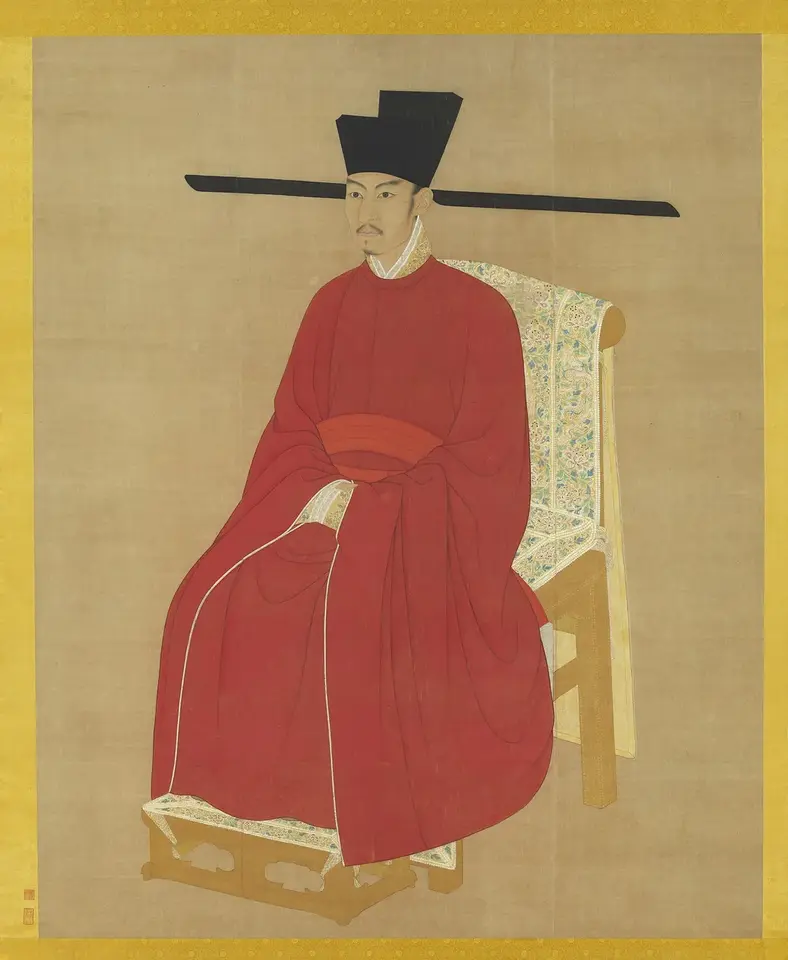
赵煦
Emperor Zhezong (赵煦, January 4, 1077 – February 23, 1100), originally named Zhao Yong (赵佣), was the seventh monarch of the Northern Song Dynasty, ruling from 1085 until his untimely death in 1100. The sixth son of Emperor Shenzong and Empress Qincheng, he ascended the throne at age nine under the regency of his grandmother, Grand Empress Dowager Gao (Empress Xuanren). During the Yuanyou era (1086–1093), Grand Empress Dowager…
Emperor Zhezong (赵煦, January 4, 1077 – February 23, 1100), originally named Zhao Yong (赵佣), was the seventh monarch of the Northern Song Dynasty, ruling from 1085 until his untimely death in 1100. The sixth son of Emperor Shenzong and Empress Qincheng, he ascended the throne at age nine under the regency of his grandmother, Grand Empress Dowager Gao (Empress Xuanren). During the Yuanyou era (1086–1093), Grand Empress Dowager Gao and Conservative chancellor Sima Guang dismantled the New Policies of Wang Anshi in what historians termed the Yuanyou Restoration, marginalizing the Reformist faction and triggering bitter factional strife between the Luoyang, Shu, and Shuo factions while leaving the young emperor politically isolated. Following Grand Empress Dowager Gao's death in 1093, the seventeen-year-old Emperor Zhezong assumed direct personal rule. Determined to realize his father's vision of state wealth and military power, he proclaimed the Shaosheng reign (1094–1098), recalled Reformist leaders Zhang Dun, Zeng Bu, and Cai Bian to power, and fully reinstated the New Policies, including the Hired Service Act and Green Sprouts Law. In foreign policy, Zhezong abandoned defensive appeasement toward Western Xia, dispatching commanders Zhang Jie and Wang Hou to construct advance fortifications along the frontier. Song forces won the decisive Battle of Pingxia City against Western Xia's thirty-thousand-strong host and reconquered the Hehuang region from Tibetan chieftains. However, his direct reign was marred by vengeful purges against Yuanyou officials and the controversial deposition of Empress Meng. Dying without male heirs in 1100 at age twenty-four, he was succeeded by his younger brother Emperor Huizong.
Born in the Kaifeng palace on January 4 as the sixth son of Emperor Shenzong.
Appointed Military Commissioner of Zhangwu and elevated to Prince of Yan'an.
Crowned emperor at age nine upon Shenzong's death; Grand Empress Dowager Gao assumed regency.
Sima Guang appointed chancellor; New Policies dismantled amidst internal Conservative factionalism.
Grand Empress Dowager Gao died in autumn; Emperor Zhezong assumed personal governance.
Promulgated the Shaosheng era, appointed Zhang Dun as chancellor, and reinstated the New Policies.
Deposed Empress Meng on witchcraft charges and banished her to Yaohua Palace as a Daoist nun.
General Zhang Jie fortified Pingxia City, crushing Western Xia's army and forcing the Tanguts to sue for peace.
Song armies captured Miaochuan and Zongge, pacifying Tibetan tribes across the Hehuang corridor.
Died of severe illness at Funing Palace on February 23 at age twenty-four; buried in the Yongtai Mausoleum.
Emperor Zhezong was born on January 4, 1077, in the inner palace of Bianjing (modern Kaifeng, Henan). His father was Emperor Shenzong, who spearheaded the New Policies, and his mother was Consort Zhu (later honored as Empress Qincheng). Although ranked as Shenzong's sixth son, the premature deaths of his five elder brothers made Zhao Yong the eldest surviving prince. He received careful classical instruction in childhood, earning the deep affection of his grandmother, Grand Empress Dowager Gao.
In the twelfth month of 1076, Shenzong granted him the personal name Zhao Yong, along with nominal titles of defender-in-chief and military commissioner of Tianping, enfeoffing him as Duke of Jun. In 1082, he was elevated to Prince of Yan'an. In the spring of 1084, Shenzong hosted an imperial banquet at the Jiying Palace and commanded the eight-year-old prince to stand beside the imperial throne. Senior ministers, including Chancellor Wang Gui, marveled at the young prince's composed bearing and royal dignity.
By the winter of 1084, Emperor Shenzong fell critically ill from chronic exhaustion. In the second month of 1085, as Shenzong lay speechless on his sickbed, palace rumors suggested that ministers Cai Que and Xing Shu favored enthroning Shenzong's adult brothers, Prince of Yong or Prince of Cao. Chancellor Wang Gui led senior councilors to the imperial bedside, insisting on primogeniture succession and petitioning for Grand Empress Dowager Gao to co-administer state affairs. Shenzong repeatedly nodded his consent. On March 1, 1085, Shenzong issued a decree naming Zhao Yong as crown prince and renaming him Zhao Xu. Four days later, Shenzong died, and the nine-year-old prince was enthroned as Emperor Zhezong.
Following Zhezong's accession, Grand Empress Dowager Gao governed as regent behind an imperial screen. Hailing from an illustrious military lineage, Empress Dowager Gao had opposed Wang Anshi's reforms throughout Shenzong's reign. She immediately summoned Conservative leader Sima Guang and Lu Gongzhu to the capital, appointing Sima Guang as chancellor and systematically repealing the New Policies.
Within months, Sima Guang abolished the Fair Tax Law, Market Exchange Law, and Equine Administration System. In 1086, Sima Guang decreed the abolition of the Hired Service Act within one hundred days, reinstating archaic corvee duties despite warnings from fellow Conservatives Fan Chunren and Su Shi. Green Sprouts loans were banned, and Reformist leaders Zhang Dun and Zeng Bu were demoted to provincial postings. Octogenarian statesman Wen Yanbo emerged from retirement to serve as senior military advisor. Following Sima Guang's death in late 1086, Lu Gongzhu and Lu Dafang maintained the Conservative course.
Concurrently, the Conservative coalition fractured into warring regional factions: the Luoyang faction under Cheng Yi, the Shu faction under Su Shi and Su Zhe, and the Shuo faction under Liu Zhi, Liang Tao, and Wang Yansou. Their mutual recriminations paralyzed the imperial bureaucracy.
Throughout the eight-year Yuanyou regency, Emperor Zhezong was excluded from administrative authority. Ministers addressed their petitions exclusively to the empress dowager's screen, ignoring the young monarch seated on the throne. When Empress Dowager Gao asked why he remained silent in court, Zhezong curtly replied: "The Empress Dowager has already decided everything; why should I speak?" Court ministers also repeatedly slighted Zhezong's biological mother, Consort Zhu, by refusing to grant her appropriate imperial status, fostering deep resentment within the young emperor.
In the autumn of 1093, Grand Empress Dowager Gao fell critically ill. Aware of Zhezong's suppressed anger, she summoned Chancellors Lu Dafang and Fan Chunren to her deathbed, warning that the young emperor would overturn their policies and advising them to retire to avoid political retribution. She died days later.
Seventeen-year-old Emperor Zhezong immediately seized direct control of the government. Deeply attached to his father's memory, Zhezong had preserved Shenzong's battered writing desk in his private quarters, refusing replacements because it was his father's relic. As soon as mourning protocols concluded, Zhezong recalled the exiled Reformist leadership to Kaifeng.
In early 1094, Zhang Dun was appointed senior chancellor, with Cai Bian serving as vice military affairs commissioner and Zeng Bu entering the Hanlin Academy. In April 1094, Zhezong proclaimed the Shaosheng reign era, formally committing his administration to continuing Shenzong's reforms. The New Policies were reinstated, including the Hired Service Act, Green Sprouts Law, and Mutual Responsibility System (Baojia), while Wang Anshi was posthumously reinstated with the highest imperial honors and enshrined in Shenzong's ancestral temple.
The Shaosheng era soon degenerated into vengeful factional warfare. Driven by Zhezong's resentment against his Yuanyou handlers, Chancellor Zhang Dun established the Judicial Review Bureau (Suli Suo) to prosecute Conservative officials. Over eight hundred literati households suffered demotion and exile.
Deceased chancellors Sima Guang and Lu Gongzhu were posthumously stripped of their noble ranks, and their imperial epitaphs were defaced. Exiled leaders Lu Dafang, Liu Zhi, and Liang Tao died in distant provincial outposts, while literary giants Su Shi and Su Zhe were banished to Hainan and Leizhou. The court even used the imperial examinations to enforce ideological conformity, requiring candidates to denounce Yuanyou policies in their essays. Zhang Dun even advocated desecrating Sima Guang's tomb, which Zhezong rejected on ethical grounds following Zeng Bu's intervention.
Factional strife spilled into the inner palace. In 1092, Empress Dowager Gao had selected Lady Meng, a highborn woman with Conservative ties, as Zhezong's empress. Zhezong favored Consort Liu, an accomplished and ambitious court lady who openly defied the empress. In 1096, when Empress Meng's daughter fell ill and Daoist talismans were employed, Consort Liu and eunuch Hao Sui accused the empress of practicing sorcery against the emperor. Thirty palace attendants were tortured into confessions, and Zhezong deposed Empress Meng, expelling her to Yaohua Palace as a Daoist nun. In 1099, Consort Liu was consecrated as empress, sparking widespread moral outrage and protest among remonstrance officials.
In external affairs, Emperor Zhezong reversed the appeasement policies of the Yuanyou era, which had surrendered strategic border fortresses to Western Xia. Zhezong appointed Zhang Jie as military commissioner of Jingyuan Circuit, adopting an aggressive forward-fortification strategy that constricted Tangut cavalry maneuvering.
In the autumn of 1096, Empress Dowager Liang of Western Xia launched an invasion with fifty thousand troops against Jinming Fortress. Zhang Jie lured the Tangut army deep into Song territory, where General Zhe Keshi ambushed their retreating columns at Hongde City, inflicting severe casualties.
In the spring of 1097, Zhang Jie directed Zhe Keshi and Guo Cheng to advance into the Hulu River valley and construct Pingxia City at the mouth of Moyan Gorge, severing Western Xia's primary invasion route. In the tenth month of 1098, Empress Dowager Liang mobilized thirty thousand elite Tangut warriors to besiege Pingxia City. General Guo Cheng held the ramparts against overwhelming assaults, while Zhang Jie coordinated relieving armies to execute night ambushes against the Tangut headquarters. Song forces annihilated the Tangut army, capturing grand commanders Weiming Amai and Meile Dubu. The catastrophic defeat broke Western Xia's military strength, compelling the Tangut court to dispatch peace envoys to Kaifeng to acknowledge Song suzerainty.
Building upon the Pingxia victory, Emperor Zhezong directed his armies westward to complete Shenzong's annexation of the Hehuang corridor, which severed Tangut communication with Tibetan horse-breeders. In the summer of 1099, Song generals Wang Shan and Wang Hou captured Miaochuan and Zongge, accepting the surrender of Tibetan chieftain Xiazheng. In September, Wang Shan entered Qingtang City, bringing the entire region under Song civilian administration as Shanzhou and Huangzhou.
Song military prestige resonated across Eastern and Central Asia. The Goryeo Dynasty dispatched tribute missions and sent students to compete in Song imperial examinations, while Khotan, the Abbasid Caliphate, and the Karakhanids sent embassies to present thoroughbred warhorses and tribute, praising Zhezong's imperial hegemony.
The physical toll of frontier campaigns, coupled with long-standing respiratory ailments, steadily eroded Zhezong's health. In the autumn of 1099, the newborn crown prince Zhao Mao and his infant sister Princess Yang died within days of each other. Shattered by grief, Zhezong suffered recurring hemorrhages and became bedridden.
By the first month of 1100, the emperor was unable to hold court audiences. On February 23, 1100, Emperor Zhezong died at Funing Palace at age twenty-four. Lacking male issue, he was succeeded by his half-brother Zhao Ji, who reigned as Emperor Huizong. He was buried in the Yongtai Mausoleum in Gongxian, Henan.
Upon assuming personal rule, Emperor Zhezong reinstated Wang Anshi's New Policies, including the Hired Service Act, Green Sprouts Law, and Mutual Responsibility System. The administration refined regulatory statutes based on Shenzong's experiences, eliminating predatory collection practices and replenishing dynastic grain reserves and treasury coffers to support extensive northwestern military campaigns.
Zhezong replaced defensive appeasement with offensive fortification along the northwestern frontier. By advancing into Tangut territory and constructing Pingxia City, Song forces compelled Western Xia into costly siege warfare. The crushing victory at Pingxia City in 1098 decimated Tangut elite cavalry, forcing Western Xia to acknowledge Song authority and securing northern border security.
Capitalizing on tribal divisions among Tibetan clans, Zhezong launched the Hehuang offensive in 1099. Song forces captured Miaochuan and Qingtang, establishing permanent prefectures at Shanzhou and Huangzhou. This conquest neutralized Western Xia's southern flank and reestablished direct Song authority over the ancestral Silk Road corridors.
The primary institutional failing of Zhezong's reign was the institutionalization of punitive factional retribution. Through the Judicial Review Bureau, the Shaosheng administration purged hundreds of Conservative officials and desecrated the memory of respected ministers like Sima Guang. Coupled with the wrongful deposition of Empress Meng, this factional purge destroyed political consensus within the scholar-official elite, paving the way for the destructive ascendancy of Cai Jing during Huizong's subsequent reign.
FIGURES ASSOCIATED WITH THIS DYNASTY