Birth in Taiyuan
Born into the prominent Wen clan of Qi County, as a descendant of early Tang Chancellor Wen Yanbo.
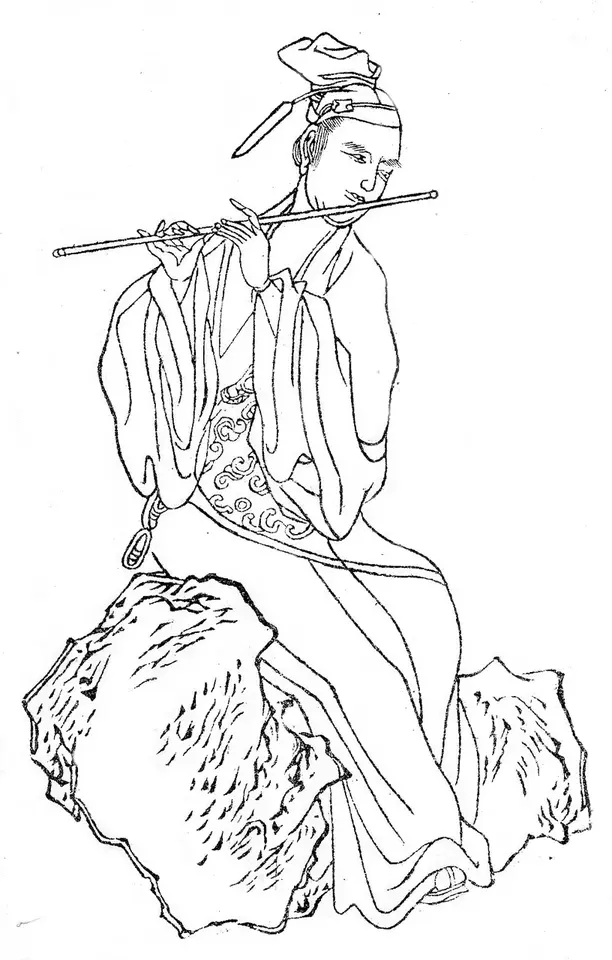
温庭筠
Wen Tingyun (c. 812 – c. 866), originally named Wen Qi and styled Feiqing, was a native of Qi County, Taiyuan (present-day Qi County, Shanxi Province). A descendant of Chancellor Wen Yanbo from the early Tang Dynasty, he was a celebrated late Tang literary master, poet, and lyricist. Recognized as the first literatus in Chinese literary history to dedicate himself systematically to composing lyrics to set musical melodies…
Wen Tingyun (c. 812 – c. 866), originally named Wen Qi and styled Feiqing, was a native of Qi County, Taiyuan (present-day Qi County, Shanxi Province). A descendant of Chancellor Wen Yanbo from the early Tang Dynasty, he was a celebrated late Tang literary master, poet, and lyricist. Recognized as the first literatus in Chinese literary history to dedicate himself systematically to composing lyrics to set musical melodies (Yisheng Tianci), he is revered by posterity as the founding patriarch of the Huajian (Among the Flowers) school of ci poetry. Wen Tingyun possessed astonishing literary agility: according to contemporary legend, he could compose an eight-rhyme poem after folding his hands merely eight times during examination sessions, earning him the moniker 'Wen of Eight Folds' (Wen Bacha); because of his striking and ungainly facial appearance, contemporaries also playfully dubbed him 'Wen Zhongkui.' Having lost his father in childhood, Wen Tingyun was sheltered by his father's close friend Duan Wenchang, migrating between provincial military headquarters and forming a lifelong friendship with Duan Chengshi. Upon reaching adulthood, his literary brilliance shone brightly across poetry, ci lyrics, and parallel prose, yet his proud, uninhibited temperament and disdain for bureaucratic hypocrisy entangled him in a tragic official career. He repeatedly sat for the imperial examinations without success, and provoked the wrath of conservative examiners and court officials by acting as a clandestine examination surrogate ('ghostwriter') for impoverished scholars in the civil service examinations. During the Dazhong and Xiantong eras, he satirized Chancellor Linghu Tao and other high ministers, enduring constant political ostracism and demotions to low-ranking posts as Defender of Suixian, patrol officer in Xiangyang, National University Teaching Assistant, and Defender of Fangcheng. He died in impoverished obscurity around 866. In Chinese literary history, Wen Tingyun occupies an epochal bridging position. He pioneered the literati transformation of popular song lyrics into a sophisticated, self-conscious artistic medium. When Zhao Chongzuo compiled the earliest surviving anthology of literati ci poetry, Among the Flowers (Huajian ji), in the Later Shu Dynasty, Wen Tingyun's sixty-six lyrics were placed at the very head of the collection. His ornate, delicate, and deeply expressive lyric style established the thousand-year tradition of graceful and restrained (Wanyue) lyrics, exerting a transformative influence on poets such as Feng Yanji, Li Yu, Yan Shu, and Li Qingzhao. In shi poetry, he stood shoulder to shoulder with Li Shangyin under the collective designation 'Wen-Li,' with masterpieces like Early Travel in the Shang Mountains (Shangshan Zaoxing) becoming immortal classics. In parallel prose, he formed the famed 'Thirty-Six Style' alongside Li Shangyin and Duan Chengshi.
Born into the prominent Wen clan of Qi County, as a descendant of early Tang Chancellor Wen Yanbo.
Father passed away prematurely; four siblings were raised amidst poverty by their mother.
Sheltered by father's close friend Duan Wenchang; studied alongside Duan Chengshi.
Traveled to Chang'an to take the imperial examination; failed, beginning decades of itinerant travels.
Failed the exams again; caroused in Chang'an with aristocratic youths such as Linghu Hao and Pei Xian.
Composed Bodhisattva Barbarian lyrics for Linghu Tao; satirized the chancellor's lack of scholarship, causing estrangement.
Separated by examiner Shen Xun to prevent cheating; managed to secretly complete exams for eight candidates.
Banished from the capital to serve as Defender of Suixian following accusations of disorderly conduct.
Left Suixian to join Xu Shang's regional military headquarters in Xiangyang as a patrol officer.
Recommended by Xu Shang to return to Chang'an as National University Teaching Assistant.
Posted examination papers publicly at the academy gates to expose official corruption; demoted to Fangcheng.
Passed away in poverty and neglect while traveling near Fangcheng, aged approximately fifty-four.
Wen Tingyun descended from the illustrious Wen clan of Qi County, Taiyuan, tracing his lineage to Wen Yanbo, Chancellor to Emperor Taizong during the Zhenguan era. By the middle and late Tang Dynasty, however, the clan's political standing had declined precipitously into austere poverty. Wen Tingyun was born in Taiyuan around 812 (7th year of the Yuanhe era). In 820, when Wen Tingyun was merely nine years old, his father died prematurely, leaving his mother and four children in severe hardship.
In 824, Duan Wenchang, an esteemed former chancellor and close friend of his late father, was recalled to Chang'an as Minister of Punishments. Taking pity on the orphaned family, Duan Wenchang took Wen Tingyun into his household at Duling outside Chang'an to be educated alongside his own son, Duan Chengshi. As Duan Wenchang was subsequently posted to govern military circuits in Huainan and Jingnan, Wen Tingyun accompanied the family between Yangzhou and Jiangling. During these formative years, Wen Tingyun and Duan Chengshi formed an unbreakable intellectual brotherhood, devouring classical literature and poetry. This itinerant youth exposed Wen Tingyun to the refined elegance of regional military courts, nurturing the opulent aesthetic of his later lyrics.
Around 838 (3rd year of the Kaicheng era), Wen Tingyun moved to the imperial capital Chang'an to pursue bureaucratic advancement through the civil service examinations. Endowed with extraordinary musical intuition and swift eloquence, he could produce an eight-rhyme regulated verse without drafting, merely folding his hands eight times in contemplation, earning the celebrated nickname 'Wen of Eight Folds' (Wen Bacha), as well as 'Wen of Eight Chants' (Wen Bayin) for dictating completed essays without pause. However, his proud, irreverent demeanor and penchant for taverns and singing quarters alienated conservative court officials.
In the autumn of 839, Wen Tingyun sat for the metropolitan examinations in Chang'an but failed. The following autumn, while traveling through the Jiang-Huai region, he suffered verbal humiliation from maternal relatives, prompting him to change his birth name Wen Qi to Wen Tingyun. Over subsequent years, he traveled between Chang'an, Luoyang, and Huainan, presenting poetry portfolios to high dignitaries, yet consistently failed to pass the examinations. Following another failure in 847, Wen Tingyun grew deeply disillusioned with the corrupt favoritism of the imperial examination system. In an act of defiant rebellion, he began employing his rapid compositional skills to act as a clandestine examination surrogate ('ghostwriter') for impoverished examination candidates.
In the winter of 850, Linghu Tao was appointed Chancellor. Linghu Tao's father Linghu Chu had been an associate of Wen Tingyun's father, and Linghu Tao's son Linghu Hao was a drinking companion of Wen Tingyun in Chang'an. When Emperor Xuanzong developed a passion for musical ci lyrics set to the tune Bodhisattva Barbarian (Pusa Man), Linghu Tao, lacking poetic talent, secretly commissioned Wen Tingyun to ghostwrite twenty lyrics to present to the throne as his own, strictly ordering Wen Tingyun never to disclose the deception. However, Wen Tingyun casually leaked the secret to his literary circle, severely wounding Linghu Tao's pride.
Shortly thereafter, Emperor Xuanzong composed a verse featuring the phrase 'golden step-shaker' (Jin Buyao) and sought an appropriate poetic match. Wen Tingyun immediately supplied 'jade armlet' (Yu Tiaotuo), which delighted the emperor. When Linghu Tao subsequently asked where the phrase 'jade armlet' originated, Wen Tingyun answered that it came from the Zhuangzi (Nan Hua Jing), insolently adding: 'The Nan Hua Jing is hardly an obscure text; when the Chancellor has leisure from state affairs, it would do well for you to read a few ancient books!' Furthermore, Wen Tingyun publicly mocked the Grand Secretariat, remarking that 'a general sits within the Secretariat,' insinuating that the chancellor was an uneducated soldier. Enraged by these repeated insults, Linghu Tao severed all patronage and covertly instructed examination officials to ensure Wen Tingyun would never pass the examinations.
In the spring of 855 (9th year of Dazhong), the imperial court conducted a new round of civil examinations. The chief examiner Shen Xun, well aware of Wen Tingyun's notorious reputation as an examination surrogate, arranged a solitary desk directly beneath his private inspection curtain to monitor the poet's every move. Undeterred, Wen Tingyun casually drafted a brilliant thousand-word essay and submitted his paper early. To the astonished fury of the examiners, it was subsequently discovered that while under direct surveillance, Wen Tingyun had whispered answers, thrown folded notes, and exchanged papers, secretly completing examinations for eight separate candidates—an exploit celebrated throughout the capital as 'Wen of Eight Folds Saves Eight Men.'
This unprecedented scandal infuriated the central government. Linghu Tao and senior ministers branded Wen Tingyun a subversive agitator lacking personal virtue, formally barring him from ever sitting for future examinations. In 858, following an incident where Wen Tingyun allegedly drunkenly insulted municipal patrolling officers in Chang'an, the imperial censorate impeached him, and Emperor Xuanzong banished him from the capital to serve as Defender of Suixian in remote Suizhou.
In 859, Emperor Xuanzong passed away and Emperor Yizong succeeded the throne. Unable to endure the tedious provincial duties in Suixian, Wen Tingyun abandoned his post and sailed along the Han River to Jiangling. At this juncture, the prominent statesman Xu Shang was dispatched to govern the Shannan East Circuit, establishing his headquarters at Xiangyang. Deeply admiring Wen Tingyun's literary gifts, Xu Shang appointed him as a circuit patrol officer (Xunguan) with the concurrent central title of Examining Vice Director (Jianjiao Yuanwailang).
In Xiangyang, Wen Tingyun received generous hospitality, spending his days composing poetry on the landscapes of the Han River basin. He engaged in extensive poetic exchanges with his lifelong friend Duan Chengshi, Yu Zhigu, and Wei Chan, compiling the ten-volume anthology Collection of Joined Robes on the Han River (Hanshang Tijin Ji). During this period, Wen Tingyun cemented his friendship with Duan Chengshi by marrying his daughter to Duan's son Duan Anjie, the future musicologist. In 860, when Xu Shang was recalled to the capital, Wen Tingyun departed Xiangyang and traveled between Jiangling and Yangzhou. In 863, while passing through Guangling, Wen Tingyun was assaulted by local patrol officers, losing several teeth. When he appealed to Linghu Tao, then military governor of Huainan, the chancellor dismissed the charges out of lingering enmity, forcing Wen Tingyun to travel injured to Chang'an to submit memorials vindicating his honor.
In 863, with Xu Shang serving as Chancellor, Wen Tingyun was appointed National University Teaching Assistant (Guozi Zhujiao). Although a low-ranking scholarly post of the secondary eighth rank, this position allowed Wen Tingyun to mentor imperial academy students in poetry and composition. In 865, Wen Tingyun was assigned to preside over the autumn selection examinations for academy scholars. Determined to eliminate corrupt nepotism, Wen Tingyun flatly refused all private solicitations from high-ranking ministers, evaluating candidate papers strictly according to literary merit.
Moreover, in an unprecedented move, Wen Tingyun posted all the outstanding student essays alongside his detailed annotations publicly on the academy gates for all capital scholars to inspect, composing Posting at the National Academy (Bang Guozi Jian) to expose behind-the-scenes manipulation. This transparent action enraged Chancellor Yang Shou and the Ministry of Rites. Accused of inciting public unrest, Wen Tingyun was summarily banished from Chang'an at the end of 865, demoted to Defender of Fangcheng in Dengzhou. In early 866, aged over fifty and broken by illness and decades of persecution, Wen Tingyun died in poverty and neglect while traveling near Fangcheng.
During his intermittent stays in Chang'an, Wen Tingyun frequented the entertainment quarters, where he encountered Yu Yaowei (later known as the Daoist poetess Yu Xuanji). Following her father's death, the eleven-year-old girl and her mother survived by doing laundry for brothels in Pingkang Ward. Recognizing her extraordinary intellect and literary talent, Wen Tingyun took her as a student, patiently instructing her in regulated verse meter, rhyme schemes, and tonal euphony while subsidizing her family's livelihood from his modest earnings. Under his guidance, she rapidly blossomed into one of the capital's foremost female poets.
When Wen Tingyun departed Chang'an for Xiangyang, Yu Yaowei sent him numerous poems expressing deep affection. Upholding moral boundaries as her teacher while recognizing his own precarious career, Wen Tingyun gently deflected her romantic overtures and introduced her as a concubine to Li Yi, a young noble and newly minted top examination graduate (Zhuangyuan). Although Yu Xuanji's life subsequently unraveled due to domestic mistreatment and tragic legal scandal, Wen Tingyun's early mentorship played an indispensable role in cultivating one of the most distinctive female literary voices of the late Tang period.
Wen Tingyun's most celebrated achievement in Chinese literary history was his pivotal role in elevating the emerging ci lyric from popular song into a sophisticated literati art form, becoming the first literary figure to devote himself systematically to composing lyrics to set musical tunes (Yisheng Tianci). Before his time, song lyrics flourished primarily among courtesans and tavern performers. Wen Tingyun integrated exquisite musical sensitivity with classical poetic craftsmanship, expanding the expressive capacity of the ci genre.
When Zhao Chongzuo compiled the landmark anthology Among the Flowers (Huajian ji) in 940, Wen Tingyun's sixty-six lyrics were placed at the very head of the collection. Masterpieces such as Bodhisattva Barbarian (Pusa Man), Water Clock at Night (Genglou Zi), and Dreaming of the South (Meng Jiangnan) established the classic aesthetic paradigms of boudoir yearning, sorrow of separation, and delicate psychological introspection. His richly textured imagery, vibrant visual palettes, and emotional restraint earned him revered recognition as the founding patriarch of the Huajian school, providing the stylistic blueprint for the Southern Tang masters Feng Yanji and Li Yu, as well as Song masters Yan Shu, Ouyang Xiu, and Li Qingzhao.
Wen Tingyun's ci lyrics encompass two complementary yet distinct aesthetic modes. The first is an ornate, densely layered, and richly colored style exemplified by his Bodhisattva Barbarian suite, characterized by lavish descriptions of brocades, mirrors, and gilded hairpins that subtly reflect inner melancholy. The second is a lucid, flowing, and emotionally transparent style seen in lyrics like Dreaming of the South and Water Clock at Night, marked by conversational clarity and musical rhythm.
Exploiting his mastery of musical instrumentation and familiarity with folk and court tunes, Wen Tingyun meticulously disciplined the emerging genre's metrical structures. He harmonized textual tonal pitch with musical melodic intervals, standardizing rhyme placements and rhythmic cadences for popular tunes. This metrical discipline provided the formal framework that allowed the ci form to evolve from ephemeral banquet songs into an enduring classical genre.
In classical shi poetry, Wen Tingyun stood alongside Li Shangyin as the twin titans of late Tang verse, celebrated in literary history as 'Wen-Li.' Over 310 of his poems survive, spanning regulated verse, quatrains, and ancient-style ballads. His poetry is characterized by dazzling imagery, resonant musicality, and a poignant fusion of personal melancholy with deep foreboding over the decline of the Tang empire.
His poetic oeuvre is organized around three major thematic pillars: political frustration and ambition (Inscribing on a Friend's Wall), the hardships of travel and landscape observation (Early Travel in the Shang Mountains), and historical meditation (Visiting the Tomb of Chen Lin, The Temple of Su Wu). His five-character regulated poem Early Travel in the Shang Mountains, featuring the immortal couplet 'Rooster crow, the thatch inn moon; / Footprints, the wooden bridge frost,' pioneered the technique of juxtaposing purely concrete nouns to evoke atmospheric solitude, celebrated across centuries as an unrivaled masterpiece of Chinese landscape poetics.
Wen Tingyun achieved distinction in yuefu ballads, with approximately one-sixth of his extant poetry falling into this category. He inherited the realism of the Han-Wei folk ballads and the New Yuefu movement of Yuan Zhen and Bai Juyi, while transforming their didactic directness into intricate artistic allegories. He softened explicit political critique, infusing historical narratives with evocative musicality and emotional ambiguity.
In celebrated ballads such as Song of the Brocade City (Jincheng Qu) and Ballad of the Reed Flute (Bili Ge), Wen Tingyun utilized historical allegories from the Han and Six Dynasties to critique contemporary late Tang political decay. His accomplishments in the yuefu genre were so pronounced that later literary scholars ranked him alongside Li Bai, Du Fu, and Bai Juyi as one of the 'Four Great Yuefu Masters of the Tang.'
In addition to poetry and lyrics, Wen Tingyun was a leading exponent of late Tang parallel prose (Pianwen). Following the ancient-style prose (Guwen) revival led by Han Yu and Liu Zongyuan, parallel prose experienced an artistic renaissance in the late Tang, developing into an ornate style characterized by strict four-and-six character phrasing, intricate antithesis, and sophisticated allusions.
Because Wen Tingyun, Li Shangyin, and Duan Chengshi were each the sixteenth child in their respective family generational cohorts, their shared artistic brilliance in parallel prose was celebrated by contemporaries as the 'Thirty-Six Style' (Sanshiliu Ti). Wen Tingyun's surviving parallel prose works—including Posting at the National Academy, Rhapsody on the Reborn Cypress, and over twenty memorials addressed to chancellors—display extraordinary rhetorical dexterity, rhythmic resonance, and trenchant political critique, standing alongside Li Shangyin's Fannan Anthology as the artistic summit of late Tang parallel prose.
Wen Tingyun's legendary exploits as an examination surrogate and his public defiance of bureaucratic examiners represented a profound cultural protest against the corrupt aristocratic monopoly over the civil service examinations. In the late Tang, high-ranking ministerial lineages routinely manipulated examination results through pre-arranged recommendations, leaving talented commoner scholars with little hope of advancement.
Disgusted by this systemic corruption, Wen Tingyun utilized his exceptional speed to write exams for impoverished candidates during the 855 examination scandal, disrupting the capital bureaucracy. During his tenure as National University Teaching Assistant in 865, he rejected all private appeals from chancellors and posted the top examination papers on the academy gates in Posting at the National Academy, demanding that grading be subjected to open public scrutiny. His willingness to sacrifice his personal official career to champion meritocracy cemented his reputation as an uncompromising defender of academic integrity.
In narrative fiction, Wen Tingyun authored Qianxunzi, an influential three-volume collection of classical tales (Chuanqi) recorded in the bibliographic treatises of the New Book of Tang and the History of Song. While the original text was lost, over thirty tales survive in the Northern Song encyclopedia Taiping Guangji, detailing contemporary anecdotes, supernatural occurrences, and urban street life.
His tale Dou Yi is an extraordinary work in classical Chinese fiction, meticulously recounting the commercial rise of a resourceful Tang merchant who accumulated colossal wealth through astute market timing, real estate speculation, and waste recycling in urban Chang'an. Qianxunzi played a crucial role in shifting Tang fiction away from mythical ghost stories toward realistic depictions of urban commerce and secular society, providing modern historians with invaluable primary evidence regarding late Tang urban economics and social customs.
Wen Tingyun's scholarly repertoire extended well beyond literary composition into encyclopedic scholarship and the fine arts. According to the New Book of Tang, he authored Record of Tea Harvesting (Caicha Lu), an important treatise on tea cultivation and brewing techniques that updated Lu Yu's Classic of Tea. He also compiled the ten-volume encyclopedia Sea of Learning (Xuehai), organizing vast classical commentaries and historical allusions.
In calligraphy, Wen Tingyun excelled in standard, running, and cursive scripts. In his Huashanshi Suibi, the late Ming calligrapher Dong Qichang praised Wen Tingyun's manuscript Huyin Qu, observing that his brushwork inherited the monumental strength of Yan Zhenqing while possessing graceful elegance, noting that Song master Mi Fu had modeled his brush technique after Wen Tingyun. These wide-ranging accomplishments illuminate Wen Tingyun's stature as a universal cultural luminary of the late Tang period.
In the Old Book of Tang (Jiu Tang Shu), biographers recorded: "Wen Tingyun possessed rapid intellect; each time he entered an examination, he composed a rhymed rhapsody with merely eight hand-folds, known to contemporaries as 'Wen of Eight Folds.' Yet his conduct was unconstrained and unpolished, pursuing musical sounds and composing ornate lyrics. Under Emperor Xuanzong, Chancellor Linghu Tao, deficient in scholarship, secretly summoned him to ghostwrite lyrics, which Tingyun casually revealed to the public, incurring Tao's bitter embarrassment and wrath. Consequently, he languished in minor provincial posts for life, dying in Fangcheng during the Xiantong era."
The Song Dynasty literary critic Huang Sheng remarked in Hua'an Cixuan: "Wen Tingyun's ci lyrics are supremely fluid and beautiful, rightfully crowning the collection Among the Flowers."
In the Qing Dynasty, Chen Tingzhuo praised in Baiyuzhai Cihua: "Feiqing's lyrics are exceptionally gorgeous, yet their underlying meaning is profound and their structural bones are resolute. Throughout the entire Tang Dynasty, no lyricist surpassed Feiqing; he is truly the leader of an entire generation. That Among the Flowers crowns him across myriad generations is no empty title."
Wang Guowei famously observed in Poetic Remarks on the Human World (Renjian Cihua): "'On the painted screen, golden partridges' is Feiqing's verse, and his poetic quality reflects this aesthetic."
The modern historian Fan Wenlan summarized: "Li Shangyin was the concluder of the old poetic tradition; Wen Tingyun was the pioneer of the new literary trend."
Modern literary historians regard Wen Tingyun as an extraordinary genius and a tragic archetype of the declining Tang world. He inaugurated the literati era of Chinese song lyrics while leaving enduring monuments in shi poetry and parallel prose. However, his unyielding intellectual integrity clashed violently with the suffocating bureaucracy of late Tang court politics, leaving him to die in impoverished exile—an enduring historical embodiment of the tension between literary brilliance and political misfortune.
FIGURES ASSOCIATED WITH THIS DYNASTY