Birth on the Steppe
Born in February on the Mongolian Plateau, the eldest son of Hulagu Khan.
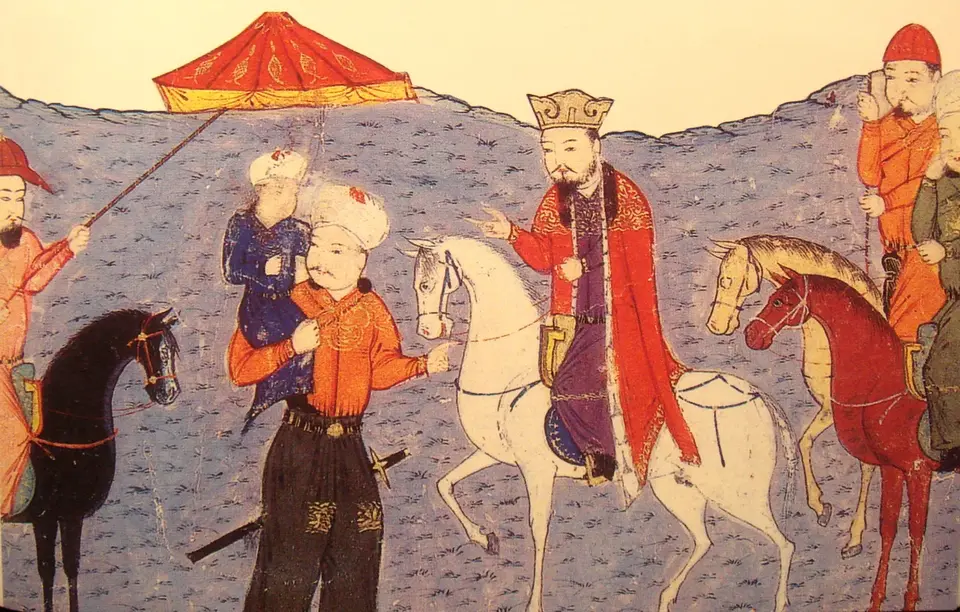
阿八哈
Borjigin Abaqa (February 1234 – April 1, 1282) was an imperial prince of the Mongol Empire and the second Ilkhan of the Ilkhanate, reigning from 1265 to 1282. He was the eldest son of Hulagu Khan, the founder of the Ilkhanate, a great-grandson of Genghis Khan, and a grandson of Tolui. Endowed with martial courage and strategic acumen from youth, Abaqa accompanied his father during the third major Mongol western expedition…
Borjigin Abaqa (February 1234 – April 1, 1282) was an imperial prince of the Mongol Empire and the second Ilkhan of the Ilkhanate, reigning from 1265 to 1282. He was the eldest son of Hulagu Khan, the founder of the Ilkhanate, a great-grandson of Genghis Khan, and a grandson of Tolui. Endowed with martial courage and strategic acumen from youth, Abaqa accompanied his father during the third major Mongol western expedition into West Asia, participating in the destruction of the Abbasid Caliphate at Baghdad and subsequently receiving the governorship of the vital eastern frontier territories of Khorasan and Mazandaran. Following Hulagu Khan's death in 1265, Abaqa was acclaimed Ilkhan by the imperial assembly; Kublai Khan dispatched imperial envoys to formally invest him as the "Ruler of Persia" (Bosi Guozhu), granting imperial jade and golden seals that anchored the Ilkhanate's status within the Yuan imperial commonwealth. Upon ascending the throne, Abaqa transferred the imperial capital to Tabriz in Azerbaijan, transforming it into a preeminent trans-Eurasian metropolis connecting Mediterranean and Silk Road commerce. Throughout his seventeen-year reign, Abaqa conducted vigorous military and diplomatic campaigns: to the north, he constructed fortifications along the Caucasus to repel repeated invasions by the Golden Horde under Berke and Mengu-Timur; to the east, he personally commanded the army to crush the invasion of Chagatai Khan Baraq at the Battle of Herat in 1270, dismantling Qaidu's coalition designs on Persia; to the west, he married Byzantine imperial princess Maria Palaiologina and dispatched numerous diplomatic missions to Rome, England, and France, pursuing the historic grand strategy of a Frank-Mongol Alliance against the Mamluk Sultanate of Egypt. Abaqa practiced Tibetan Buddhism while maintaining enlightened tolerance toward Christian denominations, influenced by his Nestorian stepmother Doquz Khatun and Eastern Orthodox wife, providing legal protections to West Asian merchants, scholars, and diverse religious communities. On April 1, 1282, Abaqa passed away suddenly at his palace in Hamadan at the age of forty-eight. His reign consolidated Mongol rule across the Iranian plateau and Mesopotamia, exerting a lasting impact on East-West connectivity and Eurasian geopolitics.
Born in February on the Mongolian Plateau, the eldest son of Hulagu Khan.
Accompanied Hulagu Khan on the third Mongol western expedition into Persia and Mesopotamia.
Participated in the siege of Baghdad and the fall of the Abbasid Caliphate; assigned to govern Khorasan.
Succeeded Hulagu Khan as the second Ilkhan; invested by Kublai Khan as the Ruler of Persia.
Established Tabriz as the imperial capital and married Byzantine princess Maria Palaiologina.
Personally commanded the army at the Battle of Herat, annihilating the invading Chagatai forces under Baraq.
Dispatched envoys to the Second Council of Lyon, proposing a joint military coalition to Pope Gregory X.
Exploited internal unrest following Baybars' death, seizing Aleppo in a renewed offensive against the Mamluks.
Dispatched his brother Mengu-Timur with eighty thousand allied troops to engage Sultan Qalawun at the Second Battle of Homs.
Died of sudden illness at Hamadan Palace on April 1 at forty-eight; succeeded by his brother Tekuder.
Borjigin Abaqa was born in February 1234 on the Mongolian Plateau. His father was Hulagu Khan, the fifth son of Tolui and grandson of Genghis Khan. Raised amidst nomadic military campaigns, Abaqa mastered mounted archery and displayed resolute strategic judgment. His stepmother, Doquz Khatun, a granddaughter of the Kereit ruler Toghrul (Wang Khan), was a devout Nestorian Christian whose influence fostered in Abaqa a cosmopolitan outlook and remarkable religious tolerance.
In 1253, Möngke Khan ordered Hulagu Khan to lead the third Mongol western campaign. As the eldest son, Abaqa accompanied his father commanding vanguard formations across Central Asia into the Middle East. He fought with distinction in the subjugation of the Nizari Ismaili state at Alamut, the siege and capture of Baghdad in 1258, and the conquest of Syria. Following the establishment of the Ilkhanate, Hulagu assigned Abaqa to govern Khorasan and Mazandaran, tasking him with defending the eastern border against incursions from the Chagatai Khanate.
In February 1265, Hulagu Khan died in Azerbaijan. Prior to his demise, Hulagu had negotiated a diplomatic alliance with Byzantine Emperor Michael VIII Palaiologos, who dispatched his illegitimate daughter Maria Palaiologina to marry the Ilkhan. When Maria arrived in Persia after a perilous voyage, Hulagu had already passed away; in accordance with Mongol levirate custom, Abaqa married Maria, cementing a strategic military partnership with Constantinople.
Four months after Hulagu's death, an imperial kurultai unanimously acclaimed Abaqa as the second Ilkhan. In Dadu, Yuan Emperor Kublai Khan dispatched imperial envoys across Eurasian trade routes to formally invest Abaqa as "Ruler of Persia," conferring Chinese jade and gold seals of state. Deeming the initial capital at Maragheh overly peripheral, Abaqa transferred the imperial seat to Tabriz in Azerbaijan in 1266. He initiated extensive building projects, erecting fortified palace complexes, commercial bazaars, and academic observatories, transforming Tabriz into the foremost hub of trans-continental trade and establishing it as the permanent capital of the Ilkhanate.
Throughout his reign, Abaqa confronted relentless military challenges on three distinct frontiers. To the north, the Golden Horde under Berke and Mengu-Timur repeatedly launched cavalry assaults across the Caucasus defiles. Abaqa fortified the Derbent pass and repeatedly routed invading armies along the Kura River, maintaining his northern border. To the east, Central Asian prince Qaidu of the House of Ögedei formed an alliance with Baraq of the Chagatai Khanate to oppose Kublai Khan and Abaqa. In 1270, Baraq led an army across the Amu Darya, devastating Herat and Nishapur.
Facing this acute threat, Abaqa marched east with the main imperial cavalry. At the Battle of Herat in July 1270, Abaqa executed a tactical feint, drawing Baraq's forces into an ambush before unleashing flank cavalry charges that annihilated the invaders. Baraq was wounded and fled to Central Asia, dying shortly thereafter. The victory shattered the coalition's eastern designs and secured the Ilkhanate's frontier. On the western front, Abaqa waged a protracted contest against the Mamluk Sultanate of Egypt. Although campaigns in Syria experienced alternating fortunes, Abaqa maintained firm control over Mesopotamia and eastern Anatolia.
In spring 1282, following the arduous campaign of the Second Battle of Homs, Abaqa traveled from Azerbaijan to his seasonal palace at Hamadan. Decades of ceaseless military campaigning had exhausted his health, compounded by chronic heavy drinking. On April 1, 1282, following a palace banquet, Abaqa died suddenly at the age of forty-eight. His brother Tekuder was acclaimed as his successor by the assembly of princes. Abaqa's seventeen-year reign consolidated the institutional foundations of the Ilkhanate and solidified its stature as a civilized Eurasian empire.
Abaqa's greatest military achievement was his decisive victory at the Battle of Herat in 1270. Following the Toluid Civil War, the Mongol Empire fractured into rival camps: Qaidu of the House of Ögedei formed a coalition with Mengu-Timur of the Golden Horde and Baraq of the Chagatai Khanate at the Talas Kurultai to dismantle the authority of Kublai Khan and his Ilkhanate allies. Baraq invaded Khorasan with tens of thousands of horsemen, threatening to dismember the eastern half of Abaqa's realm.
Steadfast in his loyalty to Kublai Khan, Abaqa marshaled his veteran divisions and advanced rapidly into Khorasan. At Herat, Abaqa stood firm against the fierce initial assault of Baraq's center, while secretly sending detachment units to encircle the enemy's rear supply lines. When the enemy panicked, Abaqa launched a crushing general counterattack, slaying thousands and capturing principal commanders. The triumph at Herat preserved Khorasan, crippled Qaidu's offensive momentum, and maintained the geopolitical supremacy of the Yuan-Ilkhanate alliance across western Asia.
Confronting the formidable Mamluk Sultanate of Egypt following the Battle of Ain Jalut, Abaqa formulated an innovative intercontinental grand strategy known as the Frank-Mongol Alliance. Recognizing that unilateral frontal campaigns against Mamluk armies in Syria were costly, Abaqa sought to coordinate military pressure with Western Christendom.
Drawing on the Christian heritage of his stepmother Doquz Khatun and his Byzantine consort Maria, Abaqa dispatched four official embassies to Rome, England, and France between 1267 and 1277. At the Second Council of Lyon in 1274, Abaqa's sixteen-member delegation was received with great honor by Pope Gregory X and assembled European monarchs. Abaqa proposed a synchronized offensive: Ilkhanate armies would strike Damascus and Aleppo from the east, while European crusader forces and the Knights Hospitaller launched amphibious landings on the Levantine coast, converging on Cairo with the promise of restoring Jerusalem to Christian custody. Although European internal divisions prevented full execution, this diplomacy permanently transformed thirteenth-century Levantine geopolitics.
In domestic administration and economic development, Abaqa demonstrated remarkable vision. Recognizing that a nomadic court could not effectively govern settled West Asian commercial civilization, he shifted the imperial center to Tabriz, a crossroads connecting Anatolia, the Caucasus, and Persia. He enacted imperial decrees protecting caravans, established royal postal stations (yam), prohibited princes from extorting merchants, and instituted standardized transit duties.
In constructing Tabriz, Abaqa welcomed Persian Muslim scholars, Armenian Christian architects, and Han Chinese craftsmen, erecting grand palaces, commercial caravanserais, and scientific institutions. Under his patronage, Tabriz emerged as the preeminent commercial hub of Eurasia, where Venetian and Genoese traders arriving via Trebizond purchased Chinese silks, porcelains, and Persian textiles, invigorating trans-continental commerce and cultural exchange during the Pax Mongolica.
FIGURES ASSOCIATED WITH THIS DYNASTY