The Westward Exodus
Accompanied Yelü Dashi and two hundred cavalry across the Gobi Desert, enduring severe hardship to establish a new empire in Central Asia.
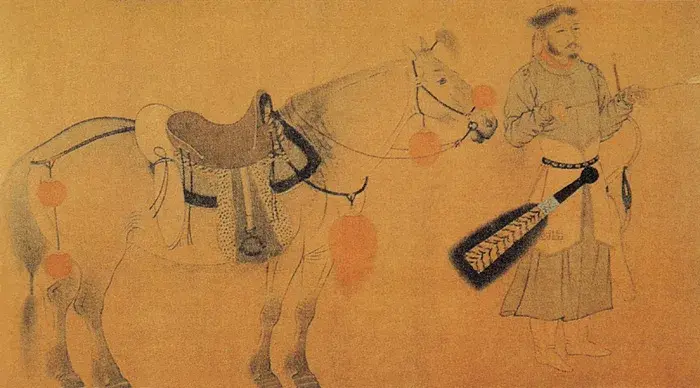
萧塔不烟
Xiao Tabuyan (萧塔不烟, ?–1150), honorifically known as Empress Gantian (and styled Emperor Gantian in Song and Jin historical texts), was the founding empress, second sovereign, and ruling empress regnant of the Western Liao (Qara Khitai) during the 12th century. Originating from the aristocratic Xiao consort lineage of the Khitan nobility, she was the principal consort of Yelü Dashi (Emperor Dezong). In 1124, as Jurchen Jin…
Xiao Tabuyan (萧塔不烟, ?–1150), honorifically known as Empress Gantian (and styled Emperor Gantian in Song and Jin historical texts), was the founding empress, second sovereign, and ruling empress regnant of the Western Liao (Qara Khitai) during the 12th century. Originating from the aristocratic Xiao consort lineage of the Khitan nobility, she was the principal consort of Yelü Dashi (Emperor Dezong). In 1124, as Jurchen Jin armies dismantled the Liao dynasty, she accompanied Yelü Dashi on his historic westward trek with two hundred mounted warriors, traversing the harsh Mongolian plateau and the Gobi Desert to lay the foundations of the Western Liao Empire in Central Asia. In 1132, following Yelü Dashi's coronation as Gurkhan at Emil, Xiao Tabuyan was formally invested as Empress. Upon Yelü Dashi's death in 1143 at the capital of Balasagun (Husi Ordo, modern Tokmok, Kyrgyzstan), Crown Prince Yelü Yilie remained in his minority. In accordance with Khitan traditions of female regency, the civil and military ministers enthroned Xiao Tabuyan to direct state affairs. She adopted the era name Xianqing and assumed the regnal title Empress Gantian. During her seven-year reign (1143–1150), she faithfully upheld Yelü Dashi's centralized administrative framework, maintaining state control over prefectural tax registries without apportioning territorial fiefs to imperial princes. She promoted sweeping religious tolerance, allowing Islam, Nestorian Christianity, Buddhism, and Manichaeism to coexist harmoniously across the empire. When emissaries from the Jin dynasty traveled to Central Asia to entice Western Liao into submission, she forcefully repudiated their overtures, preserving the sovereign dignity of the Liao throne. In 1150, once Crown Prince Yelü Yilie attained maturity, Xiao Tabuyan voluntarily surrendered state authority and retired, passing away peacefully shortly thereafter.
Accompanied Yelü Dashi and two hundred cavalry across the Gobi Desert, enduring severe hardship to establish a new empire in Central Asia.
Elevated to Founding Empress following Yelü Dashi's coronation as Gurkhan at Emil, assisting in diplomatic tribal outreach.
Enthroned as ruling empress regnant upon Yelü Dashi's death; adopted the era name Xianqing and title Empress Gantian.
Maintained direct prefectural taxation, barred the feudal division of land among royal princes, and patronized regional commerce.
Forcefully rejected and expelled the Jurchen Jin emissary Xiao Qi, who sought to persuade Western Liao to accept tributary vassalage.
Relinquished imperial authority to her adult son, Yelü Yilie (Emperor Renzong); passed away peacefully shortly after retirement.
Xiao Tabuyan was born into the prestigious Xiao consort clan, the hereditary matrimonial partners of the imperial Yelü house since the founding of the Khitan Liao Empire by Abaoji (Emperor Taizu). Renowned within aristocratic circles for her poise, mental acuity, and proficiency in mounted archery, she married the imperial prince and metropolitan civil graduate (jinshi) Yelü Dashi.
In 1124, as the armies of the Jurchen Jin swept across northern China and Emperor Tianzuo fled before the onslaught, the collapse of the Liao dynasty became imminent. Serving as Regional Military Commissioner of Liaoxing, Yelü Dashi recognized that Tianzuo's obstinacy would lead to total destruction. Executing loyalist imperial favorites, Dashi mobilized two hundred veteran cavalry and escaped northward through Jiashan into the steppes. Xiao Tabuyan rode beside her husband across barren terrain, braving sandstorms and extreme continental winter cold. Sharing hardship with the troops, she oversaw food allocations and morale as Dashi united eighteen northern nomadic tribes at Kedun City, creating the military foundation for the revival of the Liao in the west.
Following the assembly of tribal forces, the expedition traversed the Altai Mountains, descending into the fertile Emil River basin (modern Emin, Xinjiang). Regional nomadic tribes and the Uighur Kingdom of Qocho submitted to their authority. On the fifth day of the second month of 1132, Yelü Dashi was proclaimed emperor at Emil, receiving the Khitan title "Gurkhan" (Universal Sovereign) and the Chinese title "Tianyou Emperor," inaugurating the Yanqing era. Xiao Tabuyan was formally consecrated as the founding Empress of Western Liao.
Subsequently, the Western Liao forces pacified the Eastern Kara-Khanid Khanate, relocating the imperial court to Balasagun along the Chu River basin (south of modern Tokmok, Kyrgyzstan), which was renamed Husi Ordo ("The Mighty Palatial Tent"). Empress Xiao managed the imperial household, welcoming Uighur merchants, Sogdian administrators, and Persian scholars into the new realm. During the climactic Battle of Qatwan in 1141, wherein Yelü Dashi crushed the hundred-thousand-strong army of the Seljuk Sultan Ahmad Sanjar, Empress Xiao organized logistical transport and remount reserves from the rear, contributing significantly to the imperial conquest of Transoxiana.
In 1143, after ruling for twenty years, Emperor Dezong (Yelü Dashi) passed away in Husi Ordo. Because Crown Prince Yelü Yilie was still a child incapable of personal command over the sprawling multi-ethnic empire, the imperial princes and founding commanders turned to Khitan ancestral traditions of female regency. Emulating the famous precedents of Empress Dowager Chengtian (Xiao Chuo) and Empress Dowager Qina'i (Xiao Noujin), they petitioned Empress Xiao to assume direction of the state. She accepted the mandate, ascended the throne as ruling monarch, inaugurated the regnal title Xianqing, and assumed the honorific title "Empress Gantian."
During her seven-year regency, Empress Gantian governed with prudence, rigor, and strategic clarity. She strictly enforced the core institutional statutes established by Yelü Dashi. To prevent imperial fragmentation, she outlawed the granting of territorial fiefdoms to princes and commanders, requiring all sedentary oasis cities and nomadic pastures to submit directly to metropolitan prefectural administration. Land registries were rigorously updated, and a modest flat household levy of one dinar per year was instituted, avoiding the predatory tax extraction common in contemporaneous Islamic states.
Furthermore, Empress Gantian championed extensive religious and cultural pluralism. Under her governance, the diverse communities of Western Liao—including Buddhists, Shamanist nomads, Muslim urbanites, and Nestorian Christians—enjoyed imperial protection. Islamic clerics (imams) and Christian metropolitans were granted religious freedom in Balasagun, and holy orders were exempted from labor corvée. Through these policies, the agricultural oases flourished, livestock herds multiplied across Semirechye, and caravan trade along the Silk Road thrived, earning her reign historical acclaim as the "Xianqing Era of Good Governance."
Throughout Empress Gantian's regency, the Jurchen Jin Empire maintained active surveillance over Central Asia. Believing that Yelü Dashi's death and a female regency offered an opportune moment for diplomatic intimidation, the Jin emperor dispatched an embassy headed by Xiao Qi in 1146 to travel across the deserts to Balasagun. The Jin envoy presented diplomatic letters promising ancestral territories in northern China in exchange for Western Liao's formal submission as a tributary vassal.
Convening the imperial assembly, Empress Gantian received the envoy with imperial dignity. She delivered a blistering denunciation of the Jurchen dynasty, recalling their treachery in overthrowing the Liao royal house and executing imperial captives. Firmly proclaiming that Western Liao maintained the true mandate of the celestial Liao Empire, she adamantly refused to submit or send imperial hostages, ordering the Jin envoy immediately expelled from the realm. Her unyielding resolve electrified the court, forging strong cohesion among her multi-ethnic commanders.
In 1150, Crown Prince Yelü Yilie attained full adulthood. Demonstrating supreme administrative rectitude and an utter lack of personal ambition, Empress Gantian convened a grand council of civil and military officials. She voluntarily resigned the regency, presenting the imperial seals and military talismans to Yelü Yilie, who ascended the throne as Emperor Renzong and adopted the era name Shaoxing. Retiring to her private residence in Husi Ordo, she passed away peacefully shortly thereafter. The Western Liao court conducted state funerary rites of the highest imperial honor, conferring upon her the eternal posthumous title of Empress Gantian.
In 1124, Xiao Tabuyan accompanied Yelü Dashi on the historic westward march of two hundred cavalry across the Mongolian steppes. Enduring two decades of severe frontier warfare, she contributed decisively to the logistical organization and diplomatic stabilization that brought the Qara Khitai Empire into existence.
From 1143 to 1150, Xiao Tabuyan reigned as empress regnant under the era name Xianqing. She safeguarded the core administrative policies of Yelü Dashi, prohibiting feudal fragmentation, managing direct imperial taxation, and practicing religious tolerance across Muslim, Christian, and Buddhist populations.
Empress Gantian fearlessly expelled Jurchen diplomatic envoys who demanded tributary submission, preserving Western Liao sovereign independence. Upon her son's maturity in 1150, she willingly abdicated the throne, exemplifying the highest standards of female statesmanship in medieval East Asian history.
FIGURES ASSOCIATED WITH THIS DYNASTY