Birth in Fujian
Born on the 11th day of the 10th lunar month at Ziyang Academy in Xiamen, into a scholarly family hailing from Shanyin, Shaoxing; studied classical literature, martial arts, and swordsmanship from childhood.
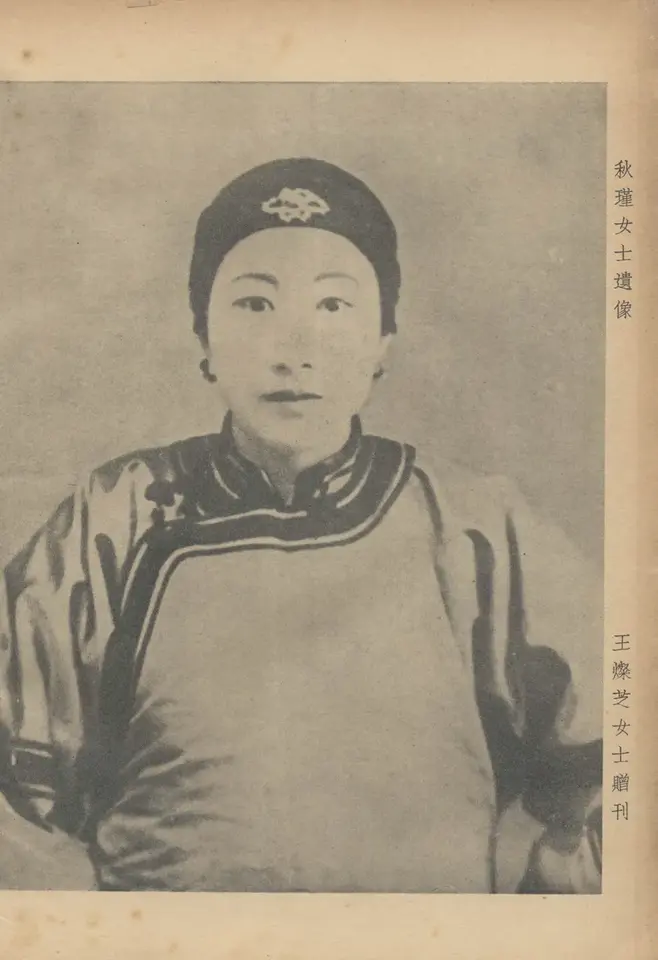
秋瑾
Qiu Jin (秋瑾, November 8, 1875 – July 15, 1907), born Qiu Guijin with courtesy names Xuanqing and Jingxiong, styled herself the "Female Knight of Mirror Lake" (Jianhu Nüxia). A native of Shanyin in Shaoxing, Zhejiang, born in Xiamen, Fujian, she was an eminent democratic revolutionary martyr, national hero, and pioneer of the women's rights and liberation movements in modern China. Breaking free from the constraints of…
Qiu Jin (秋瑾, November 8, 1875 – July 15, 1907), born Qiu Guijin with courtesy names Xuanqing and Jingxiong, styled herself the "Female Knight of Mirror Lake" (Jianhu Nüxia). A native of Shanyin in Shaoxing, Zhejiang, born in Xiamen, Fujian, she was an eminent democratic revolutionary martyr, national hero, and pioneer of the women's rights and liberation movements in modern China. Breaking free from the constraints of traditional feudal domesticity, she journeyed to Japan in 1904 to pursue modern education. There she joined the Triad Society, the Restoration Society (Guangfu Society), and the Revolutionary Alliance (Tongmenghui), where Sun Yat-sen appointed her Councilor and Leader of the Zhejiang Branch. Returning to China, she founded the Vernacular Newspaper and China Women's News, tirelessly championing gender equality, financial independence, and women's political participation. In 1907, as superintendent of the Datong Academy in Shaoxing, she organized the Restoration Army, unified secret society networks across eastern Zhejiang, and coordinated with Xu Xilin for a synchronized uprising across Zhejiang and Anhui. Following the failure of the Anqing uprising, Qiu Jin refused to flee, staying behind to cover comrades before being captured. Remaining unyielding under brutal torture, she was executed at Xuantingkou in Shaoxing at the age of thirty-three. Sun Yat-sen revered her as a "Heroine Among Women," and she remains an immortal symbol of China's struggle for national renewal and women's emancipation.
Born on the 11th day of the 10th lunar month at Ziyang Academy in Xiamen, into a scholarly family hailing from Shanyin, Shaoxing; studied classical literature, martial arts, and swordsmanship from childhood.
Married Xiangtan merchant-gentry scion Wang Tingjun under parental orders; moved to Hunan, feeling acutely constrained by feudal domestic life.
Following the Boxer Rebellion and Eight-Nation Alliance occupation of Beijing, composed the poem Worries of Qi lamenting national humiliation and imperial decay.
Moved to Beijing after her husband purchased an official post in the Ministry of Revenue; befriended calligrapher Wu Zhiying and resolved to dedicate her life to national salvation.
Sold her jewelry to finance studies in Japan against her husband's wishes; established the Vernacular Newspaper and joined the Triad Society.
Joined the Restoration Society in Shanghai, then the Revolutionary Alliance in Tokyo; appointed Head of the Zhejiang Branch; protested Japanese student regulations.
Returned to Shanghai to launch China Women's News; moved between Shanghai and Zhejiang to recruit secret society allies for armed rebellion.
Took command of Datong Academy in Shaoxing, reorganizing several thousand fighters into eight divisions of the Restoration Army.
Following the collapse of the Anqing uprising, covered retreating students and was captured at Datong Academy; executed at Xuantingkou on July 15.
Formally reinterred beside Xiling Bridge at West Lake in Hangzhou, where Sun Yat-sen personally officiated the memorial ceremony.
Qiu Jin was born on November 8, 1875, at Ziyang Academy in Yunxiao County, Fujian, where her father Qiu Shounan held an official appointment. Her grandfather, Qiu Jiahe, had served as Prefect of Xiamen, and her family maintained a distinguished lineage of gentry scholars based in Shanyin, Shaoxing. From age seven, Qiu Jin was educated in traditional academies, demonstrating extraordinary memory and intellectual sharpness. Unlike conventional gentry daughters, she disdained rigid primers, immersing herself instead in dynastic histories, heroic biographies, and Ming-Qing vernacular romances, often comparing herself to Hua Mulan and the Ming woman general Qin Liangyu. At age fourteen, while staying with her maternal relatives in Xiaoshan, she studied horseback riding, swordsmanship, and boxing under her cousin Shan Baoxun, developing robust physical endurance and martial prowess.
In 1893, Qiu Jin accompanied her father to his official post in Hunan, a province then undergoing rapid intellectual ferment under the Reform Movement of 1898. In 1895, wealthy Xiangtan merchant Wang Fuchen sought Qiu Jin's hand for his son, Wang Tingjun. Under strict patriarchal dictates, Qiu Jin married Wang in May 1896. Although Wang's family was wealthy, he was an indolent youth given to indulgence and gambling, possessing none of Qiu Jin's high ideals. Although they had a son, Wang Yuande, and a daughter, Wang Canzhi, the profound ideological rift caused deep estrangement. Qiu Jin felt suffocated within the feudal domestic compound, pouring her sorrow into poetry.
When the Eight-Nation Alliance invaded Beijing in 1900, Qiu Jin was horrified by the devastation of the capital and the capitulation of the Qing court. In 1903, Wang Tingjun purchased an appointment as Secretary in the Ministry of Revenue, and the family relocated to Beijing. Amid the ruins of foreign occupation and dynastic humiliation, Qiu Jin's patriotic fervor deepened. She formed an enduring friendship with the progressive woman scholar and calligrapher Wu Zhiying, avidly reading new political treatises and discussing constitutional and revolutionary ideas. Composing her famous Sword Song, she vowed to break free from domestic drudgery to pursue national salvation.
In the spring of 1904, determined to liberate herself from feudal shackles, Qiu Jin resolved to study in Japan. Facing fierce opposition and financial boycotts from her husband, she sold all her personal jewelry to finance her journey. Arriving in Tokyo in July, she studied Japanese at the Chinese Students Association institute before enrolling in the teacher-training program at Aoyama Practical Girls' School. Immersing herself in anti-Qing student activism, she reorganized the Mutual Love Society, joined the Yokohama Triad Society as military advisor ("White Fan"), and founded the Vernacular Newspaper to propagate democracy and women's rights. Her passionate speeches in Tokyo made her widely respected among Chinese intellectuals, including Tao Chengzhang, Song Jiaoren, Lu Xun, and He Xiangning.
During her studies in Japan, Qiu Jin delivered fiery, impassioned speeches that won widespread admiration among Chinese overseas students. In the autumn of 1904, she independently founded Baihua Bao (The Vernacular Journal), using accessible modern vernacular Chinese to systematically disseminate democratic revolutionary ideas and women's liberation to readers back home. By late 1904, she met Tao Chengzhang, a key leader of the Restoration Society. In early 1905, during a brief family visit to China, she joined the Restoration Society in Shanghai through Xu Xilin's recommendation. Returning to Tokyo in July, she was formally sworn into Sun Yat-sen's Revolutionary Alliance at Huang Xing's residence, where Sun appointed her Councilor and Leader of the Zhejiang Branch. Tirelessly networking among provincial student associations, she practiced marksmanship and swordsmanship, determined to overthrow the Qing through armed revolution.
In November 1905, the Japanese Ministry of Education, acting upon requests from the Qing court, promulgated harsh restrictive regulations targeting Chinese students to suppress overseas patriotic activities. The student community split violently between radicals advocating mass withdrawal and return to China in protest, and moderates counseling submission. Qiu Jin stood resolutely with the walkout faction. In December, when early revolutionary pioneer Chen Tianhua drowned himself in Tokyo Bay to awaken his compatriots, Qiu Jin attended his memorial service. Seeing the demoralization of the compromise faction, she drew her dagger and publicly denounced those who surrendered national honor, resolutely leading a massive contingent of patriotic students to quit school and return to China.
Returning to Shanghai in early 1906, Qiu Jin co-founded the China Public Institute and taught at Xunxi Girls' School in Nanxun, Huzhou, forging a lifelong bond with poet Xu Zihua. Resigning that summer, she returned to Shanghai, establishing a clandestine base in Hongkou where she tested explosives, suffering burns to her arm in an accidental blast. On January 14, 1907, overcoming severe financial hardships, she launched the inaugural issue of China Women's News. Her incendiary manifestos urged two hundred million Chinese women to throw off patriarchal bondage, pursue independent livelihoods through education, and unite with male revolutionaries to overthrow the Qing autocracy.
Following the failed Ping-Liu-Li uprising in late 1906, Qiu Jin turned her energy toward military insurrection in eastern Zhejiang. Moving to Shaoxing, she took charge of Datong Academy, originally founded by Xu Xilin. Behind its facade as a physical education school, Datong served as the headquarters of the revolutionary underground. In early 1907, Qiu was appointed superintendent. She integrated progressive students, military cadets from the Hangzhou Military Academy, and eastern Zhejiang secret societies into a disciplined revolutionary army, creating a clandestine network across the region.
In the spring of 1907, Qiu Jin and Xu Xilin coordinated a dual-province uprising across Zhejiang and Anhui. Secret society allies in Jinhua and Chuzhou were to stage diversions to draw Qing garrisons out of Hangzhou, enabling Shaoxing forces to cross the Qiantang River and take the provincial capital, while Xu launched a simultaneous rebellion in Anqing. However, premature action in Jinhua exposed the plot. On July 6, 1907, Xu Xilin assassinated Governor Enming in Anqing during a military inspection, but his forces were overwhelmed and he was brutally executed. Captured documents directly implicated Datong Academy, prompting Shaoxing Prefect Guifu and Zhejiang Governor Zhang Zengyang to dispatch troops to crush the Shaoxing revolutionaries.
On July 10, Qiu Jin received word of Xu Xilin's death. Military cadets from Hangzhou and secret society leaders such as Wang Jinfa urged her to escape immediately. She adamantly refused, declaring that while many men had died for the revolution, no Chinese woman had yet shed blood for the cause, and that she would be the first. She ordered students to disperse while remaining behind to burn secret membership lists and weapons caches. On the afternoon of July 13, Qing troops surrounded Datong Academy. After a fierce exchange of fire in which several students fell, Qiu Jin was captured.
Subjected to harsh interrogations by Prefect Guifu and Magistrate Li Zhongyue, Qiu Jin refused to confess or betray her comrades. When pressed to write a confession, she took the brush and penned seven melancholic characters: "Autumn wind and autumn rain break one's heart with sorrow." Fearing an armed rescue by local secret societies, Qing officials obtained summary execution orders. In the early morning of July 15, 1907, Qiu Jin was led under heavy guard to the commercial crossroads of Xuantingkou in Shaoxing. Walking with head held high and serene courage, she was decapitated, dying for the republican cause at age thirty-three.
Following her execution, Qiu Jin's remains were hastily buried near Wolong Mountain. Her sworn sisters Xu Zihua and Wu Zhiying risked their lives and imperial arrest to fulfill her wish to be buried beside Xiling Bridge in Hangzhou. Over the subsequent turbulent years, her casket was moved ten times across Zhejiang and Hunan due to official persecution. Following the victory of the 1911 Revolution, her remains were permanently reinterred beside Xiling Bridge in 1913, where an imposing pavilion and memorial statue stand today in perpetual remembrance.
Qiu Jin was the first thinker in modern Chinese history to link the emancipation of women directly with the political liberation of the nation. Observing that centuries of foot-binding and Confucian dogma had crippled half of China's population, she identified economic dependency and lack of education as the root causes of women's subjection. In her regulatory proposal for China Women's News, she made the groundbreaking call to establish the "China Women's Association," an all-encompassing national federation uniting two hundred million Chinese women. She urged women to master practical vocational arts, open factories, and become teachers, establishing an enduring intellectual foundation for the modern Chinese feminist movement.
Published in Shanghai in January 1907, China Women's News served as a revolutionary beacon across China. Qiu Jin penned passionate declarations such as An Inscription for China Women's News and A Respectful Warning to My Sisters, proclaiming natural human rights and equality between men and women. She composed the popular Exhortation for Women's Rights, set to music for mass singing, and serialized Nursing Course Tutorials. Her publications dismantled patriarchal feudal myths, urging women to take up weapons alongside men in the national salvation struggle and elevating feminist consciousness across late Qing society.
Qiu Jin demonstrated remarkable military organizing talent at Datong Academy. To forge fragmented secret society bands into a disciplined army, she designed an innovative sixteen-tier hierarchical structure using characters from a seven-character quatrain as military ranks. Xu Xilin was designated supreme commander, while Qiu took the second command rank. Officers wore customized gold rings inscribed with code designations. Furthermore, she divided several thousand volunteers into eight divisions called the "Restoration Army," complete with regular officer ranks, uniform codes, and a white military flag bearing the black character Han. This transformation converted traditional underworld brotherhoods into a cohesive modern revolutionary army.
Recognizing that intellectual agitation alone could not overthrow the Qing autocracy, Qiu Jin actively mobilized traditional secret societies in Zhejiang. Disguising herself in male attire, she rode alone through Shaoxing, Jinhua, Chuzhou, Lanxi, Yiwu, and Shengxian to forge blood oaths with bandit chiefs and Triad leaders such as Zhu Shaokang, Wang Jinfa, and Zhang Gong. Her charismatic bravery and martial expertise commanded immense respect among these rugged fighters, turning the Yangtze Delta hinterland into an active hotbed of armed rebellion.
Under Qiu Jin's superintendence, Datong Academy evolved from a physical education school into the foremost subterranean military academy and command bunker of the revolutionary movement in southeast China. She instituted rigorous drills in infantry tactics, marksmanship, field surveying, and reconnaissance for all students regardless of gender. Concealing secret ammunition depots behind partition walls, she used the school's athletic programs to recruit progressive officers and non-commissioned officers from the provincial New Army, creating an elite vanguard for the anticipated uprising.
When the uprising unravelled, Qiu Jin chose martyrdom with unyielding clarity. Recognizing that male revolutionaries such as Tan Sitong, Shen Jin, Shi Jianru, and Wu Yue had sacrificed their lives for reform and revolution, she felt that women had yet to shed blood for the nation. Her conscious self-sacrifice demonstrated absolute moral fearlessness. Her calm composure at Xuantingkou shocked the entire nation, exposing the cruelty of the crumbling Qing dynasty and catalyzing an overwhelming wave of public outrage that accelerated the fall of imperial rule four years later.
Qiu Jin was also a celebrated poet and writer whose literary works captured the martial spirit and patriotic agony of her era. Drawing inspiration from High Tang verse, her poems—such as Song of the Precious Sword, Facing Wine, To the Tune of Man Jiang Hong, and To the Tune of Zhe Gu Tian—are celebrated for their heroic defiance and soaring idealism. She also authored six chapters of the vernacular tanci ballad-novel The Pure Stone of Jingwei, chronicling a young woman's flight from arranged marriage to study abroad and fight for revolution. Her collected writings, preserved in The Qiu Jin Anthology, remain a revered monument of modern revolutionary literature.
FIGURES ASSOCIATED WITH THIS DYNASTY