Entity Type: Historical Figure Dynasty: Qing Dynasty
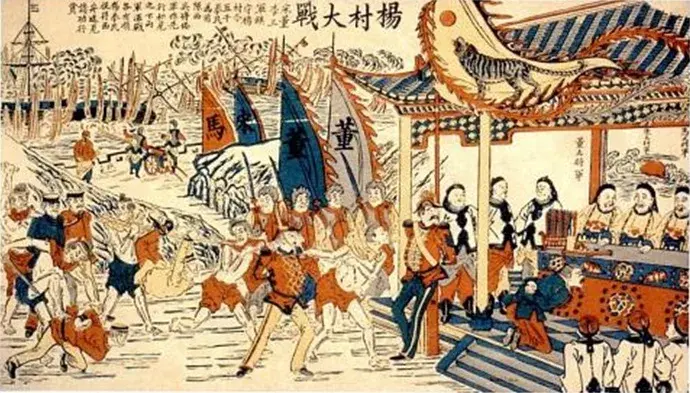
Image credits
page 170 of Some did it for civilisation, some did it for their country: a revised view of the boxer war By Jane E. Elliott · Public domainImage sourceHistorical figure
Dong Fuxiang (董福祥)
董福祥
Dong Fuxiang (董福祥, January 8, 1840 – February 9, 1908), courtesy name Xingwu, a native of Guyuan, Gansu (modern Yuanzhou District, Guyuan City, Ningxia), was a prominent late Qing military commander and the paramount leader of the northwestern Gansu Army. In the early Tongzhi period, amid widespread sectarian rebellions across northwestern China, Dong organized local defense militias in eastern Gansu, commanding forces…
Era not stated
PROFILE
Dong Fuxiang (董福祥, January 8, 1840 – February 9, 1908), courtesy name Xingwu, a native of Guyuan, Gansu (modern Yuanzhou District, Guyuan City, Ningxia), was a prominent late Qing military commander and the paramount leader of the northwestern Gansu Army. In the early Tongzhi period, amid widespread sectarian rebellions across northwestern China, Dong organized local defense militias in eastern Gansu, commanding forces numbering tens of thousands before surrendering to Zuo Zongtang, Governor-General of Shaanxi and Gansu. Impressed by his physical boldness and battlefield leadership, Zuo reorganized Dong's followers into the Three Battalions of the Dong Division, forming the nucleus of the formidable Gansu Army (Gan Army). During the historic Qing campaign to reconquer Xinjiang, Dong served as the vanguard commander under General Liu Jingtang. Leading his troops across the Tianshan Mountains, Dong captured Gumudi and Urumqi before advancing deep into southern Xinjiang, taking Toksun, Aksu, Ush, and Kashgar to dismantle Yakub Beg's regime and restore imperial sovereignty. Appointed Provincial Commander of Kashgar, Dong garrisoned southern Xinjiang for over a decade, checking Russian encroachment in the Pamir Mountains and overseeing agricultural irrigation colonies. In 1894, he transferred his troops east to protect the capital during the First Sino-Japanese War. In 1898, his forces were reorganized into the Rear Division of the Wuwei Army (Wuwei Rear Army), stationed at Nanyuan outside Beijing. During the 1900 Boxer Crisis, Dong's troops spearheaded attacks against the foreign legation quarter and fought allied forces at Guangqumen and Chongwenmen. Following the fall of Beijing, Dong escorted Empress Dowager Cixi and Emperor Guangxu on their flight to Xi'an as chief military escort. Under the Boxer Protocol, foreign powers demanded his execution as a principal instigator, but imperial authorities shielded him, commuting his sentence to dismissal from office and confinement to his home in Ningxia. Dong spent his final years at his Jinjipu estate, establishing schools and funding charitable irrigation projects until his death in 1908 at sixty-eight.
- Courtesy Name
- Xingwu (星五)
- Native Place
- Southern Township, Guyuan, Gansu (modern Yuanzhou District, Guyuan City, Ningxia Hui Autonomous Region)
- Date of Birth
- January 8, 1840 (Qing Daoguang 19, 12th Month, 5th Day)
- Date of Death
- February 9, 1908 (Qing Guangxu 34, 1st Month, 8th Day)
- Age at Death
- 68
- Highest Office
- Provincial Commander of Gansu concurrently Commander-in-Chief of the Rear Division of the Wuwei Army, Junior Protector of the Crown Prince
- Major Offices
- Regional Commander of Aksu, Provincial Commander of Kashgar, Provincial Commander of Gansu, Commander-in-Chief of the Rear Wuwei Army, Grand Minister in Attendance
- Historical Identity
- Eminent late Qing military commander, supreme leader of the Gansu Army (Kansu Braves), foremost vanguard general in Zuo Zongtang's reconquest of Xinjiang, key military figure in resisting the Eight-Nation Alliance during the Boxer Crisis
LIFE TIMELINE
Relationship graph
BIOGRAPHY
Chronology
- 1840 (Qing Daoguang 19) | Birth in Guyuan | Born on the fifth day of the twelfth lunar month in southern Guyuan, growing up robust, outspoken, and skilled in martial arts.
- 1864 (Qing Tongzhi 3) | Uprising in Anhua | Organized regional defense militias in Anhua during northwestern unrest, consolidating authority across border counties in Shaanxi and Gansu.
- 1869 (Qing Tongzhi 8) | Surrender to Zuo Zongtang | Submitted to Zuo Zongtang's forces at Dongzhiyuan; his followers were reorganized into the Three Battalions of the Dong Division.
- 1876 (Qing Guangxu 2) | Marching into Xinjiang | Served as vanguard under Liu Jingtang, crossing the desert beyond Xingxingxia to storm Gumudi and recover Urumqi.
- 1877 (Qing Guangxu 3) | Southern Xinjiang Campaign | Advanced across the Tianshan Mountains into the Tarim Basin, capturing Toksun, Aksu, and Kashgar to eliminate Yakub Beg's regime.
- 1889 (Qing Guangxu 15) | Commander of Kashgar | Appointed Provincial Commander of Kashgar, guarding the Pamir frontier against Russian encroachment and constructing agricultural irrigation canals.
- 1894 (Qing Guangxu 20) | Capital Defense Deployment | Ordered east with the Gansu Army to defend the capital region during the First Sino-Japanese War, garrisoning Baoding and Jizhou.
- 1897 (Qing Guangxu 23) | Commander of Gansu | Promoted to Provincial Commander of Gansu, retaining command of his field divisions stationed at Nanyuan outside Beijing.
- 1898 (Qing Guangxu 24) | Reorganization as Wuwei Army | The Gansu Army was reorganized into the Rear Division of the Wuwei Army, with Dong appointed supreme commander and Junior Protector of the Crown Prince.
- 1900 (Qing Guangxu 26) | Clashes with Allied Forces | Attacked foreign legations in Beijing and engaged Eight-Nation Alliance armies at Guangqumen before escorting the imperial court to Xi'an.
- 1901 (Qing Guangxu 27) | Dismissal under Treaty Terms | Branded a principal anti-foreign instigator by Western powers in the Boxer Protocol; pardoned from execution, stripped of office, and confined to Ningxia.
- 1908 (Qing Guangxu 34) | Passing at Jinjipu | Passed away on the eighth day of the first lunar month at his Gongbao Palace residence in Jinjipu, Ningxia, at sixty-eight.
Life and Career
Frontier Origins and Surrender to Zuo Zongtang
Dong Fuxiang was born in Sanjingzi, Southern Township, Guyuan, Gansu (modern Yuanzhou District, Guyuan City, Ningxia). Born into a commoner family, Dong had little interest in civil examinations, preferring hunting, equestrian archery, and swordsmanship. Tall and charismatic, he gained a widespread reputation for personal bravery across eastern Gansu. In 1862, with the outbreak of sectarian unrest across Shaanxi and Gansu, regional administration disintegrated. To protect their lineage and local villages, Dong and his father Dong Shigong organized armed self-defense fortifications in Anhua (modern Qingyang, Gansu).
Capitalizing on his organizational leadership, Dong allied with surrounding rural stockades, gathering over a hundred thousand displaced villagers and local fighters within several years. Calling himself the General Commander of the Shaanxi-Gansu Militia, he held control across Anhua, Heshui, Qingyang, and Ningxian, emerging as the most powerful regional armed confederation in the borderlands.
In 1868, Imperial Commissioner and Governor-General Zuo Zongtang led elite Xiang Army forces into the northwest to pacify the region. Confronting Zuo's coordinated military and political campaign, Dong recognized that regional isolationism was unsustainable. In late 1869, Dong led his followers out of Dongzhiyuan to surrender to Xiang Army commanders Liu Songshan and Liu Jingtang. Zuo Zongtang met Dong personally, recognizing his martial presence and practical leadership. Zuo selected ten thousand elite fighters from Dong's followers to form the Three Battalions of the Dong Division, appointing Dong as their commander and incorporating the force into the regular imperial army.
In subsequent operations against rebel strongholds at Jinjipu and Hezhou, Dong led his men in assaults against defensive earthworks. In 1872, during the assault on Datong in Xining, Dong fought through severe wounds. He was promoted to regional commander and awarded the imperial title "Arhanga Baturu," establishing the Gansu Army as a formidable military formation.
Vanguard Commander in the Reconquest of Xinjiang
In 1875, following extensive strategic debates at court over coastal versus frontier defense, the Qing government endorsed Zuo Zongtang's proposal to reconquer Xinjiang from the Central Asian invader Yakub Beg. In early 1876, Zuo appointed Liu Jingtang as frontline commander, selecting Dong's six battalions of Gansu infantry and cavalry as the spearhead of the expeditionary army.
Crossing the desert beyond Xingxingxia, Dong's units were tasked with reducing fortified centers in northern Xinjiang. In the battle of Gumudi, the defensive gate to Urumqi, rebel forces held deep watercourses and thick earthen ramparts. Dong directed his troops through waist-deep mud, breaching the walls with artillery before leading a charge with lances that shattered the defending garrison. Following this breakthrough, imperial forces entered Urumqi. Dong then marched west, reducing the fortress of Manas and clearing northern Xinjiang. In recognition of these achievements, he was granted the rank of provincial commander and awarded an imperial yellow jacket.
In the autumn of 1877, the expeditionary army crossed the Tianshan Mountains into the Tarim Basin. Confronting vast desert expanses and water shortages, Dong led his cavalry in a forced march across hundreds of li to strike Toksun, breaking rebel forces under Yakub Beg's son Haigula. Following Yakub Beg's death, his regime collapsed. Marching over a hundred li each day, Dong rapidly captured Yanqi, Korla, Aksu, and Ush.
By late 1877, Dong's vanguard approached Kashgar. Rebel remnants under Bai Yanhu and Beg Kuli had allied with Russian Cossacks in an attempt to hold the oasis. Dong divided his units into two columns, storming the Han and Muslim quarters of Kashgar. The rebel chieftains fled across the Russian border, and Dong pressed forward to recover Yarkand and Khotan. Through these rapid advances, Dong played a primary role in returning over 1.6 million square kilometers of Xinjiang territory to imperial administration, receiving an appointment as Regional Commander of Aksu.
Frontier Defense and Colonization in Kashgar
In 1889, following the creation of Xinjiang Province, the Qing court appointed Dong as Provincial Commander of Kashgar to oversee southern frontier defense. Headquartered at the eastern foot of the Pamirs adjacent to Russian-controlled Central Asia, Kashgar was an exposed strategic bastion. During this period, Tsarist military detachments advanced into the Pamir Mountains, seizing territory and stirring local unrest.
Dong garrisoned Kashgar for over a decade, implementing Zuo Zongtang's dual strategy of military defense and agricultural colonization. He established dozens of fortified border posts along the passes of the Pamirs and personally led cavalry patrols along the frontier. Confronting Russian border probes, Dong stood firm, demanding the withdrawal of trespassing military detachments and halting Russian expansion into Tashkurgan and the eastern Pamir ranges.
Concurrently, Dong promoted agricultural reclamation. He organized his troops to dig extensive irrigation canal networks along the Kashgar and Yarkand rivers, known locally as the "Dong Canal", diverting glacial runoff to cultivate tens of thousands of acres of arid soil. These farms made the garrison self-sufficient in food while providing arable plots for impoverished local Uyghur peasants. Known for his accessible manner and respect for local Islamic customs, Dong was regarded with deep affection by local communities, who referred to him as "Provincial Commander Dong".
In the summer of 1894, with the outbreak of the First Sino-Japanese War, imperial authorities summoned northwestern forces to defend Beijing. Dong led twenty battalions of Gansu cavalry and infantry across thousands of li to garrison Baoding and Lutai. In 1895, when sectarian unrest erupted in the Hehuang region of Qinghai and Gansu, Dong returned to stabilize the region. In 1897, he was appointed Provincial Commander of Gansu.
The Wuwei Army and the Boxer Conflict
In the autumn of 1898, following the Hundred Days' Reform, Empress Dowager Cixi summoned Dong and the Gansu Army to encamp at Nanyuan outside Beijing, garrisoning Changxindian and Lugouqiao as an essential political and military shield.
In late 1898, Grand Secretary Ronglu reorganized northern ground forces into the five divisions of the Wuwei Army. While Nie Shicheng commanded the Front Army and Yuan Shikai commanded the Right Army, Dong's Gansu troops were designated the Rear Division of the Wuwei Army, numbering ten thousand soldiers. Dong was named commander-in-chief and awarded the rank of Junior Protector of the Crown Prince. Consisting of hardy soldiers from Gansu, Ningxia, and Qinghai, the Gansu Army was renowned for aggressive hand-to-hand combat.
In the spring of 1900, the Boxer movement spread across northern China, and allied navies attacked the Dagu Forts. Conservative court factions under Prince Duan (Zaiyi) and Gangyi advocated utilizing the Boxers to confront foreign forces, seeking Dong's support. Sharing deep resentment against foreign incursions, Dong pledged his troops to national defense. On June 11, Gansu Army pickets killed Japanese legation secretary Sugiyama Akira outside Yongdingmen, marking the start of hostilities in the capital.
Throughout June and July, following the imperial declaration of war, Dong directed the Wuwei Rear Army in assaults against the foreign legation quarter and Xishiku Cathedral in Dongjiaominxiang. Gansu troops erected artillery platforms and engaged foreign legation guards in intense urban combat. Simultaneously, Dong detached cavalry detachments to coordinate with Nie Shicheng at Luofa and Langfang, checking Seymour's relief expedition.
In August, the main allied armies arrived before Beijing. Dong led his men in defense of Guangqumen, Chongwenmen, and Zhangyimen, engaging British and Russian shock troops in close-quarters combat and inflicting hundreds of allied casualties. On the night of August 14, allied artillery breached Guangqumen, and the outer city fell.
Imperial Escort and Retirement to Ningxia
As Beijing fell on August 15, Empress Dowager Cixi and Emperor Guangxu fled the Forbidden City in civilian carts. In the unfolding disaster, Dong gathered his surviving cavalry outside Xizhimen to guard the imperial flight. Riding beside the imperial carriages, Dong provided armed protection through Juyongguan, Datong, and Taiyuan, safely guiding the court to Xi'an. Throughout their stay in the temporary capital, Dong was appointed Grand Minister in Attendance, supervising palace security and earning the deep gratitude of the Empress Dowager.
However, during peace negotiations with the Eight-Nation Alliance, foreign powers led by Britain, Germany, Japan, and the United States demanded severe retribution, naming Dong as the foremost military instigator of the anti-foreign resistance and insisting upon his execution.
Empress Dowager Cixi was reluctant to execute a commander who had protected the throne, especially as Dong retained command of tens of thousands of veteran Gansu soldiers along the northwestern approaches. Recognizing that executing Dong would provoke a major military rebellion in Gansu, imperial negotiators Prince Qing (Yikuang) and Li Hongzhang resisted foreign demands, eventually securing a compromise: Dong was stripped of all military ranks and titles, dismissed from service, and sentenced to perpetual confinement under local surveillance in Ningxia.
In the spring of 1901, Dong parted from the imperial court and returned to Ningxia. At Jinjipu, he constructed a sprawling residence known as the Dong Estate (Gongbao Palace). Over the final seven years of his life, Dong lived quietly, declining political visitors and studying classical literature. He distributed his personal fortune to local communities, establishing free schools for poor children and opening his granaries to feed tens of thousands of famine victims during droughts.
On February 9, 1908 (Guangxu 34, 1st Month, 8th Day), Dong passed away peacefully at his Jinjipu residence at sixty-eight. Prior to his death, he submitted a memorial expressing unyielding devotion to the dynasty and donating tens of thousands of taels of silver and stored weapons to the imperial treasury for frontier defense. Although foreign treaty restrictions prevented formal public honors, local officials and citizens observed mourning throughout the region, burying him in his ancestral village at Shifosi in Guyuan.
Major Achievements
Vanguard Champion in the Recovery of Xinjiang
In the reconquest of Xinjiang under Zuo Zongtang, Dong Fuxiang's Gansu Army served as the principal offensive weapon. Spearheading assaults at Gumudi and Manas in the north and undertaking grueling marches across the Tarim Basin to recover Toksun, Aksu, and Kashgar, Dong led his men through desert extremes to crush Yakub Beg's foreign-backed regime. His leadership contributed decisively to the restoration of imperial authority over vast Central Asian territories.
Strategic Guardian of the Pamir Frontier
Dong's decade of service as Provincial Commander of Kashgar provided an unyielding barrier against Russian expansion in Central Asia. Establishing border outposts across the high passes of the Pamirs, he checked Russian probes into southern Xinjiang. Concurrently, his initiation of large-scale irrigation projects and military farming colonies fostered economic self-sufficiency and promoted harmony between local Uyghur and Han populations.
Determined Resistance against Allied Intervention
During the 1900 Boxer Crisis, Dong stood as one of the few high-ranking Qing commanders willing to confront invading foreign armies directly. Leading the Wuwei Rear Army in urban warfare in Beijing and frontline engagements at Guangqumen and Langfang, he inflicted significant casualties on Eight-Nation Alliance forces, demonstrating deep personal defiance against foreign encroachment.
Archetype of Late Qing Martial Tragedy
Dong's career encapsulates the complex tragedy of late Qing military commanders confronting modern imperialist geopolitics. Rising from provincial self-defense militias to become a celebrated frontier general, he was ultimately branded a war criminal by foreign powers and sacrificed during dynastic peace negotiations. His rise and fall reflect the helplessness of patriotic traditional generals trapped within the collapse of the Qing imperial system.
Personal Relationships
- Mentor and Commander: Zuo Zongtang, Governor-General of Shaanxi and Gansu, who recruited Dong into the regular army and entrusted him with vanguard commands.
- Expeditionary General: Liu Jingtang, inaugural Governor of Xinjiang and commander of the Xiang Army, who directed Dong during the Xinjiang campaigns.
- Imperial Patron: Empress Dowager Cixi, who relied upon Dong's military loyalty, appointed him imperial escort, and protected him from execution after the Boxer Protocol.
- Reorganizing Superior: Ronglu, Grand Secretary and Minister of War, who created the Wuwei Army and named Dong commander of the Rear Division.
- Military Comrade: Nie Shicheng, Provincial Commander of Zhili and head of the Front Wuwei Army, who fought alongside Dong during the defense of the capital.
- Central Asian Invader: Yakub Beg, ruler of the Kashgar regime whose forces were routed by Dong's vanguard.
- Allied Adversary: Edward Hobart Seymour, British Admiral whose expeditionary column was checked by Dong's cavalry at Langfang.
- Political Rival: Yuan Shikai, commander of the Right Wuwei Army, who maintained competitive tensions with Dong over capital defense influence.
Historical Evaluation
- Emperor Guangxu: "When the drums of war sound in future days and the state yearns for valiant commanders, to whom should we turn if not to you!" (Imperial Vermilion Rescript)
- Zuo Zongtang: "Dong Fuxiang's valor surpasses all other commanders; he is endowed with natural loyalty. Marching west beyond the frontier and repeatedly breaking formidable foes, he is truly the Fan Kuai of our generation." (Complete Works of Zuo Zongtang)
- Zeng Jize: "Provincial Commander Dong garrisons Kashgar with terrifying prestige; the Russians fear him like a tiger, and our western borders remain secure thanks to his presence."
- Zhao Erxun et al., Draft History of Qing, Biographies 242: "Dong Fuxiang fought across the western borders, taking Gumudi and Manas and pacifying southern Xinjiang with celebrated merit. In the crisis of 1900, his troops assaulted the legations and held the city gates. Though condemned by foreign powers as a chief instigator, his courageous resistance against foreign aggression cannot be erased."
- Cai Dongfan, Popular Romance of the Qing History: "Dong Fuxiang's Gansu troops were exceptionally bold and skilled in combat, followed loyally by the sons of Guanlong. His escort of the imperial court to the west was a magnificent service. When foreign powers demanded his head during the peace talks, the court shielded him from death, knowing that executing a leader so revered across the northwest would spark uncontrollable rebellion."
Related Entries
- Reconquest of Xinjiang
- Yakub Beg
- Zuo Zongtang
- Liu Jingtang
- Kansu Braves (Wuwei Rear Army)
- Boxer Rebellion
- Boxer Protocol
FIGURES ASSOCIATED WITH THIS DYNASTY
Bibliography
- Zhao Erxun et al., Draft History of Qing, Volume 455, Biography 242: Biography of Dong Fuxiang, Zhonghua Book Company punctuated edition.
- Zuo Zongtang, Complete Works of Zuo Zongtang: Memorials, Yuelu Publishing House punctuated edition.
- Jin Liang, Short Records of Guangxu and Xuantong Reigns, Zhonghua Book Company punctuated edition.
- Liu Jingtang, Memorials of Liu Xiangqin, Yuelu Publishing House punctuated edition.