Birth in Poverty
Born into an impoverished scholar-peasant family in Jingcheng, Yingzhou, dedicating himself to study.
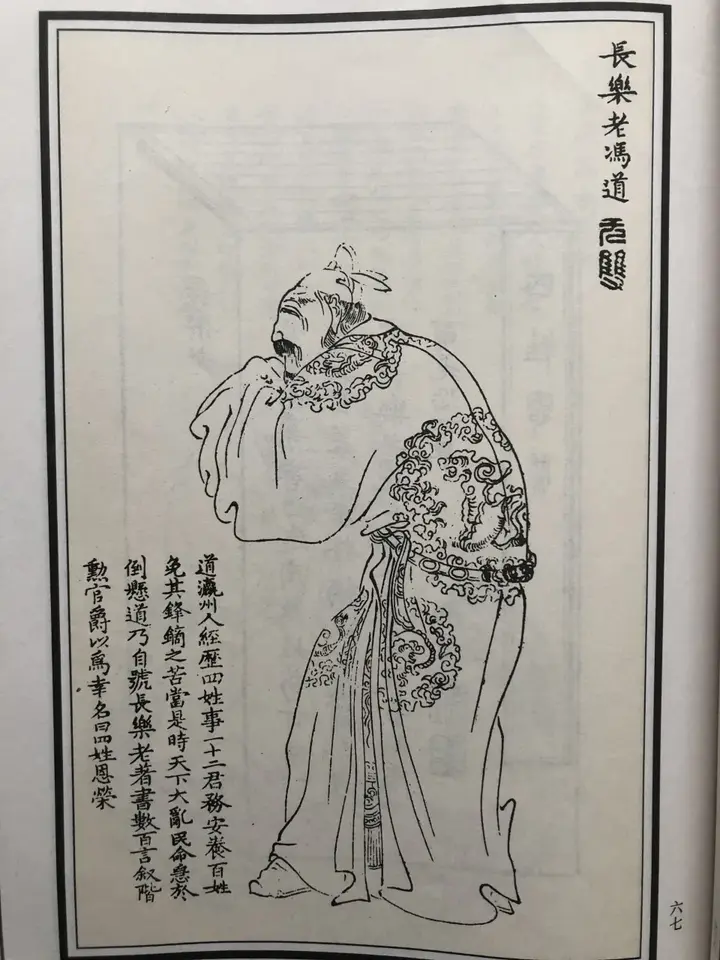
冯道
Feng Dao (冯道, 882–954), courtesy name Kedao and literary name Changle Lao, was a native of Jingcheng, Yingzhou (modern southeast of Jiaohe, Cangzhou, Hebei). He was a preeminent statesman, chancellor, and cultural custodian during the Five Dynasties and Ten Kingdoms period, celebrated as the pioneer who inaugurated state-sponsored large-scale woodblock printing of the Confucian classics in Chinese history. Born into an…
Feng Dao (冯道, 882–954), courtesy name Kedao and literary name Changle Lao, was a native of Jingcheng, Yingzhou (modern southeast of Jiaohe, Cangzhou, Hebei). He was a preeminent statesman, chancellor, and cultural custodian during the Five Dynasties and Ten Kingdoms period, celebrated as the pioneer who inaugurated state-sponsored large-scale woodblock printing of the Confucian classics in Chinese history. Born into an impoverished family of rural scholars, he was renowned for his broad erudition and refined prose from early youth. After serving warlord Liu Shouguang in Youzhou, where he was imprisoned for opposing aggressive warfare, he fled to Taiyuan to join Prince Li Cunxu of Jin, rising through the ranks to become Palm Secretary and Hanlin Academician. Over four turbulent decades marked by rapid dynastic changes, Feng Dao served four successive dynasties (Later Tang, Later Jin, Later Han, and Later Zhou) and ten different emperors, while briefly submitting to Emperor Taizong of Liao (Yelü Deguang), holding supreme chancellor offices throughout. Confronted with chronic warfare, military despotism, and severe civilian suffering, Feng Dao formulated a pragmatic governing ethos prioritizing the welfare of the people over fealty to a single ruling clan. He aided Emperor Mingzong of Later Tang in establishing the peaceful Changxing Governance, traveled into the Khitan army camp after the fall of Bianjing to dissuade the nomadic conquerors from mass slaughter, and petitioned the throne to print the Nine Classics through the National University, completing an epic cultural project that spanned twenty-two years. Feng Dao was noted for his personal frugality, integrity, and philanthropic devotion, distributing his official stipends to famine victims, observing strict filial mourning, and avoiding partisan feuds. Although criticized by Song Dynasty Neo-Confucian historians such as Ouyang Xiu and Sima Guang for shifting political allegiances, statesmen and scholars including Wang Anshi, Su Shi, and Li Zhi hailed him as a compassionate savior who preserved civilization and saved countless lives amid catastrophe. He passed away in Kaifeng in 954 at the age of seventy-three, and was posthumously honored as Prince of Ying with the posthumous title Wenyi.
Born into an impoverished scholar-peasant family in Jingcheng, Yingzhou, dedicating himself to study.
Served as staff officer under warlord Liu Shouguang, imprisoned for remonstrating against war, and later released.
Fled to Taiyuan and was recommended by supervisor Zhang Chengye to serve as Palm Secretary for Li Cunxu.
Appointed Vice Minister of Revenue and Hanlin Academician upon Li Cunxu's founding of the Later Tang Dynasty.
Returned to Jingcheng to mourn his father's death, plowing his own fields and ransoming captive women.
Recalled by Emperor Mingzong and appointed Vice Director of the Secretariat and Chancellor.
Successfully petitioned to carve woodblocks for printing the Nine Classics under the National University.
Stabilized the capital administration during the palace rebellions of Emperor Min and Emperor Mo.
Reappointed Chancellor, Grand Minister of Works, and Director of the Chancellery by Shi Jingtang.
Traveled north to confer imperial honors upon Emperor Taizong of Liao, returning safely with full diplomatic dignity.
Reassigned as Military Commissioner of Tongzhou and Nanyang following strategic disagreements with Emperor Chu.
Traveled to Bianjing to meet Yelü Deguang, persuading the Khitan ruler to halt the massacre of Central Plains civilians.
Recalled to the court by Liu Zhiyuan as Grand Preceptor, heading the official hierarchy.
Appointed Grand Preceptor and Director of the Secretariat by Guo Wei, pacifying regional military commissioners.
Finalized the comprehensive woodblock printing of the Nine Classics and commentaries after twenty-two years.
Remonstrated against Emperor Shizong's personal campaign at Gaoping; died in Kaifeng and posthumously created Prince of Ying.
Feng Dao was born in 882 in Jingcheng, Yingzhou. For generations, his ancestors had engaged in farming and classical studies, living in modest obscurity and extreme poverty. From early childhood, Feng Dao demonstrated natural virtue and an extraordinary passion for learning, immersing himself in the Confucian classics and historical treatises. Indifferent to physical hardships, he lived on coarse meals and wore plain clothing. Even during severe winter blizzards when icy drafts pierced the walls of his modest dwelling, he remained seated before his desk, reading aloud with unwavering composure.
During the chaotic Tianyou era of the late Tang, the warlord Liu Shouguang usurped control of the Lulong regional commandery in Youzhou. Hearing of Feng Dao's literary talent, Liu Shouguang recruited him as an administrative staff officer. Liu Shouguang was brutal and megalomaniacal, resolving to launch an aggressive military campaign against neighboring military governor Wang Chuzhi to seize Cangzhou. While other staff officers cowered in silence, Feng Dao stepped forward to remonstrate, warning of civilian devastation and military peril, and urged Liu Shouguang to cultivate peace.
Enraged by the rebuke, Liu Shouguang accused Feng Dao of subverting army morale and had him thrown into a dungeon. Conditions in the prison were horrific, with tortures regularly inflicted on inmates. Nevertheless, Feng Dao maintained complete equanimity, reciting classical texts day and night. Through the determined appeals of sympathetic colleagues, Liu Shouguang relented and released him. Recognizing that Liu Shouguang was doomed to ruin, Feng Dao abandoned his office, disguised himself, and crossed the Taihang Mountains to Taiyuan to seek service with Prince Li Keyong and his son Li Cunxu.
Upon arriving in Taiyuan, Feng Dao initially held minor clerical posts in the Jin military command. A noted local physiognomist, Zhou Yuanbao, advised court eunuch and army supervisor Zhang Chengye that Feng Dao appeared too destitute to achieve greatness. However, clerical secretary Lu Zhi refuted this claim, pointing out that Feng Dao bore an uncanny resemblance to Du Huangshang, the celebrated virtuous prime minister of the Tang Dynasty, and predicted that Feng Dao would shoulder enormous responsibilities for the realm.
Zhang Chengye, possessing exceptional insight into human character, personally reviewed Feng Dao's writings and recognized his statesmanship. He recommended him to Li Cunxu, who immediately appointed Feng Dao as Palm Secretary, responsible for military decrees, secret dispatches, and proclamations. On campaign, Feng Dao lived without luxury, sleeping on bundles of horse straw in a makeshift shelter and sharing simple meals with grooms and soldiers from the same cauldron, winning the admiration of the rank and file.
During the protracted war along the Yellow River, General Guo Chongtao sought to execute numerous surrendered Later Liang officers to assert military authority. Feng Dao intervened directly, arguing that an army claiming to restore justice must win hearts through broad-minded clemency rather than driving opponents to despair. Guo Chongtao relented, sparing many lives. When Li Cunxu clashed furiously with Guo Chongtao over catering expenditures and ordered Feng Dao to draft a proclamation announcing his resignation from command, Feng Dao paused with brush in hand and diplomatically persuaded Li Cunxu that public discord would embolden the enemy, successfully reconciling sovereign and minister.
In 923, Li Cunxu proclaimed himself emperor of Later Tang (Emperor Zhuangzong) and captured Luoyang. Feng Dao was rewarded with appointments as Vice Minister of Revenue and Hanlin Academician. Despite his proximity to the throne, he shunned flattery and retained his austere lifestyle. As Zhuangzong increasingly indulged in court spectacles and theatrical frivolities, Feng Dao performed his official duties conscientiously, distributing royal gifts among impoverished clerks and maintaining an immaculate reputation for probity.
In early 926, Feng Dao received news that his father, Feng Xin, had passed away in Jingcheng. He immediately resigned his posts to observe the three-year mourning period in his native village. At that time, North China was gripped by widespread drought and locust plagues, reducing the peasantry to starvation. Upon arriving home, Feng Dao constructed a simple thatched hut beside his father's grave, observing ancient mourning rituals.
Moved by the suffering around him, Feng Dao distributed his accumulated official salaries, grain reserves, and silk among starving villagers. He donned rough clothing and worked the soil with agricultural tools. Whenever he noticed elderly or frail neighbors unable to cultivate their lands, he crept into their fields at night to plow and sow seeds on their behalf. When grateful villagers discovered his deeds and thanked him, he brushed aside their gratitude as ordinary neighborly duty, and politely redirected gifts from local magistrates toward destitute households.
During this period, rogue soldiers and nomadic horsemen raided the countryside, abducting numerous young women. Deeply grieved, Feng Dao expended all his remaining possessions to ransom these captives. He housed them safely in a separate compound, ensuring their honor was protected, and sent inquiries across neighboring districts. Once the turmoil subsided, he returned each woman unharmed to her relatives, earning universal acclaim across Cangzhou and Yingzhou.
In 926, Emperor Zhuangzong was slain in a mutiny in Luoyang, and Li Siyuan ascended the throne as Emperor Mingzong. Recognizing Feng Dao's wisdom and steadiness, Mingzong recalled him to the court in 927 as Scholar of the Duanming Hall, and soon elevated him to Vice Director of the Secretariat and Chancellor.
Emperor Mingzong had risen from the military ranks and was illiterate, but he desired good governance. Feng Dao assisted him in curbing unruly commanders, reducing burdensome taxes, and fostering agrarian recovery. During the Changxing era, consecutive bumper harvests created complacency among courtiers. Feng Dao maintained acute vigilance, frequently using vivid practical parables to keep the monarch grounded in moral responsibility.
When Mingzong inquired whether consecutive harvests meant the people were fully contented, Feng Dao explained that cheap grain harmed farmers while dear grain harmed townspeople. He recounted an experience riding through the perilous Jingxing Pass, where he held the reins tightly out of fear and suffered no harm, whereas on flat plains he relaxed his grip and fell from his horse. He advised that peace required even greater vigilance than crisis. On another occasion, when Mingzong displayed a jade cup inscribed with imperial slogans, Feng Dao observed that material curiosities were transient, and that true royal treasure lay in benevolence and righteousness, prompting the chastened monarch to remove the artifact.
At court, when Chancellor Lu Wenji jealously assigned Feng Dao to supervise ceremonial sweeping at imperial sacrifices, Feng Dao cheerfully accepted, remarking that sweeping was an ancient statutory duty of the Minister of Works. When official Ren Zan mocked his scholarly depth, Feng Dao gently defended practical education over pretentious literary conceits. When a subordinate military officer drunkenly cursed outside his headquarters in Tongzhou, Feng Dao invited him in and served him fine food and wine, moving the officer to tears of repentance. Under Feng Dao's guidance, the Changxing era became celebrated as an oasis of peace within the Five Dynasties.
Since the devastating rebellions of the late Tang, imperial libraries and private book collections had perished in fires, leaving students destitute of texts. Confucian classics had to be transcribed by hand, resulting in rampant transcription errors. In 932, Feng Dao and Secretariat Drafter Li Yu submitted a memorial to Emperor Mingzong proposing that the National University finance the woodblock carving of the Nine Classics, using the authoritative Kaicheng stone classics as the standard text.
Emperor Mingzong approved the proposal. Feng Dao appointed Chancellor of the National University Tian Min to lead the editorial work, bringing together eminent scholars and calligraphers to verify readings and carve pearwood and datewood printing blocks. Feng Dao continuously secured imperial funding through dynastic upheavals, ensuring that the endeavor proceeded uninterrupted and establishing the first official state printing of canonical literature in world history.
In 933, Emperor Mingzong died, and Emperor Min ascended the throne. Soon afterward, Prince of Lu Li Congke rebelled in Fengxiang and marched on Luoyang, prompting Emperor Min to flee. Amid widespread panic, while other ministers debated protocol, Feng Dao acted decisively under the principle of responding pragmatically to reality, assembling officials to welcome Li Congke as Emperor Mo, thereby preventing the capital from being sacked. When Emperor Mo grew suspicious of elder statesmen, Feng Dao voluntarily stepped down and governed Tongzhou.
In 936, Shi Jingtang secured Khitan military support to overthrow Later Tang and establish the Later Jin Dynasty. Revering Feng Dao's national stature, Shi Jingtang recalled him to the court as Grand Minister of Works, Vice Director of the Chancellery, and Chancellor, later advancing him to Duke of Lu.
In 938, Shi Jingtang sought to dispatch a high-ranking embassy to the Khitan court to present imperial seals and honorific titles to Emperor Taizong of Liao (Yelü Deguang). The mission was fraught with danger, and many courtiers feigned illness to avoid going. Feng Dao stepped forward and wrote the words "I shall go" on official registry paper. Without returning home to bid farewell to his family, he took lodging at the official post station that very evening.
Upon his arrival in the Khitan capital, Yelü Deguang treated him with exceptional deference, hosting banquets in his honor and presenting him with an ivory tablet and an ox head. Feng Dao composed verse with graceful humor, declaring that he received the ox head with gratitude and held the ivory tablet with ease. Impressed by his dignity, Yelü Deguang attempted to detain him as a Liao chancellor. Feng Dao calmly noted that Later Jin and Khitan were bonded as father and son states, making his service identical in either land, and used his gifts to buy firewood as though planning to stay indefinitely. Convinced of his detachment, the Khitan ruler permitted his departure. On the return journey, Feng Dao traveled slowly from station to station, demonstrating composure that discouraged pursuit, and returned home with full diplomatic honor.
In late 946, Khitan forces shattered Later Jin defenses and captured Bianjing (Kaifeng), causing the fall of Later Jin. Nomadic cavalry rampaged across the central plains on foraging raids, killing and pillaging across Henan and Hebei, threatening the civilian population with extermination.
Yelü Deguang entered Bianjing and summoned former Jin ministers to the palace. Traveling north from Nanyang, Feng Dao appeared in the imperial hall. Yelü Deguang asked mockingly what kind of man he was, to which Feng Dao replied that he was merely an old man devoid of talent and virtue. The Khitan sovereign then posed a lethal question: "How can the people of the realm be saved?"
Feng Dao looked directly at the conqueror and answered calmly: "At this moment, even if the Buddha came forth, he could not save them; only you, the Emperor, can save them!" Flattered and morally burdened by this reply, Yelü Deguang's ferocious temperament softened. Over following days, Feng Dao gently reasoned with the Khitan ruler, explaining that destroying agricultural communities would leave the throne without revenue. Persuaded by Feng Dao, Yelü Deguang issued strict decrees prohibiting random slaughter and canceled plans for mass executions, sparing millions of innocent lives.
Following Yelü Deguang's withdrawal and death, Liu Zhiyuan founded the Later Han Dynasty and appointed Feng Dao as Grand Preceptor. When Emperor Yin ascended the throne, factional intrigues flared at court, but Feng Dao remained detached, supervising historical compilation and academic studies.
In late 950, General Guo Wei rebelled against Emperor Yin. To pacify the capital, Guo Wei initially pledged to enthrone Liu Yun, military governor of Xuzhou, and requested Feng Dao to lead the welcoming delegation. Feng Dao asked Guo Wei if he was sincere, and Guo Wei swore to heaven. Feng Dao remarked that he had never spoken an untruth in his life and trusted Guo Wei would not make him do so. However, when Guo Wei seized power in Chanzhou, General Guo Chong intercepted Liu Yun's retinue at Songzhou. Officer Jia Zhen sought to execute Feng Dao in anger, but Liu Yun intervened to protect him.
After founding the Later Zhou Dynasty, Guo Wei treated Feng Dao with profound respect, appointing him Grand Preceptor and Director of the Secretariat, and dispatching him to pacify regional commanders. In 953, the twenty-two-year woodblock printing of the Nine Classics was finally completed, fulfilling Feng Dao's life's cultural work.
In early 954, Emperor Shizong (Chai Rong) ascended the throne. When Northern Han ruler Liu Chong allied with Khitan cavalry to invade, Chai Rong determined to lead the imperial army personally. Feng Dao remonstrated, advising that a newly enthroned monarch should dispatch veteran commanders rather than risk his person. When Chai Rong insisted that defeating Liu Chong was as easy as crushing an egg with Mount Tai, Feng Dao asked whether His Majesty could truly act as Mount Tai. When Chai Rong cited Emperor Taizong of Tang leading campaigns, Feng Dao retorted by asking whether the court possessed generals comparable to those of Taizong.
Chai Rong was deeply displeased and proceeded to win a narrow victory at the Battle of Gaoping. After returning, he assigned Feng Dao to supervise the construction of the late emperor's mausoleum. On May 21, 954, Feng Dao passed away in Kaifeng at the age of seventy-three. Chai Rong mourned his passing, suspended court audiences for three days, and posthumously created him Prince of Ying with the posthumous title Wenyi.
Feng Dao's most enduring legacy was his initiation and stewardship of the first state-sponsored woodblock printing of the Confucian canonical corpus. Before his initiative, Confucian texts circulated through fragile hand-copied manuscripts or monumental stone steles. Hand-copied editions were notoriously plagued by textual corruptions, while stone rubbings were prohibitively expensive for common scholars.
In 932, recognizing that Buddhist monasteries had long utilized woodblock printing while Confucian statecraft texts lacked standard printed editions, Chancellor Feng Dao petitioned the throne to print the Nine Classics through the National University. Over twenty-two years, navigating the collapse and rise of four dynasties, he sustained the project until its completion in 953.
Under his oversight, scholars led by Tian Min selected fine datewood and pearwood blocks, engaged master calligraphers, and instituted a rigorous three-tier proofreading system verifying characters, commentaries, and punctuation against ancient stone steles. The resulting 130-volume set of the Nine Classics dramatically reduced book costs, democratized learning, and provided authoritative textual foundations that enabled the educational boom and Neo-Confucian resurgence of the Song Dynasty.
During the catastrophic sack of Bianjing in 947, Feng Dao demonstrated remarkable moral courage and diplomatic skill. When northern nomadic forces laid waste to central China, Feng Dao journeyed to the enemy camp to confront Yelü Deguang.
By humorously deflecting initial insults and declaring that "only the Emperor can save the people," Feng Dao adroitly placed the moral burden of human preservation squarely upon the conqueror's shoulders. His subsequent daily counsel persuaded the Khitan ruler to restrain his marauding cavalry, safeguard agricultural land, and rescind mass execution orders, thereby averting the near-total destruction of Central Plains society and culture.
Feng Dao's tenure as chancellor under Emperor Mingzong produced the celebrated Changxing Governance, a rare period of peace and prosperity in the Five Dynasties. He formulated a governing philosophy centered on vigilance during prosperity, often using folk analogies to warn the monarch against self-indulgence.
His administrative policies curbed military extortion, streamlined local tax levies, stabilized grain prices through public granaries, and maintained harmonious relations within the ruling apparatus. His practical benevolence provided common people with vital respite from endless warfare.
In 938, Feng Dao volunteered for the hazardous diplomatic mission to the Khitan capital when other officials shrank back. Facing imperial intimidation and generous bribes aimed at keeping him in the north, he maintained impeccable diplomatic composure.
By feigning an intention to stay and purchasing firewood for winter, he disarmed suspicious Khitan authorities, and departed slowly from station to station to project an aura of serene confidence. His mission preserved sovereign dignity and secured essential peaceful relations without compromising moral honor.
Throughout his decades as chief minister, Feng Dao adhered to an unyielding standard of personal incorruptibility. He lived in simple quarters, ate ordinary meals alongside servants, and refused shares of wartime loot, using his resources instead to ransom and repatriate captive women.
In his autobiographical essay, Changle Lao Zixu, he expressed his contentment with a simple life guided by cosmic principle. In his renowned poem Tiandao, he urged contemporaries to perform good deeds without agonizing over future fortunes, embodying a profound humanitarian ethos amid ruthless political turbulence.
Feng Dao possessed extraordinary magnanimity in an era infamous for vicious factionalism. When mocked by peers like Ren Zan over elementary educational texts, he responded with calm intellectual defense rather than punitive anger.
When insulted by a drunken military subordinate, he treated the offender with hospitality until the man repented. By refusing to engage in bureaucratic vendettas, Feng Dao provided a safe haven for literati and civil officials across successive dynastic transitions.
FIGURES ASSOCIATED WITH THIS DYNASTY