Birth in Central Asian Exile
Born in the Fergana basin of the Kokand Khanate as a descendant of the exiled White Mountain Khojas.
张格尔
Jahangir Khoja (张格尔, 1790–1828), original name Jahangir Khwaja, was a religious and military chieftain of the Afaqi White Mountain Khoja lineage in Xinjiang during the Qing dynasty. He was the grandson of Burhan al-Din (the Big Khoja) and the second son of Samsaq. Following the Qing dynasty's suppression of the Revolt of the Altishahr Khojas in 1759, Samsaq fled west of the Pamirs to take refuge in the Kokand Khanate. Raised…
Jahangir Khoja (张格尔, 1790–1828), original name Jahangir Khwaja, was a religious and military chieftain of the Afaqi White Mountain Khoja lineage in Xinjiang during the Qing dynasty. He was the grandson of Burhan al-Din (the Big Khoja) and the second son of Samsaq. Following the Qing dynasty's suppression of the Revolt of the Altishahr Khojas in 1759, Samsaq fled west of the Pamirs to take refuge in the Kokand Khanate. Raised in the Fergana basin, Jahangir traveled extensively across Central Asia and visited Kabul in Afghanistan, coming under the geopolitical influence of British imperial agents and Islamic theocratic networks amidst the Great Game, nurturing lifelong ambitions to restore his family's theocratic dominion over southern Xinjiang. In 1826 (the sixth year of the Daoguang reign), supported by the military forces of the Kokand Khanate and armed with British-supplied weapons, Jahangir rallied bands of Andijani and Kyrgyz horsemen to launch a massive cross-border invasion of southern Xinjiang. Overrunning the Western Four Cities—Kashgar, Yengisar, Yarkand, and Khotan—his forces killed the Imperial Counselor Resident Qingxiang, after which Jahangir proclaimed himself Sayyid Jahangir Sultan. His rule was marked by arbitrary executions, heavy religious levies, and extortionate plunder, swiftly alienating local Uyghur merchants and peasants. In response, the Daoguang Emperor appointed Ili General Changling as Generalissimo, mobilizing over 40,000 elite troops from Jilin, Heilongjiang, Shaanxi, and Gansu. Following pivotal victories at Kelping and Shabudur, Qing forces liberated the Western Four Cities. In late 1827, Imperial Commissioner Yang Fang ambushed and captured Jahangir at Mount Kartiega. Transported to Beijing in 1828, Jahangir was presented before the Daoguang Emperor at the Meridian Gate and executed by slow slicing. The suppression of Jahangir's revolt secured China's northwestern territorial integrity and prompted far-reaching military and administrative reforms throughout Xinjiang.
Born in the Fergana basin of the Kokand Khanate as a descendant of the exiled White Mountain Khojas.
Inherited religious leadership of the Afaqi faction following the death of his father Samsaq.
Raided the southern Xinjiang frontier during the Daoguang Emperor's accession; repulsed by Qing outpost garrisons.
Led Kyrgyz cavalry against the Ulukchat frontier post and was decisively routed by the Kashgar garrison.
Invaded with regular Kokand forces; captured Kashgar and the Western Four Cities; Qingxiang committed suicide.
Declared himself Sayyid Jahangir Sultan in Kashgar, establishing an extractive theocratic regime.
Changling directed 40,000 troops to victory at Shabudur, expelling the rebels and liberating the Western Four Cities.
Tracked into the mountains by Yang Fang in the twelfth month and taken alive during a surprise night encirclement.
Escorted to Beijing in the fifth month; presented in an imperial triumph and executed by slow slicing.
Jahangir was born in 1790 in the Fergana basin of the Kokand Khanate (in modern Uzbekistan). He belonged to the prominent Afaqi White Mountain branch of the Makhdumzada Khojas of Xinjiang. His grandfather was Burhan al-Din (historically known as the Big Khoja), and his granduncle was Jahan Khoja (the Small Khoja). In 1759, the Qianlong Emperor dispatched imperial armies to conquer Altishahr and suppress the revolt of the two brothers, ending over a century of Khoja hegemony. Following the defeat, Burhan al-Din's son Samsaq fled with his family west across the Pamir Mountains to take refuge in Kokand.
To preserve stability along its far-western frontiers, the Qing court remitted an annual subsidy of 10,000 taels of silver to the Kokand Khanate, commissioning the Kokand rulers to keep Samsaq and his family under strict surveillance. During his exile in Kokand, Samsaq had three sons: the eldest Maimaiti Yusupu, the second Jahangir (originally named Jahangir Khwaja), and the youngest Babuding. From early childhood, Jahangir was steeped in dynastic grievances and the messianic ideology of White Mountain Sufism. Seeking to rally support, he traveled widely among nomadic Kyrgyz and Fergana tribesmen, reciting prayers and distributing talismans while recruiting armed retainers.
As he matured, Jahangir journeyed across various Central Asian principalities, extending his travels to Kabul in Afghanistan. During this period, the expanding rivalry between the British Empire and Imperial Russia—the Great Game—intensified across Central Asia. British East India Company intelligence officers sought to cultivate local proxies to monitor and destabilize Qing inner Asian territories. Aligning himself with both British agents and Kokand commercial aristocrats, Jahangir secured shipments of advanced British firearms, tactical instruction, and funding, positioning himself as a vehicle for external geopolitical ambition in northwest China.
In September 1820, following the death of the Jiaqing Emperor and the accession of the Daoguang Emperor, frontier vigilance was briefly disrupted. Believing the moment opportune, Jahangir assembled several hundred Andijani and Kyrgyz raiders to cross the mountain checkpoints of southern Xinjiang. However, the Qing garrison under Kashgar Imperial Counselor Resident Qingxiang was fully prepared, deploying Manchu and Han cavalry to deliver a crushing counter-blow that forced Jahangir to flee back across the border. In 1824, Jahangir launched another raid on the border post of Ulukchat, where entrenched imperial pickets repulsed his force, inflicting heavy losses.
Undeterred by these setbacks, Jahangir exploited growing local discontent stemming from bureaucratic corruption among minor Qing frontier magistrates. In the summer of 1826, learning of lax security in Kashgar, he mobilized 500 horsemen for another strike. To expand the scale of the uprising, Jahangir promised the plunder of Kashgar and the concession of customs revenues to Muhammad Ali Khan (Madali Khan), the ruler of the Kokand Khanate, who dispatched 10,000 regular troops to join the invasion.
Confronting this joint offensive, imperial frontier defenses collapsed. Rebel columns besieged the citadels of Kashgar, Yengisar, Yarkand, and Khotan. In Kashgar, Counselor Resident Qingxiang and his outnumbered garrison defended the walled compound for months until food and ammunition were exhausted. In August 1826, as the city ramparts fell, Qingxiang chose an honorable death, detonating the central gunpowder magazine. The remaining three cities fell in rapid succession, precipitating the crisis known as the Fall of the Western Four Cities.
Following his triumph, Jahangir established his court in Kashgar, proclaiming himself Sayyid Jahangir Sultan. His rule quickly degenerated into arbitrary theocratic extortion. After reneging on his revenue-sharing pledges to Kokand, which prompted the withdrawal of Madali Khan's forces, Jahangir instituted a reign of terror. He confiscated the estates and livestock of indigenous Uyghur elites and commoners alike, levied exorbitant religious taxes, executed dissenters under fundamentalist edicts, and forcibly took local women as consorts. These repressive actions alienated the local population, turning former supporters into staunch opponents.
News of the catastrophe in southern Xinjiang and the martyrdom of Qingxiang reached Beijing, prompting swift imperial intervention. The Daoguang Emperor recognized that the uprising represented an existential threat to national sovereignty and territorial unity. He appointed Ili General Changling as Generalissimo, paired with Shaanxi-Gansu Governor Yang Yuchun and Shandong Governor Wu Long'e as joint field commanders, with Imperial Commissioner Nayancheng directing logistical support. More than 40,000 crack troops—comprising northern Banner horsemen from Jilin and Heilongjiang alongside Green Standard infantry from Shaanxi, Gansu, and Sichuan—were mobilized for the campaign.
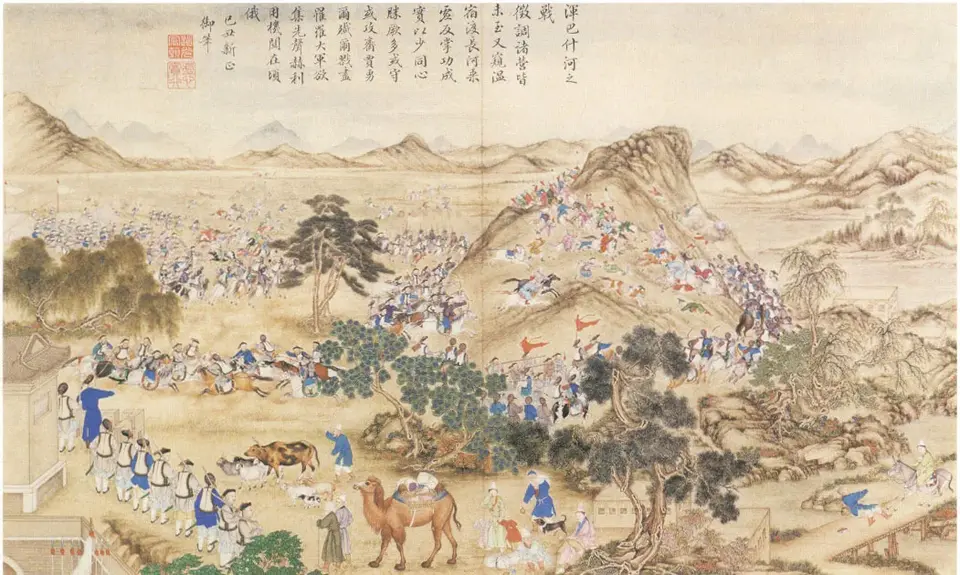
By the winter of 1826, the imperial expeditionary army assembled at Aksu. Aware of the imperial concentration, Jahangir advanced tens of thousands of troops eastward, aiming to seize Ush and Aksu to sever communications between northern and southern Xinjiang. At Kelping on the approaches to Aksu, Changling and Yang Yuchun engaged the rebel forces. Employing disciplined artillery barrages supported by decisive cavalry charges on both flanks, the Qing forces shattered the advance, killing thousands of insurgents and securing their base for the westward offensive.
In February 1827, the Qing expeditionary force launched its grand counter-offensive in three columns. Generalissimo Changling and General Yang Fang led the main strike force toward Yangialbat and Shabudur, the fortified northeast gateway to Kashgar. Jahangir had entrenched tens of thousands of Andijani auxiliaries and local levies behind multiple stone stockades along the river.
On February 28, 1827, the decisive Battle of Shabudur commenced. General Yang Fang spearheaded a frontal cavalry charge across the river, shattering the rebel vanguard, while Yang Yuchun directed concentrated cannon and musket fire against the stockades. Overwhelming the defenses, Qing forces captured eighteen fortified redoubts in rapid succession, inflicting over 10,000 casualties and routing the insurgent army. On March 1, imperial troops entered Kashgar. Jahangir fled into the mountain passes with a few hundred retainers. The imperial army pressed onward, liberating Yengisar, Yarkand, and Khotan within weeks, restoring the Western Four Cities to imperial authority.
Following the recovery of the cities, the Daoguang Emperor issued strict commands that Jahangir be captured alive to face formal dynastic justice. In the winter of 1827, isolated and spurned by Central Asian rulers, Jahangir slipped back across the border into Mount Kartiega (in modern Ulugqat County) to rally scattered followers. Alerted by local scouts, General Yang Fang braved blizzards and sub-zero temperatures, leading several hundred elite cavalrymen across hundreds of miles of mountain terrain to mount a surprise encirclement.
On the night of December 28, 1827, Yang Fang sealed the exits of the valley and ambushed the camp. In the ensuing hand-to-hand melee, Yang personally cut down several bodyguards before his troops dragged Jahangir from a rock crevice and took him alive. News of the rebel leader's capture sparked jubilant celebrations across southern Xinjiang.
In May 1828, securely bound in an iron cage, Jahangir was delivered to Beijing under heavy military escort. The Daoguang Emperor presided over an elaborate victory celebration at the Meridian Gate of the Forbidden City, where the grand secretaries and civil-military officials formally presented the captive. Following an imperial trial by the three judicial boards, the emperor ordered that Jahangir be executed by slow slicing (lingchi), with his severed head displayed across the empire as a deterrent against treason.
Jahangir leveraged his ancestral standing as a Makhdumzada Khoja to fuse local religious authority with foreign imperialist ambitions. Capitalizing on Sufi veneration in southern Xinjiang, he presented himself as an Islamic liberator while collaborating with external powers in the emerging Great Game. He courted British agents in Kabul, obtaining weapons and funding, and ceded sovereign commercial prerogatives to induce Kokand state intervention. His seven-year campaign disrupted six decades of peace in Altishahr, establishing an early historical precedent for external imperialist encroachment and armed separatism on China's northwestern frontier.
During his brief occupation of the Western Four Cities, Jahangir's administration laid bare the reactionary nature of Khoja theocratic feudalism. Proclaiming himself Sayyid Jahangir Sultan, he subjected Kashgar to systematic plunder by foreign Andijani mercenaries, massacring merchants and imposing harsh religious exactions. The expropriation of estates, arbitrary executions, and the abduction of local women alienated the Uyghur population and traditional Beg elites alike. This widespread disillusionment dismantled the remaining religious prestige of the White Mountain Khojas, isolating the movement and accelerating its political and ideological extinction across southern Xinjiang.
Jahangir's uprising provoked the largest military mobilization undertaken by the Qing dynasty during the Daoguang era. Demonstrating firm resolve in defending imperial territorial sovereignty, the Qing court mobilized over 40,000 multi-ethnic troops and expended ten million taels of treasury silver under commanders Changling, Yang Yuchun, and Yang Fang. Through coordinated campaigns across the desert and mountain corridors of Altishahr—most notably at Kelping and Shabudur—the imperial armies dismantled the insurgent forces and captured the rebel leader at Mount Kartiega. This victory permanently ended the threat of foreign-sponsored partition in the Tarim Basin, safeguarding over one million square kilometers of national territory.
In the aftermath of the rebellion, the Qing court undertook far-reaching structural reforms of its administrative and military apparatus in Xinjiang. Imperial Commissioner Nayancheng remained in the region to implement institutional overhauls: commercial sanctions were imposed on Kokand to regulate border trade; the Karun frontier outpost network was expanded and fortified along the Pamir perimeter; the hereditary privileges of local Aqim Begs were curtailed to prevent abuses; and permanent Green Standard and Eight Banners garrisons were augmented alongside agricultural military colonies (tuntian). These reforms substantially enhanced central state control over southern Xinjiang, providing the institutional foundation for Zuo Zongtang's recovery of the region decades later and Xinjiang's formal elevation to provincial status.
FIGURES ASSOCIATED WITH THIS DYNASTY