Birth in Ōmi
Born into the naturalized Chinese Mitsunoobito family in Shiga, Ōmi Province.
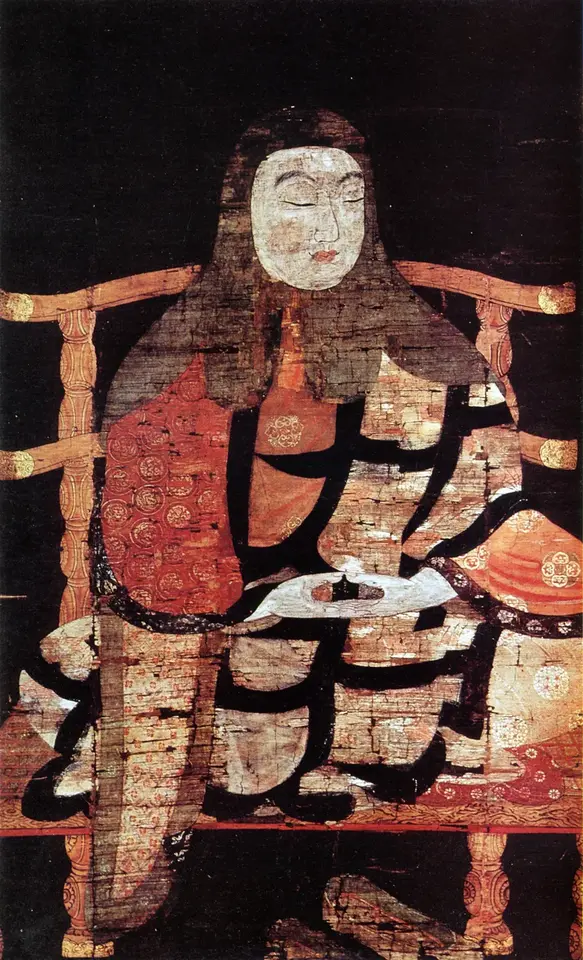
最澄
Saichō (最澄, 767–822), secular name Mitsunoobito Hirono, posthumously honored as Dengyō Daishi (传教大师), was an eminent Buddhist monk of early Heian-period Japan and the founder of the Japanese Tendai school of Buddhism. Tracing his lineage to immigrant Chinese gentry from the late Eastern Han dynasty, he entered the provincial temple of Ōmi under the monk Gyōhyō and subsequently received full vinaya ordination at Tōdai-ji in…
Saichō (最澄, 767–822), secular name Mitsunoobito Hirono, posthumously honored as Dengyō Daishi (传教大师), was an eminent Buddhist monk of early Heian-period Japan and the founder of the Japanese Tendai school of Buddhism. Tracing his lineage to immigrant Chinese gentry from the late Eastern Han dynasty, he entered the provincial temple of Ōmi under the monk Gyōhyō and subsequently received full vinaya ordination at Tōdai-ji in Nara. Disillusioned with the political entanglements and corruption of the established Nara clerical hierarchy, he withdrew to Mount Hiei in 785 to spend twelve years in strict ascetic retreat, immersing himself in the works of Chinese Tiantai master Zhiyi. In 804, he traveled to Tang China as a state-sponsored scholar-monk attached to the Japanese diplomatic embassy. Visiting Mount Tiantai in Zhejiang, he received direct transmission of Tiantai meditation doctrines and the Mahayana bodhisattva precepts from the seventh patriarch Daosui and master Xingman, while also receiving esoteric Esoteric Buddhist initiations at Longxing Temple in Yuezhou from Shunxiao. Returning to Japan in 805 with hundreds of canonical texts, Saichō formally established the Japanese Tendai school, advocating a comprehensive fourfold synthesis encompassing Tiantai exoteric philosophy, Esoteric Buddhism, Chan contemplation, and bodhisattva precepts. In his later years, he engaged in renowned theological debates against Hossō scholar Tokuitsu and waged a determined campaign to establish an independent Mahayana ordination platform on Mount Hiei. He passed away in 822 at the age of fifty-six; seven days after his demise, the imperial court officially granted permission for the Mount Hiei ordination platform. In 866, Emperor Seiwa bestowed upon him the posthumous title Dengyō Daishi, marking the first time an imperial master title was conferred in Japanese history.
Born into the naturalized Chinese Mitsunoobito family in Shiga, Ōmi Province.
Received full vinaya ordination at Tōdai-ji, but promptly departed for Mount Hiei to pursue solitary cultivation.
Founded Ichijō Shikan'in (the future Central Main Hall of Enryaku-ji) on Mount Hiei, lighting the Inextinguishable Dharma Lamp.
Sailed with the Japanese embassy to Tang China, climbing Mount Tiantai to receive Tiantai transmission from Daosui.
Returned to Japan carrying over two hundred scriptural collections, performing Japan's first official esoteric abhiṣeka ceremony.
Emperor Kanmu officially sanctioned two annual ordinands for the Tendai Lotus school, formally establishing the tradition.
Passed away at Chūdō-in on Mount Hiei at age fifty-six; the imperial court approved his Mahayana ordination platform seven days later.
Saichō was born into the prominent Mitsunoobito lineage of Shiga District in Ōmi Province, a clan tracing its descent to continental immigrant families claiming lineage from Emperor Ling of the Eastern Han dynasty. Endowed with profound intellectual aptitude from childhood, he showed an early aversion to secular honors. In 778, at the age of twelve, he entered the provincial monastery of Ōmi under the guidance of Master Gyōhyō of Daian-ji, taking monastic vows and studying the Avatamsaka Sutra, the Lotus Sutra, and Yogacara philosophy.
In 785, at age nineteen, Saichō was formally ordained as a state-sponsored monk at the official ordination hall of Tōdai-ji in the southern capital of Nara. However, he found the Nara monastic establishment deeply corrupted by secular ambition, political intrigue, and wealth accumulation. Just three months after his formal ordination, Saichō abandoned the administrative prospects of the southern capital and climbed Mount Hiei near his native province. Erecting a thatched hut amid the rugged peaks, he committed himself to a twelve-year solitary retreat, vowing never to return to the secular world until he attained genuine awakening. During this intensive hermitage, he studied the Three Great Works of Tiantai by Master Zhiyi, which had been brought to Japan decades earlier by the Chinese master Jianzhen. In 788, Saichō carved a statue of the Medicine Buddha with his own hands and established Ichijō Shikan'in, igniting the Inextinguishable Dharma Lamp and dedicating the sanctuary to the supreme realization of the One Vehicle.
In 802, at the invitation of court noble Wake no Hiroyo, Saichō delivered lectures on the Lotus Sutra and Tiantai exegesis at Takaosan-ji near Kyoto, winning the warm admiration of Emperor Kanmu, who appointed him an imperial court chaplain. Recognizing that the Tiantai texts available in Japan contained textual omissions, Saichō submitted a formal memorial requesting imperial permission to travel to Tang China as a short-term scholar-monk to retrieve authentic canonical transmissions.
In 804, accompanied by his disciple Gishin, who possessed fluent Chinese language skills, Saichō embarked on the primary vessel of the Japanese diplomatic mission commanded by Ambassador Fujiwara no Kadonomaro. Surviving violent ocean storms, they landed at Mingzhou (modern Ningbo, Zhejiang). Assisted by Lu Chun, the Prefect of Taizhou, Saichō made a pilgrimage to Mount Tiantai, the ancestral seat of the Tiantai school, visiting Guoqing Temple and Foglong Temple. At Guoqing Temple, he presented himself as a humble disciple before Master Daosui, the seventh patriarch of the Tiantai lineage, studying meditation manuals day and night and transcribing primary commentaries. Daosui subsequently conferred upon Saichō and Gishin the Mahayana bodhisattva precepts at Dade Temple. Saichō then traveled to Mount Foglong to receive guidance from Abbot Xingman, receiving essential Tiantai doctrinal transmissions. Completing his studies at Tiantai, he proceeded to Longxing Temple in Yuezhou (modern Shaoxing), where he studied esoteric rituals under Master Shunxiao, receiving initiation into both the Diamond Realm and Womb Realm mandalas along with ritual implements.
In 805, having completed his mission, Saichō returned to Japan aboard the embassy fleet, bringing with him two hundred and thirty distinct canonical works spanning four hundred and sixty scrolls, including Tiantai commentaries, esoteric manuals, Chan treatises, and sacred mandalas. Upon his arrival in Kyoto, he was received with high honors by Emperor Kanmu. At Takaosan-ji, Saichō performed Japan's first official esoteric consecration ceremony, administering the two-realm initiations to retired sovereign Heizei, royal princes, senior ministers, and prominent Nara abbots.
In 806, Emperor Kanmu issued an imperial decree officially authorizing two annual state ordinands for the Tendai Lotus tradition, one specializing in meditative contemplation and the other in esoteric rituals. This decree marked the formal establishment of Japanese Tendai as an independent state-recognized Buddhist school. Saichō anchored his new tradition upon the Lotus Sutra, crafting a comprehensive framework that harmonized Tiantai exoteric philosophy, Zhenyan esoteric rituals, Chan meditation, and Mahayana bodhisattva ethics. Over the following decades, Ichijō Shikan'in on Mount Hiei was systematically developed into the monastic complex known as Enryaku-ji.
As Saichō articulated the theoretical foundations of Tendai, he encountered fierce resistance from the entrenched scholastic establishment in Nara. During the Kōnin era, Saichō engaged in a celebrated literary debate with Tokuitsu, an erudite scholar of the Hossō (Yogacara) school. Tokuitsu maintained the orthodox Hossō position that sentient beings possess five distinct natures and that not all beings are destined for Buddhahood. In response, Saichō authored monumental polemical works, including Exemplary Sentences of the Lotus Sutra and Treatise on Protecting the Realm, arguing on canonical grounds that the universal Buddhahood revealed in the Lotus Sutra represents the ultimate truth of the Mahayana, thereby solidifying Tendai's intellectual supremacy.
Simultaneously, Saichō waged a protracted struggle against Nara's monopoly over monastic ordination. Under contemporary Japanese law, valid monastic ordination required candidates to receive the two hundred and fifty Hinayana vinaya rules at one of three state-controlled ordination platforms in Nara. Saichō argued that these rigid monastic rules hindered the active compassion required of Mahayana bodhisattvas, petitioning the court to permit an independent Mahayana ordination platform on Mount Hiei based on the Brahma Net Sutra. In 819, he submitted the Regulations for Tendai Students and his masterpiece, the Treatise Clarifying the Precepts, vehemently critiquing the Hinayana ordination system. His proposals triggered vehement protests from the Nara Office of Monastic Affairs, leaving the issue deadlocked.
Worn down by relentless institutional struggles and deteriorating health, Saichō passed away peacefully on the fourth day of the sixth lunar month in 822 at Chūdō-in on Mount Hiei at the age of fifty-six. In his final instructions to his disciples, he urged them to preserve the pure Mahayana bodhisattva precepts and protect the spiritual integrity of Mount Hiei as a treasure of the nation.
Deeply moved by Saichō's lifelong devotion and uncompromising vision, Emperor Saga issued an imperial rescript just seven days after the master's passing, officially sanctioning the establishment of an independent Mahayana ordination platform on Mount Hiei. This monumental grant liberated the monastery from the supervision of Nara, elevating Enryaku-ji into the preeminent spiritual and academic citadel of medieval Japan. In 866, Emperor Seiwa conferred upon Saichō the posthumous title of Dengyō Daishi, marking the first time in Japanese history that the title of Daishi (Great Master) was bestowed upon a Buddhist master.
Saichō's foremost conceptual innovation was his creation of an inclusive Buddhist framework that synthesized four distinct traditions: Tiantai exoteric doctrine, Esoteric Buddhism, Chan contemplation, and bodhisattva precepts. During his brief study in China, he sought out lineages across sectarian divides, mastering meditation from the Tiantai patriarchs, receiving esoteric initiations in Yuezhou, and studying Oxhead Chan meditation.
Upon returning to Japan, Saichō mandated that all Tendai scholar-monks pursue rigorous training in both exoteric contemplation and esoteric rituals. This holistic integration gave birth to the unique Taimitsu tradition, which enriched Buddhist contemplative practices and shaped the aesthetic, philosophical, and institutional trajectory of Japanese culture throughout the medieval era.
Saichō's successful crusade for an independent Mahayana ordination platform transformed the institutional history of Japanese Buddhism. Prior to his campaign, all Japanese monastics were legally bound to receive the Hinayana vinaya under the authority of the Nara monastic hierarchy, which maintained a conservative monopoly over clerical credentials.
Through his treatise Treatise Clarifying the Precepts, Saichō demonstrated that the bodhisattva precepts of the Brahma Net Sutra possessed supreme spiritual authority, arguing that Mahayana monks should be ordained solely through the tenfold major and forty-eight minor bodhisattva vows. The establishment of the Mount Hiei ordination platform granted the monastery full legal autonomy. As a consequence, nearly all transformative figures of medieval Japanese Buddhism—including Hōnen, Shinran, Dōgen, Eisai, and Nichiren—received their foundational ordination and education on Mount Hiei, establishing Saichō as the grandfather of Japanese Buddhist reformation.
FIGURES ASSOCIATED WITH THIS DYNASTY
Bibliographic information is not yet available for this entry.