Birth and Childhood
Born on the fifth day of the eleventh lunar month into a scholarly family in Huating County, Songjiang Prefecture.
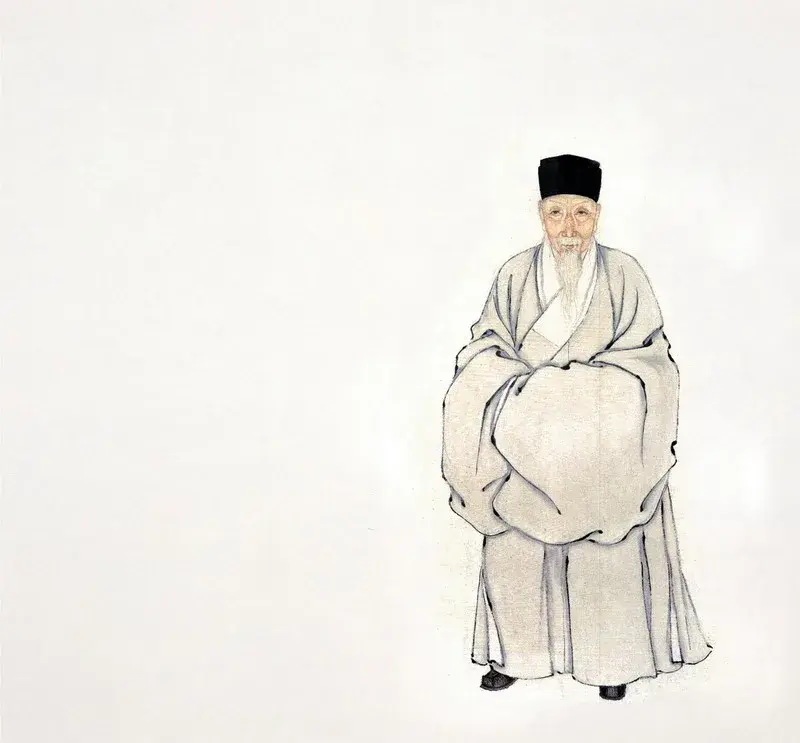
陈继儒
Chen Jiru (December 14, 1558 – October 16, 1639), courtesy name Zhongchun and art names Meigong and Migong, was a native of Huating County, Songjiang Prefecture, South Zhili (present-day Songjiang District, Shanghai). A celebrated writer, painter, calligrapher, connoisseur, and publisher of the late Ming dynasty, he was the preeminent leader of the late Ming "mountain recluse" (shanren) culture. In his early years as a…
Chen Jiru (December 14, 1558 – October 16, 1639), courtesy name Zhongchun and art names Meigong and Migong, was a native of Huating County, Songjiang Prefecture, South Zhili (present-day Songjiang District, Shanghai). A celebrated writer, painter, calligrapher, connoisseur, and publisher of the late Ming dynasty, he was the preeminent leader of the late Ming "mountain recluse" (shanren) culture. In his early years as a government student (xiucai), Chen displayed extraordinary literary brilliance, earning deep admiration from former Senior Grand Secretary Xu Jie. Disillusioned with the corrupt conventions of civil service examinations, the twenty-nine-year-old Chen publicly burned his scholar's robes and cap in 1586, swearing never to enter officialdom. He lived in secluded retirement in Small Kun Mountain and East She Mountain, building the Wanxian Hermitage, Wanxiang Hall, and Laiyi Hall, dedicating himself to writing and artistic connoisseurship for over fifty years. Although residing in mountain retreats, his renown resounded across the empire. High officials eagerly sought his counsel, and the imperial court repeatedly summoned him to serve in prestigious literary posts in the Hanlin Academy, which he steadfastly declined, pleading chronic illness. He remained deeply concerned with regional public welfare, repeatedly petitioning the throne on critical local matters including famine relief during Songjiang's great floods, white grain tribute reforms, and the restructuring of Jinshan Guard. Artistically, he was an intimate friend of Dong Qichang, jointly advocating literati painting and the doctrine that calligraphy and painting share the same source; he excelled in ink plum blossoms and mist-shrouded landscapes, characterized by sparse elegance. In calligraphy, he followed Su Shi and Mi Fu, engraving the Wanxiang Tang Tie. In literature, he pioneered late Ming familiar essays (xiaopinwen), compiling and publishing the monumental collection Baoyantang Miji, and authoring Nigu Lu, Xiaochuang Youji, and Chen Meigong Quanji. He passed away at East She Mountain in 1639 at the age of eighty-two.
Born on the fifth day of the eleventh lunar month into a scholarly family in Huating County, Songjiang Prefecture.
Attained licentiate status at twenty-one, earning praise from former Grand Secretary Xu Jie; his poetry won wide acclaim.
At twenty-nine, publicly burned his scholar's robes, renouncing civil examinations to retire to Small Kun Mountain.
Relocated to East She Mountain, building Wanxian Hermitage and Wanxiang Hall to collect antiques and rare books.
When catastrophic floods struck Songjiang, petitioned Senior Grand Secretary Wang Xijue and established porridge stations.
Gathered rare and endangered texts, compiling and printing the massive collectanea Baoyantang Miji.
Composed Jinshan Wei Yi, proposing to transform Jinshan Guard into an administrative county to relieve local tax burdens.
Submitted memorials detailing the bankruptcy of tribute-transporting households in Songjiang, urging systemic reforms.
Emperor Chongzhen issued special decrees recruiting him for court office; Chen declined citing advanced age and infirmity.
Passed away peacefully at East She Mountain on October 16 at eighty-two, buried on the mountain.
Chen Jiru was born on December 14, 1558 (the fifth day of the eleventh lunar month in the thirty-seventh year of the Jiajing reign) in Huating County, Songjiang Prefecture. His family was an eminent Jiangnan lineage; Chen displayed precocious brilliance from youth, reading widely across classics and standard histories. At twenty-one, he passed the examinations to become a government student (xiucai), his literary reputation spreading rapidly. Former Senior Grand Secretary Xu Jie, retired in Songjiang, read Chen's poetry and was struck by his talent, inviting him to his estate as an honored guest and praising him as an incomparable talent of the realm. However, late Ming civil examinations were plagued by rigid eight-legged conventions. Though Chen sat repeatedly for provincial examinations, his refusal to conform to stereotypical formats resulted in successive failures. Observing examiners' dogmatism and contemporary literati chasing fame, Chen experienced profound disillusionment.
During his studies, Chen forged a close bond with fellow county talent Dong Qichang, touring mountains and debating classical philosophy and painting. While Dong chose to pursue imperial examinations and attained the jinshi degree, Chen preferred the freedom of the hills. In 1586 (the fourteenth year of the Wanli reign), the twenty-nine-year-old Chen resolved to break all bureaucratic shackles. Before astonished teachers and friends, he stripped off his blue scholar's robes and cap before the Songjiang Confucian Academy, casting them into an open brazier to burn to ashes, swearing never to sit for another civil examination. He then relocated to the southern slope of Small Kun Mountain, building a thatched retreat on the site of the ancient cottage of Western Jin literary masters Lu Ji and Lu Yun. He built a shrine honoring the Lu brothers, requesting flowering plants and strange stones from friends to plant before the hermitage, calling it the "Flower-Begging Field" and declaring that in his poverty, this was how he entertained the ancient masters. Living in seclusion, burning incense and meditating, he styled himself "Meigong." Rather than diminishing his fame, his proud renunciation of office made him celebrated throughout southeastern China.
Following his father's death, Chen fulfilled filial mourning rites, burying his parents at East She Mountain in Songjiang. In 1595 (the twenty-third year of the Wanli reign), he moved his residence from Small Kun Mountain to the foot of East She Mountain, constructing his celebrated East She Mountain Retreat. East She Mountain was blessed with pristine springs and bamboo groves; Chen built pavilions and studies following the natural slopes, naming them Wanxian Hermitage, Wanxiang Hall, Laiyi Hall, and Banyan Studio. Within these halls, Chen gathered ancient bronze vessels, stone stelae, Song and Yuan rubbings, and rare manuscripts, brewing spring water tea at dawn and collating texts continuously. He remarked: "Reading a book one has never seen is like making a virtuous friend; seeing a book one has read before is like meeting an old companion."
During this era, Chen established the quintessential model of late Ming literati reclusion. Deeply versed in tea connoisseurship, incense appreciation, zither playing, and landscape horticulture, he possessed refined taste in Yixing purple clay teapots, Xuande bronze censers, Duan and She inkstones, and Huizhou pine-soot ink. Maintaining a close friendship with master potter Shi Dabin, he designed purple clay teapot shapes and inscribed poetic epigraphs upon them, leading the trend of literati involvement in decorative craft arts. Walking through the hills in rustic robes and straw sandals, scholars, high officials, and Chan monks traveling through Jiangnan regarded visiting Master Chen Meigong at East She Mountain as an essential pilgrimage. Newly appointed provincial governors and county magistrates dispatched messengers to consult his governance advice; scholars publishing anthologies competed to secure his prefaces to lend prestige to their books; even tributary envoys from Korea, Japan, and Ryukyu arriving in Beijing purchased books and calligraphy bearing "Chen Meigong's" signature.
Confronted with Chen's lofty seclusion and nationwide fame, imperial ministers repeatedly petitioned the throne to employ him. Across the Wanli, Tianqi, and Chongzhen reigns, court grandees recommended him as an exemplary scholar of superior conduct, urging that he be appointed to imperial posts. Emperors Wanli and Chongzhen issued special edicts summoning him to Beijing to serve as Hanlin Compiler or Director of Studies in the Directorate of Education, while local officials visited his hermitage urging him to accept. Aware of the vicious factionalism and deadly perils of late Ming court politics, Chen maintained his commitment to mountain seclusion, submitting humble memorials pleading advanced age and chronic ailments to decline every offer, remaining an unranked commoner throughout his life.
Yet Chen was far from a self-absorbed recluse indifferent to public suffering. Songjiang was subject to the heaviest tax quotas in the empire, leaving commoners impoverished by ruthless tax collectors. In 1608 (the thirty-sixth year of the Wanli reign), catastrophic rainstorms flooded Songjiang, submerging agricultural fields and triggering famine. Grief-stricken, Chen authored A Letter on Famine Relief to Senior Grand Secretary Wang, detailing how starving peasants were selling children, condemning merciless tax collection, urging the throne to forgive delinquent taxes, and coordinating with local gentry to establish porridge relief stations along major transport junctures, saving countless famine victims.
In 1622 (the second year of the Tianqi reign), responding to the depletion of military revenue at the coastal Jinshan Guard and mounting friction between garrison soldiers and landless migrants, Chen composed his celebrated Jinshan Wei Yi (Proposals for Jinshan Guard). Tracing the history of military colonies (tuntian), he exposed the bankruptcy of the garrison colony system, advocating that Jinshan Guard be converted into an administrative civilian county to equalize corvee duties and reduce surplus grain quotas, relieving local burdens through institutional reform. In 1632 (the fifth year of the Chongzhen reign), addressing the ruinous requirement forcing Songjiang peasants to transport imperial "white grain" tribute to Beijing, he submitted a memorial exposing the injustice of the delivery system, urging official transport and the abolition of private compensatory liability.
In 1638 (the eleventh year of the Chongzhen reign), the eighty-one-year-old Chen, observing peasant uprisings sweeping northern China and banditry rising around Lake Tai, took up his brush while ill to write to Songjiang Prefect Fang Yuegong, detailing strategies for training urban militia and patrolling coastal waterways. On October 16, 1639 (the twentieth day of the ninth lunar month in the twelfth year of the Chongzhen reign), Chen passed away peacefully at Wanxiang Hall at eighty-two. Disciples honored his noble conduct with the private posthumous title "Master Zhenxian," laying him to rest amid the forests of East She Mountain.
Chen Jiru held a patriarchal status in late Ming art history. An intimate friend of Dong Qichang since youth, the two inspired each other over sixty years of artistic exchange, co-founding the "Huating School" (Songjiang School) and constructing the theoretical framework of literati painting that influenced subsequent centuries. Chen was the firmest champion and co-creator of Dong Qichang's famous "Northern and Southern Schools" theory of Chinese landscape painting. He maintained that painting must trace its orthodox literati lineage from Wang Wei, Jing Hao, Guan Tong, Dong Yuan, and Juran down through the Four Great Masters of the Yuan (Huang Gongwang, Wu Zhen, Ni Zan, Wang Meng), fiercely criticizing the late Zhejiang School academy style for its rigid brushwork and ostentatious displays of force.
Chen emphasized the doctrine that calligraphy and painting share the same origin (shuhua tongyuan), insisting that a painter must possess profound scholarly erudition and an untrammeled moral character to project spontaneous, naive scholar-spirit onto paper. In his own painting, Chen excelled in ink landscapes, bamboo, and plum blossoms. His plum paintings stood supreme in his era, executed largely in album leaves and small hanging scrolls without colors, utilizing dry, dilute ink brushwork to convey the archaic vitality of gnarled, mossy branches adorned with sparse, cold blossoms, capturing the spirit of Lin Bu's solitary plum verse and Yuan master Wang Mian. His style exerted an immense influence on the Eight Masters of Jinling, Huang Binhong, and modern expressive ink painting. Surviving masterpieces like Plum Blossom Album and Cloud-Shrouded Mountains Scroll are preserved in the Palace Museum.
In calligraphy, Chen initially studied Su Shi, capturing his fleshy and dignified charm; in mid-life he absorbed Mi Fu's dynamic, multi-directional brushwork; in his late years he incorporated Yan Zhenqing's archaic weightiness. His calligraphy possessed internal bone strength with untrammeled ease, projecting the transcendent aura of a mountain recluse. He selected and transcribed Jin and Tang masterpieces, engraving the Wanxiang Tang Tie and Laiyi Tang Tie, which circulated widely across China as gems of late Ming model calligraphic engraving.
Chen's signature contribution to Chinese literary history was founding and popularizing late Ming "pure talk" familiar essays (xiaopinwen). Confronting the sterile dogmatism of late Song-Ming Neo-Confucianism and the empty archaism of the Former and Latter Seven Masters, Chen advocated writing from authentic personal experience, deploying fresh, elegant, and concise prose to convey existential wisdom and aesthetic sensibility. His masterworks Xiaochuang Youji (also known as Zuigutang Jiansao) and Ande Zhangzhe Yan were divided into twelve thematic sections—Awakening, Passion, Steepness, Spirit, Simplicity, Landscape, Resonance, Wonder, Splendor, Heroism, Principle, and Charm—synthesizing Confucian moral self-cultivation, Daoist tranquility, and Chan Buddhist insight.
With unique literati insight, Chen elevated everyday practices—reading, brewing tea, admiring flowers, burning incense, mountain walking, zither playing, and conversing with friends—into a conscious philosophy of life aesthetics. Famous aphorisms such as "Untroubled by favor or disgrace, watch leisure flowers bloom and fall in the courtyard; indifferent to staying or leaving, follow wandering clouds rolling and unrolling across the sky" and "Building a thatched hut amid pines and bamboo, idle clouds seal the door; strolling beside forest streams, falling petals fill one's robes" have been recited for centuries, reshaping the spiritual composure and leisurely aesthetic philosophy of Chinese literati.
In classical bibliography and documentary collation, Chen achieved monumental success. Relying on Wanxiang Hall's extensive library and his broad network of scholar friends, Chen spent decades directing the compilation and woodblock printing of Baoyantang Miji, the most important large-scale comprehensive private collectanea of the late Ming. Divided into four series—Universal, Broad, Continued, and Remaining Collections—it gathered hundreds of rare classical texts spanning from the pre-Qin to the Ming dynasty.
In compiling the collectanea, Chen focused on tracking down endangered, rarely printed miscellaneous essays, technological and agricultural treatises, epigraphic commentaries, geographical notes, and unofficial local histories. Departing from rigid fourfold cataloging conventions, he sought to preserve the original textual authenticity of ancient works, rescuing large quantities of precious Song and Yuan literature from destruction during late Ming wars. Beautifully printed from clear woodblocks, the collection inaugurated the scholarly trend among late Ming gentry of compiling massive literary collectanea, praised by the compilers of the Qing Siku Quanshu as an indispensable treasury for classical scholarship.
Though living in mountain reclusion, Chen's writings were animated by deep statecraft concern for the people. In A Letter on Famine Relief to Senior Grand Secretary Wang, he analyzed how wealthy merchants hoarding grain and predatory official collections caused social collapse during Jiangnan floods, proposing tax remissions, relief soup kitchens, grain price stabilization, and water conservancy projects. In Jinshan Wei Yi, he analyzed the decay of coastal garrisons where lands lay fallow and soldiers were subjected to menial corvee, advocating that military guards be peacefully converted into civilian administrative counties to reduce Songjiang's disproportionate tax burdens. His practical foresight regarding white grain tribute reforms and county militia defenses destroyed the stereotype of mountain recluses as idle talkers detached from reality, exemplifying the patriotic conscience of classical Chinese intellectuals.
FIGURES ASSOCIATED WITH THIS DYNASTY