Joining the Uprising
Cao Cao raised a volunteer army at Chenliu to oppose Dong Zhuo; Xiahou Yuan and Xiahou Dun arrived first to join his banner as Separate Division Majors.
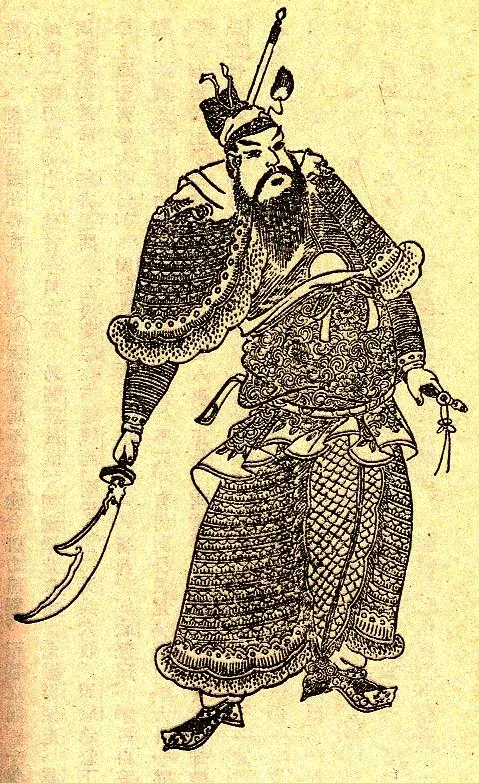
夏侯渊
Xiahou Yuan (died 219), courtesy name Miaocai, was a native of Qiao County in Peiguo. A descendant of the Western Han dynasty founding minister Xiahou Ying, he was a distinguished imperial clan general of Cao Wei and a maternal relative of Cao Cao (his wife was the younger sister of Cao Cao's primary consort Lady Ding). In his youth, Xiahou Yuan took the fall for Cao Cao when the latter committed an offense in their hometown,…
Xiahou Yuan (died 219), courtesy name Miaocai, was a native of Qiao County in Peiguo. A descendant of the Western Han dynasty founding minister Xiahou Ying, he was a distinguished imperial clan general of Cao Wei and a maternal relative of Cao Cao (his wife was the younger sister of Cao Cao's primary consort Lady Ding). In his youth, Xiahou Yuan took the fall for Cao Cao when the latter committed an offense in their hometown, enduring imprisonment until Cao Cao secured his release. During years of catastrophic famine across Yan and Yu provinces, Xiahou Yuan abandoned his own infant son in order to share his meager provisions and preserve the orphaned infant daughter of his deceased elder brother, winning widespread acclaim for his self-sacrificing virtue. As a military commander, Xiahou Yuan was celebrated for his thunderous operational speed and mastery of fluid maneuver warfare. His rapid marches inspired the contemporary army adage: "Disciplinary Colonel Xiahou Yuan marches five hundred li in three days and a thousand li in six days." Following Cao Cao's victory over the northwestern warlords at Weinan in 211, Xiahou Yuan was stationed at Chang'an to oversee the pacification of the Guanzhong and Longyou regions. Over the next three years, he launched relentless counteroffensives against Ma Chao and Han Sui, relieved the siege of Jicheng, drove Di king Qianwan into exile, and crushed Han Sui at Changli by striking at his logistical base. In 214, he stormed the mountain fortress of Fuhan in a lightning thirty-day siege, executing Song Jian and extinguishing his self-proclaimed Kingdom of Hantou after thirty-one years of separatist rule, prompting Cao Cao to lavishly praise him as having strided like a tiger across the western passes. Appointed General Who Conquers the West and supreme commander of Hanzhong, Xiahou Yuan spearheaded the defense of the southern passes against Liu Bei's full-scale northern invasion between 217 and 219. In the first month of 219, during the climactic confrontation around Mount Dingjun, Liu Bei set fire to the outer wooden palisades protecting the Wei camp under cover of darkness and mounted a ferocious assault against the eastern lines held by Zhang He. Xiahou Yuan dispatched half of his core troops to reinforce Zhang He and personally led four hundred lightly equipped retainers to repair the breached deer-horn palisades. Observing his isolated position from the high ridges, the Shu strategist Fa Zheng urged veteran general Huang Zhong to launch an immediate downhill charge. Xiahou Yuan was surrounded and killed in the ensuing melee. Posthumously styled Marquis Min, Xiahou Yuan left an indelible imprint upon Cao Wei's founding territorial expanse through his legendary mobile campaigns.
Cao Cao raised a volunteer army at Chenliu to oppose Dong Zhuo; Xiahou Yuan and Xiahou Dun arrived first to join his banner as Separate Division Majors.
Cao Cao escorted Emperor Xian to Xuchang; Xiahou Yuan served as Agricultural Commissioner in Chenliu and Yingchuan to oversee military farming.
During the Battle of Guandu, Xiahou Yuan mobilized and supervised grain shipments across Yan, Yu, and Xu provinces, keeping the frontline supplied.
Reinforced Yu Jin at Donghai to crush the persistent insurrection of Chang Xi, storming more than ten camps and earning promotion to Disciplinary Colonel.
Marched swiftly to Hefei to confront several tens of thousands of insurgents under Lei Xu, slaying the rebel leader and absorbing his remnants.
Following Cao Cao's victory at Weinan, Xiahou Yuan stayed behind as Acting Army Leader in Chang'an, pacifying Yang Qiu's forces in Anding.
Besieged and captured Daling in Taiyuan, executing the rebel leader Shang Yao and receiving enfeoffment as Marquis of Bochangting.
Rescued Jicheng from Ma Chao, routed Han Sui at Changli, and stormed Fuhan to decapitate Song Jian, subduing the entire Longyou region.
Assisted Cao Cao in subduing Zhang Lu; commissioned General Who Conquers the West to hold Hanzhong against Shu forces.
Defended Yangping Pass alongside Zhang He, repelling multiple probing assaults launched by Liu Bei's northern invasion force.
Liu Bei burned the outer perimeter fences at Mount Dingjun; Xiahou Yuan sent half his host to save Zhang He and repaired the barriers in person.
Charged downhill by Huang Zhong's strike force, Xiahou Yuan fell in ferocious combat on Mount Dingjun and was posthumously styled Marquis Min.
Xiahou Yuan was born in Qiao County of Peiguo, claiming direct descent from Xiahou Ying, the founding Minister of the Coachmen under Emperor Gaozu of Han. For generations, the Xiahou and Cao lineages of Qiao shared close marital and fraternal ties. In his youth, Xiahou Yuan was acclaimed for his courage, stamina, and prowess in horsemanship and archery. When Cao Cao ran afoul of local magistrates in Qiao, Xiahou Yuan unhesitatingly took the blame and submitted to imprisonment on his behalf. Cao Cao worked tirelessly behind the scenes to secure his liberation, cementing an unshakeable bond of mutual loyalty between the two men. Subsequently, severe drought and locust plagues struck the Central Plains, leading to widespread famine, social collapse, and cannibalism. In this desperate crisis, with grain supplies exhausted, Xiahou Yuan made the heartbreaking decision to abandon his own infant son in order to preserve the life of his deceased elder brother's orphaned infant daughter, an act of familial devotion celebrated throughout his native commandery.
In the twelfth month of 189, following Dong Zhuo's usurpation of the imperial court, Cao Cao fled Luoyang and disbursed his family wealth at Chenliu to recruit a volunteer coalition. Xiahou Yuan, accompanied by his elder cousin Xiahou Dun, rallied local kin and retainers to join Cao Cao's standard, receiving appointment as Separate Division Major and Cavalry Commandant. In 196, after Cao Cao welcomed Emperor Xian to the newly established capital of Xuchang, he instituted military farming colonies to resolve pervasive shortages of provisions. Xiahou Yuan was appointed Agricultural Commissioner of Chenliu and subsequently of Yingchuan, directing soldiers and civilians in clearing uncultivated fields and dredging irrigation canals, accumulating vast storehouses of grain within a few years. His administrative efficiency led to promotions as Agricultural Colonel and ultimately Army Leader.
In 200, the Battle of Guandu erupted between Cao Cao and Yuan Shao. Outnumbered and locked in a grinding war of attrition across entrenched earthworks, Cao Cao's troops faced severe food shortages that threatened complete collapse. Cao Cao appointed Xiahou Yuan supreme supervisor over the requisition and transport of grain from Yan, Yu, and Xu provinces. Xiahou Yuan organized round-the-clock transport caravans across waterways and roads, maintaining an unbroken supply of hundreds of thousands of bushels of grain to the frontline camps. His logistical mastery ensured that Cao Cao never suffered tactical collapse from starvation, laying the material foundation for the decisive victory at Guandu. Following Yuan Shao's downfall, Xiahou Yuan served as Acting Army Leader, frequently leading expeditions across the Yellow River to extinguish remnants of the Yuan clan.
Following the pacification of the north, scattered insurgent bands plagued the central commanderies. Renowned for his extraordinary operational speed and aptitude for long-distance rapid deployment, Xiahou Yuan was repeatedly entrusted by Cao Cao with high-priority mobile strike missions. In 206, when Chang Xi rebelled for the third time in Donghai Commandery and stalemated initial assaults, Cao Cao dispatched Xiahou Yuan with a mobile detachment to reinforce Yu Jin. Upon arrival, Xiahou Yuan launched immediate assaults without pause for encampment, overrunning ten peripheral outposts in rapid succession and cornering Chang Xi into unconditional surrender. He was promoted to Disciplinary Colonel.
In 209, the rebel leader Lei Xu gathered tens of thousands of followers in Lujiang Commandery, relying on rough terrain to ravage the Huai River basin. Cao Cao ordered Xiahou Yuan to conduct a punitive campaign. Having scouted weaknesses in Lei Xu's sprawling layout, Xiahou Yuan forced-marched his troops day and night across hundreds of li, achieving complete tactical surprise. In a pitched open-field battle, he routed Lei Xu's army, beheaded the rebel chieftain, and accepted the surrender of more than ten thousand fighters, restoring security to the Huai region. That same year, Shang Yao assembled several thousand rebels at Daling in Taiyuan Commandery. Xiahou Yuan marched through Bing Province, united with Zhang He's detachment, stormed the mountaintop stronghold, and slew Shang Yao along with a thousand followers.
Xiahou Yuan's defining operational hallmark was his lightning operational tempo. Time and again, his columns appeared in enemy rear areas far ahead of anticipated schedules, falling upon unprepared garrisons before defensive lines could crystallize. Soldiers throughout the Cao Wei military marveled at his speed, coining the widely quoted military proverb: "Disciplinary Colonel Xiahou Yuan marches five hundred li in three days and a thousand li in six days." Cao Cao routinely deployed him as his primary operational firefighter, and in 212, in recognition of his accumulation of field victories, the court enfeoffed Xiahou Yuan as Marquis of Bochangting.
In 211, Cao Cao personally led the northern grand army to campaign against the allied warlords of Guanzhong, shattering the coalition of Ma Chao and Han Sui at the Battle of Weinan. When Cao Cao returned east to Ye, he appointed Xiahou Yuan Acting Army Leader stationed at Chang'an, vesting him with full theater command over eastern garrisons in the west to extinguish remaining pockets of resistance. Yang Qiu rallied tens of thousands of survivors at Anding, but Xiahou Yuan executed a rapid encirclement, compelling Yang Qiu to surrender without prolonged siege and pacifying the central Guanzhong basin.
However, Ma Chao retreated into Liang Province to rebuild his strength. In 213, Ma Chao unified the Qiang and Di tribes across Longyou, capturing the provincial capital of Jicheng, slaying Inspector Wei Kang, and proclaiming himself General Who Conquers the West and Governor of Bing Province. In the spring of 214, local loyalists Yang Fu, Jiang Xu, and Zhao Ang launched a coordinated insurrection against Ma Chao from Mount Qi. When Ma Chao retaliated viciously, Jiang Xu dispatched couriers to Chang'an seeking immediate relief. Several generals under Xiahou Yuan argued that because Cao Cao was far away in Ye, imperial authorization had to be obtained before marching. Xiahou Yuan overruled them emphatically, declaring that Ye was four thousand li away round-trip, and that waiting for a dispatch would mean the slaughter of Jiang Xu and his men long before help arrived. Xiahou Yuan immediately deployed Zhang He with five thousand light horsemen as the forward vanguard, while he followed closely with the main host.
Ma Chao met Zhang He's contingent at Mount Qi, but when he saw the massive banners of Xiahou Yuan's main army cresting the horizon, his tribal allies lost heart and withdrew in disarray. Exploiting his advantage, Xiahou Yuan pursued the retreating enemy to Xiabian, where Di chieftain Qianwan attempted to block his passage across the defiles. Xiahou Yuan broke through with a furious cavalry charge, scattering the Di warriors and forcing Qianwan to flee south to join Liu Bei in Yi Province. Xiahou Yuan captured all of Qianwan's supply trains and livestock before wheeling his columns westward toward Yueyang to strike at Han Sui's heartland.
Aware of Xiahou Yuan's approach, Han Sui gathered his forces to make a stand at Xianqin, but retreated in alarm upon learning that Xiahou Yuan had already seized Yueyang. Xiahou Yuan's subordinates urged an immediate pursuit to surround Xianqin, but Xiahou Yuan demonstrated superior strategic insight: "Han Sui's army is composed of veteran Qiang and Hu fighters holding fortified positions. Frontal assault will incur heavy casualties. Han Sui's primary supply depot is stationed at Changli, defended mostly by elderly and infirm tribal levies. If we bypass Xianqin and strike Changli directly, the frightened tribesmen will cry out for relief. If Han Sui refuses to march to their rescue, his grain supply will be cut and his army will disintegrate. If he comes to their aid, he must fight us on open ground where we can crush him at our convenience."
Leaving his baggage train under guard, Xiahou Yuan advanced rapidly toward Changli, putting thousands of Qiang encampments to the torch. Panic swept through Han Sui's ranks as tribal warriors demanded to return home to save their families, forcing Han Sui to lead several tens of thousands of troops in a desperate relief march. Confronted by Han Sui's numerical superiority, Xiahou Yuan's officers advised digging entrenchments. Xiahou Yuan drew his sword and declared that after a grueling march of a thousand li, entrenching would signal weakness and demoralize the men. Pointing out that Han Sui's host was a chaotic tribal coalition unprepared for sudden combat, Xiahou Yuan beat the war drums himself and launched an overwhelming cavalry pincer into both enemy flanks. Han Sui's army collapsed in total rout, suffering thousands of casualties, while Han Sui fled alone into the wastes of Xiping.
Following the defeat of Han Sui, the sole remaining independent warlord in the northwest was Song Jian at Fuhan in Longxi. Song Jian had proclaimed himself the Riverhead King Who Pacifies Han during the Yellow Turban Rebellion of 184, establishing an autonomous regime with civil officials and maintaining independence for over thirty years beyond imperial reach. In the tenth month of 214, Xiahou Yuan marched directly on Fuhan, surrounding the mountain fortress. Constructing siege towers and battering rams, Xiahou Yuan pressed the assault day and night without interruption, taking the fortress within a single month. He captured and executed Song Jian along with his entire civil administration, terminating thirty-one years of separatist dominion.
Xiahou Yuan subsequently detached Zhang He to cross the Yellow River into the Huangshui valley, receiving the formal submission of Qiang and Di tribes throughout Longyou and Hexi. The western commanderies of Jincheng, Xiping, Jiuquan, Zhangye, and Dunhuang were fully re-integrated under Cao Wei administration. Rejoicing at the report of complete western pacification, Cao Cao issued an imperial proclamation declaring: "Song Jian has maintained rebellion for over thirty years, yet Xiahou Yuan extinguished him in a single stroke. He strides like a tiger across the western passes, completely without equal! Whenever I face military crises, I regret that I cannot duplicate myself; now that I have Miaocai in the west, what worry can I have?" In formal recognition of his triumph, Cao Cao had Emperor Xian promote Xiahou Yuan to General Who Conquers the West with ceremonial staff of authority, supervising all military forces west of the passes.
In the third month of 215, Cao Cao mobilized one hundred thousand troops to invade Hanzhong and subdue the celestial masters under Zhang Lu. Xiahou Yuan led the western contingents from Chang'an, pacifying Di settlements along the route, securing mountain supply lines, and coordinating flanking maneuvers at Yangping Pass. Following Zhang Lu's capitulation, Hanzhong fell under imperial control. That winter, Cao Cao returned to Ye, leaving Xiahou Yuan as General Who Conquers the West stationed at Nanzheng, commanding Zhang He, Xu Huang, and Guo Huai to guard the rugged border against Liu Bei in Yi Province.
In 217, Liu Bei mobilized the entire resources of Yi Province to launch a northern campaign to conquer Hanzhong. Liu Bei dispatched Zhang Fei and Ma Chao toward Xiabian in Wudu, but Xiahou Yuan directed Cao Hong and Cao Xiu to smash Wu Lan and slay Lei Tong, forcing Zhang Fei to withdraw. In 218, Liu Bei personally advanced to Yangping Pass, confronting Xiahou Yuan and Zhang He across the mountain rivers. Xiahou Yuan erected deep earthworks and repelled numerous probing assaults over a grueling year-long standoff.
In the first month of 219, Liu Bei abandoned direct attacks on Yangping Pass, crossing the Mianshui River by night to occupy the commanding ridges of Mount Dingjun, peering down directly into Xiahou Yuan's encampments. Xiahou Yuan deployed troops along the mountain base, erecting extensive wooden palisades and deer-horn barriers around the perimeter to block access. Employing a stratagem devised by advisor Fa Zheng, Liu Bei dispatched elite commandos under cover of darkness to set fire to the deer-horn barriers, sending sheets of flame into the night sky.
Simultaneously, Liu Bei committed more than ten thousand veteran shock troops in ten assault columns to launch a ferocious assault against the eastern palisades held by Zhang He. Zhang He was overwhelmed and dispatched desperate couriers to Xiahou Yuan's command tent begging for reinforcements. Seeing Zhang He's peril, Xiahou Yuan made the fateful decision to divide his forces, sending half of his personal guard to relieve the eastern line. Observing that the fires had burnt down the southern perimeter barriers and exposed a gaping vulnerability, Xiahou Yuan ignored his retainers' warnings and led four hundred lightly armed guards out of the camp to personally supervise the reconstruction of the deer-horn barriers.
From his vantage point on the crest of Mount Dingjun, Fa Zheng spotted Xiahou Yuan working exposed with a tiny rearguard. Recognizing that the commander-in-chief was isolated without protective formations, Fa Zheng urged veteran commander Huang Zhong to strike immediately. Huang Zhong sounded the war drums and led his shock troops charging down the steep slopes like an avalanche, slamming directly into the repair party. Caught off guard, Xiahou Yuan drew his blade and fought desperately with his personal guards, but the downhill momentum of the Shu veterans was unstoppable. Xiahou Yuan was overwhelmed and killed in action beside the burning palisades.
The fall of Xiahou Yuan plunged the Wei forces in Hanzhong into near-fatal disarray. Major Guo Huai and Army Supervisor Du Xi rallied the demoralized commanders and elevated Zhang He as interim commander, stabilizing the defensive lines. When news of Xiahou Yuan's death reached Cao Cao, he wept uncontrollably, later marching an army to Hanzhong in an unsuccessful attempt to avenge him before evacuating the population north. Cao Cao posthumously styled him Marquis Min, and his eldest son Xiahou Heng inherited the marquisite. Xiahou Yuan's six other sons, notably Xiahou Ba, Xiahou Wei, and Xiahou He, went on to hold prominent civil and military posts in Cao Wei, with Xiahou Ba later defecting to Shu Han following Sima Yi's purge of the Cao clan.
FIGURES ASSOCIATED WITH THIS DYNASTY