Central Commission Duty
Appointed Noble Guard administering affairs of the Left Chief Military Commission, gaining Emperor Taizu's trust.
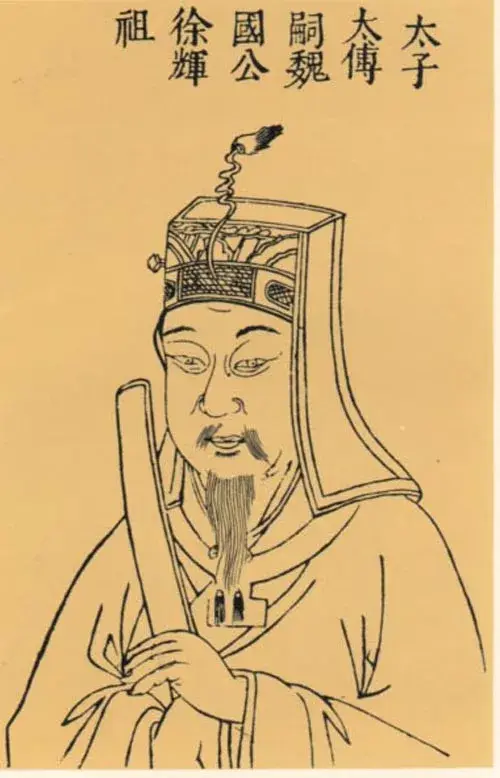
徐辉祖
Xu Huizu (徐辉祖, ?–1407), originally named Xu Yungong (徐允恭), was a native of Zhongli in Haozhou (modern Fengyang County, Anhui Province). He was the eldest son of Grand Marshal Xu Da, Prince of Zhongshan and foremost founding commander of the Ming dynasty, and stood as an exemplary military general and steadfast loyalist during the reign of Emperor Jianwen. Tall, handsome, dignified in bearing, and deeply versed in martial…
Xu Huizu (徐辉祖, ?–1407), originally named Xu Yungong (徐允恭), was a native of Zhongli in Haozhou (modern Fengyang County, Anhui Province). He was the eldest son of Grand Marshal Xu Da, Prince of Zhongshan and foremost founding commander of the Ming dynasty, and stood as an exemplary military general and steadfast loyalist during the reign of Emperor Jianwen. Tall, handsome, dignified in bearing, and deeply versed in martial statecraft and family discipline, he earned the deep admiration of the founding emperor Zhu Yuanzhang. In 1388, he formally inherited his father's hereditary title as the Duke of Wei, later changing his given name to Huizu to avoid the personal name of Crown Imperial Grandson Zhu Yunwen. Throughout the late Hongwu era, Xu Huizu was entrusted with inspecting borders, training troops, and organizing coastal defenses against wokou pirates across Shaanxi, Beiping, Shanxi, Shandong, and Zhejiang, subsequently rising to direct the Central Chief Military Commission in the capital. Upon the enthronement of Emperor Jianwen, he was elevated to Grand Tutor to the Crown Prince. On the eve of the Jingnan civil war, Xu Huizu presciently discerned the rebellion brewing under his brother-in-law Zhu Di (the Prince of Yan) and earnestly urged the court to detain Zhu Gaoxu. During the war, he served as a primary southern army commander, orchestrating the rearguard defense that saved tens of thousands of troops following the disaster at Baigou River, and later inflicting a crushing defeat on the Yan vanguard at Qimeishan. Recalled prematurely due to court factionalism, he nonetheless mounted a fierce defensive stand at Pukou as Yan forces crossed the Yangtze. After the fall of Nanjing, Xu Huizu remained steadfast in his father's ancestral temple, flatly refusing to acknowledge the usurpation. Stripped of his noble rank and placed under house arrest, he passed away in confinement in 1407. He was later enshrined as the foremost among Jianwen loyalists under Emperor Shenzong and posthumously honored as Grand Preceptor with the posthumous title Zhongzhen.
Appointed Noble Guard administering affairs of the Left Chief Military Commission, gaining Emperor Taizu's trust.
Sent with an imperial decree to meet his ailing father Xu Da en route from Beiping; Xu Da passed away shortly after.
Inherited the hereditary title Duke of Wei; subsequently changed his personal name from Yungong to Huizu to avoid the Crown Grandson's name taboo.
Dispatched to Shaanxi to inspect border posts, audit garrisons, and train military units along the northwestern frontier.
Cooperated with Zhu Di to arrest suspected rebel Mongol commanders in Beiping; returned to take charge of the Central Chief Military Commission.
Assigned to Zhejiang coastal garrisons to inspect maritime defenses and drill ground and naval forces against pirate incursions.
Emperor Jianwen ascended the throne, placing utmost trust in Xu Huizu and elevating him to Grand Tutor to the Crown Prince.
Warned the throne against releasing his nephew Zhu Gaoxu; his prescient advice was ignored, and the Jingnan civil war erupted months later.
Led thirty thousand imperial troops to cover the retreat of Li Jinglong's routed southern army, bringing his force back intact.
Won a major field victory at Qimeishan, resisted at Pukou, refused to submit after Nanjing fell, and was stripped of rank and confined.
Passed away in house confinement at around age forty; his eldest son Xu Qin was later permitted to inherit the ducal title.
Xu Huizu was the eldest son of Xu Da, the supreme military commander and principal founding merit subject of the Ming dynasty who held the hereditary title Duke of Wei and was posthumously honored as Prince of Zhongshan. Standing eight feet five inches tall, with an exceptionally handsome countenance, refined scholarly bearing, and profound grasp of classical and military strategy, Xu Huizu distinguished himself early among the imperial nobility. During the numerous campaigns in which Xu Da was away commanding northern border garrisons, Xu Huizu managed the extensive ducal household with rigorous discipline, earning the personal esteem of Emperor Taizu (Zhu Yuanzhang).
In 1384, Xu Huizu entered official service as an Imperial Noble Guard administering the Left Chief Military Commission, receiving an imperial grant of twenty bushels of grain monthly. In 1385, when Xu Da fell gravely ill while returning from Beiping, Emperor Taizu personally dispatched Xu Huizu carrying an imperial decree to attend to his father on the road. Following Xu Da's passing, Xu Huizu was formally invested as the second Duke of Wei in October 1388. Emperor Taizu presented him with an iron certificate, urging him to emulate his father's illustrious loyalty and chivalry. Soon afterward, to avoid the taboo of Crown Imperial Grandson Zhu Yunwen's personal name, he changed his given name from Yungong to Huizu.
Following his succession, Xu Huizu established himself as a reliable and experienced military leader. In 1389, after Fu Youde pacified southwestern border unrest, the emperor assigned Xu Huizu to Changde and neighboring guards in Huguang to review military readiness and train garrisons. At the end of the year, he returned to the capital, and Emperor Taizu granted him an imperial residence in Fengyang along with a personal bodyguard of 120 armored soldiers.
In 1391, Xu Huizu was dispatched to inspect the northwestern defensive perimeter in Shaanxi. In 1393, when rumors indicated that surrendered Northern Yuan commanders Arur Temür and Nayir Buqa intended to mutiny within the princely appanage of Yan, Emperor Taizu dispatched Xu Huizu to Beiping. Coordinating closely with Prince Zhu Di, Xu Huizu arrested the conspirators and escorted them back to Nanjing for judgment. Upon his return, he was appointed to oversee the prestigious Central Chief Military Commission. In 1394, he traveled to the coastal garrisons of Zhejiang to oversee naval defenses against wokou pirates. In addition to his military duties, he frequently attended Crown Grandson Zhu Yunwen in classical studies and practiced calligraphy under the master Zhan Xiyuan, mastering monumental standard script and earning widespread reputation as a cultivated Confucian general.
In 1398, Emperor Taizu passed away, and Crown Grandson Zhu Yunwen ascended the throne as Emperor Jianwen. The new emperor placed immense trust in Xu Huizu, appointing him Grand Tutor to the Crown Prince and directing him to serve as principal supervisor for the compilation of the Veritable Records of Emperor Taizu.
In the fourth month of 1399, during the anniversary memorial for the late emperor, Prince Zhu Di dispatched his three sons—Zhu Gaochi, Zhu Gaoxu, and Zhu Gaosui—to Nanjing. While Minister of War Qi Tai urged their immediate detention, Huang Zicheng argued for their release to avoid provoking the northern prince. Xu Huizu, though their maternal uncle, prioritized dynastic stability and secretly submitted a candid memorial: "Among my three nephews, only Gaoxu is fiercely violent and devoid of moral restraint. He will not only betray Your Majesty, but will inevitably betray his own father. He will bring immense calamity to the realm!" However, Emperor Jianwen consulted Xu Huizu's younger brother Xu Zengshou and imperial son-in-law Wang Ning, both of whom secretly sympathized with Zhu Di. The princes were permitted to return north. Zhu Gaoxu stole Xu Huizu's prized steed to flee, and Xu Huizu's attempt to capture him failed. Months later, Zhu Di raised his banner in rebellion, launching the Jingnan civil war with Zhu Gaoxu serving as his most lethal cavalry shock commander. Emperor Jianwen lamented bitterly that he had not heeded Xu Huizu's warning.
As the civil war intensified, imperial commander Li Jinglong suffered successive catastrophic defeats. In the fourth month of 1401, at the Battle of Baigou River, the southern imperial forces were thrown into total disarray by wind-driven fires and ferocious Yan cavalry charges, suffering over one hundred thousand casualties. Facing disaster, Xu Huizu, who had been dispatched with thirty thousand elite capital troops, deployed sturdy chariot barriers and crossbow lines to check the surging enemy horsemen. His disciplined rearguard defense allowed Li Jinglong's shattered remnants to retreat safely toward Dezhou, preserving his entire division intact.
In early 1402, as Zhu Di bypassed fortified cities in Shandong to thrust southward, the court placed Xu Huizu in direct command of northern operations. In April, at Qimeishan, thirty li southwest of Lingbi in Suzhou, Xu Huizu engaged the main Yan army in a pitched battle. Deploying infantry firearms and heavy assault units, Xu Huizu routed the Yan forces, slaying their vanguard commander Li Bin and taking thousands of prisoners. Suffering under extreme summer heat and pestilence, the Yan army was demoralized, and Zhu Di contemplated withdrawing north.
Tragically, rumors reached Nanjing that the northern rebels were already exhausted, and factional voices at court whispered that Xu Huizu might be reluctant to inflict total defeat upon his own imperial brother-in-law. Emperor Jianwen recalled Xu Huizu to defend the capital. Denied his leadership, the remaining southern armies under He Fu and Ping An were surrounded and annihilated at Lingbi, fatally tipping the balance of the war.
With the Huai River defense shattered, Yan armies reached the northern bank of the Yangtze. In June 1402, Xu Huizu led his remaining troops to Pukou on the northern bank, forming defensive lines that bloodily repulsed the initial Yan river-crossing attempts. However, southern naval commander Sheng Yong suffered defeat on the river, and the imperial fleet surrendered, allowing Zhu Di to ferry his armies across at Guazhou.
When the Prince of Gu and Li Jinglong threw open the Jinchuan Gate of Nanjing, the capital fell, the imperial palace burned, and Emperor Jianwen vanished. As scholar-officials rushed to kneel before Zhu Di, Xu Huizu alone retreated to the ancestral temple of his father Xu Da, sitting in solitary defiance. Seized and dragged before Zhu Di, Xu Huizu maintained complete silence, showing neither terror nor any intention to acknowledge the usurper.
When judicial officers demanded a written confession, Xu Huizu took up the brush and wrote a single unyielding declaration: "The descendants of the founding merit subject Prince of Zhongshan are exempt from execution." Enraged, Zhu Di contemplated executing him, but refrained out of concern for dynastic protocol, Empress Xu's standing, and public reverence for the late Xu Da. Instead, Zhu Di stripped Xu Huizu of his ducal title and stipends, confining him under strict house arrest. In 1407, Xu Huizu passed away in confinement in his early forties. One month after his death, Zhu Di restored the dukedom to his eldest son Xu Qin, declaring that the house of Xu Da could not be left without an heir. Under Emperor Shenzong in 1576, Xu Huizu was placed first among the honored loyalists of Jianwen in Nanjing, and the Southern Ming court later conferred upon him the title Grand Preceptor with the posthumous name Zhongzhen.
Throughout the middle and late Hongwu era, Xu Huizu served as an indispensable military troubleshooter for Emperor Taizu. Demonstrating exceptional organizational ability, he conducted exhaustive inspections of defensive works, weapon stockpiles, and cavalry remounts across garrisons in Shaanxi, Beiping, Henan, and Shanxi.
In 1394, when Japanese wokou pirates repeatedly raided coastal towns in southeastern China, Xu Huizu traveled to Zhejiang alongside Wu Jie. He inspected coastal forts in Ningbo, Taizhou, and Wenzhou, reorganized naval patrols, and drilled amphibious defense units. His rigorous measures fortified the maritime defenses of southeastern China, protecting coastal farming communities from pillage and establishing a model for subsequent coastal defense arrangements.
In 1393, when surrendered Northern Yuan commanders Arur Temür and Nayir Buqa plotted sedition within the Beiping regional command, Emperor Taizu selected Xu Huizu for his discretion and decisiveness. Arriving swiftly in Beiping, Xu Huizu worked with Prince Zhu Di to execute a coordinated preemptive strike, disarming and arresting the conspirators before they could launch an open rebellion, and transporting them securely to the capital.
Following this success, Xu Huizu was appointed to head the Central Chief Military Commission, the foremost military administrative body in Nanjing. In this role, he systematically purged ghost soldiers from military rosters, reformed grain transport logistics, and enforced rigorous merit evaluations for guard commanders, ensuring the operational readiness of the core imperial divisions.
The Battle of Baigou River in 1401 resulted in the catastrophic rout of the main southern imperial army under Li Jinglong, with over one hundred thousand soldiers killed or dispersed. As Yan cavalry pursued the fleeing remnants to deliver a finishing blow, Xu Huizu arrived on the battlefield leading thirty thousand imperial reinforcements.
Displaying superb battlefield composure, Xu Huizu deployed an unyielding defensive perimeter composed of heavy shield barriers, anti-cavalry spikes, and massed crossbow volleys. His steady rearguard resistance blunted repeated charges by elite Yan cavalry, allowing Li Jinglong's routed troops to retreat safely to Dezhou. Xu Huizu then withdrew his own force in perfect formation without losing a single unit, single-handedly preventing the complete destruction of the southern army.
In the fourth month of 1402, during the pivotal clash at Qimeishan near Suzhou, Xu Huizu commanded southern forces in a direct confrontation with the main army of Zhu Di. Recognizing the enemy's aggressive reliance on mounted flanking maneuvers, Xu Huizu deployed interlocking infantry lines reinforced with firearms and heavy shock brigades.
The resulting southern counterattack shattered the Yan vanguard, killing veteran commander Li Bin and inflicting thousands of casualties upon the northern army. Combined with blistering summer heat and disease, Xu Huizu's decisive victory pushed the Yan army to the verge of retreat, marking the most significant tactical victory achieved by the southern loyalist forces in the final year of the conflict.
During the closing phase of the Jingnan civil war, when imperial defenses along the Huai River had collapsed, Xu Huizu mounted a valiant defense at Pukou on the northern shore of the Yangtze River. His fierce resistance temporarily blocked the northern invaders from securing crossing points, showcasing his unwavering loyalty to Emperor Jianwen.
When Nanjing fell due to treachery, Xu Huizu refused to join the stampede of officials seeking personal advancement under the new regime. Secluded in his father's shrine, he answered Zhu Di's interrogations with resolute silence, invoking his father's founding iron certificate to reaffirm his refusal to submit. His unbending integrity transformed him into an enduring symbol of Confucian loyalty and familial rectitude in Ming history.
FIGURES ASSOCIATED WITH THIS DYNASTY