Birth at Panyang
Wu Rui was born at the foot of Longshan in Panyang, a royal descendant of the ancient Wu kingdom.
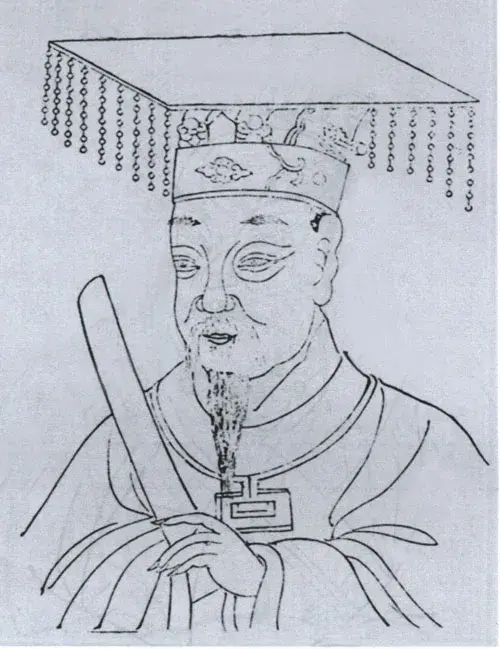
吴芮
Wu Rui (241–201 BCE), styled Zhicheng, a native of Panyang (modern Poyang County, Jiangxi), was a descendant of King Fuchai of the ancient State of Wu, an accomplished political and military leader of the Baiyue peoples, and one of the eight non-imperial kings of the early Western Han dynasty. He holds the distinction of being the sole founding king whose lineage successfully preserved its royal rank and died a natural death.…
Wu Rui (241–201 BCE), styled Zhicheng, a native of Panyang (modern Poyang County, Jiangxi), was a descendant of King Fuchai of the ancient State of Wu, an accomplished political and military leader of the Baiyue peoples, and one of the eight non-imperial kings of the early Western Han dynasty. He holds the distinction of being the sole founding king whose lineage successfully preserved its royal rank and died a natural death. Under the Qin dynasty, Wu Rui served as Magistrate of Panyang, governing with benevolence and light taxation, earning the deep devotion of the southern indigenous communities who honored him as "Lord of Fan" (Fan Jun). Following the outbreak of Chen Sheng's Daze rebellion, while other Qin magistrates were killed by the populace, Wu Rui took the initiative to mobilize tens of thousands of Yue warriors against Qin rule. Recognizing the military genius of the fugitive convict Ying Bu, Wu Rui married his daughter to him and dispatched his general Mei Xuan to join Liu Bang's westward advance, capturing the passes to overthrow the Qin dynasty. Following the fall of Qin, Xiang Yu enfeoffed Wu Rui as King of Hengshan. During the Chu-Han Contention, recognizing Liu Bang's superior statecraft and Xiang Yu's tyranny, Wu Rui broke with Chu, persuaded his son-in-law Ying Bu to align with Han, and committed his southern forces to support Liu Bang's triumph. In 202 BCE, Emperor Gaozu created Wu Rui the King of Changsha, establishing his capital at Linxiang. Practicing Daoist modesty and self-restraint, Wu Rui voluntarily yielded large territories and disbanded his elite guard to alleviate imperial suspicion. Passing away in 201 BCE, his kingdom endured peacefully for five generations, standing as a legendary model of political wisdom and self-preservation.
Wu Rui was born at the foot of Longshan in Panyang, a royal descendant of the ancient Wu kingdom.
Appointed Magistrate of Panyang under the Qin administrative system, he abolished oppressive laws and promoted agriculture, earning the title "Lord of Fan."
Following Chen Sheng's uprising, Wu Rui mobilized tens of thousands of Yue warriors, wedded his daughter to Ying Bu, and launched an armed rebellion against Qin.
Wu Rui dispatched general Mei Xuan to reinforce Liu Bang's army, storming Xi, Li, and Wu passes to capture Xianyang.
Xiang Yu partitioned the empire into eighteen kingdoms, creating Wu Rui King of Hengshan with his capital at Zhu.
Encouraged by Zhang Liang, Wu Rui persuaded Ying Bu to abandon Xiang Yu and aligned the entire Yue military apparatus with the Han cause.
Liu Bang assumed the imperial title and proclaimed Wu Rui King of Changsha, establishing his royal seat at Linxiang.
Wu Rui surrendered extensive commanderies and military authority to avert imperial distrust, passing away peacefully later that year with the posthumous title King Wen.
Wu Rui traced his ancestry to King Fuchai of the ancient State of Wu. Following the conquest of Wu by Yue in 473 BCE, the displaced royal clan adopted the state name "Wu" as their surname to commemorate their heritage. Wu Rui's father, Wu Shen, served as Grand Marshal in the State of Chu, but was banished to the Panyang region after submitting frank remonstrances to King Kaolie of Chu. In 241 BCE, Wu Rui was born on the southern slopes of Longshan in modern Yugan County.
From an early age, Wu Rui demonstrated remarkable intellectual clarity, studying classical statecraft and the ancestral treatises of Sun Wu and Wu Qi. Following the Qin unification of the realm, Panyang County was established as one of the earliest administrative districts in Jiangxi. Renowned for his integrity, martial valor, and generosity, Wu Rui was universally recommended by both local officials and tribal elders to serve as the first Magistrate of Panyang.
Upon assuming office, Wu Rui moved decisively against violent bandits, publicly trying and executing the notorious local warlord Liang Meng, restoring social order. In economic administration, he abolished the draconian Qin penal statutes, introducing light taxes, low corvee duties, and three-to-five-year tax exemptions on newly reclaimed land. He directed extensive irrigation works, cleared waterways, and introduced superior Central Plains rice varieties, cultivating the celebrated "Rui Rice." The indigenous Baiyue clans of Jiangxi, Hunan, and Fujian embraced his governance, reverently addressing him as "Lord of Fan" (Fan Jun).
In the autumn of 209 BCE, Chen Sheng and Wu Guang launched their historic uprising in Daze. Across the southern commanderies, commoners rose up to slaughter Qin magistrates. In contrast to these hated officials, Wu Rui commanded profound popular devotion and took the lead in raising the standard of rebellion against Qin rule.
During this period, the fugitive convict Ying Bu arrived in Panyang leading several thousand escaped laborers from Mount Li. Recognizing Ying Bu's extraordinary tactical brilliance, Wu Rui welcomed him without prejudice and married his daughter to him, forming a tight military alliance. Wu Rui placed thousands of seasoned Yue warriors under Ying Bu's direct command, dispatching them north across the Yangtze to engage the Qin main armies. Concurrently, Wu Rui's kinsman Mei Xuan joined the uprising with three thousand troops from the Dayu Ridge.
In 207 BCE, Liu Bang led an insurgent army toward Wu Pass to penetrate the Qin heartland. Finding his forces undermanned, Liu Bang was joined by Mei Xuan, whom Wu Rui had ordered to assist the Han vanguard. Mei Xuan fought heroically, storming the fortified strongholds of Xi and Li before spearheading the assault on Wu Pass, enabling Liu Bang to reach Xianyang and accept the surrender of the last Qin monarch.
In 206 BCE, Xiang Yu convened the coalition forces at Hongmen to divide the empire among eighteen kings. In recognition of Wu Rui's leadership over the Baiyue and Mei Xuan's battlefield achievements, Xiang Yu enfeoffed Wu Rui as King of Hengshan, with his capital at Zhu (modern Huanggang, Hubei), while creating Mei Xuan a feudal marquis with an estate of one hundred thousand households.
However, Xiang Yu soon revealed his tyrannical nature, issuing secret orders to Wu Rui, Gong Ao, and Ying Bu to assassinate the displaced Emperor Yi (Xiong Xin) on his journey to Chen County. Wu Rui steadfastly refused to participate in regicide. Enraged by his defiance, Xiang Yu seized portions of Hengshan territory during the ensuing war, demoting Wu Rui's title to "Lord of Fan."
As the Chu-Han war intensified, Wu Rui recognized that Xiang Yu's brutality was alienating the realm, while Liu Bang's leniency and rule of law embodied the future of China. Through secret correspondence facilitated by Liu Bang's chief strategist Zhang Liang, Wu Rui severed all ties with Western Chu. He successfully persuaded his son-in-law Ying Bu to defect to the Han, while committing his own Yue divisions under Mei Xuan to launch an offensive against Chu's southern flank. This southern intervention cut off Xiang Yu's line of retreat to the Yangtze, contributing critically to the final Han victory at Gaixia.
In early 202 BCE, following Xiang Yu's destruction, Wu Rui joined the other kings in presenting an imperial memorial urging Liu Bang to assume the throne. In his formal proclamation, Emperor Gaozu praised Wu Rui: "Leading the armies of the Baiyue to aid the feudal lords in overthrowing tyrannical Qin, he established monumental merit." The emperor invested Wu Rui as the King of Changsha, establishing his royal capital at Linxiang (modern Changsha, Hunan), granting him jurisdiction over Changsha, Yuzhang, and peripheral southern territories.
Arriving in Linxiang, Wu Rui was acutely aware of the perilous position of non-imperial kings under the emerging centralized autocracy. Recognizing that imperial suspicion would inevitably fall upon large private armies, Wu Rui heeded the advice of Zhang Liang and embraced complete humility. He formally petitioned Emperor Gaozu to surrender direct control over Yuzhang Commandery and other territories to the central government. Furthermore, he requested that his premier general Mei Xuan be reassigned to remote southern borders, while voluntarily disbanding his elite personal guard and placing all military commands under imperial appointees.
Emperor Gaozu was profoundly reassured by Wu Rui's modesty and lack of political ambition, praising his loyalty in public edicts. In the autumn of 201 BCE, Wu Rui passed away peacefully in Linxiang at the age of forty-one. Emperor Gaozu mourned his passing, dispatching envoys to preside over his funeral and granting him the posthumous title King Wen, while confirming the succession of his eldest son Wu Chen.
Among the eight non-imperial kings created by Emperor Gaozu—Han Xin, Peng Yue, Ying Bu, Zang Tu, Lu Wan, Han Xin of Han, Zhang Er, and Wu Rui—seven were violently purged or executed for rebellion. Only Wu Rui's Changsha kingdom survived intact, passing down peacefully for five generations across forty-six years until the fifth king Wu Zhu died without issue in 157 BCE. Even then, Emperor Jing continued to honor Wu Rui's memory by granting marquisates to his collateral descendants, creating an immortal legacy of political wisdom and filial honor.
As Magistrate of Panyang, Wu Rui broke through historical ethnic divisions, harmonizing indigenous Yue and Han populations through benevolent governance. When tyranny became intolerable, he mobilized the southern peoples into a unified military force, supporting Liu Bang's capture of Guanzhong and ensuring that the southern territories integrated smoothly into the emerging Han empire.
Wu Rui's voluntary surrender of territorial control and military commands demonstrated consummate mastery of political survival. In an era when warlords fought desperately to preserve feudal independence, Wu Rui's understanding of centralizing imperial power enabled his family to avoid the violent purges that consumed his contemporaries, preserving his kingdom for five peaceful generations.
FIGURES ASSOCIATED WITH THIS DYNASTY