Enlisting in the Army
In response to the outbreak of the Yellow Turban Rebellion, Yu Jin enlisted under the banner of local Taishan magnate Bao Xin.
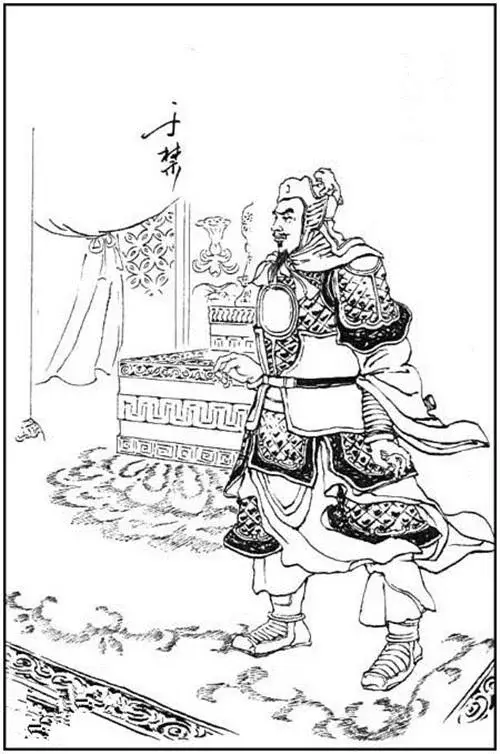
于禁
Yu Jin (died 221), courtesy name Wenze, was a native of Juping County in Taishan Commandery. He was a distinguished founding military commander of Cao Wei during the late Eastern Han dynasty and the Three Kingdoms era, widely recognized as Cao Cao's most trusted non-imperial field commander. Originally enlisting under local magnate Bao Xin to combat the Yellow Turban rebels, Yu Jin joined Cao Cao's service following Bao Xin's…
Yu Jin (died 221), courtesy name Wenze, was a native of Juping County in Taishan Commandery. He was a distinguished founding military commander of Cao Wei during the late Eastern Han dynasty and the Three Kingdoms era, widely recognized as Cao Cao's most trusted non-imperial field commander. Originally enlisting under local magnate Bao Xin to combat the Yellow Turban rebels, Yu Jin joined Cao Cao's service following Bao Xin's death in battle. Recommended by Major Wang Lang for his grave bearing and strict organizational command, he was appointed Army Major and embarked on three decades of ceaseless campaigning across northern China, eventually becoming the foremost of Cao Wei's renowned Five Elite Generals alongside Zhang Liao, Yue Jin, Zhang He, and Xu Huang. Throughout his military career, Yu Jin was celebrated for his unflinching composure under crisis and ruthless military discipline. In the disastrous ambush at Wan City, while other units dissolved in chaos, Yu Jin conducted a fighting retreat with his contingent, severely punished marauding Qingzhou troops, and fortified an entrenched camp before counterattacking, earning Cao Cao's highest praise that even the greatest generals of antiquity could not surpass him. During the Battle of Guandu, he held the critical northern crossing of Yanjin with two thousand troops against Yuan Shao's massive host for months and led daring raids that incinerated thirty enemy forward encampments. When his long-time personal acquaintance Chang Xi rebelled, Yu Jin strictly executed the imperial military code by beheading Chang Xi upon surrender, demonstrating that sovereign law superseded private intimacy. He was successively promoted to General of the Left and conferred the ceremonial battle-axe with capital jurisdiction over subordinate officers. In 219, during the pivotal campaign around Fancheng, unprecedented torrential autumn rains caused the Han River to overflow, completely submerging Yu Jin's seven armies. Stranded in waist-deep water without avenues for escape and seeking to spare his surviving soldiers from slaughter, Yu Jin surrendered to Guan Yu and was imprisoned in Jiangling. Following Lu Meng's surprise conquest of Jingzhou, he fell into the custody of Eastern Wu, enduring repeated public insults and vitriol from Wu officials such as Yu Fan. Repatriated to Wei by Sun Quan after Cao Pi ascended the throne, Yu Jin was formally pardoned but subjected to devastating psychological torment when Cao Pi ordered murals painted at Cao Cao's mausoleum depicting his kneeling submission before Guan Yu. Devastated by shame and grief, Yu Jin fell gravely ill and died shortly thereafter, given the pejorative posthumous title Marquis Li. Despite the tragedy of his final years, his decades of unmatched discipline, tactical fortitude, and organizational genius secured him a lasting place among the preeminent founding generals of the Cao Wei empire.
In response to the outbreak of the Yellow Turban Rebellion, Yu Jin enlisted under the banner of local Taishan magnate Bao Xin.
Bao Xin fell in battle near Shouzhang; Yu Jin led his remaining troops to Cao Cao and was recommended as Army Major by Wang Lang.
Campaigned against Lu Bu at Puyang, storming two fortified peripheral camps and earning promotion to Major Who Breaks Formations.
Zhang Xiu rebelled at Wan City; Yu Jin suppressed looting Qingzhou troops, fortified defenses, and was enfeoffed as Marquis of Yishuting.
Entrusted with two thousand men to hold Yanjin during the Guandu campaign, launching raids that razed over thirty enemy encampments.
Besieged the rebel Chang Xi at Donghai; when Chang Xi surrendered relying on their friendship, Yu Jin executed him by military law.
Assisted Zhang Liao in crushing Chen Lan and Mei Cheng in the mountains of Liu'an by guarding supply lines and rugged terrain.
Following Cao Cao's elevation to King of Wei, Yu Jin was appointed General of the Left with ceremonial battle-axe authority.
Led seven armies to relieve Fancheng but was submerged by catastrophic floods; surrendered to Guan Yu and was jailed in Jiangling.
Lu Meng conquered Jingzhou and captured Guan Yu; Yu Jin was released into Sun Quan's custody, where he suffered insults from Yu Fan.
Sun Quan submitted formal tributary homage to Emperor Wen (Cao Pi) and repatriated Yu Jin to the capital Luoyang.
Visiting Cao Cao's mausoleum and beholding murals mocking his surrender, Yu Jin died in agony and shame, posthumously styled Marquis Li.
Yu Jin was born in Juping County of Taishan Commandery into an era of mounting turmoil. In 184, when the Yellow Turban Rebellion convulsed the central plains of China, local magnate Bao Xin recruited an independent volunteer army in Taishan to safeguard the region. Yu Jin promptly enlisted as a mounted officer within Bao Xin's command. In 192, massive remnants of the Qingzhou Yellow Turbans invaded Yan Province, where Inspector Liu Dai was killed in reckless engagement. Bao Xin and Chen Gong invited Cao Cao to assume the governorship of the province. During a ferocious counter-offensive near Shouzhang, Bao Xin sacrificed his life to rescue Cao Cao from an enemy encirclement. Following Bao Xin's demise, Yu Jin led the surviving remnants of his unit into Cao Cao's camp, where he was assigned to the command of Major Wang Lang. While reviewing military divisions, Wang Lang recognized Yu Jin's austere posture, unwavering resolve, and meticulous enforcement of command, leading him to strongly recommend Yu Jin to Cao Cao as a commander of rare operational gifts.
Cao Cao personally interviewed Yu Jin regarding defensive tactics and frontline coordination. Deeply impressed by his articulate grasp of military organization, Cao Cao immediately appointed him Army Major. In 194, while Cao Cao was campaigning against Tao Qian in Xu Province, Chen Gong and Zhang Miao orchestrated a widespread insurrection in Yan Province, welcoming Lu Bu to seize command of the territory. Cao Cao rushed his main force back to confront Lu Bu south of Puyang. Entrusted with a detachment, Yu Jin spearheaded an assault against two of Lu Bu's fortified auxiliary camps, completely annihilating them in rapid succession. Continuing his advance to Gaowan, he crushed Lu Bu's general Gao Ya and captured numerous opposing officers, earning promotion to Major Who Breaks Formations. In 196, Cao Cao launched operations against Yellow Turban remnants under Liu Pi and He Yi in Runan and Yingchuan. Yu Jin served as the vanguard commander, routing thousands of enemy troops and dismantling rebel stockades, for which he was elevated to Colonel Who Pacifies Bandits.
In 199, Cao Cao mounted another campaign against Lu Bu at Xiapi in Xu Province. Yu Jin captured the enemy's western fortifications and rounded up dozens of senior lieutenants. Following Lu Bu's execution, Cao Cao turned south to confront the self-proclaimed emperor Yuan Shu in the Huai River basin. Leading the forward vanguard to Qixian, Yu Jin defeated and severed the heads of Yuan Shu's four premier commanders: Qiao Rui, Li Feng, Liang Gang, and Yue Jiu, capturing immense quantities of mounts and armaments. He was promoted to General Who Waves the Waves. Over fifteen years of constant warfare, Yu Jin stood at the forefront of Cao Cao's pacification campaigns, earning widespread renown for never losing cohesion under duress.
In the first month of 197, Cao Cao led a southern expedition against Wan City, prompting the regional warlord Zhang Xiu to surrender without resistance. However, Cao Cao's dalliance with the widowed aunt of Zhang Xiu provoked bitter humiliation and outrage. Guided by strategist Jia Xu, Zhang Xiu launched a coordinated midnight assault on Cao Cao's headquarters. Caught entirely off guard, Cao Cao's entourage collapsed in terror. Cao Cao's eldest son Cao Ang, his nephew Cao Anmin, and his devoted bodyguard Dian Wei were all killed in brutal rearguard fighting. Cao Cao escaped on horseback with a handful of retainers, while the vast majority of the imperial army disintegrated into leaderless flight across the plains. Yu Jin alone maintained complete composure, rallying several hundred men of his core contingent to execute an orderly, disciplined fighting retreat. Although pursued relentlessly by Zhang Xiu's cavalry, Yu Jin beat war drums, deployed archers in dense ranks, and repelled repeated charges, preventing the pursuing horsemen from overrunning his column.
During the retreat, Yu Jin observed that the Qingzhou troops—former Yellow Turban surrenderers whom Cao Cao had incorporated into a distinct corps—were exploiting the panic to plunder local villages and kill innocent civilians along the roadside. Enraged by this flagrant breakdown of order, Yu Jin detached a portion of his force, encircled the rogue Qingzhou soldiers, and summarily beheaded the ringleaders on the spot. Accustomed to special indulgence from Cao Cao, the surviving Qingzhou troops fled directly to Cao Cao's headquarters ahead of Yu Jin, fabricating false reports that Yu Jin was staging an armed mutiny against the commander-in-chief.
Upon reaching his designated defensive sector, Yu Jin did not rush to Cao Cao's tent to clear his name. Instead, he commanded his exhausted men to immediately dig moats, erect wooden palisades, and construct fortified earthen ramparts. His subordinate officers grew deeply anxious and urged him to report to Cao Cao without delay to refute the slander. Yu Jin calmly rebuked them, stating that Zhang Xiu's pursuing horsemen were hot on their heels and could arrive at any moment, and that without fortified defenses, the entire army would face annihilation. He expressed utter confidence that their lord possessed superior discernment and would not be misled by base fabrications. Only after the camp was securely fortified did Yu Jin remove his armor and enter Cao Cao's presence to present a detailed account of the events. When Zhang Xiu's cavalry arrived, they found the encampment impenetrable and withdrew. Astonished and delighted by Yu Jin's foresight and resolute courage, Cao Cao praised him before all assembled commanders, declaring that even the celebrated generals of antiquity could not have performed better. In formal recognition of his heroism, Cao Cao enfeoffed him as Marquis of Yishuting.
In 199, Yuan Shao consolidated his control over the four northern provinces of You, Bing, Qing, and Ji, assembling an army of one hundred thousand infantry and ten thousand cavalry to march southward toward the Han capital of Xuchang. The monumental showdown of the Battle of Guandu commenced. While Cao Cao stationed his central army at Guandu, the southern crossing of Yanjin along the Yellow River represented the strategic gateway through which Yuan Shao's main columns sought to bridge the waterway and penetrate the central plains. Cao Cao placed Yu Jin in command of a modest detachment of two thousand elite troops, stationing him at Yanjin to blunt the primary axis of Yuan Shao's offensive.
In 200, Cao Cao personally led a lightning expedition eastward into Xu Province to crush Liu Bei's emerging rebellion. Anticipating that Yuan Shao would strike at the defenseless capital, Yu Jin held the fortifications at Yanjin against overwhelming odds for several months, beating back every crossing attempt and protecting the rear of Cao Cao's main forces. Upon Cao Cao's return to Guandu, Yu Jin combined forces with Yue Jin to launch an aggressive amphibious counter-raid across the Yellow River. Driving through Jixian and Huojia along the northern bank, their five thousand troops stormed and burned more than thirty of Yuan Shao's peripheral forward encampments, slaying and capturing several thousand hostile soldiers and compelling twenty hostile commanders, including He Mao and Wang Mo, to yield in submission.
Cao Cao subsequently dispatched Yu Jin to hold an independent command at Yuanwu, where he obliterated another northern detachment at Dushijin. Throughout the grueling standoff at Guandu, Yuan Shao constructed elevated earthen mounds within his lines and erected tall wooden towers, allowing archers to rain continuous volleys into the Cao camp. As morale plummeted under the relentless barrage, Yu Jin personally anchored the foremost earthworks, pacing the battlements amidst showers of arrows to rally his troops. When Cao Cao executed his daring raid on the enemy supply depot at Wuchao, Yu Jin led a sweeping flank assault that crushed Yuan Shao's retreating lines, precipitating the total collapse of the northern host. In recognition of these achievements, Yu Jin was commissioned Vice General and shortly after elevated to Assistant General.
In 206, the warlord Chang Xi rebelled once more in Donghai Commandery, coordinating with coastal pirate factions. Chang Xi had submitted to Cao Cao on multiple previous occasions and maintained a profound, long-standing personal friendship with Yu Jin. Cao Cao commissioned Yu Jin and Xiahou Yuan to pacify the rebellion. Yu Jin led his columns against Donghai, methodically reducing over a dozen fortified strongholds and placing Chang Xi under a tight encirclement for months. With provisions exhausted and all hope of relief severed, Chang Xi recognized that his defeat was inevitable. Trusting that his deep personal intimacy with Yu Jin would spare his life, Chang Xi rode out of the fortress unaccompanied and surrendered directly to Yu Jin's headquarters.
The assembled officers, mindful of Chang Xi's voluntary submission and his close relationship with their commander, unanimously advocated sending the captive to Xuchang for Cao Cao to decide his fate. Yu Jin sternly rejected the proposal, reminding them of Cao Cao's strict military decree that any rebel who surrendered only after an army had completed a full encirclement was ineligible for pardon. Yu Jin declared that strict obedience to sovereign statutes was the prime duty of a military commander, and that private affection could never supersede imperial law. Standing face-to-face with his old friend, Yu Jin wept bitterly and bade him farewell, yet issued the command without wavering, executing Chang Xi outside the camp gates. Upon learning of the execution, Cao Cao was deeply moved and remarked with a heavy sigh that Chang Xi had met his fate by trusting in Yu Jin rather than appealing directly to him. Applauding his unbending integrity, Cao Cao awarded Yu Jin the title of General of Tiger Might.
In 209, the rogue commanders Chen Lan and Mei Cheng mobilized more than ten thousand men, entrenching themselves within the precipitous crags of Mount Tianzhu in Liu'an. Cao Cao appointed Zhang Liao supreme commander of the punitive expedition, with Yu Jin, Zhang He, and Zang Ba serving as supporting field commanders. When Mei Cheng feigned submission, Yu Jin accepted the truce and withdrew, only for Mei Cheng to immediately take flight into the craggy heights to unite with Chen Lan. The peaks of Mount Tianzhu rose sheer for dozens of leagues, cut through by narrow ravines impassable to cavalry. Zhang Liao resolved to lead an elite strike force up the sheer faces on foot, entrusting the vital logistical artery and rearguard defense entirely to Yu Jin. Yu Jin deployed troops along the treacherous defiles, personally coordinating pack trains and securing uninterrupted supplies to the summit assault columns. Zhang Liao successfully stormed the peak and slew Chen Lan and Mei Cheng, extinguishing the rebellion. Following the victory, Cao Cao rewarded Yu Jin's flawless logistics by granting him an additional two hundred households, bringing his estate to twelve hundred households. In 216, when Cao Cao was created King of Wei, Yu Jin was appointed General of the Left and granted ceremonial battle-axe authority. He was the sole non-imperial commander in Cao Cao's service to receive this supreme honor, standing preeminent above all contemporary peers.
In 219, Liu Bei repelled Cao Cao's army in the Hanzhong Campaign and declared himself King of Hanzhong. In Jingzhou, Shu Han Vanguard General Guan Yu launched a powerful northern offensive against Xiangyang and Fancheng, pinning Cao Ren within the walls of Fancheng. Cao Cao urgently ordered Yu Jin to lead seven armies consisting of thirty thousand elite soldiers to relieve the siege, with Pang De serving as vanguard. Yu Jin established his encampments in the low-lying plains north of Fancheng. In the eighth lunar month, torrential autumn rains battered the region unceasingly for several weeks, causing the Han River to surge violently. The floodwaters rose several fathoms over dry land, inundating the camps of Yu Jin's seven armies. Tens of thousands of imperial troops were drowned, while the survivors clambered onto dikes, rooftops, and treetop perches to escape the deluge.
Guan Yu had prepared an armada of large warships and gunboats, which he deployed to encircle the stranded Wei contingents across the submerged terrain. While Pang De put on heavy armor and fought fiercely with a small band of retainers until his boat was overturned and he was captured and executed for refusing to submit, Yu Jin found himself surrounded by vast stretches of deep water with thirty thousand helpless men facing certain death by drowning or arrow fire. Concluding that continued resistance was futile and hoping to save the remnants of his command from slaughter, Yu Jin gave the command to lay down arms and surrendered to Guan Yu. Guan Yu sent Yu Jin under heavy escort to the dungeons of Jiangling, while the thirty thousand captured troops were marched into rear custody, putting an immense strain on Jingzhou's grain reserves. When news of Yu Jin's surrender reached Luoyang, Cao Cao was utterly devastated, weeping bitterly as he lamented that having known Yu Jin for thirty years, he could not fathom why the general had proved inferior to Pang De in the face of mortal peril.
In the intercalary tenth month of that year, Sun Quan dispatched Chief Commander Lu Meng to execute a surprise crossing of the Yangtze River disguised in merchant attire. Shu commanders Mi Fang and Shi Ren surrendered, and Guan Yu was captured and executed during his retreat at Maicheng. Following the capture of Jiangling, Yu Jin was freed from prison by Eastern Wu forces. Sun Quan treated Yu Jin with formal courtesy as a distinguished guest, but prominent Wu scholars held his surrender in profound contempt. On one occasion, when Sun Quan was riding on horseback and invited Yu Jin to ride beside him, the prominent scholar Yu Fan lashed out in furious indignation, raising his horsewhip to strike Yu Jin while shouting that a disgraced captive had no right to ride abreast with his lord. Sun Quan intervened to stop him. At another imperial banquet aboard a pleasure galley, Yu Jin was moved to tears by a somber classical tune performed by musicians, upon which Yu Fan loudly sneered at him before the entire court, asking if he was shedding feigned tears in a pitiful bid to prolong his miserable life. Yu Jin bowed his head in utter silence, bearing the humiliation without offering a word of reply.
In 220, Cao Cao died in Luoyang, and his successor Cao Pi usurped the Han throne to establish the Cao Wei dynasty. Between 220 and 221, facing an imminent retaliatory invasion by Liu Bei's full army in the Battle of Yiling, Sun Quan dispatched envoys to submit formal tribute to Emperor Wen (Cao Pi) and repatriated Yu Jin to the capital. By the time Yu Jin returned to northern soil, he was an old man of broken health, his hair and beard snow-white, his countenance withered, and his body emaciated from imprisonment and mental torment.
Yu Jin presented himself at court before Cao Pi, prostrating himself on the palace floor and weeping bitterly as he begged forgiveness for his failure. Cao Pi offered soothing words, citing the ancient historical precedents of Xun Linfu of Jin being pardoned after the defeat at Bi and Duke Mu of Qin forgiving Meng Mingshi, and bestowed upon Yu Jin the title of General Who Pacifies Distant Lands. However, Cao Pi was naturally vengeful and petty, harboring intense inner contempt for the veteran's surrender. Shortly thereafter, Cao Pi ordered Yu Jin to journey to Ye to pay respects at Cao Cao's western mausoleum, an errand Yu Jin accepted with gratitude, hoping to mourn his late master.
Upon entering the ceremonial hall of the imperial tomb, Yu Jin was confronted by colossal, vividly painted murals recently commissioned by the throne. The murals depicted the raging waters of the Han River, Guan Yu commanding his warships in triumphant majesty, Pang De glaring with defiance as he met an honorable death, and Yu Jin himself prostrating on the ground, begging for his life in complete degradation. Realizing that Cao Pi had orchestrated the pilgrimage solely to inflict the ultimate public humiliation, Yu Jin was overwhelmed by unbearable agony, shame, and remorse. His spirit shattered, he coughed up pints of blood and collapsed on the stone floor. Carried back to his quarters, he fell into a terminal decline and expired within days. Following his death, Cao Pi bestowed upon him the pejorative posthumous title of Marquis Li, explicitly marking his failure of character in his final hour. His marquisite was inherited by his son, Yu Gui. Decades later during the Taihe era, Emperor Ming (Cao Rui), mindful of Yu Jin's foundational service during the founding campaigns of the empire, issued an imperial decree to posthumously re-style him Marquis Gong, offering posthumous amends for his sullied memory.
FIGURES ASSOCIATED WITH THIS DYNASTY