Birth into Gaodu Scholar-Gentry Clan
Born into the Li family in Huoxiuli, Gaodu; orphaned in infancy and raised by his virtuous uncle.
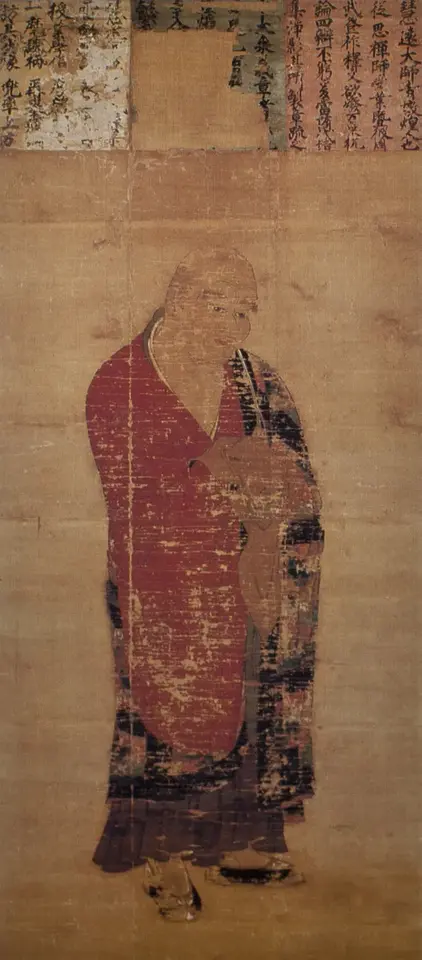
净影慧远
Jingying Huiyuan (净影慧远, 523–592 CE), whose secular surname was Li, traced his paternal ancestry to Dunhuang and resided in Huoxiuli, Gaodu County, Jianxing Commandery (present-day Jincheng, Shanxi). He was an illustrious Buddhist doctrinal synthesizer spanning the Northern and Southern Dynasties and the Sui Dynasty. Alongside Zhiyi of the Tiantai school and Jizang of the Sanlun school, he was venerated as one of the "Three…
Jingying Huiyuan (净影慧远, 523–592 CE), whose secular surname was Li, traced his paternal ancestry to Dunhuang and resided in Huoxiuli, Gaodu County, Jianxing Commandery (present-day Jincheng, Shanxi). He was an illustrious Buddhist doctrinal synthesizer spanning the Northern and Southern Dynasties and the Sui Dynasty. Alongside Zhiyi of the Tiantai school and Jizang of the Sanlun school, he was venerated as one of the "Three Great Masters of the Sui Dynasty." Precocious in youth, he was tonsured at age thirteen and moved to the northern Buddhist center of Ye at sixteen under Master Zhan. He studied the Four-Part Vinaya (Sifenlü) under Vinaya Master Tan'yin and received the full monastic precepts under Zhaoxuan Datong Fashang, inheriting the scholarly lineage of Guangtong (Hui Guang). Immersing himself in the Dashabhumika-sastra (Shidi Jinglun) and the Mahaparinirvana Sutra, he achieved wide acclaim across the Central Plains before returning to his native county to establish Xiashi Temple (present-day Ancient Qinglian Temple). In 577 CE (the sixth year of the Jiande era), following the conquest of Northern Qi, Emperor Wu of Northern Zhou issued an imperial decree to eradicate Buddhism, summoning over five hundred prominent monks to the imperial hall in Ye. While the assembled clergy trembled in fear, the fifty-five-year-old Huiyuan stepped forward alone to challenge the monarch in open court debate. Utilizing the Confucian veneration of ancestral tablet likenesses and Emperor Ming of Han's reception of the Dharma, he refuted imperial arguments and warned Emperor Wu that persecuting the Dharma would consign him to the Avici Hell. Following the crackdown, Huiyuan hid in the Western Mountains of Jiqun for three years to maintain scriptural study. When the Northern Zhou court restored religious freedom, he emerged to serve as abbot of Shaolin Temple on Mount Song. During the Sui Dynasty, Emperor Wen (Yang Jian) treated Huiyuan with the highest honors. In 583 CE (Kaihuang 3), Emperor Wen constructed the magnificent Jingying Temple in the capital Chang'an specifically for Huiyuan, prompting contemporaries to honor him as "Jingying Huiyuan." In 587 CE, the emperor established the "Six Great Virtues" council to govern all Buddhist affairs nationwide, placing Huiyuan at its head. In 592 CE, Huiyuan was commissioned to supervise the official translation academy and standardize Buddhist scriptural terminology. His scholarly output was monumental: his twenty-volume Essay on the Meaning of the Mahayana (Dacheng Yizhang), structured into fourteen categories and two hundred and twenty-two entries, is acclaimed as the earliest Buddhist encyclopedia in Chinese history. His extensive commentaries on the Dashabhumika-sastra, Nirvana Sutra, and Vimalakirti Sutra totaled over one hundred volumes, synthesizing the Dilun South Road tradition and exerting profound influence upon the later Huayan, Faxiang, and Yogacara traditions.
Born into the Li family in Huoxiuli, Gaodu; orphaned in infancy and raised by his virtuous uncle.
Tonsured at age thirteen under master Tanshi; trained rigorously in scriptures under Chan master Sengsi for three years.
Arrived in Ye at age sixteen; studied the Four-Part Vinaya under master Tan'yin for five years, displaying imposing stature.
Received full upasampada ordination administered by Fashang; studied the Dashabhumika-sastra and Nirvana Sutra for seven years.
Returned home to preach in Gaodu; founded Xiashi Temple (Ancient Qinglian Temple), turning Jincheng into a doctrinal center.
Converted imperial debate into a defense of the Dharma; warned Emperor Wu of karmic retribution in Avici Hell before five hundred monks.
Retreated into the Western Mountains of Jiqun for three years; emerged after religious restoration to become abbot of Shaolin Temple.
Welcomed to Chang'an by Emperor Wen; installed as founding abbot of Jingying Temple, known as Jingying Huiyuan.
Appointed to lead the Six Great Virtues at Daxingshan Temple, overseeing the monastic registry and ecclesiastical governance.
Completed the twenty-volume Dacheng Yizhang alongside dozens of scriptural commentaries totaling over one hundred volumes.
Commissioned to standardize translation terminology; passed away peacefully at Jingying Temple at age seventy.
Jingying Huiyuan traced his distant paternal lineage to Dunhuang in the western regions. During the Western Jin and Sixteen Kingdoms periods, his ancestors migrated to Huoxiuli in Gaodu County, Jianxing Commandery (present-day suburban Jincheng, Shanxi Province), where they established a respected scholar-gentry house for generations. In 523 CE (the fourth year of the Zhengguang era of Northern Wei), Huiyuan was born into this lineage. Local monastic lore recorded that prior to his birth, Abbot Tanshi of the neighboring Cangyin Temple witnessed an auspicious crimson light during seated meditation, foretelling that the Li family would produce a monumental prelate.
Huiyuan experienced personal hardship in early infancy when his father fell from a mountain cliff and died. The infant boy and his widowed mother were supported by his paternal uncle, who raised the child with paternal care. Historical annals in the Continued Biographies of Eminent Monks (Xu Gaoseng Zhuan) emphasize that Huiyuan possessed a tranquil, dignified disposition and treated his mother and uncle with filial devotion. At the age of three, whenever he encountered wandering monks in the village streets, he would bow solemnly with hands joined, displaying an innate inclination toward monastic life.
As he grew, his desire to enter the clergy intensified. At the age of six, he declared his intention to renounce secular life, even initiating a fast to demonstrate his resolve. Recognizing his unshakeable vocation, his family brought the six-year-old child to Cangyin Temple to study under the elder master Tanshi. Within the monastery, the boy studied classical literacy and basic Buddhist prayers, demonstrating photographic memory. In 535 CE (the second year of the Tianping era of Eastern Wei), when Huiyuan reached the age of thirteen, Master Tanshi performed his formal tonsure, conferring the monastic name Huiyuan.
Soon afterward, Chan master Sengsi of Guxiangu Temple visited Cangyin Temple and was captivated by the young novice's spiritual aura. With Tanshi's consent, Sengsi took Huiyuan to Guxiangu Temple in the mountains between Jincheng and Lingchuan. Sengsi exercised strict pedagogical discipline, employing verbal and physical chastisement to stimulate intellectual diligence. Under this guidance, Huiyuan advanced rapidly over three years. By the time he reached sixteen, he stood eight feet six inches tall, possessed an imposing physical presence, and had mastered the doctrinal subtleties of fundamental Mahayana texts.
In 538 CE (the first year of the Yuanxiang era), the itinerant preceptor Master Zhan arrived in Zezhou. Recognizing Huiyuan's genius, he declared that such a talent should not remain confined to provincial valleys. With the blessing of Tanshi and Sengsi, Zhan escorted the sixteen-year-old novice to Ye (southwest of modern Linzhang, Hebei), the imperial capital of Eastern Wei.
As the political and cultural capital of Eastern Wei and Northern Qi, Ye was the preeminent Buddhist metropolis of northern China, housing over four thousand monasteries and eighty thousand monastics. The spiritual leader of the capital was Grand Master Guangtong (Hui Guang), the founder of the Southern Branch of the Dilun school and the Four-Part Vinaya tradition, whose ten senior disciples led northern Buddhist scholarship.
Upon arriving in Ye, Huiyuan enrolled as a personal disciple of Vinaya Master Tan'yin, the foremost student of Hui Guang. Although Tan'yin was known for his solitary habits and reluctance to accept disciples, he was impressed by Huiyuan's moral clarity and made an exception. For five years, Huiyuan studied the Four-Part Vinaya under Tan'yin, resolving difficult judicial cases within the sangha and establishing a reputation as a gifted young legal scholar.
In 542 CE (the fourth year of the Xinghe era), at age twenty, Huiyuan received full monastic ordination (upasampada). The ceremony was treated as a state event: Fashang, the Supreme Controller (Zhaoxuan Datong) of Northern Qi, personally administered the ordination platform, with Master Deshun serving as master of decorum and the ten senior disciples of Hui Guang acting as precept witnesses.
Following his ordination, Huiyuan advanced to study under Fashang. Fashang imparted broad intellectual principles, quoting Hui Guang: "Our late master always taught that one should aspire to the Buddha's realm without sectarian bias; amidst diverse doctrinal schools, a scholar must transcend parochial boundaries and absorb the essence of all traditions to accomplish great works." Guided by this open-minded philosophy, Huiyuan spent seven years mastering Bodhiruci's translation of the Dashabhumika-sastra, the Mahaparinirvana Sutra, and diverse Abhidharma treatises. In his twenties, Huiyuan was appointed to expound the Dashabhumika-sastra in Ye before an audience of over one thousand listeners, establishing him as a foremost master of the Dilun South Road tradition.
Having achieved renown in the capital, Huiyuan resolved to spread Mahayana doctrines to his native region. He departed Ye alongside dozens of fellow monastics and returned to Gaodu. His return was celebrated across Zezhou, with local gentry and devotees donating land and funds to build lecture halls.
Huiyuan established his platform at Qinghua Temple on Mount Xiashi, lecturing on the Awakening of Faith in the Mahayana, Bodhisattvabhumi, and Dashabhumika-sastra, emphasizing the permanent, blissful, and pure Buddha-nature expounded in the Mahaparinirvana Sutra. As students flooded his monastery, the original facilities proved inadequate. Huiyuan cleared ground on the lower slopes of Mount Xiashi to construct a spacious monastic complex named Xiashi Temple, later celebrated as the Ancient Qinglian Temple.
Residing in the Dangu hermitage of Mount Xiashi, Huiyuan instructed students and composed scholarly commentaries. He integrated northern practical meditation with central doctrinal analysis, transforming the local region into a major center of Buddhist scholarship, recognized in the Sui and Tang dynasties as the "Northern Buddhist Capital."
In 577 CE (the sixth year of the Jiande era), Emperor Wu of Northern Zhou (Yuwen Yong) conquered Northern Qi, unifying northern China. Seeking to augment state revenues, expand peasant conscription, and consolidate central authority, Emperor Wu resolved to abolish Buddhism across his expanded realm.
In the spring of 578 CE (the first year of Xuanzheng), Emperor Wu visited the captured city of Ye, assembling over five hundred leading northern Buddhist masters in the Dade Hall. Armored guards flanked the hall with drawn weapons, creating an atmosphere of terror. From his throne, Emperor Wu issued a proclamation: "I have received the mandate of Heaven to rule the people. The sutras state that the true Buddha has no image; yet today, mud and wood idols waste popular wealth and bring no benefit to the state! Furthermore, monastics neglect parental filial piety! Therefore, I decree that all Buddhist scriptures and images be burned, and all monks return to secular life to farm, fight, and fulfill family duties!"
Confronted by drawn swords and imperial authority, five hundred renowned masters remained silent, trembling in fear. As the emperor demanded immediate submission, a booming voice rang through the hall: "Your Majesty, this must not be done!"
The assembly turned to behold the speaker: the fifty-five-year-old Huiyuan, standing over eight feet tall. Facing armed guards, Huiyuan looked directly at Emperor Wu and argued: "Your Majesty rules the realm, yet ascends the dais to destroy the Three Jewels! You claim that the true Buddha has no image, which accords with scriptural truth. Yet ordinary mortals are unenlightened; they require scriptural recitation to grasp principle, and reverent contemplation of statues to awaken devotion. If you destroy all scriptures and statues, how can the people generate faith?"
Emperor Wu retorted: "The true Buddha resides in vast emptiness; the people will understand naturally without scriptures and statues!" Huiyuan pressed: "Prior to Emperor Ming of Han's dream, the Dharma had not arrived; why did ancient mortals fail to recognize the true Buddha in emptiness? In antiquity, before writing existed, humans knew their mothers but not their fathers; were they not like beasts? If Your Majesty abolishes Buddhist statues because they are lifeless wood and stone, I ask: do the ancestral tablets of seven generations of emperors in the imperial ancestral temple possess living flesh and consciousness? If you abolish Buddhist statues, should you not equally raze the imperial ancestral temples?"
Flustered, Emperor Wu replied: "Buddhist scriptures are foreign doctrines; our realm has no need for them! As for ancestral portraits, I do not regard them as absolute, and they may equally be discarded!" Huiyuan responded with righteous indignation: "If foreign texts must be discarded, Confucius was born in Lu and Laozi was born in Chen; to the state of Zhou in Guanzhong, both are foreign guests from the east! Why does Your Majesty not abolish Confucianism and Daoism as well? You order monastics to secular life to practice filial piety, yet by destroying the Dharma, you lead the populace into karmic ruin; how can that be considered filial?"
Reaching the climax of the confrontation, Huiyuan cast aside personal survival and warned the monarch: "Your Majesty relies upon temporal sovereign power to destroy the Three Jewels, fancying yourself immune from guilt. Yet in the Avici Hell, boiling cauldrons and raging flames show no deference to earthly monarchs! Your Majesty commits outrageous deeds today, and tomorrow you will descend directly into the Avici Hell to suffer eternal torment; how can you not be terrified!"
Shaken by this direct condemnation, Emperor Wu regained his composure with difficulty, declaring: "If the people obtain peace and prosperity, I will not shrink from the tortures of hell!" Huiyuan countered: "Your Majesty destroys true teachings through perverse laws, dragging your subjects into shared transgression; when all beings descend into hell alongside you, what joy can there be!"
Confronted by Huiyuan's moral courage, Emperor Wu found himself speechless and dismissed the assembly. Huiyuan's fearless court defense became celebrated throughout China as an exemplar of monastic defiance against tyrannical rule.
Following the debate, the Northern Zhou administration initiated an empire-wide purge of the clergy, proscribing monasteries. To safeguard the transmission of the Dharma, Huiyuan fled with select disciples into the remote ravines of the Western Mountains of Jiqun (modern Huixian, Henan). For three years, he lived in mountain caves, reciting the Lotus Sutra and the Vimalakirti Sutra while contemplating the non-dual Mahayana path.
In 580 CE (Daxiang 2), Emperor Xuan died, and Emperor Jing ascended the throne under the regency of Yang Jian. A devout Buddhist, Yang Jian lifted the proscription and restored monasteries. Ending his three-year seclusion, Huiyuan reentered the world. Acknowledging his moral fortitude during the persecution, the clergy and court invited him to serve as abbot of Shaolin Temple on Mount Song. Assuming leadership, Huiyuan repaired the halls, gathered scattered monks, and restored meditation lectures, reviving northern monastic life.
In 581 CE, Yang Jian established the Sui Dynasty as Emperor Wen. Constructing his capital at Chang'an, Emperor Wen utilized Buddhism as an ideological framework to unify the empire.
In 583 CE (Kaihuang 3), having long revered Huiyuan's learning, Emperor Wen dispatched envoys to Mount Song to invite him to the capital. The emperor ordered state funds used to construct a monastery for Huiyuan in the Kaihua ward of Chang'an: Jingying Temple. Huiyuan was installed as founding abbot, establishing ongoing lecture series on the Dashabhumika-sastra and Nirvana Sutra. Literati, imperial princes, and visiting scholars crowded his lectures, leading the realm to honor him as "Jingying Huiyuan."
In 587 CE (Kaihuang 7), to oversee monastic discipline and scholarship across the empire, Emperor Wen created the state office of the "Six Great Virtues." Huiyuan was selected to lead this council. Stationed at Daxingshan Temple, the Six Great Virtues supervised monastic ordinations, codified rules, and harmonized northern and southern doctrinal lineages.
Huiyuan's years at Jingying Temple marked the zenith of his scholarly output. Observing that Buddhist terms had proliferated without systematic organization, he resolved to compile an encyclopedic synthesis. Working late into the night at Jingying Temple, he authored his twenty-volume magnum opus: Essay on the Meaning of the Mahayana (Dacheng Yizhang).
Organized into five broad divisions—Dharma, Doctrine, Defilements, Purity, and Miscellaneous—and fourteen distinct categories, the Dacheng Yizhang analyzed two hundred and twenty-two foundational Mahayana concepts. Huiyuan examined the two truths, the three natures, and the relationship between the alaya-vijnana and the pure tathagatagarbha, providing a structured philosophical synthesis of Six Dynasties Buddhism. Concurrently, he authored seminal commentaries including the Shidi Jinglun Shu, Niepan Jing Shu, and Weimo Jing Yiji, totaling over one hundred volumes.
In the spring of 592 CE (Kaihuang 12), Emperor Wen commissioned Huiyuan to head the imperial translation academy, standardizing Sanskrit terminology and reviewing new translations. The intellectual exertion exhausted his health. Later that year, having completed the editorial review, Huiyuan passed away peacefully at Jingying Temple at age seventy.
Emperor Wen mourned his death, sponsoring a lavish state funeral attended by tens of thousands of monastics and citizens in Chang'an. Jingying Huiyuan's synthesis of northern doctrinal traditions laid the conceptual groundwork for the Huayan school under Fazang and the Faxiang Yogacara tradition under Xuanzang, while his fearless defense of religious conscience remains an enduring monument in Chinese cultural history.
Tonsured at Cangyin Temple at age thirteen and studied under Sengsi; mastered the Four-Part Vinaya under Tan'yin in Ye for five years.
Received full upasampada ordination administered by Fashang and verified by the ten disciples of Hui Guang; mastered the Dashabhumika-sastra and Nirvana Sutra.
Returned to Gaodu, establishing Xiashi Temple (Ancient Qinglian Temple) on Mount Xiashi in Zezhou.
Expounded Mahayana treatises in the Dangu hermitage, turning Jincheng into a celebrated center known as the "Northern Buddhist Capital."
Challenged Emperor Wu in 578 CE before five hundred intimidated monks, defending Buddhist statues through ancestral tablet analogies.
Warned the monarch of karmic retribution in Avici Hell, demonstrating unyielding moral courage in defense of religious conscience.
Maintained scriptural study in the caves of the Western Mountains of Jiqun for three years during the persecution.
Assumed the abbotship of Shaolin Temple on Mount Song upon religious restoration, rebuilding the complex and restoring monastic discipline.
Installed by Emperor Wen of Sui as founding abbot of the imperial Jingying Temple in Chang'an in 583 CE, honored as Jingying Huiyuan.
Appointed head of the Six Great Virtues at Daxingshan Temple in 587 CE, directing national clerical administration and translating canonical texts.
Authored the twenty-volume Dacheng Yizhang, analyzing two hundred and twenty-two doctrinal entries across fourteen categories.
Synthesized the doctrines of the two truths, the three natures, alaya-vijnana, and tathagatagarbha, establishing the Dilun South Road tradition.
Authored over twenty major commentaries totaling more than one hundred volumes, including the Shidi Jinglun Shu and Niepan Jing Shu.
FIGURES ASSOCIATED WITH THIS DYNASTY