Life Story
Orphan of a Scholar Clan and County Clerkship
Kuang Zhong was born on September 3, 1383, in Longgangzhou, Jing'an County, Jiangxi. His ancestors had settled in Jing'an during the late Yuan dynasty. By the time of his grandfather, Kuang Yuan, escalating peasant insurrections and conflicts with imperial forces brought tragedy to the household, and the family was massacred. Only his six-year-old father, Kuang Zhongqian, miraculously survived as an orphan. A wealthy neighbor, Huang Shengzu, took pity on the child and adopted him, changing his name to Huang Zhongqian. In time, Huang Zhongqian fathered two sons: the elder named Huang Zhong (later Kuang Zhong) and the younger named Huang Yong.
On his deathbed, Kuang Zhongqian left a solemn injunction instructing his elder son to restore the ancestral Kuang surname once established in the world, while directing the younger son to preserve the Huang lineage in gratitude for their foster care. Kuang Zhong engraved this duty upon his heart. In 1390, his biological mother Lady Liao passed away when he was eight years old. Raised in hardship, Kuang Zhong cultivated an austere, disciplined moral character. He immersed himself in the Confucian classics and mastered diverse calligraphic styles, developing a dignified, precise hand that laid a firm foundation for official drafting.
In 1406, Magistrate Yu Yi assumed office in Jing'an and urgently required an exceptionally capable and articulate clerk to manage county administration. Sifting through candidates, he selected the twenty-four-year-old Kuang Zhong. His family hesitated, viewing clerical service as menial, but Yu Yi persuaded them by pointing out that eminent statesmen like Xiao He, Cao Shen, Sun Fugia, and Zhang Yuansu had all risen from clerical ranks. Kuang Zhong accepted the post and served as protocol clerk for nine years, handling administrative tasks with such scrupulous accuracy and incorruptible diligence that Yu Yi came to rely on him as an indispensable confidant.
Promotion to the Ministry of Rites and Royal Recognition
In 1414, having completed his nine-year term, Kuang Zhong traveled to Nanjing for regular bureaucratic evaluation. Magistrate Yu Yi, who was an intimate friend of Minister of Rites Lu Zhen, sent an urgent recommendation praising Kuang Zhong's profound capacity for statecraft. At that juncture, Lu Zhen was preparing to accompany the Yongle Emperor on a major northern inspection and needed a master of state ritual. Following a prolonged interview, Lu Zhen was astonished by Kuang Zhong's commanding bearing and mastery of imperial protocol, resolving to recommend him directly to the throne.
In the spring of 1415, the Yongle Emperor summoned Kuang Zhong for an imperial audience in the Fengtian Hall. Although Yongle generally held sharp prejudices against yamen clerks, accusing them of pursuing narrow self-interest at the expense of moral principle, he was deeply impressed by Kuang Zhong's poised eloquence and incisive answers. Overriding court conventions, Yongle immediately appointed him Vice Director in the Bureau of Ceremonies (Rank Six). In the central ministry, Kuang Zhong served with unflagging dedication, overseeing delicate protocols for the investiture of empresses, imperial heirs, vassal princes, imperial marriages, and foreign tributary audiences without the slightest error.
In 1417, Kuang Zhong accompanied the emperor north to Beijing. Because the new northern capital had just been completed, complex ceremonial programs—including state suburban sacrifices, imperial ancestral temple liturgies, foreign tributary receptions, the metropolitan examinations, and northern military campaigns—fell under his personal direction. He executed every task with consummate skill. In 1423, upon completing his nine-year term in the capital, having received thirty-one imperial commendations from the Yongle Emperor, he was granted an exceptional merit promotion, ascending to Bureau Director of the Bureau of Ceremonies (Rank Four).
In 1429, Kuang Zhong presented a memorial to the Xuande Emperor, recounting his grandfather's tragedy and his father's adoption. Deeply moved by his filial piety, the emperor issued an imperial decree permitting him to officially resume his ancestral name of Kuang Zhong, posthumously restoring the Kuang surname to his late father.
Feigning Folly to Eradicate Corrupt Clerks in Suzhou
In 1430, the Ming dynasty reached the height of the Xuande Reign. However, Suzhou Prefecture, the economic hub of the Lower Yangtze, presented an intractable administrative nightmare. Renowned as the most difficult prefecture under heaven, its staggering tax obligations and flourishing commerce had fostered deeply entrenched syndicates of corrupt clerks, predatory gentry, and conniving officials. In 1428, the emperor had ordered the personnel ministry to find a truly fearless and incorruptible magistrate. Grand Secretary Yang Shiqi, Minister of Personnel Jian Yi, and Minister of Rites Hu Ying unanimously recommended Kuang Zhong. The Xuande Emperor hosted a banquet for Kuang Zhong and eight other prefects, bestowing imperial proclamations granting them direct memorial access to the throne.
Kuang Zhong arrived in Suzhou in the seventh month of 1430. Knowing that the yamen clerks were cunning masters of obstruction, he refrained from hasty measures. When hundreds of clerks crowded around the bench presenting documents, Kuang Zhong feigned ignorance, hesitating and approving their requests blindly. Believing the new prefect to be a bumbling incompetent, the corrupt clerks celebrated in secret.
Three days later, having gathered incontrovertible proof of their venality, Kuang Zhong suddenly ordered the gates barred and armed guards stationed in the hall. He summoned the clerks and roared that while they had pretended to advise him, they had willfully obstructed justice and extorted the populace. Citing the emperor's decree, Kuang Zhong immediately executed six notorious clerk ringleaders on the spot, arrested five corrupt officials, and dismissed dozens of incompetent staff. The entire prefectural administration was stunned into absolute submission, and systemic corruption vanished overnight.
Furthermore, Kuang Zhong cracked down mercilessly on local bullies, imperial textile eunuchs, and arrogant military commanders from coastal garrisons who had long terrorized civilians. He prosecuted illegal land seizures and extortion with unbending severity, forcing powerful elites into complete retreat.
Exonerating Fabricated Military Registries and Ending Abuses
Suzhou administered seven counties: Wu, Wujiang, Changzhou, Changshu, Jiading, Kunshan, and Chongming. The local populace was prone to litigation, while previous magistrates had neglected their duties, leaving countless cases unresolved. Kuang Zhong established a relentless schedule, traveling from county to county to hold open trials day and night. Within a single year, he resolved over one thousand one hundred and twenty backlogged cases, emptying prisons of innocent detainees and earning universal acclaim as the reincarnation of Lord Bao.
Popular literature and Feng Menglong's celebrated story in Stories to Caution the World, "Prefect Kuang Decides the Case of the Dead Child", illustrate his refusal to rely on forced confessions, highlighting his on-site investigations and psychological acumen in solving baffling homicides and restoring justice to the wronged.
Under the Ming system, military status was strictly hereditary. In 1428, Censor Li Li and Suzhou Vice Prefect Zhang Hui had been assigned to hunt down military deserters. Seeking personal glory, they fabricated charges and arbitrarily reclassified ordinary civilians as hereditary soldiers, driving hundreds to suicide. Confronting crowds of weeping petitioners, Kuang Zhong investigated the extortionate ring and submitted a blistering memorial to the throne. The Xuande Emperor dispatched imperial investigators, resulting in the complete discharge of one hundred and sixty falsely registered families and restricting service for one thousand two hundred and forty men to their own lifetimes, sparing their descendants.
Simultaneously, Kuang Zhong eliminated parasitic levies. Local garrisons had extorted thousands of taels annually for forty rotting anti-pirate vessels that were never deployed; county authorities had demanded fifteen thousand dan of rice to offset five hundred seasonal transport boats; and northern post stations had borrowed over four hundred horses from Suzhou thirty years earlier, refusing to return them while requiring Suzhou to replace dead animals. Kuang Zhong dug through thirty years of archives, petitioned the emperor, and abolished the maritime extortion, canceled the boat levy, and compelled northern stations to return the horses.
Reducing Excessive Taxes and Reforming the Grain System
Suzhou's crushing tax burden was a historical legacy of Zhu Yuanzhang's punitive taxation against the former base of rival Zhang Shicheng, with official land rates reaching up to three dan per mu. Comprising only 1.1 percent of the empire's arable land, Suzhou paid nearly ten percent of imperial land revenues, forcing widespread abandonment of farms and leaving four years of taxes unpaid.
Teaming up with Grand Coordinator Zhou Chen, Kuang Zhong traversed muddy fields across all seven counties, surveying land quality and assessing flood damage. They submitted joint memorials requesting a reduction of over seven hundred thousand dan of grain. When the Ministry of Revenue repeatedly rejected the proposal, Kuang Zhong drafted passionate follow-up appeals, arguing that enforcing impossible quotas would drive the peasantry into open rebellion. Moved by his persistence, the Xuande Emperor personally intervened in 1432, approving the reduction of 721,600 dan from official land and 150,000 dan from flooded coastal tracts in Kunshan.
To prevent future embezzlement, Kuang Zhong introduced a modern accounting system. He mandated that tax registers be printed with pre-numbered folios bearing official seals, recording precise dates and names without alterations. Receipts were issued in triplicate—retained by the taxpayer, the tax captain, and the prefectural treasury—eliminating fraudulent bookkeeping and protecting peasants from extortion.
Recalled from Mourning, Polder Reclamation, and Relief Granaries
In 1431, Kuang Zhong received news of his stepmother's death in Jiangxi and prepared to observe three years of mourning. Over thirty thousand citizens from across seven counties presented petitions to the provincial censor, pleading for his retention, while local residents posted ballads across city walls begging for his return. Impressed by this outpouring of popular love, the Xuande Emperor ordered him to resume office immediately without traveling to Beijing to offer thanks.
Upon returning in the spring of 1432, Kuang Zhong encountered severe flooding that submerged over seven thousand qing of farmland. He observed that ancient polders were excessively large, spanning thousands of mu, making localized drainage impossible. Kuang Zhong boldly reorganized regional polders, subdividing massive tracts into manageable units of five hundred mu, each enclosed by sturdy embankments and connected to main rivers via sluice gates. This allowed farmers to shut gates against rising rivers and open them to drain excess rainwater, converting flood-prone lowlands into fertile fields.
In autumn, Kuang Zhong and Zhou Chen established the Agriculture Relief Granaries. In bountiful years, small surcharges were retained in communal granaries, eventually accumulating up to 6.9 million dan of grain. During catastrophic droughts in 1433 and 1434 that impacted 1.3 million residents, the granaries provided emergency grain and interest-free seed loans, preventing mass starvation and ensuring that not a single refugee starved to death.
Patronizing Education and Promoting Commoner Scholar Zou Liang
Despite having risen from clerical ranks, Kuang Zhong harbored profound reverence for Confucian scholarship. Observing that county schools were cramped and decaying, he contributed his own salary and raised private funds to rebuild Wu County School into a sprawling academy of two hundred and thirty rooms, commemorated by Grand Secretary Yang Rong in a special essay. He subsequently spent three years expanding the Suzhou Prefectural Academy to hundreds of rooms and personally funded the printing of the Four Books in Detail for local students.
Kuang Zhong treated scholars with sincere warmth, welcoming students visiting on public business into his private quarters for tea and classical discussions, while sternly refusing any private patronage requests. When talented commoner Zou Liang was targeted by anonymous smear letters posted on the yamen gates, Kuang Zhong laughed and declared that the coward was merely helping to speed Zou Liang's fame. He immediately recommended Zou Liang to the throne; the Xuande Emperor examined him, appointed him to the Ministry of Personnel, and eventually promoted him to Investigating Censor, where he became celebrated as one of the Ten Talents of the Jingtai Era.
Furthermore, Kuang Zhong regularly traveled into the countryside in a simple carriage, composing accessible vernacular Poems Admonishing Agriculture to encourage honest toil, frugal living, and community harmony, bridging the divide between magistrates and peasants.
Third Term Elevation to Rank Three and Incorruptible Demise
In 1439, having completed nine years as prefect, Kuang Zhong prepared to travel to Beijing for imperial evaluation. Fearing he would be transferred to a higher central office, thirteen thousand citizens submitted petitions begging the throne to keep him in Suzhou. Recognizant of his unmatched governance, Emperor Yingzong granted Kuang Zhong the exceptional status of Rank Three Surveillance Commissioner while ordering him to remain as Prefect of Suzhou.
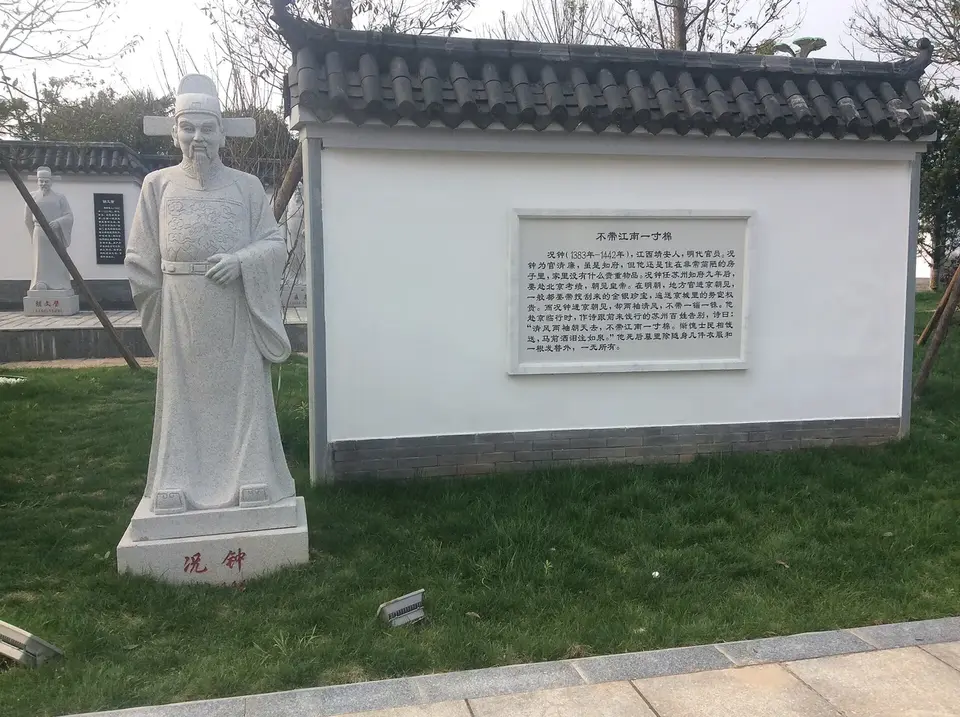
While other officials traveling to Beijing carried lavish gifts of silk and gold extorted from their districts, Kuang Zhong set out with only worn cotton bedding and crates of books. Departing from Suzhou, he composed the famous lines: "With two sleeves of pure breeze I ride to the throne, carrying not an inch of southern silk. Ashamed before the weeping elders who toast my horse, I recall my days of rule, every deed pure enough to swear before Heaven."
During his final term, Kuang Zhong continued his vigilant administration, maintaining economic prosperity and civic peace. He exhorted his descendants in his Poems Warning My Sons that integrity must never waver, that land and jewels are but encumbrances to heirs, and that true wealth lies in virtue. On January 30, 1443, he passed away from exhaustion in his official quarters at the age of sixty. The entire prefecture erupted into mourning, closing markets and weeping in the streets. When his coffin was transported by boat to Jiangxi, weeping crowds lined the canal banks for miles. Officials inspecting his effects found only books, worn garments, and a single bone hairpin. Shrines were founded in his honor throughout Suzhou, cementing his legend as the incorruptible Clear Sky for all time.
Major Achievements
Eradicating Deep-Seated Corruption and Restoring Administrative Integrity
Upon assuming office in 1430, Kuang Zhong confronted an administrative swamp dominated by arrogant, entrenched clerical networks. Utilizing deceptive complacency to lower their defenses, he uncovered extensive criminal evidence within three days, produced the emperor's decree, and executed six primary clerk ringleaders while dismissing dozens of corrupt underlings. His swift, unhesitating suppression of bureaucratic malpractice restored judicial authority, dismantled abusive patronage cliques, and established a clean, law-abiding administration across the prefecture.
Tenaciously Reducing Onerous Land Taxes alongside Zhou Chen
Confronting the crushing fiscal burdens imposed since the early Ming, Kuang Zhong joined forces with Grand Coordinator Zhou Chen to conduct meticulous field evaluations of soil productivity and flood damage. Facing staunch opposition from the Ministry of Revenue, he repeatedly memorialized the throne, warning that fiscal injustice would foment unrest. His persistent advocacy secured the reduction of 721,600 dan from official land taxes and 150,000 dan from abandoned coastal tracts, while standardizing pre-numbered triplicate tax ledgers that eliminated clerical embezzlement and rescued the peasant economy.
Exonerating Unjust Military Registries and Defending Human Dignity
Kuang Zhong exhibited extraordinary humanitarian courage in dismantling the abuses of hereditary military recruitment. Investigating the fabricated registries engineered by Censor Li Li and Vice Prefect Zhang Hui, he documented instances of extortion and successfully petitioned the emperor to exonerate 160 families entirely, while restricting obligations for 1,240 individuals to their own lifetimes. Furthermore, he cleared more than 1,120 backlogged legal cases within a single year and centralized appellate litigation to curb malicious lawsuits, earning widespread veneration as the second coming of Lord Bao.
Reorganizing Lowland Polders and Creating Agriculture Relief Granaries
As a master of hydraulic engineering, Kuang Zhong restructured the lowland drainage network around Lake Tai, subdividing unwieldy multi-thousand-mu polders into standardized five-hundred-mu enclosures bordered by protective dikes and regulated canals. In tandem, he and Zhou Chen instituted the Agriculture Relief Granaries, storing millions of dan of surplus grain. During the devastating droughts of 1433 and 1434, these reserves fed over 1.3 million peasants, preventing mass migration and starvation in an unprecedented achievement of disaster relief.
Rebuilding Schools and Fostering Commoner Talent without Bias
Recognizing that moral education is the bedrock of societal harmony, Kuang Zhong donated his personal salary and mobilized private funds to construct the new Wu County School with 230 rooms, while vastly expanding the Suzhou Prefectural Academy and publishing the Four Books in Detail. He fostered talent without regard to birth, ignoring anonymous smear letters to recommend the gifted commoner Zou Liang, who rose to become an Investigating Censor and prominent literatus, setting an enduring benchmark for impartial patronage.
Abolishing Arbitrary Levies and Settling Three Decades of Post-Horse Debts
Kuang Zhong systematically eliminated illegal extortion practiced by corrupt officials and regional garrisons. He terminated fraudulent collections for forty decommissioned anti-piracy vessels, abolished forced cash substitutions for five hundred seasonal transport boats, and successfully compelled northern post stations to return over four hundred horses borrowed thirty years earlier while canceling replacement liabilities. Additionally, he overturned disproportionate textile quotas imposed on Suzhou by the Ministry of Works, bringing immense financial relief to the local population.
Exemplifying Incorruptibility and the Timeless Legacy of the Clear Sky
Throughout thirteen years administering the richest prefecture in the empire, Kuang Zhong lived in Spartan simplicity, dining on frugal fare and refusing every form of bribe. When summoned to Beijing for imperial evaluation, he traveled without luxury goods, famously declaring that he departed with nothing save pure breeze in both sleeves. Upon his death, he left no personal estate, his funeral vessel containing only crates of books and worn garments. His legacy was preserved in shrines across seven counties, immortalizing him alongside Bao Zheng and Hai Rui as the supreme paragon of clean governance in Chinese history.