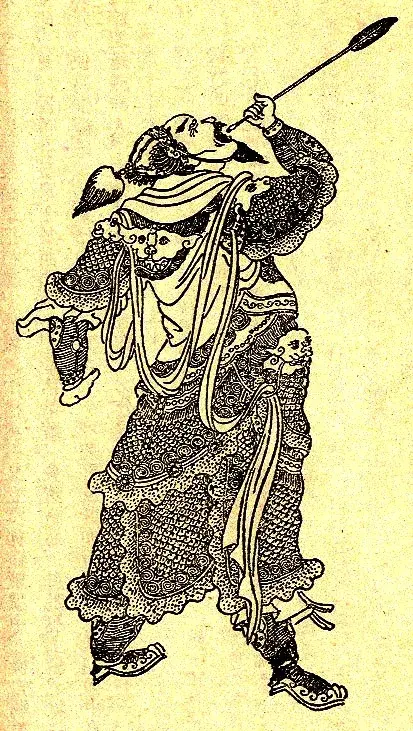
Biographical History
Early Uprising and Accompanying Expeditions
At the age of fourteen, while studying under a classical tutor, Xiahou Dun killed a person who had publicly insulted his teacher, thereby establishing widespread renown throughout his home region for ferocious valor and righteous pride. When chaos engulfed the realm at the end of the Han dynasty and Cao Cao raised volunteer troops at Chenliu to resist Dong Zhuo, Xiahou Dun and his clan cousin Xiahou Yuan rallied their local kinsmen and retainers to follow him. When Cao Cao served as Acting General of Resolute Might, Xiahou Dun was appointed Major of the army.
During the Chuping era, Xiahou Dun accompanied Cao Cao south into Yang Province to recruit volunteer troops. Along the journey, he demonstrated keen talent evaluation by recognizing the military competence of Han Hao, a gentleman of Henei, taking him into his retinue and placing him in vital positions of trust. After Cao Cao established a firm territorial base across Yan Province, Xiahou Dun was sent to garrison the critical crossing at Baima, soon advancing to Colonel of Breaching Impetus while concurrently serving as Administrator of Dong Commandery, managing regional border defense and local civil governance.
Crisis in Yan Province and Defense of the Base
In the first year of Xingping (194), Cao Cao led an eastern punitive campaign into Xu Province against Tao Qian, leaving Xiahou Dun behind to garrison the logistical base at Puyang. Unexpectedly, Zhang Miao, Administrator of Chenliu, conspired with the scholar Chen Gong to revolt, welcoming Lu Bu to seize the cities of Yan Province. At that time, Cao Cao's family members and heavy baggage were stationed at Juancheng, creating an existential emergency. Xun Yu hastily mobilized defenses and urgently summoned Xiahou Dun to come to their rescue. Xiahou Dun acted immediately, leading light cavalry on a forced march, intercepting Lu Bu's vanguard force on the road.
After an initial skirmish, Lu Bu withdrew and exploited the unguarded state of Puyang to seize the city and capture Xiahou Dun's logistical supplies. Xiahou Dun pushed through the night to reach Juancheng, where he immediately coordinated with Xun Yu to execute dozens of covert conspirators within the city walls, thereby restoring calm and steadfast loyalty among the garrison and populace. Xiahou Dun, Xun Yu, and Cheng Yu divided responsibilities to hold the three remaining strongholds of Juancheng, Fan County, and Dong'e, preserving Cao Cao's political and territorial lifeline.
Shortly thereafter, soldiers from Lu Bu's army entered the encampment under the pretense of surrender, took Xiahou Dun hostage by surprise, and demanded a heavy ransom of treasures. The entire camp fell into panic. His subordinate commander Han Hao remained completely composed. Han Hao deployed troops outside Xiahou Dun's command tent, ordering all units to remain stationary at their assigned posts, which prevented mutiny. Han Hao then marched to the scene, sternly rebuking the captors and declaring that as an officer bound by state law to suppress rebellion, he would never compromise imperial duty for the life of a single general. Weeping before Xiahou Dun, Han Hao gave the direct order for heavily armored soldiers to storm the position. The terrified captors surrendered and pleaded for mercy, but Han Hao executed every one on the spot, successfully rescuing Xiahou Dun unharmed. When informed, Cao Cao praised Han Hao's uncompromising firmness as an enduring model of military governance and decreed that all future hostage-taking situations must be met with immediate assault regardless of the captive's rank, permanently eliminating hostage schemes within his ranks.
Battlefield Injury and Agricultural Reconstruction
Following Cao Cao's return from Xu Province, Xiahou Dun accompanied the army on a general counter-offensive to retake Yan Province from Lu Bu. During the intense fighting, Xiahou Dun personally charged enemy lines and was struck in the left eye by a stray arrow. This serious injury caused soldiers in the army to refer to him as the Blind Xiahou. Xiahou Dun was deeply conscious of his appearance and dignity; whenever he looked into a mirror and observed his disfigurement, he felt intense anger and threw the mirror to the ground, and troops strictly avoided using this moniker in his presence.
After Yan Province was fully recovered, Xiahou Dun resumed duties as Administrator of Chenliu. While administering the commandery, he selected the upright scholar Wei Zhen to serve as calculating clerk and once ordered his staff to bring their wives to attend an official banquet. Wei Zhen stood firm in open remonstrance, arguing that mixed-gender gatherings violated classical rites and represented corrupt decadence. Enraged, Xiahou Dun initially ordered Wei Zhen imprisoned, but upon recognizing the official's unbending devotion to moral principles, he promptly released him and treated him with enhanced respect.
Subsequently, Xiahou Dun was promoted to General of Establishing Might, Administrator of Jiyin, and enfeoffed as Marquis of Gao'an Village. During his tenure across Chenliu and Jiyin, central China suffered severe drought accompanied by devastating swarms of locusts, leaving farmland barren and triggering widespread starvation. Xiahou Dun personally surveyed local watercourses and directed the damming of the Taishou River to construct storage reservoirs and irrigation channels. He laid aside administrative privilege, carried baskets of earth alongside common soldiers and laborers, and mobilized the garrison and returned refugees to cultivate paddy rice. This massive hydraulic effort averted acute food shortages, providing sustenance and stability to tens of thousands of families.
Campaigns in Jing and Yu and Guarding the Strategic Core
In the third year of Jian'an (198), Lu Bu renewed his alliance with Yuan Shu and dispatched Gao Shun and Zhang Liao to launch a fierce assault on Liu Bei at Xiaopei. Xiahou Dun was ordered by Cao Cao to lead relief forces, but he met stubborn resistance from Gao Shun's vanguard and suffered defeat, resulting in the fall of Pei. After Cao Cao's main forces destroyed Lu Bu, Xiahou Dun was reassigned as Intendant of Henan, placing him in supreme charge of defending the ancient imperial capital Luoyang and its surrounding transportation arteries.
In the seventh year of Jian'an (202), Liu Biao dispatched Liu Bei northward to raid Ye County, pressing against the southern boundary of Xuchang. Xiahou Dun and Yu Jin led forces to repel the invasion. Stationed at Bowang, Liu Bei set fire to his own encampment and staged a tactical retreat. Disregarding warnings from his lieutenant Li Dian concerning potential ambushes in dense vegetation, Xiahou Dun pursued the retreating column down narrow roads, falling directly into a concealed trap. Facing heavy defeat, he was rescued when Li Dian brought forward the rear guard in disciplined formation, compelling Liu Bei to break off the engagement and retreat south.
In the ninth year of Jian'an (204), after Cao Cao seized Ye city and dismantled Yuan Shao's heirs, Xiahou Dun was elevated to General Who Subdues Waves while continuing as Intendant of Henan. Recognizing his commanding stature and absolute dependability, Cao Cao granted him the extraordinary authority to execute administrative and military decisions at his discretion without being constrained by regular administrative codes. In the tenth year of Jian'an (205), when Gao Gan rebelled in Bing Province and Wei Gu rose in Hedong, Xiahou Dun marched forces to coordinate with Administrator Du Ji and western generals, quickly pacifying the commandery. In the twelfth year of Jian'an (207), recording his comprehensive civil and logistical merits, the court augmented his fief by one thousand eight hundred households, bringing his estate to two thousand five hundred households. When the upright hermit Tian Chou refused nobility titles following the northern conquest, Cao Cao instructed Xiahou Dun, Tian Chou's intimate friend, to persuade him. Hearing Tian Chou's tearful defense of moral fidelity, Xiahou Dun respected his conscience and faithfully reported the matter to Cao Cao, who honored Tian Chou's wishes.
Victory at Hanzhong and Supreme Defense of the Southeast
In the twentieth year of Jian'an (215), Xiahou Dun participated in Cao Cao's western expedition against Zhang Lu in Hanzhong. During assaults on the heavily fortified Yangping Pass, imperial troops suffered heavy casualties against rugged terrain, prompting Cao Cao to consider an orderly withdrawal. Xiahou Dun and Xu Chu were sent to the heights to summon dispersed units back to main lines. During the night march, forward units lost their way and stumbled into the undefended mountain redoubt of Zhang Lu's brother Zhang Wei. Recognizing that the enemy was thoroughly disorganized, Xiahou Dun galloped back to apprise Cao Cao, who launched a full offensive that captured Yangping Pass and secured Hanzhong.
In the winter of the twenty-first year of Jian'an (216), Cao Cao led another campaign against Sun Quan, advancing to Ruxukou the following spring before agreeing to peace terms. Upon withdrawing north, Cao Cao appointed Xiahou Dun supreme commander of twenty-six army divisions, stationing him alongside veteran commanders Cao Ren and Zhang Liao at Juchao in Yang Province to guard the southeastern frontier. Cao Cao honored Xiahou Dun by bestowing skilled musical entertainers upon his headquarters, remarking that if ancient states rewarded ministers who pacified non-Hu tribes with court chimes, supreme generals defending the realm deserved no less.
In the twenty-fourth year of Jian'an (219), when Guan Yu besieged Cao Ren at Fancheng, Cao Cao moved his army to Mopo. Xiahou Dun led his forces to join him there. Cao Cao showed Xiahou Dun peerless intimacy, inviting him to ride in the royal carriage and granting him unrestricted access to his private living quarters, an honor shared by no other general. Xiahou Dun was subsequently appointed General of the Front, directing army movements back to Shouchun and then establishing headquarters at Zhaoling to hold the Huai River corridor.
In early 220, Cao Cao died in Luoyang, and Cao Pi succeeded as King of Wei. In the third month, Cao Pi elevated Xiahou Dun to General-in-Chief. However, Xiahou Dun fell grievously ill only months after taking office and passed away in the fourth month. Cao Pi was overwhelmed with sorrow, personally putting on plain mourning garments at the eastern gate of Ye to conduct funeral rites, conferring the posthumous title Marquis Zhong. In the first year of Qinglong (233), Emperor Ming Cao Rui issued an imperial edict granting Xiahou Dun sacrificial honors in Cao Cao's ancestral temple alongside Cao Ren and Cheng Yu.
Major Achievements and Legacy
Hydraulic Engineering and Leading by Example
During his governance over Chenliu and Jiyin, central China was afflicted by simultaneous drought and widespread locust plagues, threatening total famine. Instead of passive relief, Xiahou Dun initiated comprehensive water management. He personally surveyed topographical gradients and oversaw the construction of an earthen dam across the Taishou River, forming extensive reservoirs for systematic field irrigation. Throughout the grueling labor, he discarded gubernatorial pretense, personally carrying soil baskets on his shoulders and working shoulder to shoulder with soldiers and common laborers. His personal example inspired collective morale, enabling timely planting and harvesting of paddy crops. This initiative stabilized military rations, supported thousands of resettled households, and was remembered by local residents as an enduring public blessing.
Frugality and Reverence for Classical Teachers
Despite holding supreme civil and military authority for several decades, Xiahou Dun remained remarkably modest and uncorrupted. Whenever imperial rewards or regional tributes were conferred upon him, he immediately distributed the wealth among his subordinates, officers, and impoverished scholars. When necessary administrative expenditures exceeded his private allowance, he drew officially from state accounts rather than engaging in commerce or acquiring private real estate. At the time of his death, his household possessed no surplus property, and his family required state funeral assistance. Furthermore, even amidst continuous military campaigning, he maintained deep reverence for Confucian education, personally visiting scholars to receive instruction whenever prominent teachers passed through his jurisdiction.
Assisting the Dynastic Foundation and Modesty in Honors
After Cao Cao was created King of Wei, most civil officials and military generals accepted official appointments under the newly formed Wei administration. Xiahou Dun alone continued to hold his military commission under the Han court. He submitted memorials insisting that proper minister-ruler decorum required him to hold office within the Wei establishment. Cao Cao initially declined, observing that the most noble ruler-minister bonds resemble friendship and tutelage, suggesting that an office within a regional kingdom would demean a founding pillar. Xiahou Dun persistently reiterated his request until Cao Cao formally appointed him General of the Front under Wei. When courtiers urged Cao Cao to usurp the Han throne, Xiahou Dun advised prioritizing the pacification of Shu and Wu before accepting the imperial mandate, demonstrating sober political judgment in consolidating the new dynasty.
Talent Recognition and Tolerance of Direct Admonition
Although renowned for raw bravery in his youth, Xiahou Dun possessed exceptional administrative generosity and keen discernment of human character. While recruiting soldiers in Yang Province, he identified Han Hao's exceptional strategic capabilities and elevated him to command; Han Hao later saved his life during the hostage crisis and collaborated with Zao Zhi to formulate the vital agricultural colony system that sustained Cao Wei. While governing Chenliu, Xiahou Dun accepted blunt criticism from Wei Zhen regarding banquet propriety, overcoming initial displeasure to promote the principled official. Similarly, when Tian Chou adamantly refused noble enfeoffment out of moral loyalty to his deceased former lord, Xiahou Dun listened with deep sympathy and persuaded Cao Cao to respect his integrity, reflecting the magnanimity of a foundational statesman.