Birth in Western India
Born into a Brahmin family in Ujjain, Western India, receiving rigorous training in the Sammitiya tradition and Mahayana treatises.
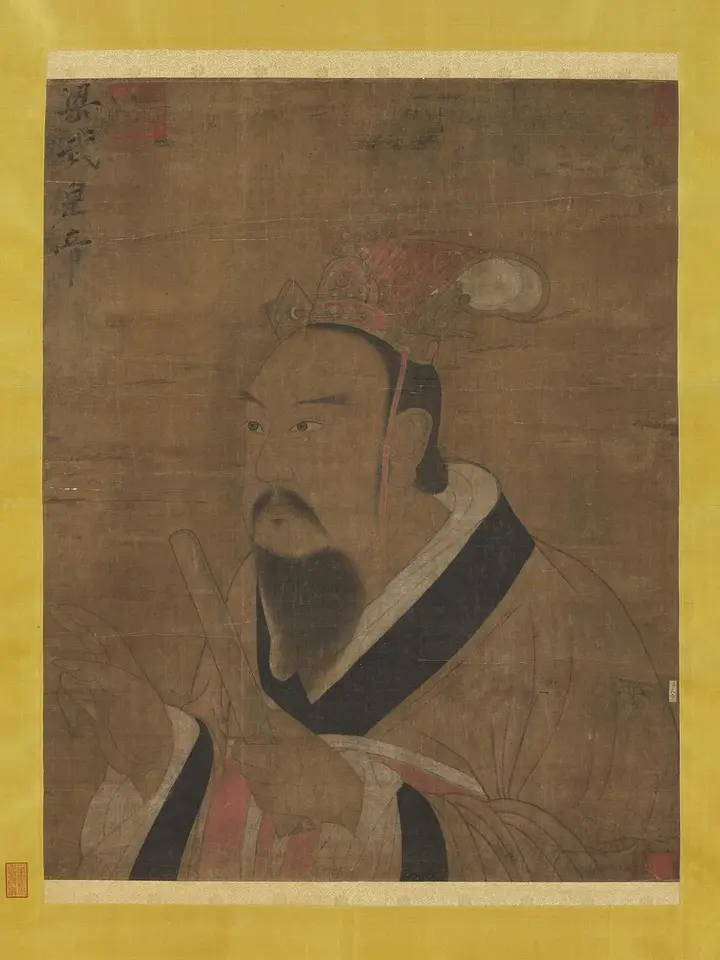
真谛
Zhendi (真谛, 499–569), Sanskrit name Paramartha and originally Gunarata, was an eminent Indian Buddhist master, translator, and philosopher during the Southern Dynasties (Liang and Chen), revered alongside Kumarajiva, Xuanzang, and Amoghavajra as one of the Four Great Translators of Chinese Buddhism. Born into a Brahmin family in Ujjain in Western India, he was educated in both orthodox Indian philosophy and the Buddhist…
Zhendi (真谛, 499–569), Sanskrit name Paramartha and originally Gunarata, was an eminent Indian Buddhist master, translator, and philosopher during the Southern Dynasties (Liang and Chen), revered alongside Kumarajiva, Xuanzang, and Amoghavajra as one of the Four Great Translators of Chinese Buddhism. Born into a Brahmin family in Ujjain in Western India, he was educated in both orthodox Indian philosophy and the Buddhist Tripitaka, acquiring profound expertise in the Mahayana Yogacara philosophy of Asanga and Vasubandhu. In the 530s, he traveled across the Indian Ocean to the kingdom of Funan (modern Cambodia). When Emperor Wu of Liang dispatched envoys to Funan to invite prominent scholars and seek Mahayana manuscripts, Paramartha accepted the call, arriving in Guangzhou with 240 bundles of Sanskrit palm-leaf texts in 546 and reaching the imperial capital of Jiankang in 548. However, his planned grand translation bureau was immediately disrupted by the catastrophic Hou Jing Rebellion. Over the subsequent two decades, Paramartha was displaced by regional warfare across Fuchun, Yuzhang, Xinwu, Jin'an (Fujian), and Guangzhou, yet he maintained continuous translation sessions wherever he traveled. His translations, totaling forty-eight works in over two hundred fascicles, include the Mahayanasamgraha, Abhidharmakosa-bhasya, Madhyanta-vibhaga, and Golden Light Sutra. Introducing the complete Yogacara doctrinal system to China and pioneering the doctrine of the Ninth Consciousness (Amalavijnana), he founded the Shelun school, which profoundly shaped medieval East Asian Buddhist philosophy.
Born into a Brahmin family in Ujjain, Western India, receiving rigorous training in the Sammitiya tradition and Mahayana treatises.
Traveled south across the Indian Ocean to Funan, establishing an international reputation as an authoritative master of Buddhist metaphysics.
Responded to an invitation from Emperor Wu of Liang, arriving at Nanhai Commandery with 240 bundles of Sanskrit palm-leaf manuscripts.
Reached the southern capital of Jiankang, received with deep reverence by Emperor Wu in the Baoyun Hall of the Hualin Garden.
Fled to Fuchun following the sack of Jiankang and the death of Emperor Wu, translating five fascicles of the Saptadasabhumi-sastra before warfare halted work.
Resided briefly at Zhengguan Temple in Jiankang before moving to Baotian Temple in Yuzhang and Xinwu, translating the Golden Light Sutra and early Vijnaptimatrasiddhi tracts.
Relocated to Foli Temple in Jin'an Commandery, where prominent scholar-monks gathered to study, creating a flourishing regional center of translation.
Attempted to sail home to India from Lianghua, but unfavorable maritime winds carried his vessel back to Guangzhou, where Governor Ouyang Wei provided extensive patronage.
Spent seven productive years at Zhizhi Temple in Guangzhou, producing master translations of the Mahayanasamgraha and Abhidharmakosa.
Stricken with grief following the death of his primary disciple Huikai, he passed the lineage to twelve disciples and entered parinirvana at age seventy-one.
Paramartha was born in Ujjain in Western India (modern Madhya Pradesh) into an aristocratic Brahmin lineage. Ujjain was situated near Valabhi, the premier center of Buddhist scholasticism in Western India, where the Sammitiya school and Mahayana Yogacara philosophy flourished. From his youth, Paramartha was trained in traditional Brahmin Vedic learning, grammar, and formal logic, before taking monastic vows and mastering both Hinayana and Mahayana canons. He distinguished himself through deep comprehension of the consciousness-only treatises articulated by Indian masters Asanga and Vasubandhu.
Driven by a vow to disseminate the dharma abroad, Paramartha sailed southward across the Indian Ocean to the kingdom of Funan on the Indochinese peninsula. In maritime Southeast Asia, he spent over two decades lecturing on Buddhist treatises. Meanwhile, in the southern Chinese empire of Liang, the devout Buddhist sovereign Emperor Wu sought to enrich the Chinese canon with authentic Indian treatises on Yogacara and the Avatamsaka. In the mid-540s, Emperor Wu dispatched his envoy Zhang Si to escort a Funan tribute embassy home and request the transmission of eminent scholars and Sanskrit texts. The sovereign and sangha of Funan urged Paramartha to accept the imperial mission. Paramartha agreed, assembling 240 bundles of Sanskrit palm-leaf manuscripts and embarking for China alongside the imperial envoy.
On August 15, 546, the first year of the Zhongdatong era, Paramartha arrived at Nanhai Commandery (modern Guangzhou) after a hazardous sea voyage. Due to the immense weight of his scriptural library and the mountainous terrain of the Nanling corridor, he traveled slowly overland, taking nearly two years to reach the imperial capital of Jiankang in late summer 548. Paramartha was then fifty years old. Overjoyed by the arrival of the renowned master, Emperor Wu bowed before him in imperial audience and installed him in the Baoyun Hall of the Hualin Garden with generous state stipends, preparing to inaugurate an imperial translation bureau.
However, only one month after his arrival, the rebellious general Hou Jing launched a catastrophic insurrection. In October 548, rebel troops besieged the palace city of Jiankang, burning monasteries and devastating the capital. Emperor Wu was starved to death in his quarters, and court society collapsed. His translation bureau destroyed before it could open, Paramartha fled into the countryside, carrying his precious manuscripts on foot toward Fuchun in eastern Zhejiang. There, magistrate Lu Yuanzhe provided private hospitality, gathering twenty scholar-monks, including Baoqiong, to assist Paramartha in translating the Saptadasabhumi-sastra (the foundational section of the Yogacarabhumi-sastra). Yet as the flames of war spread into eastern Zhejiang, the project was forced to halt after producing only five fascicles.
Over the next decade, Paramartha lived as an itinerant refugee across southern China. In 552, after imperial loyalists suppressed Hou Jing, Paramartha returned to Jiankang, residing at Zhengguan Temple to translate the Golden Light Sutra alongside twenty disciples, completing seven fascicles. However, civil war among Liang princes erupted anew across the middle Yangtze, and Western Wei armies sacked Jiangling, killing Emperor Yuan. Fleeing severe famine in the capital, Paramartha traveled south to Baotian Temple in Yuzhang (modern Nanchang) in 554, subsequently retreating to Xinwu. In these remote locations, he translated the Maitreyavyakarana, Benevolent King Prajnaparamita Sutra with a six-fascicle commentary, Madhyamaka-sastra commentary, and initial formulations of the Nine Consciousnesses doctrine.
In 555, Paramartha crossed the Nanling Mountains to Shixing, but was invited back to Nankang by imperial regent Xiao Bo. When Xiao Bo was defeated and killed in 557, Paramartha traveled through Linchuan to find refuge in coastal Jin'an Commandery (modern Fujian), residing at Foli Temple. Although Jin'an was an isolated and underdeveloped frontier, distinguished scholar-monks from across central China, including Zhiwen, Sengzong, Fazhun, and Sengren, undertook hazardous journeys to study under him. Assisting Paramartha with scribal recording and doctrinal commentary, these disciples created an unexpected golden age of Buddhist scholasticism in medieval Fujian.
By 559, as the Chen dynasty replaced the Liang, the sixty-one-year-old master grew disheartened by decades of civil war and prepared to return to India. In 561, he boarded a vessel sailing southward, and in autumn 562 prepared a large seagoing ship in Lianghua. However, contrary monsoons drove his ship back to the port of Guangzhou. Governor Ouyang Wei and his son Ouyang Ge, both devout Buddhist laymen, welcomed the master enthusiastically, installing him at Zhizhi Temple (modern Guangxiao Temple) and receiving the Bodhisattva precepts from his hands.
At Zhizhi Temple, Paramartha enjoyed seven uninterrupted years of peaceful scholarly life, surrounded by celebrated disciples such as Huikai, Fatai, Zhijiao, and Daoni. This period marked the pinnacle of his translation career. Directing a disciplined collegium, he translated the core treatises of the Indian Yogacara and Sarvastivada traditions, including Asanga's Mahayanasamgraha in three fascicles with Vasubandhu's fifteen-fascicle commentary, and Vasubandhu's monumental twenty-two-fascicle Abhidharmakosa-bhasya. Combining philological precision with profound oral commentary, Paramartha accomplished the central scholarly mission of his life during these final years in Guangzhou.
In 568, while lecturing on the Abhidharmakosa, Paramartha suffered a devastating personal blow when his chief disciple, Huikai, succumbed to sudden illness in his thirties. Huikai was an accomplished scholar-monk who served as the primary scribe, editor, and organizer of Paramartha's lecture notes. Terrified that the newly translated Yogacara doctrines would disappear with his death, the aging master gathered twelve senior disciples, including Daoni, Zhijiao, and Fatai, in Fazhun's quarters. Passing an incense burner among them, he extracted a solemn vow that they would dedicate their lives to propagating the Mahayanasamgraha and Abhidharmakosa without interruption.
Attempting to finish Huikai's incomplete lecture series, Paramartha resumed teaching on the fifth chapter of the Kosa, but collapsed from grief and physical exhaustion. On January 11, 569, the first year of the Taijian era under Emperor Xuan of Chen, Paramartha passed away peacefully at Zhizhi Temple at the age of seventy-one. His disciples gathered his manuscripts and traveled across northern and southern China, founding the influential Shelun school, which dominated Chinese Buddhist thought during the late sixth century.
Before Xuanzang's famous pilgrimage in the seventh century, the entire structural corpus of Yogacara philosophy in East Asia was introduced through Paramartha's translations. Prior to his arrival, Chinese scholars possessed only partial texts from the Northern Dilun tradition. Working under chaotic wartime conditions, Paramartha translated the definitive treatises of Asanga and Vasubandhu, including the Mahayanasamgraha (She Dacheng Lun), its extensive commentary, the Madhyanta-vibhaga (Zhongbian Fenbie Lun), the Tridharmanirbhasa (San Wuxing Lun), the Trimshika-vijnaptimatrata (Zhuanshi Lun), the Vimshatika (Weishi Lun), and the Vini-scayasamgrahani section of the Yogacarabhumi-sastra. These texts established the foundational theoretical frameworks of consciousness-only, the transformations of the alayavijnana, and the three natures (trisvabhava), directly giving rise to the Shelun school and preparing the way for the later Faxiang school.
Paramartha's most original doctrinal contribution was his articulation of the Ninth Consciousness, termed Amalavijnana (immaculate consciousness or undefiled awareness). While standard Indian Yogacara posited an eight-consciousness model where the eighth alayavijnana acts as the storehouse of all karmic seeds, Paramartha harmonized Yogacara with the Tathagatagarbha (buddha-nature) traditions of the Anunatvapurnatvanirdesa and Ratnagotravibhaga. He argued that the alayavijnana contains both defiled and pure elements, and that transcending its dualistic permutations reveals the fundamentally pure, unarisen Ninth Consciousness. This synthesis of Mind-Only metaphysics with intrinsic buddha-nature resolved deep tensions in Chinese soteriology, exerting profound influence on the Awakening of Faith in the Mahayana and Huayan philosophy.
In the realm of Abhidharma scholasticism, Paramartha produced the landmark first Chinese translation of Vasubandhu's Abhidharmakosa-bhasya (Jushe Lun) in twenty-two fascicles. Synthesizing the doctrinal categories of the Sarvastivada and Sautrantika schools, the Kosa was regarded as the definitive encyclopedia of classical Indian Buddhist ontology, psychology, and cosmology. Paramartha's rigorous translation and accompanying lectures provided Chinese monks with their first comprehensive textbook on analytical Buddhist metaphysics, inaugurating the influential Kosa (Jushe) scholarly tradition that flourished alongside Mahayana studies throughout the medieval period.
Reflecting his early training in Western India, Paramartha enriched the Chinese canon with rare scriptures from the Sammitiya school. He translated the Lu Ershier Mingliao Lun, an essential Vinaya treatise that elucidated monastic rules through twenty-two mnemonic verses. Compared with prevailing Dharmaguptaka and Sarvastivada Vinayas, this text provided valuable insights into divergent institutional practices within Indian monasticism. Furthermore, in translating the Samayabhedoparacanacakra (Buzhi Yi Lun), he preserved unique Sammitiya interpretations of the pudgala (person) and the three kinds of nominal designations, expanding Chinese scholarly knowledge of early Buddhist sectarian divergence.
Beyond canonical Buddhist treatises, Paramartha made seminal contributions to biographical literature and non-Buddhist Indian philosophy. He translated the Biography of Vasubandhu (Posoupandou Fashi Zhuan), which provided a vital primary record of the lives, philosophical debates, and royal patronage of Asanga and Vasubandhu in Gupta India. Displaying remarkable intellectual breadth, he also translated the Suvarnasaptati (Jin Qishi Lun), the primary commentary on the Samkhyakarika of Ishvarakrishna. Expounding the dualistic philosophy of purusha (spirit) and prakriti (matter), this work stands as the earliest objective translation of an orthodox non-Buddhist Indian philosophical system in Chinese history.
Paramartha maintained rigorous philological standards throughout his career, balancing literal accuracy with conceptual fidelity. In his translation bureaus, he expounded the Sanskrit original phrase by phrase, ensuring that his scribes grasped the underlying philosophical argument before committing it to Chinese prose. Every translation session was integrated with public lectures, during which disciples such as Huikai and Fatai recorded extensive commentaries, notes, and glossaries. Despite working during the collapse of the southern dynasties, Paramartha's dedication preserved the textual integrity of his corpus, setting a high standard for subsequent medieval translators.
FIGURES ASSOCIATED WITH THIS DYNASTY