Alliance with Liu Bang
Joined Liu Bang's westward campaign at Yangcheng; appointed General of Han and breached Wu Pass to destroy the Qin dynasty.
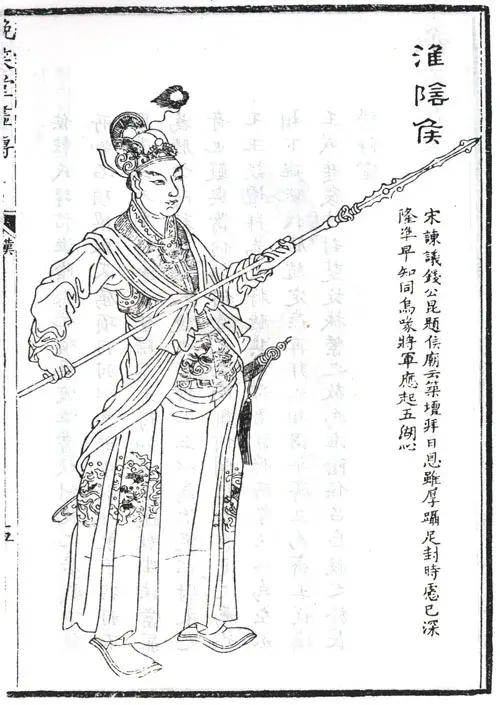
韩王信
Han Wangxin (韩王信, ?–196 BCE), originally named Han Xin, was an aristocratic descendant of King Xiang of Han from the Warring States period, as well as a prominent regional monarch and general during the Qin-Han transition. To distinguish him from the famed Han generalissimo and Marquis of Huaiyin, Han Xin, historical texts universally refer to him as "Han Wangxin" (King Xin of Han). During the uprisings against the Qin…
Han Wangxin (韩王信, ?–196 BCE), originally named Han Xin, was an aristocratic descendant of King Xiang of Han from the Warring States period, as well as a prominent regional monarch and general during the Qin-Han transition. To distinguish him from the famed Han generalissimo and Marquis of Huaiyin, Han Xin, historical texts universally refer to him as "Han Wangxin" (King Xin of Han). During the uprisings against the Qin dynasty, he joined the forces of Liu Bang, the Duke of Pei, serving as General of Han and marching through Wu Pass to participate in the overthrow of the Qin regime. When Liu Bang was relegated to Hanzhong as King of Han, Han Wangxin astutely perceived the homesick sentiments of the troops and urged Liu Bang to march eastward to contest supreme dominion over China. Appointed Grand Commandant of Han, he spearheaded operations across the ancestral territory of Han, compelling Xiang Yu's appointed monarch Zheng Chang to surrender and formally re-establishing the tributary Kingdom of Han under Liu Bang's aegis. Following the foundation of the Han dynasty, Emperor Gaozu formally enfeoffed him with split tallies as King of Han, establishing his capital at Yingchuan. In 201 BCE, cautious of his martial vigor and the strategic proximity of Yingchuan to the imperial core, Emperor Gaozu relocated his kingdom north of Taiyuan to garrison the frontier against the Xiongnu nomadic confederation, with its royal seat at Mayi. Besieged by a hundred thousand Xiongnu cavalry under Modu Chanyu, Han Wangxin conducted unauthorized truce negotiations, incurring severe imperial reprimands and suspicion. Terrified of execution, he defected to the Xiongnu, yielding Mayi and guiding nomadic hosts into Shanxi, precipitating the renowned Siege of Baideng against Emperor Gaozu. Remaining in the steppe as a frontline commander raiding the Han northern border, he was ultimately slain in combat by Grand General Chai Wu at the Battle of Canhe in 196 BCE.
Joined Liu Bang's westward campaign at Yangcheng; appointed General of Han and breached Wu Pass to destroy the Qin dynasty.
Accompanied Liu Bang into Hanzhong and strongly advocated an immediate eastward offensive; appointed Grand Commandant of Han.
Captured over ten cities across Han territory and compelled Xiang Yu's puppet king Zheng Chang to surrender; confirmed as King of Han.
Defended besieged Xingyang alongside Zhou Ke; surrendered upon the city's fall but subsequently escaped back to Liu Bang's camp.
Aided in crushing Chu; received formal enfeoffment with imperial tallies as King of Han ruling Yingchuan Commandery from Yangdi.
Transferred north to Taiyuan to counter the Xiongnu; petitioned to establish his seat at the forward frontier fortress of Mayi.
Besieged at Mayi by Modu Chanyu; rebuked for truce talks, he rebelled and surrendered Mayi to the Xiongnu, invading Taiyuan.
Campaigned alongside Xiongnu cavalry, enticing Emperor Gaozu's advance forces into the disastrous seven-day encirclement at Baideng.
Dispatched envoy Wang Huang to coordinate with the rebel general Chen Xi, intensifying military pressure on the northern border.
Led joint Xiongnu and insurgent forces in an invasion of Canhe; refused Chai Wu's call to surrender and was slain in battle.
Han Wangxin was an aristocratic descendant of King Xiang of Han, a monarch of the state of Han during the Warring States period. Standing eight chi and five cun tall (approximately 1.96 meters), he possessed a commanding physique and commanded immense prestige among the displaced nobility and former subjects of Han. During the terminal years of the Qin dynasty, the widespread anti-Qin uprisings initiated by Chen Sheng and Wu Guang triggered the resurgence of royal descendants across the former Six States. When the Chu commander Xiang Liang enthroned the grandson of King Huai of Chu, royal lineages in Qi, Zhao, Yan, and Wei had already reconstituted their independent thrones, leaving only the state of Han without a designated royal heir. Zhang Liang, acting as a key strategist within the Chu coalition, proposed the enthronement of Prince Cheng of Han (the Lord of Hengyang), which Xiang Liang endorsed to rally the population of the former Han heartland.
Following Xiang Liang's defeat and death at Dingtao, King Cheng fled to Pengcheng under the protection of King Huai. Concurrently, Liu Bang, the Duke of Pei, led a westward expeditionary army against Yangcheng. During this campaign, Zhang Liang, serving as Chancellor of Han, facilitated the pacification and submission of various ancestral Han settlements, during which he introduced Han Xin to Liu Bang. Recognizing his royal lineage and operational aptitude, Liu Bang appointed him General of Han. Leading his personal contingents, Han Xin served as an integral vanguard during the westward drive, successfully forcing Wu Pass, overcoming Lantian, receiving the capitulation of Ziying, and bringing about the downfall of the Qin empire.
Following the fall of Qin, Xiang Yu, the Hegemon-King of Western Chu, oversaw the division of the realm, exiling Liu Bang to the remote and mountainous regions of Ba, Shu, and Hanzhong as King of Han. Han Xin accompanied the Han forces southward to Nanzheng. The Han rank and file, predominantly natives of the eastern plains and Guandong territories, suffered acute demoralization, leading to rampant desertion and unrest. Han Xin astutely identified the strategic potential inherent in this emotional volatility, advising Liu Bang: "Xiang Yu has enfeoffed his favored generals in the fertile central plains while banishing Your Majesty to this inaccessible hinterland, an overt demotion. Your soldiers are all eastern men who stand on tiptoe, desperately yearning for their native soil. If you harness their fierce desire to return eastward, supreme dominion over the realm can be achieved."
Greatly impressed by this strategic insight, Liu Bang formally pledged to make Han Xin the King of Han upon the conquest of the Three Qins. To prepare for this offensive, Liu Bang appointed Han Xin as Grand Commandant of Han, providing him with a dedicated army to infiltrate and recover the ancestral territory of Han. Meanwhile, Xiang Yu, harboring resentment toward the original King Cheng for failing to accompany his military campaigns, detained and executed Cheng in Pengcheng, replacing him with Zheng Chang, a former magistrate of Wu County and trusted confidant, to block the Han forces.
In 205 BCE, Grand Commandant Han Xin led his expeditionary force deep into Han territory, rapidly reclaiming more than ten strategic cities. As Liu Bang's main army advanced into Henan, Han Xin launched a fierce assault against Zheng Chang at Yangcheng, forcing Zheng Chang to surrender unconditionally. Fulfilling his earlier pledge, Liu Bang invested Han Xin as the legitimate King of Han. Throughout the subsequent Chu-Han Contention, King Xin commanded dedicated contingents of Han troops, serving as an indispensable operational bulwark anchoring the central Henan battlefront.
In 204 BCE, during the height of the Chu-Han war, Xiang Yu directed the elite strike forces of Western Chu in a protracted siege against the strategic fortress of Xingyang. Facing starvation and imminent collapse, Liu Bang resolved to execute a daring breakout with a handful of mounted guards, delegating the defense of the fortress to King Xin of Han, Imperial Counselor Zhou Ke, and General Cong Gong. The Chu forces eventually breached the fortifications; Zhou Ke adamantly refused to submit and was boiled to death, while King Xin was captured after all avenues of resistance were exhausted. Xiang Yu placed him under confinement within the Chu military compound.
Unwilling to serve the Hegemon-King, King Xin orchestrated a daring escape from Chu custody, undertaking an arduous journey to rejoin Liu Bang's headquarters. Liu Bang exhibited no rancor regarding his temporary capitulation, instead praising his loyalty and perseverance, promptly reconfirming him as King of Han and restoring his command over regional armies. King Xin subsequently spearheaded campaigns across the Central Plains and Huai River valleys, tying down major Chu formations until the decisive victory at Gaixia extinguished the Western Chu regime.
In the first month of 202 BCE, Liu Bang ascended the imperial throne at Dingtao, founding the Western Han dynasty. To reward military merit and stabilize the empire, Emperor Gaozu executed formal tallies with King Xin, investing him with Yingchuan Commandery, encompassing fourteen prosperous counties with its capital at Yangdi (modern Yuzhou, Henan). Situated in the fertile agricultural and commercial crossroad of the empire, the Kingdom of Han stood as one of the preeminent regional kingdoms of the early Han dynasty.
As imperial centralization solidified, Emperor Gaozu grew increasingly uneasy regarding the autonomous power wielded by the heterosurnamed kings. In the spring of 201 BCE, the imperial court initiated aggressive containment measures. Emperor Gaozu noted that King Xin of Han was exceptionally martial and that his domain in Yingchuan bordered imperial strategic bottlenecks at Gong and Luoyang to the north, Wan and Ye to the south, and Huaiyang to the east. Unwilling to leave such a seasoned general in control of the empire's core, Gaozu issued an edict decreeing the relocation of the Kingdom of Han to the northern frontier beyond Taiyuan, with Jinyang (modern Taiyuan, Shanxi) as its administrative seat.
Recognizing the decree as an intentional maneuver to weaken his territorial base, King Xin complied. However, evaluating the northern frontier, he realized Jinyang lay hundreds of li south of the border fortifications, rendering it ineffective for intercepting nomadic incursions. Seeking to demonstrate unreserved commitment to frontier defense, King Xin petitioned the throne to move his capital directly to the northernmost garrison post of Mayi (modern Shuozhou, Shanxi). Gaozu granted permission, and King Xin established his fortress seat at Mayi, directly facing the northern steppes.
In autumn of the same year, the Xiongnu nomadic confederation, unified under the formidable leadership of Modu Chanyu, mobilized a hundred thousand elite mounted warriors across the Great Wall, completely surrounding Mayi. Deprived of sufficient provisions and facing overwhelming odds, King Xin endured months of heavy fighting. With imperial relief forces failing to arrive, King Xin repeatedly dispatched private envoys to negotiate a ceasefire with Modu Chanyu to preserve his surviving troops.
News of King Xin's covert diplomatic exchanges reached imperial headquarters, triggering intense rage and suspicion from Emperor Gaozu, who feared King Xin was plotting treason with the nomads. Gaozu dispatched imperial envoys carrying stern rebukes, harshly censuring the King of Han. Already alarmed by the imperial court's aggressive suppression of other regional rulers, such as Zang Tu, King Xin concluded that imperial reinforcements would only bring his immediate arrest and execution.
Driven by mortal fear, King Xin made the fateful decision to sever ties with the Han court. In the autumn of 200 BCE, he surrendered Mayi to the Xiongnu, entering into an offensive alliance with Modu Chanyu. Acting as vanguard and guide, King Xin directed Xiongnu cavalry across the Gouzhu Mountains, overrunning Taiyuan Commandery and laying siege to Jinyang. The northern frontier collapsed overnight, sending shockwaves through the imperial court in Guanzhong.
Faced with King Xin's defection, Emperor Gaozu personally commanded an imperial expeditionary force of 320,000 troops to pacify the northern frontier. In the winter of 200 BCE, imperial units engaged King Xin's vanguard at Tongdi, where Han forces commanded by Zhou Bo routed the insurgents and slew King Xin's leading general, Wang Xi. The rebel forces scattered, and King Xin fled into the northern grasslands under the protection of Modu Chanyu.
In the steppe, King Xin reconstituted his remnant units with generals Manqiu Chen and Wang Huang, elevating Zhao Li, a descendant of the Zhao royal family, as King of Zhao. Joining forces with the Xiongnu Right Worthy Prince, they launched repeated incursions against Guangwu and Jinyang. Emperor Gaozu pursued aggressively amid extreme blizzards, which inflicted severe frostbite on up to thirty percent of the imperial infantry. Perceiving Gaozu's overconfidence, Modu Chanyu concealed his veteran cavalry in secluded valleys, deliberately leaving frail troops and emaciated mounts along the advance route.
Deceived by these appearances and dismissing the cautionary advice of Lou Jing, Emperor Gaozu advanced impulsively with his vanguard cavalry toward Pingcheng. Modu Chanyu immediately sprung the trap, deploying four hundred thousand elite mounted warriors to encircle Gaozu on Mount Baideng. The imperial force was besieged for seven days and nights without food or supplies. In this extreme peril, Gaozu implemented Chen Ping's secret stratagem, dispatching envoys laden with magnificent treasures to bribe Modu Chanyu's primary consort (Yanzhi). She persuaded the Chanyu that the nomadic tribes could never permanently occupy agrarian Chinese plains and warned that King Xin and Zhao Li had failed to arrive on schedule, suggesting potential treachery. Suspecting a covert trap, Modu opened a corridor in the encirclement, allowing Gaozu's vanguard to withdraw safely under cover of heavy crossbow arrays.
Following the Baideng standoff, the Western Han government adopted a policy of political marriage and annual subsidies (heqin) to manage relations with the Xiongnu, while King Xin remained stationed beyond the northern frontier as an operational commander under the Chanyu. From his headquarters in the border steppe, King Xin continuously coordinated cavalry raids into the northern commanderies. In the winter of 199 BCE, he joined Manqiu Chen and Wang Huang in another invasion of Dai, which was repelled by imperial forces under Zhou Chang.
Recognizing that isolated nomadic raids could not overturn the Han empire, King Xin sought internal dissension among Han frontier commanders. In 197 BCE, Chen Xi, the Chancellor of State of Dai, rose in rebellion in the northern domains, declaring himself King of Dai. King Xin immediately dispatched Wang Huang to coordinate with Chen Xi, forming an offensive pact to conduct synchronized strikes from beyond the frontier, plunging the border territories of Dai and Zhao into protracted turmoil.
In 196 BCE, Emperor Gaozu conducted an imperial expedition against Chen Xi, dispatching Grand General Chai Wu with tens of thousands of elite troops to purge the northern perimeter. Advancing to the frontier stronghold of Canhe (modern Yanggao, Shanxi), Chai Wu confronted the joint insurgent and Xiongnu cavalry force led in person by King Xin of Han.
Prior to engaging, Chai Wu, remembering their past camaraderie during the founding campaigns under Emperor Gaozu, sent an earnest personal epistle urging King Xin to surrender. Chai Wu assured him: "The Emperor is humane and generous. Even when regional lords have rebelled and fled, upon their voluntary return, His Majesty invariably restores their original titles and fiefs without retribution, as the King well knows. You fled to the northern tribes solely out of military defeat, not profound malice. Return promptly to imperial favor!"
Reading Chai Wu's overture, King Xin replied with one of the most poignant testaments in early Chinese history, declining the invitation. He articulated three unpardonable capital crimes: "I have committed three mortal sins; with what countenance could I ever face the Son of Heaven? At the crisis of Xingyang, I failed to die for my post and surrendered to Chu, which was my first crime. When the Xiongnu besieged Mayi, I failed to hold the fortress and surrendered to the barbarians, which was my second crime. Today, arrayed in barbarian garb, I command foreign cavalry against Your Excellency on the battlefield, which is my third crime. Fan Li and Wen Zhong committed no crime, yet upon their sovereign's triumph, one fled and the other was executed; having committed three fatal crimes against the Emperor, were I to seek life under Han rule, it would be repeating the fatal error of Wu Zixu."
King Xin concluded with bleak candor: "Exiled in desolate mountain ravines, I depend daily upon the charity of nomadic tribes. My longing to return home is like a paralyzed man who never forgets the urge to walk upright, or a blind man who never forgets the desire to open his eyes. Yet circumstances and inexorable guilt make return impossible!" Battle commenced immediately at Canhe. Chai Wu spearheaded a fierce Han counteroffensive that shattered the Xiongnu lines, and King Xin of Han was slain amidst the clash of arms. His demise terminated the long-running collusion between early Han feudatories and the northern steppe power.
When King Xin first defected to the Xiongnu, his eldest son, the Han Crown Prince, accompanied him into the steppe. Upon reaching the frontier settlement of Tuidang, the Crown Prince fathered a son, whom King Xin named Han Tuidang after the location; another grandson, Han Ying, was born shortly thereafter. Following King Xin's death, his descendants remained in the grasslands for over three decades, yet preserved their cultural memory and affinity for the central plains.
In 166 BCE (14th Year of Emperor Wen of Han), observing the mounting prosperity and stability of the Han empire, Han Tuidang and Han Ying led their entire tribal following southward to surrender to Han authority. Welcoming their return, Emperor Wen enfeoffed Han Tuidang as Marquis of Gungao and Han Ying as Marquis of Xiangcheng. During the Rebellion of the Seven States in 154 BCE, Marquis of Gungao Han Tuidang served as a principal cavalry general, distinguishing himself with battlefield exploits that surpassed most veteran commanders of the era.
The lineage continued to achieve prominence under subsequent monarchs. Han Tuidang's grandson, Han Yan, enjoyed imperial favor under Emperor Wu of Han, exercising significant influence within the court. Han Yan's younger brother, Han Yue, campaigned with distinction against the Xiongnu and was created Marquis of Andao, while his descendant Han Zeng served as one of the Nine Ministers under Emperor Xuan of Han, enfeoffed as Marquis of Long'e. From King Xin's royal beginnings through exile and martial rehabilitation, the vicissitudes of the Han lineage mirrored the turbulent integration of early Han feudatory nobility.
Han Wangxin demonstrated sharp strategic foresight during the foundational crisis of the Han dynasty. When Liu Bang's legions were exiled to Hanzhong and paralyzed by pervasive despair, King Xin astutely identified the powerful homesick impulses of the soldiers, formulating the decisive strategic counsel to channel their vigor eastward. This strategic initiative aligned with Han Xin the grand general's subsequent Grand Plan of Hanzhong, providing the initial impetus for reclaiming the Three Qins and establishing imperial supremacy.
In tactical execution, King Xin operated as an independent field commander in Henan. Confronting puppet regimes instituted by Xiang Yu, he executed aggressive encirclement and mobile operations, capturing more than ten strategic strongholds and forcing the surrender of Zheng Chang at Yangcheng. These victories re-established the Kingdom of Han in its ancestral terrain and secured the essential eastern communications corridor for Liu Bang during the Chu-Han war.
The political trajectory of King Xin illustrates the systemic confrontation between the centralizing imperial monarchy and autonomous heterosurnamed kings. His prosperous domain at Yingchuan constituted an unacceptable strategic threat to the imperial capital at Luoyang. Emperor Gaozu's relocation of his kingdom to the harsh northern border under the pretext of barbarian defense functioned as a deliberate geographical displacement and military neutralization.
King Xin's subsequent surrender at Mayi revealed critical structural flaws in the early Western Han northern frontier defense system. The imperial court demanded that distant feudatories withstand overwhelming nomadic incursions, yet simultaneously viewed tactical negotiations with deep suspicion. This mutual crisis of trust compelled a decorated founding monarch into open insurrection and defection, precipitating the prolonged military confrontation between the Han dynasty and the Xiongnu confederation.
King Xin's defection marked a watershed moment in early Han foreign and military affairs. Providing strategic navigation and vital intelligence regarding Chinese troop deployments, he guided Modu Chanyu's hosts into Shanxi, directly orchestrating the catastrophic Siege of Baideng. The encirclement of Emperor Gaozu convincingly exposed the acute deficiencies of Han mobile combat units against steppe cavalry, directly prompting the adoption of Lou Jing's heqin appeasement and alliance policy.
For over a decade, King Xin's forces functioned as a permanent raiding vanguard operating along the borders of Dai and Zhao, while serving as a conduit linking domestic insurgents like Chen Xi to the Xiongnu confederation. His persistent presence forced the Han court to maintain rigorous frontier mobilizations, accelerating long-term national policies emphasizing economic rehabilitation, domestic horse breeding programs, and agricultural fortification.
King Xin's final letter to Grand General Chai Wu on the eve of the Battle of Canhe stands as a profound testament within classical Chinese political literature. By enumerating his three cardinal transgressions—failing to die at Xingyang, yielding Mayi, and leading foreign cavalry against his ancestral land—he demonstrated acute self-awareness while invoking the historical fates of Fan Li, Wen Zhong, and Wu Zixu to illustrate the lethal precariousness confronting accomplished ministers under imperial autocratic rule.
This correspondence captures the psychological despair of early Han feudatories trapped between ruthless imperial centralization and foreign tribal dominance. Refusing to entertain deceptive offers of reconciliation, King Xin chose death in combat over precarious survival. His final demise marked a tragic conclusion to the tumultuous era of heterosurnamed kingdoms during the Western Han founding.
FIGURES ASSOCIATED WITH THIS DYNASTY