Birth into Imperial Lineage
Born in Gaoping, Shanyang, a direct descendant of Western Han Prince Gong of Lu.
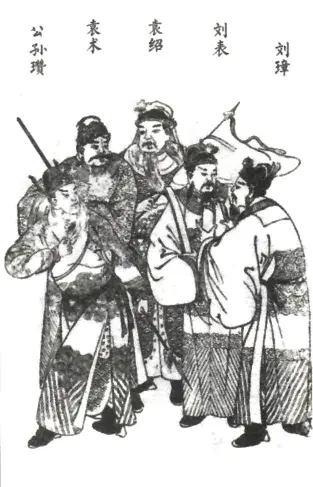
刘表
Liu Biao (刘表, 142–208), courtesy name Jingsheng, was an eminent imperial clansman, scholar, and powerful regional warlord of the late Eastern Han dynasty, descended from Prince Gong of Lu (Liu Yu). Standing over eight feet tall with a dignified and commanding presence, he participated in the student reform movements in the capital and gained nationwide acclaim as one of the "Eight Paragons" (Bajun). After surviving years…
Liu Biao (刘表, 142–208), courtesy name Jingsheng, was an eminent imperial clansman, scholar, and powerful regional warlord of the late Eastern Han dynasty, descended from Prince Gong of Lu (Liu Yu). Standing over eight feet tall with a dignified and commanding presence, he participated in the student reform movements in the capital and gained nationwide acclaim as one of the "Eight Paragons" (Bajun). After surviving years of fugitive life during the Disasters of the Partisan Prohibitions, he entered officialdom under General-in-Chief He Jin as Middle Officer of the Northern Army. In 190, following the death of Inspector Wang Rui, the imperial court appointed Liu Biao as Inspector of Jingzhou. Braving rampant rebel piracy and Yuan Shu's encircling forces, Liu entered Yicheng on a single mount, allied with local gentry leaders Kuai Liang, Kuai Yue, and Cai Mao, lured and executed fifty-five bandit chieftains, and brought the eight commanderies of Jingzhou under his sway. He subsequently routed Sun Jian's invasion at Mount Xian, where Sun was killed in ambush, consolidating his undisputed control and earning appointments as General of the South, Governor of Jingzhou, and Marquis of Chengwu. Amidst the apocalyptic devastation of the warlord era, Liu Biao maintained peace, reduced agrarian taxes, and established extensive academies in Xiangyang, commissioning scholars to compile the Subsequent Redaction of the Commentary on the Five Classics. This intellectual flourishing sheltered hundreds of thousands of refugees from the Central Plains, earning recognition from historians as the "Southern Migration of the Luoyang Imperial Academy." In his final years, he adopted a cautious policy of self-preservation during the wars between Cao Cao and Yuan Shao, harboring Zhang Xiu and Liu Bei to guard his northern frontier. In 208, as Cao Cao launched a massive southern expedition, Liu died of illness in Xiangyang at sixty-seven.
Born in Gaoping, Shanyang, a direct descendant of Western Han Prince Gong of Lu.
Ranked among the celebrated Eight Paragons; forced into hiding during the Partisan Prohibitions purge.
Imperial pardon lifted partisan bans; entered the staff of General-in-Chief He Jin, later commanding the Northern Army garrison.
Dispatched as Inspector of Jingzhou; entered Yicheng alone, eliminated local clan bandits, and established his capital at Xiangyang.
Repelled Yuan Shu's assault on Xiangyang; his ambushing forces shot and killed Sun Jian at Mount Xian.
Dispatched envoys with tribute to Chang'an; appointed General of the South, Governor of Jingzhou, and created Marquis of Chengwu.
Welcomed fleeing scholars from the north; commissioned Song Zhong to standardize classical texts and instituted ritual ceremonies.
Accepted the surrender of Zhang Xiu, assigning him to garrison Wan city as a northern buffer against Cao Cao.
Suppressed the protracted rebellion of Changsha Administrator Zhang Xian, securing southern control reaching Jiaozhou.
Welcomed Liu Bei from Runan with diplomatic honors, stationing him at Xinye to guard northern approaches.
Succumbed to illness in the eighth lunar month as Cao Cao's grand expedition marched south; aged sixty-seven.
Liu Biao was born in 142 into an imperial clan line tracing back to Liu Yu, Prince Gong of Lu, residing for generations in Gaoping, Shanyang. Endowed with a towering stature exceeding eight Chinese feet and an imposing, refined demeanor, Liu immersed himself in classical Confucian scholarship during his youth in the imperial capital of Luoyang. He forged close ties with elite literati and passionately joined the imperial academy students in condemning corrupt eunuch factions, gaining widespread veneration as one of the "Eight Paragons."
In 169, during the Second Disaster of the Partisan Prohibitions, the eunuchs launched a nationwide persecution against clean-stream scholar-officials. Liu's name appeared on the proscription rosters, forcing him to alter his identity and spend over a decade in wandering exile across the lakes and forests, quietly dedicating himself to textual scholarship.
In 184, as the Yellow Turban Rebellion shattered imperial authority, the court declared a general amnesty, rescinding the partisan bans out of fear that proscribed scholars might join the insurgents. General-in-Chief He Jin, familiar with Liu's high reputation, recruited him as an administrative assistant in his headquarters. In 188, Liu was elevated to Middle Officer of the Northern Army, taking charge of elite imperial guard divisions.
In 190, the alliance of eastern regional leaders rose against the tyrant Dong Zhuo. During the mobilization, Changsha Administrator Sun Jian killed Inspector of Jingzhou Wang Rui over a personal grudge. Dong Zhuo, acting in the name of Emperor Xian, appointed Liu Biao as Wang Rui's successor. However, warlord Yuan Shu occupied Luyang and dominated Nanyang, while pirate confederacies and clan chieftains seized river ports across Jingzhou, blocking major transportation routes.
Undeterred by the peril, Liu concealed his identity and rode alone on a single horse into Yicheng. Upon arrival, he summoned leading southern magnates—Kuai Liang, Kuai Yue of Zhonglu, and Cai Mao of Xiangyang—to orchestrate an administrative takeover.
Liu outlined the dire situation: "The clan bandits are entrenched and the people remain unattached, while Yuan Shu looms aggressively to our north. If I attempt to levy troops, I fear no one will respond. What strategy should we pursue?" Kuai Liang advocated benevolent moral suasion, while Kuai Yue presented a pragmatic blueprint: "Governing peace requires benevolence, but resolving turmoil demands decisive statecraft. Yuan Shu is reckless and indecisive, while the bandit leaders are greedy and despotic. If we use my trusted agents to lure the chieftains with promises of regional authority, they will certainly arrive in force. Your Excellency can then execute the cruel ringleaders and win over their rank and file. Securing Jiangling to the south and Xiangyang to the north, the eight commanderies will be pacified by written proclamation!"
Praising their counsel as matching the great strategists of antiquity, Liu enacted the scheme. Kuai Yue invited the bandit chieftains to an imperial banquet, where Liu ambushed and decapitated fifty-five leading brigands, incorporating their troops into his army. When garrison rebels Zhang Hu and Chen Sheng held Xiangyang, Liu dispatched Kuai Yue and Pang Ji unarmed on horseback to persuade them to surrender. Local magistrates across the province yielded their administrative seals in awe of Liu's reputation, allowing him to establish his provincial seat at Xiangyang.
In 192, Yuan Shu sought to subjugate Jiangnan, commanding his formidable vanguard general Sun Jian to assault Xiangyang. Liu dispatched General Huang Zu to engage the invaders, but Huang was defeated and retreated. Sun Jian laid siege to the city walls and pursued Huang's retreating forces into the dense bamboo thickets of Mount Xian. Huang's subordinate officer Lu Gong directed hidden archers and boulder catapults to unleash a synchronized ambush, fatally shooting Sun Jian through the chest.
Following Sun Jian's death, Yuan Shu's army collapsed in disarray and withdrew toward the Huai River, extinguishing Yuan's ambitions against Jingzhou. Liu capitalized on the victory to send expeditionary forces southward, securing all surrounding commanderies. In 193, with Li Jue and Guo Si holding court in Chang'an, Liu sent tributary missions to the imperial government. Grateful for his loyalty, the court invested Liu as General of the South and Governor of Jingzhou, creating him Marquis of Chengwu with the privilege of establishing an independent administrative staff.
In 196, as central generals engaged in mutual slaughter, warlord Zhang Ji marched south from the capital in search of grain, raiding Rangcheng where he was struck and killed by a stray arrow. While his staff congratulated him, Liu remarked sorrowfully: "Zhang Ji came out of utter desperation; that I as host failed to extend hospitality and instead engaged in battle was contrary to my wishes. I accept condolences, not congratulations."
Liu then dispatched messengers to extend heartfelt condolences to Zhang Ji's army. Deeply touched by his magnanimity, Zhang Ji's nephew, Zhang Xiu, submitted with his entire force. Liu stationed Zhang Xiu at Wan city, providing food and weaponry, creating an impregnable northern bulwark that repeatedly frustrated Cao Cao's early southward incursions.
In 198, Changsha Administrator Zhang Xian, encouraged by advisor Huan Jie, revolted against Liu Biao in coordination with Cao Cao, rallying Lingling and Guiyang commanderies to his cause. Liu personally mobilized his main armies to besiege Changsha in a grueling multi-year campaign.
Following Zhang Xian's death from illness, his son Zhang Yi continued the resistance. Applying political divide-and-rule tactics alongside concentrated siege warfare, Liu breached the city defenses, executed rebel instigators, and completely recovered Lingling and Guiyang.
With the southern insurrection extinguished, Liu expanded his territorial reach to the southern sea. He appointed upright administrators, pacified the Wuxi indigenous tribes, designated Lai Gong as Inspector of Jiaozhou, and placed Wu Ju in charge of Cangwu commandery. Jingzhou's domain stretched over two thousand Chinese miles from east to west and north to south, commanding over one hundred thousand armored troops, standing as the most expansive and stable autonomous realm in late Han China.
Amidst nationwide devastation where classical texts were burned and schools obliterated, Liu turned Xiangyang into a beacon of Confucian intellectual life. He established administrative schools, provided imperial grain rations to destitute scholars, and welcomed more than a thousand refugee households of elite northern literati.
Liu commissioned Classical Academician Song Zhong and scholar Qiwu Kai to critically collate ancient manuscripts, producing the authoritative Subsequent Redaction of the Commentary on the Five Classics (Wujing Zhangju Houting), which pruned fanciful apocrypha and restored textual fidelity. Eminent thinkers such as Sima Hui, Pang Degong, Zhuge Jun, Xiang Lang, Meng Gongwei, and Shi Guangyuan lived and studied peacefully in his domain, nurturing future statesmen including Zhuge Liang and Pang Tong.
Concurrently, Liu oversaw the creation of astronomical works including Jingzhou Xingzhan (Astrological Divinations of Jingzhou), authored a five-volume commentary on the Book of Changes, and promulgated thirty volumes of ceremonial rituals. On the outskirts of Xiangyang, he erected high altars to perform imperial sacrifices to Heaven, adopting ceremonial carriages and banners that underscored his de facto regal autonomy.
In 200, Cao Cao and Yuan Shao clashed at the epic Battle of Guandu. Yuan Shao dispatched envoys soliciting Liu's military assistance. Although Liu verbally pledged support, he refrained from deploying troops northward. His senior counselors Han Song and Kuai Yue urged him to abandon his neutrality, arguing that Cao Cao held the emperor and commanded superior military strategy, advising him either to submit or join Yuan Shao in a decisive strike.
Hesitant and suspicious, Liu sent Han Song to Xuchang to evaluate the political reality. When Han Song returned loaded with imperial titles as Palace Attendant and praised Cao Cao's legitimate authority, an enraged Liu accused Han of treason and imprisoned him, demonstrating his deep-seated ambivalence and lack of strategic boldness.
In 201, Liu Bei sought asylum in Jingzhou after being defeated by Cao Cao in Runan. Liu welcomed him with great ceremony, reinforced his army, and stationed him at Xinye to absorb northern assaults. However, fearing Liu Bei's charisma, Liu Biao refused to entrust him with central military authority. In 207, when Cao Cao marched north against the Wuhuan, Liu Bei urged Liu Biao to launch a surprise attack on Xuchang, but Liu hesitated until the opportunity vanished.
In his declining years, manipulated by his second wife Lady Cai and her brother Cai Mao, Liu disinherited his elder son Liu Qi in favor of his younger son Liu Cong, sparking intense factional infighting. In August 208, as Cao Cao's grand expedition bore down upon Jingzhou, Liu Biao died in Xiangyang from a virulent back ulcer at the age of sixty-seven. Following his death, Cai Mao surrendered the province to Cao Cao, bringing Liu's autonomous realm to a close.
In 190, with central authority collapsed, southern piratical clans dominating waterways, and Yuan Shu pressing from the north, Liu Biao entered Yicheng alone on a solitary mount without military escort. Demonstrating remarkable political courage, he formed an alliance with the local gentry elites Kuai Liang, Kuai Yue, and Cai Mao.
By executing fifty-five bandit ringleaders at a banquet and using persuasive diplomacy to dissolve remaining rebel garrisons, Liu secured the eight commanderies of Jingzhou without widespread slaughter. He transferred the provincial capital to Xiangyang, fortifying it into an impenetrable river citadel that preserved stability for nearly two decades.
While the Central Plains descended into war and famine, Liu transformed Jingzhou into the cultural sanctuary of Han civilization. He established academies, distributed official stipends to displaced scholars, and initiated foundational textual compilations, including the Subsequent Redaction of the Commentary on the Five Classics.
His academic patronage sheltered an entire generation of intellectual masters and fostered the development of luminaries like Zhuge Liang and Pang Tong. The monumental flourishing of letters in Xiangyang is revered by modern scholars as the pivotal Southern Migration of the Luoyang Imperial Academy, preserving classical Chinese heritage through the transition into the Three Kingdoms era.
FIGURES ASSOCIATED WITH THIS DYNASTY