Birth
Yang Shangshan was born.
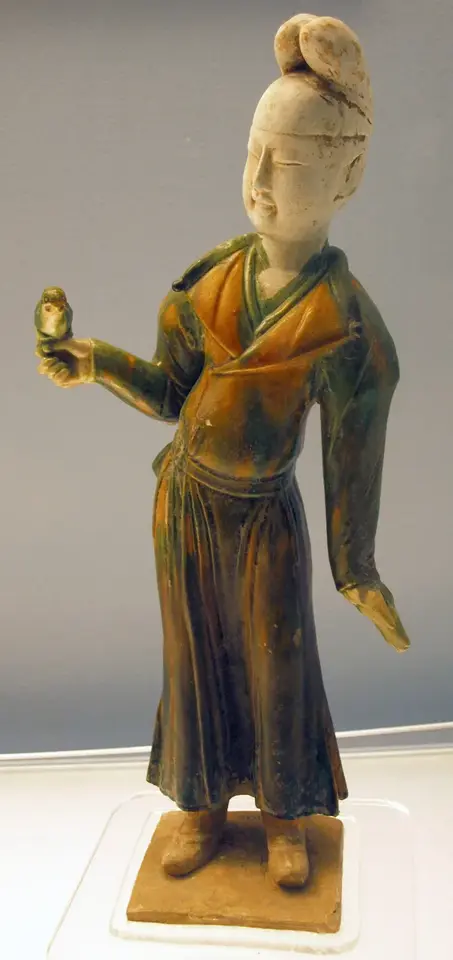
杨上善
Yang Shangshan (杨上善, 589–681) was a prominent physician, medical theorist, and Daoist scholar of the Sui Dynasty and early Tang Dynasty. Renowned for his erudition in ancient medical canons and Daoist philosophy, he lived in reclusion for many decades before entering imperial service late in life during the reign of Emperor Gaozong of Tang. During his tenure in the Eastern Palace, Yang Shangshan was commissioned by Emperor…
Yang Shangshan (杨上善, 589–681) was a prominent physician, medical theorist, and Daoist scholar of the Sui Dynasty and early Tang Dynasty. Renowned for his erudition in ancient medical canons and Daoist philosophy, he lived in reclusion for many decades before entering imperial service late in life during the reign of Emperor Gaozong of Tang. During his tenure in the Eastern Palace, Yang Shangshan was commissioned by Emperor Gaozong of Tang to organize and annotate the ancient medical canon Huangdi Neijing (Yellow Emperor's Inner Classic). His monumental thirty-volume work, Huangdi Neijing Taisu (Yellow Emperor's Inner Classic: Grand Basis), represents the earliest extant systematically categorized commentary on the Yellow Emperor's Inner Classic, holding an indispensable position in Chinese medical history and textual philology.
Yang Shangshan was born.
At age eleven, he was ordained as a Daoist Priest and subsequently lived in reclusion to pursue classical learning.
Entering imperial service at age seventy-two, he was appointed Auxiliary Academician of the Institute for the Advancement of Literature.
Appointed Adjutant for Education in the princely establishment of Li Xian, and later transferred to Administrator of the Left Militant Guard.
Transferred to serve as Administrator of the Left Guard.
Appointed Adjutant for Education of the Heir Apparent, and received an imperial edict to compile and annotate the Taisu.
Successively promoted to Court Gentleman for Deliberations of the Heir Apparent and Librarian of the Heir Apparent.
Retired from imperial office at age ninety-two and returned to his home residence.
Passed away at his residence at the venerable age of ninety-three.
Yang Shangshan was born in 589 during the Kaihuang reign of the Sui Dynasty. In 599, at the age of eleven, he left secular life to become an ordained Daoist Priest. Amid the turbulence attending the collapse of the Sui and the founding of the Tang Dynasty, Yang Shangshan chose long-term seclusion in the Zhongnan Mountains and Mount Yang, dedicating himself to ancient medicine and Daoist philosophy.
During his decades of hermit life, Yang Shangshan shunned secular glory and worldly profit. He devoted himself to exploring the fundamental principles of medicine and philosophical mysteries, gathering extensive practical knowledge of herbal remedies and engaging in exhaustive textual studies of the Yellow Emperor's Inner Classic and the Daode jing.
Around 660, when Yang Shangshan had reached seventy-two years of age, Emperor Gaozong of Tang summoned him to court in recognition of his erudition. He was appointed Auxiliary Academician of the Institute for the Advancement of Literature to assist with imperial compiling projects. In 661, he served as Adjutant for Education to Prince Li Xian, then was transferred to Administrator of the Left Militant Guard, and subsequently to Administrator of the Left Guard in 665.
In 675, Yang Shangshan became Adjutant for Education of the Heir Apparent in the Eastern Palace. Over the following years, he advanced to Court Gentleman for Deliberations of the Heir Apparent and Librarian of the Heir Apparent. During this period, Emperor Gaozong formally commissioned him to organize and elucidate the imperial court's medical manuscripts.
In 680, at the age of ninety-two, Yang Shangshan submitted his petition for retirement due to advanced age, which was granted by imperial grace. He returned to his private residence to spend his final days in peace.
In 681, Yang Shangshan passed away peacefully at his hometown residence at the age of ninety-three. His life and career details were definitively established through modern epigraphical discovery of his tomb inscription, resolving longstanding academic debates regarding his precise historical dates.
Yang Shangshan's greatest historical contribution was the compilation and commentary of the thirty-volume Huangdi Neijing Taisu (Yellow Emperor's Inner Classic: Grand Basis) under imperial auspices. Prior to the Tang Dynasty, circulating copies of the Yellow Emperor's Inner Classic (Huangdi Neijing) were characterized by disordered chapters, scribal corruptions, and obscure passages. Utilizing imperial copies of the Plain Questions (Suwen) and the Jiujuan, Yang Shangshan reorganized the medical texts into a cohesive topical framework.
The Taisu arranged the ancient medical materials into thematic categories, including health preservation, yin-yang theory, anatomical correspondence, internal organs, channels and collaterals, acupoints, protective and nutritive qi, diagnostic prognosis, pathology, and acupuncture technique. Under each category, Yang Shangshan provided detailed grammatical and medical explanations, preserving the authentic archaic text of the early medical tradition.
In addition to his medical scholarship, Yang Shangshan achieved great distinction in Daoist philosophy. He authored the twenty-volume Daode jing jizhu zhenyan (Collected Commentaries and True Words on the Daodejing), a work highly celebrated by late Tang Daoist scholar Du Guangting in his Daodejing Guangshengyi.
Yang Shangshan occupies a crucial bridge in the historical transmission of Chinese medicine. Textually, he succeeded the Western Han imperial physician Li Zhuguo and the Jin scholar Quan Yuanqi, while directly inspiring later Tang and Song masters such as Wang Bing, Lin Yi, and Shi Song. His thematic taxonomic methodology set an enduring precedent for subsequent encyclopedic medical writing throughout imperial China.
FIGURES ASSOCIATED WITH THIS DYNASTY