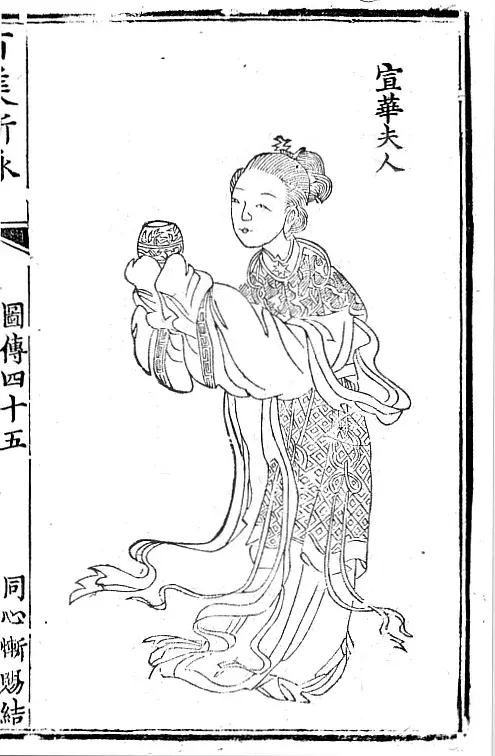
Life Story
Princess of Chen and Captivity in the North
Lady Xuanhua belonged to the imperial house of the Southern Chen dynasty. She was a daughter of Emperor Xuan (Chen Xu) and a younger half-sister of the Last Ruler of Chen (Chen Shubao), born to Emperor Xuan's favored concubine, Consort Shi. In the southern court, she was invested with the title of Princess Ningyuan, while her full elder brothers included Chen Shu'ao, Prince of Linhe, and Chen Shuxing, Prince of Yuanling. Reared within the opulent palace pavilions of Jiankang, she received extensive training in literature, music, and court deportment. Historical chronicles describe her as possessing extraordinary intelligence and matchless physical grace.
In the first month of 589, Emperor Wen of Sui dispatched Prince Yang Guang with a massive military force to cross the Yangtze River. The Sui forces captured Jiankang and seized the Southern Chen court. The thirteen-year-old Princess Ningyuan, along with her mother Consort Shi and thousands of royal kin and attendants, was marched northward under armed guard to the newly built capital of Daxing (modern Xi'an). In accordance with northern customary treatment of vanquished imperial lineages, she was enrolled in the palace weaving quarters as a bonded palace maid, abruptly falling from royal privilege into servitude.
Rise in the Sui Court and the Succession Plot
Emperor Wen of Sui was renowned for his frugal administration, while Empress Dugu (Dugu Jialuo) maintained strict dominance over the imperial bedchamber, prohibiting the emperor from consorting with lesser concubines. Despite this formidable environment, Lady Chen gradually came of age, and her graceful manners and extraordinary beauty earned the rare affection and private favor of Emperor Wen. She gradually emerged as an influential presence within the secluded palace chambers.
During the mid-to-late Kaihuang era, Yang Guang, Prince of Jin, harbored intense ambitions to supplant his elder brother Yang Yong as Crown Prince. Recognizing Lady Chen's rising proximity to the emperor, Yang Guang secretly dispatched agents to deliver magnificent rarities to her, including golden serpents and golden camels crafted in southern styles. Recognizing the precarious nature of life as a captive princess, Lady Chen allied herself with Yang Guang's faction. She repeatedly praised Yang Guang's filial piety, austerity, and administrative competence before Emperor Wen, while subtly magnifying Yang Yong's lapses and extravagance. Her discreet advocacy in the imperial bedchamber played a pivotal role when Emperor Wen formally deposed Yang Yong and appointed Yang Guang as Crown Prince in the tenth month of 600.
Promotion to Noble Consort and Rule Over the Palace
In the eighth month of 602, Empress Dugu passed away after dominating the Sui inner court for several decades. Bereft of his lifelong companion, the aging Emperor Wen fell into deep loneliness and relaxed his personal prohibitions against concubinage. Emperor Wen conducted a formal selection among his palace women, formally investing Lady Chen as Noble Consort (Guiren). Although Lady Cai was concurrently elevated to Lady Ronghua, Lady Chen commanded the preeminent share of the emperor's affection.
As Noble Consort, Lady Chen enjoyed monopolized favor. Emperor Wen not only found solace in her company but entrusted her with full administrative authority over the vast inner court, encompassing palace expenditures, logistical management, and the supervision of eunuchs and maids. Official histories in the Book of Sui emphasize that after Empress Dugu's demise, Lady Chen exercised exclusive dominance over the inner chambers and determined palace governance, holding a status equivalent to an uncrowned empress.
The Renshou Palace Crisis and the Accusation
Early in 604, the sixty-four-year-old Emperor Wen suffered severe physical exhaustion. He delegated routine state affairs to Crown Prince Yang Guang as regent and traveled with Lady Chen and top ministers to the cooler mountain retreat of Renshou Palace (in modern Linyou, Shaanxi) to recuperate. By the seventh month, Emperor Wen was critically ill. Both Yang Guang and Lady Chen attended the imperial bedchamber day and night. During this period, the emperor formally bestowed upon her the high rank of Lady Xuanhua.
At this critical juncture, a dramatic confrontation unfolded. One morning, Lady Xuanhua stepped out of Emperor Wen's bedchamber to adjust her attire in an adjacent hallway, where she encountered Crown Prince Yang Guang. Tempted by her beauty, Yang Guang attempted to force himself upon her. Lady Xuanhua fought back desperately and broke free from his grasp. Disheveled, trembling, and weeping, she rushed back to Emperor Wen's bedside. Noticing her distress, Emperor Wen demanded an explanation. Lady Xuanhua wept against his pillow and declared that the Crown Prince had acted with outrageous impropriety.
Emperor Wen was consumed with fury, slamming his fist onto the bed and exclaiming that an animal could never be entrusted with the empire, lamenting that Dugu had misled him. The emperor immediately summoned Right Vice Director of the Department of State Affairs Liu Shu and Attendant Gentleman Yuan Yan, commanding them to draft an edict deposing Yang Guang and recalling the deposed Yang Yong to the throne. Minister Yang Su intercepted this move and alerted Yang Guang. Yang Guang ordered the arrest and imprisonment of Liu Shu and Yuan Yan, commanded Eastern Palace guards under Yuwen Huaji and Yuwen Shiji to seal off the palace, and expelled all attendants and concubines from the imperial bedchamber. Shortly thereafter, Emperor Wen's abrupt death was announced to the empire.
The Concentric Knot Box and Tragic Early Death
Following Emperor Wen's sudden demise, armed troops surrounded the Renshou Palace. Lady Xuanhua and her attendant palace women trembled in terror, fearing immediate execution at the hands of the new ruler. Toward evening, an envoy dispatched by Yang Guang arrived carrying a magnificent golden box bearing an imperial seal personally affixed by Yang Guang. The palace attendants wailed, assuming the container held poison or a silk cord for compulsory suicide.
Lady Xuanhua opened the box with trembling hands, only to discover that it contained several exquisite concentric knots woven of golden thread and colored silk. While her attendants sighed with immense relief, Lady Xuanhua felt profound humiliation and flushed with anger, refusing to bow in acceptance. The surrounding attendants knelt and pleaded with her to accept the gift so that the lives of the entire palace household might be spared. Compelled by circumstance, Lady Xuanhua bowed in tearful acceptance. That very evening, Yang Guang entered her quarters and forced her into his imperial bed.
Following the imperial funeral of Emperor Wen, Lady Xuanhua requested permission to leave the main palace and reside at the Xiandu Palace south of Daxing to observe mourning and monastic seclusion. However, after ascending the throne as Emperor Yang of Sui, Yang Guang could not forget her and issued an imperial decree recalling her to the Daxing Palace, inducting her into his imperial harem. Enduring the moral condemnation of Confucian propriety and the bitter disgrace of serving two successive emperors, Lady Chen fell into deep depression. Around the first year of the Daye era (605), she passed away from lingering illness and despair at the age of twenty-nine. Deeply grieved by her passing, Emperor Yang personally composed the poetic rhapsody Shenshang Fu to express his sorrow.
Major Achievements
Survival in Captivity and Elevation to Noble Consort
Upon the destruction of the Southern Chen dynasty in 589, Lady Chen fell from an imperial princess of Jiankang to an enslaved palace maid in the northern capital. Confronting the ruin of her dynastic house and personal bondage, she relied upon her remarkable intellect, refined cultural poise, and sharp judgment to navigate the perils of the Sui inner court. Throughout more than a decade of Empress Dugu's uncompromising control over the imperial chambers, Lady Chen was among the exceedingly rare figures who secured stable respect and affection from Emperor Wen. Following Empress Dugu's death, she rapidly rose through the court ranks to become Noble Consort, exercising administrative stewardship over all inner palace affairs and illustrating extraordinary resilience in dynastic survival.
The Inner Palace Lever in Replacing the Crown Prince
During the pivotal political restructuring known as the Kaihuang succession shift, Lady Chen served as a critical internal linchpin. Prince Yang Guang's strategy to displace Crown Prince Yang Yong depended heavily upon clandestine intelligence and manipulating the psychological perceptions of his parents. Aware of Lady Chen's intimate trust with Emperor Wen, Yang Guang spared no expense in winning her favor with exotic southern goldcraft. Within the inner court, Lady Chen skillfully capitalized on Emperor Wen's late-life paranoia toward ministers and imperial kin, subtly accentuating Yang Guang's frugality and filial devotion while drawing attention to Yang Yong's reckless expenditures. Her behind-the-scenes advocacy furnished Yang Guang with a decisive palace bastion that enabled his ultimate investiture as heir apparent.
Exposing Yang Guang and Triggering the Renshou Crisis
During the turmoil at Renshou Palace in the seventh month of 604, Lady Chen unintentionally ignited the catastrophic confrontation at the core of the empire. When accosted by Crown Prince Yang Guang in an imperial gallery, she refused passive acquiescence and boldly reported the assault to the bedridden emperor. Her concise denunciation shattered Emperor Wen's long-held illusions regarding Yang Guang's dutiful character, provoking the furious monarch to attempt a sudden imperial restoration of Yang Yong. Lady Chen's resistance forced Yang Guang and Yang Su to execute an immediate armed palace coup, precipitating the violent transition of supreme authority in the Sui Empire.
Enduring the Concentric Knot and the Tragic Fate of Fallen Royalty
The arrival of the golden box containing concentric knots following Emperor Wen's death underscored the poignant tragedy of captive royal women under autocratic rule. Confronted with the victor's coercion, she initially chose defiance, yet ultimately yielded in tears to spare the lives of dozens of attending maidservants and her exiled kin. Relegated briefly to mourning at the Xiandu Palace before being reclaimed by the new emperor, she lived through the successive identities of southern princess, enslaved weaver, imperial consort, and coerced concubine across twenty-nine brief years, embodying the deep ethical and human fractures of court politics during the Sui-Tang transition.