Birth into the Ban Clan
Born into a prominent family of scholar-officials in Loufan; educated in classical poetry and rites.
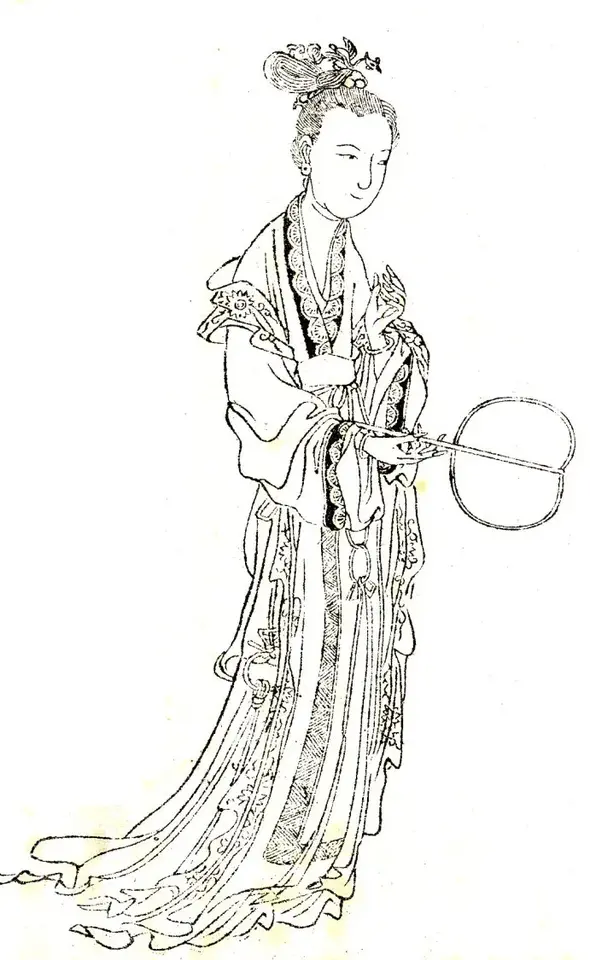
班婕妤
Consort Ban (班婕妤, c. 48 BCE – c. 6 BCE), personal name unrecorded, was an eminent Western Han woman of letters, poet, rhapsodist, and imperial consort of Emperor Cheng of Han (Liu Ao). Originating from Loufan (modern Shuozhou, Shanxi), she was the daughter of Cavalry Colonel Ban Kuang, the aunt of historian Ban Biao, and the grand-aunt of the distinguished Han intellectual siblings Ban Gu, Ban Chao, and Ban Zhao. Entering the…
Consort Ban (班婕妤, c. 48 BCE – c. 6 BCE), personal name unrecorded, was an eminent Western Han woman of letters, poet, rhapsodist, and imperial consort of Emperor Cheng of Han (Liu Ao). Originating from Loufan (modern Shuozhou, Shanxi), she was the daughter of Cavalry Colonel Ban Kuang, the aunt of historian Ban Biao, and the grand-aunt of the distinguished Han intellectual siblings Ban Gu, Ban Chao, and Ban Zhao. Entering the imperial harem in 32 BCE, she was rapidly elevated to Lady of Handsome Fairness (Jieyu) due to her profound classical erudition, poetic eloquence, and dignified grace, residing in the Zengcheng Palace. Endowed with rigorous moral rectitude, Consort Ban famously declined Emperor Cheng's invitation to ride alongside him in an imperial palanquin, warning that wise ancient sovereigns were accompanied by sage ministers while only fallen tyrants rode with favored concubines—an admonition that earned high praise from Empress Dowager Wang Zhengjun, who compared her to Fan Ji of Chu. Following the rise of Zhao Feiyan and Zhao Hede, Consort Ban was falsely implicated in witchcraft conspiracies; she successfully defended her innocence with philosophical poise before the imperial inquisitors. To avoid lethal harem machinations, she voluntarily retired to Changxin Palace to serve the Empress Dowager, where she composed the immortal Poem on the Round Fan (Song of Resentment) and the Rhapsody of Self-Sorrow, establishing the enduring literary trope of the abandoned autumn fan in Chinese classical poetics. Following Emperor Cheng's demise, she tended his mausoleum at Yanling until her death.
Born into a prominent family of scholar-officials in Loufan; educated in classical poetry and rites.
Selected into the palace upon the accession of Emperor Cheng; promoted to Lady of Handsome Fairness (Jieyu).
Refused to ride with Emperor Cheng in an imperial carriage; commended by Empress Dowager Wang as a model of consort virtue.
Falsely accused of sorcery by Zhao Feiyan; delivered a philosophical self-defense, securing an imperial dismissal of charges and a gift of gold.
Voluntarily withdrew to attend Empress Dowager Wang; composed the Poem on the Round Fan and the Rhapsody of Self-Sorrow.
Following Emperor Cheng's death, successfully petitioned to guard his imperial mausoleum at Yanling, where she resided in devotion until her death.
Consort Ban was born into the prestigious Ban lineage along the northern frontier at Loufan. Her ancestors had served the Western Han Dynasty with distinction, and her father, Ban Kuang, served as Cavalry Colonel of the Left under Emperor Yuan of Han. Renowned for balancing military valor with profound classical education, the Ban household nurtured an intellectual tradition that would later produce the foremost historiographers and generals of the Eastern Han, including Ban Biao, Ban Gu, Ban Chao, and Ban Zhao. Growing up in this scholarly milieu, Consort Ban mastered classical poetry, historical annals, and philosophical treatises from early childhood, developing extraordinary poetic eloquence alongside graceful courtly manners.
In 32 BCE (the first year of the Jianshi era), upon the accession of the eighteen-year-old Emperor Cheng of Han, the court conducted a nationwide selection of daughters from aristocratic houses to replenish the Weiyang Palace. Consort Ban was inducted into the inner harem at approximately sixteen years of age, initially designated as a Junior Attendant (Shaoshi).
Emperor Cheng, an aesthetic connoisseur of literature and music, was quickly enchanted by Consort Ban's cultured intellect, quiet dignity, and poetic finesse. Within months, the emperor exceptionally promoted her to Lady of Handsome Fairness (Jieyu), the highest consort rank beneath the Empress, assigning her to reside in the prestigious Zengcheng Palace. Consort Ban conceived and gave birth to an imperial prince; however, the infant tragically passed away within several months due to childhood illness, and she bore no further children.
Despite the tragedy of her son's early demise, Emperor Cheng's affection and intellectual admiration for Consort Ban deepened. The sovereign frequently spent his leisure hours in the Zengcheng apartments, treating Consort Ban as an indispensable intellectual companion and confidante.
During this period of intense favoritism, Emperor Cheng ordered imperial artisans from the Privy Wardrobe to construct an exceptionally broad and ornate palanquin, adorned with gilded dragons, kingfisher feathers, and luminescent pearls, designed to seat two persons abreast. On a radiant spring morning, as the emperor prepared to tour the imperial parklands, he affectionately summoned Consort Ban to mount the palanquin and ride alongside him.
Surrounded by envious court ladies and imperial attendants, Consort Ban stepped back, bowed with graceful deference, and firmly declined the honor: "Throughout history, whenever we examine ancient paintings of sage rulers such as the Three Dynasties' Yu the Great, Tang of Shang, and King Wen of Zhou, they were invariably accompanied by wise chancellors and virtuous ministers. Only fallen tyrants such as Jie of Xia, Zhou of Shang, and King You of Zhou rode openly in public chariots with their favored concubines! If Your Majesty permits me to ride alongside you today, will not the world compare Your Majesty to those ancient sovereigns of ruin? I would rather face death than lead my sovereign into moral opprobrium!"
Stunned by her solemn integrity and principled insight, Emperor Cheng withdrew his request and ordered the palanquin dismantled, proceeding on foot.
When Empress Dowager Wang Zhengjun learned of the incident within the Changxin Palace, she expressed immense delight and admiration, proclaiming before the assembled court: "Antiquity possessed Fan Ji of Chu; today the Great Han possesses Consort Ban!" This famous act of remonstrance cemented Consort Ban's enduring reputation across Han society as a paragon of royal virtue.
In his later reign, Emperor Cheng grew weary of state affairs and increasingly succumbed to sensual indulgence. During an incognito excursion to the residence of Princess Yang'a, the emperor became infatuated with the dancer Zhao Feiyan and subsequently inducted her and her younger sister Zhao Hede into the palace.
Possessing seductive charm and ruthless ambition, the Zhao sisters quickly monopolized Emperor Cheng's favor, eclipsing veteran consorts. Bent on consolidating their dominance and elevating Zhao Feiyan to empress, the sisters viewed the virtuous Empress Bo and the widely respected Consort Ban as their primary political obstacles.
In 18 BCE (Hongjia 3), Zhao Feiyan lodged a treasonous denunciation with Emperor Cheng, alleging that Empress Xu and her elder sister had erected private occult altars to curse pregnant concubines and cast hexes upon Emperor Cheng and the Zhao sisters. Consort Ban was named as an accomplice in the alleged witchcraft conspiracy.
Enraged, Emperor Cheng immediately deposed Empress Xu and ordered central inquisitors of the Commandant of Justice to arrest Consort Ban in the Zengcheng Palace for interrogation.
Confronted with harsh interrogators and judicial instruments, Consort Ban maintained absolute composure, offering an eloquent philosophical defense: "I have heard the ancient adage: 'Life and death are determined by destiny; wealth and honor reside with Heaven.' If those who cultivate rectitude and perform virtuous deeds are not guaranteed divine blessings, what could an evil conspirator hope to obtain through wicked deeds? If the spirits and gods possess awareness, they will never heed the curses of malicious schemers; if the gods possess no awareness, of what utility is sorcery? Having studied the classics from my youth, how could I ever demean myself to participate in such senseless and self-destructive practices!"
Her crystalline reasoning and unblemished dignity left the inquisitors speechless. When the transcript was presented to Emperor Cheng, the monarch felt deep remorse for suspecting his former favorite. He ordered her immediate release, dismissing all charges and bestowing one hundred catties of gold as compensation.
Although Consort Ban survived the witchcraft trial, she astutely recognized the lethal environment of the court. Following Zhao Feiyan's coronation as Empress, the Zhao sisters eliminated rival heirs, orchestrating the murder of infants born to secondary consorts such as Lady Xu and Cao Gong. Consort Ban understood that remaining in proximity to the emperor would eventually invite assassination.
Exercising consummate prudence, Consort Ban submitted a formal petition to Emperor Cheng, requesting permission to withdraw from the Weiyang Palace to attend the aging Empress Dowager Wang Zhengjun in the Changxin Palace. Recognizing his inability to shield her from harem intrigues, Emperor Cheng granted her request.
Within the secluded precincts of the Changxin Palace, Consort Ban detached herself completely from court ambitions, devoting her daily life to Buddhist devotion, filial attendance upon the Empress Dowager, and literary composition. Viewing the autumn leaves and pale moonlight, she reflected upon the vanity of palace favoritism, channeling her profound melancholia into poetic masterpieces.
During this period of isolation, she composed her immortal Poem on the Round Fan (Song of Resentment): "Freshly severed is the fine Qi silk, white and pure as frost and snow. Cut into a joined-joy fan, perfectly round like the harvest moon. Resting within my lord's sleeve, stirred to generate refreshing breezes. Yet ever do I dread the arrival of autumn, when cold gusts banish the summer heat. Cast away into a bamboo trunk, our love severed in mid-journey." Through the poignant metaphor of a silk fan cherished during summer only to be discarded upon the onset of autumn chill, Consort Ban articulated the tragic vulnerability of women whose standing depended solely upon transient physical allure. This poem established the celebrated literary motif of the "abandoned autumn fan" (qiufan jianqi) in classical Chinese poetry. She also composed the Rhapsody of Self-Sorrow and the Rhapsody on Pounding Silk, providing profound psychological portraits of female isolation in the imperial court.
In March 7 BCE (Suihe 2), Emperor Cheng passed away suddenly in the bedchamber of Zhao Hede at the age of forty-five. Zhao Hede committed suicide, and Emperor Ai of Han succeeded to the imperial throne.
Emperor Cheng was interred in the monumental Yanling mausoleum on the Xianyang plateau. Following the completion of the imperial burial, Consort Ban made a final poignant request to the throne: having received Emperor Cheng's profound favor in her youth, she petitioned to reside permanently at Yanling to guard the late sovereign's ancestral tomb and perform daily sacrificial rites.
Empress Dowager Wang granted her request. Consort Ban departed Chang'an and moved into the sparse imperial residence attached to the Yanling necropolis. Amid the windblown pines and ancient mounds, she spent her final years in quiet austerity, sweeping the ancestral courtyards at dawn and offering seasonal libations before the late emperor's spirit tablet.
Around 6 BCE, Consort Ban passed away peacefully at the Yanling retreat at approximately forty-two years of age. She was laid to rest within the imperial precinct of Yanling, remaining near her husband in eternal repose. Combining intellectual brilliance, strategic modesty, and moral nobility, Consort Ban remains celebrated as one of the most dignified and accomplished women in Chinese literary history.
FIGURES ASSOCIATED WITH THIS DYNASTY