Birth and Upbringing
Born into a prominent clan in Xianyang, mastering Confucian classics and martial arts.
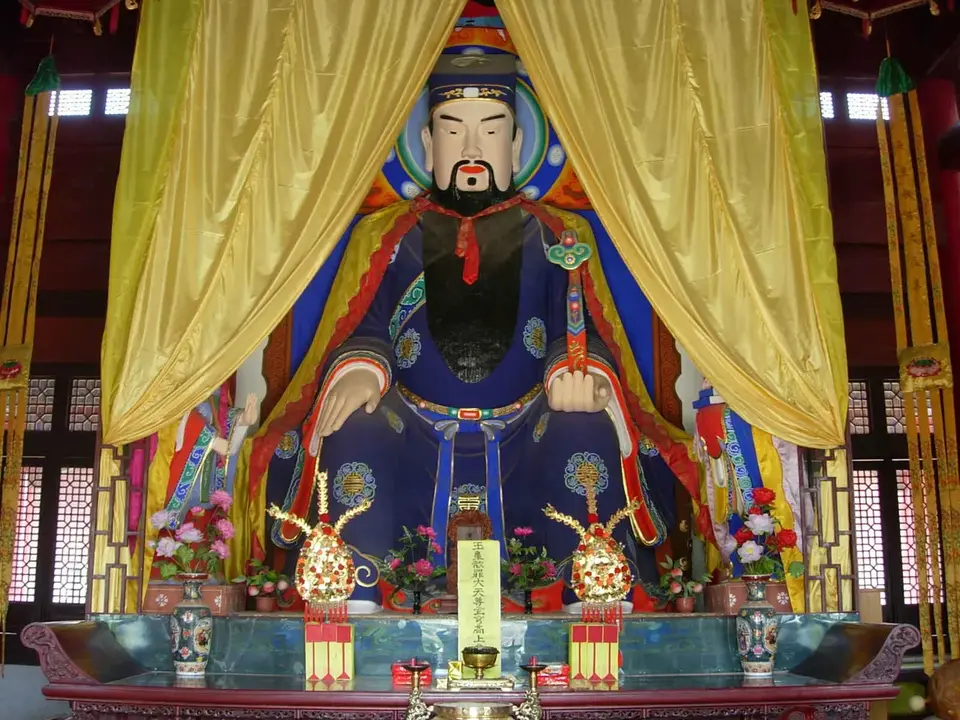
王重阳
Wang Chongyang (王重阳, 1112–1170), original name Wang Zhongfu, courtesy name Yunqing, later renamed Wang Zhe with the courtesy name Zhiming and the Daoist sobriquet Chongyangzi, was a native of Dawei Village, Xianyang, Jingzhao (modern Huxian, Shaanxi Province). He was an illustrious Daoist thinker of the Jurchen Jin dynasty, the founding patriarch of the Quanzhen (Complete Perfection) school of Daoism, and revered within…
Wang Chongyang (王重阳, 1112–1170), original name Wang Zhongfu, courtesy name Yunqing, later renamed Wang Zhe with the courtesy name Zhiming and the Daoist sobriquet Chongyangzi, was a native of Dawei Village, Xianyang, Jingzhao (modern Huxian, Shaanxi Province). He was an illustrious Daoist thinker of the Jurchen Jin dynasty, the founding patriarch of the Quanzhen (Complete Perfection) school of Daoism, and revered within Daoist tradition as one of the "Five Northern Patriarchs." Born into an affluent local gentry clan, Wang studied Confucian classics and practiced horsemanship and archery in his youth. During the Qi puppet regime and the early reign of Emperor Xizong of Jin, he participated in both civil and military examinations, achieving first place in the military examinations with grand ambitions of worldly service. Frustrated by political barriers against Han elites, he spent years confined to minor liquor tax offices before resigning in protest to live in seclusion. In 1159, during the fourth year of the Zhenglong era, Wang experienced a spiritual epiphany after meeting Daoist adepts at Ganhe Town in the Zhongnan Mountains. Renouncing worldly ties, he dug an underground crypt at Nanshi Village, secluding himself for more than two years in what he termed the "Tomb of the Living Dead." In 1167, he traveled eastward to the Shandong Peninsula to preach, establishing the Quanzhen Hall in Ninghai and initiating seven core disciples—Ma Danyang, Tan Chuduan, Liu Chuxuan, Qiu Chuji, Wang Chuyi, Hao Datong, and Sun Bu'er (later celebrated as the "Seven Immortals of the North"). In eastern Shandong, he established five lay societies integrating Confucianism, Buddhism, and Daoism. Advocating internal alchemy, moral self-purification, the harmonization of the Three Teachings, and a monastic communal lifestyle, Wang established a transformative Daoist religious movement. In 1170, he passed away in Kaifeng while leading his disciples back to Shaanxi. During the Yuan dynasty, emperors bestowed upon him the posthumous title "Imperial Lord of Quanzhen Enlightenment Assisting the Absolute."
Born into a prominent clan in Xianyang, mastering Confucian classics and martial arts.
Passed the Jin imperial military examination at the top rank; served as a liquor tax collector before resigning.
Met spiritual adepts in an inn at Ganhe Town, receiving esoteric oral formulas and resolving to enter monastic life.
Dug an underground cavern at Nanshi Village, spending two years in deep meditative asceticism.
Traveled eastward to preach across the Shandong Peninsula, establishing Quanzhen Hall in Ninghai.
Organized the lineage of the Seven Patriarchs and commenced the return journey to Shaanxi with four senior disciples.
Passed away peacefully in an inn in Kaifeng at the age of fifty-eight; his mortal remains were interred at the Zhongnan ancestral shrine.
Wang Chongyang was born in Dawei Village near Xianyang in the Guanzhong region. His family was an eminent regional clan endowed with extensive agricultural estates and wealth. Endowed with natural intelligence, he studied canonical literature in his youth, entered the prefectural academy, and gained distinction for his literary composition as well as his expertise in archery and horsemanship. However, this era coincided with the collapse of the Northern Song dynasty and relentless warfare across northern China. During the puppet Qi regime of Liu Yu, Wang sat for the imperial civil examinations under the Ministry of Rites but failed to obtain office.
In the early Tianjuan era of Emperor Xizong of Jin, Wang changed course, taking the Jin dynasty imperial military examinations. He achieved first place in the first-class category, changing his name to Shixiong and his style to Dewei. He harbored grand geopolitical ambitions to govern and pacify the realm. Nevertheless, the Jurchen authorities maintained stringent political vigilance against Han elites, relegating Wang to trivial posts collecting taxes on local liquor monopolies. Deeply disappointed by dynastic reality and official stagnation, Wang resigned from bureaucratic service and returned to live as a recluse at the foot of the Zhongnan Mountains.
In June 1159, at the age of forty-eight, Wang visited a marketplace inn at Ganhe Town in Huxian, where he encountered divine recluses who imparted secret instructions on internal alchemy and transcendent philosophy. Having experienced profound enlightenment, Wang realized that mundane wealth and honor were fleeting illusions. Resolving to sever all secular attachments, he renamed himself Zhe, adopted the courtesy name Zhiming, and chose the Daoist appellation Chongyangzi.
In 1161, Wang departed from his family household. In Nanshi Village within the Zhongnan foothills, he excavated an underground crypt several feet deep, naming it the "Tomb of the Living Dead." He erected a wooden plaque beside the excavation bearing the satirical epitaph "Spiritual Seat of the Madman Wang." Wang secluded himself within this cavern for over two years, engaging in rigorous self-cultivation, harmonizing physical essence and spirit, and completing his internal transition from a Confucian scholar into a transformative religious master. In 1213, he relocated to Liujiang Village, building a thatched hermitage to instruct local Daoist seekers.
In April 1167, sensing that the time for broader propagation had arrived, Wang burned down his thatched retreat in Liujiang and led a mission eastward beyond Tongguan Pass into the Shandong Peninsula. Arriving in Ninghai Prefecture (modern Muping, Shandong), he was welcomed by Ma Yu, a wealthy local magnate, and Ma's wife Sun Bu'er. Ma donated part of his family residential estate to establish a monastic sanctuary, for which Wang personally brushed the sign "Quanzhen Hall," thereby giving formal birth to the Quanzhen denomination.
During his three-year stay in Shandong, Wang's profound lectures and ascetic demeanor attracted thousands of followers. He initiated seven core disciples: Ma Yu (Danyang), Tan Chuduan (Changzhen), Liu Chuxuan (Changsheng), Qiu Chuji (Changchun), Wang Chuyi (Yuyang), Hao Datong (Taigu), and Sun Bu'er (Qingjing Sanren). Imparting to them his teachings on internal alchemy and the harmonization of the Three Teachings, Wang established the foundational lineage that would become universally celebrated as the "Northern Seven Immortals."
To integrate Quanzhen teachings deeply into grassroots society, Wang preached actively throughout Wendeng, Ninghai, Fushan, Laizhou, and Dengzhou. He organized five lay religious societies open to ordinary citizens: the Three Teachings Seven Treasures Society, the Three Teachings Golden Lotus Society, the Three Teachings Three Luminaries Society, the Three Teachings Jade Flower Society, and the Three Teachings Equality Society. Wang urged believers of all social strata and philosophical convictions to unite within these societies to cultivate inner virtue, practice mutual charity, and tame selfish worldly desires.
In terms of institutional organization, Wang authored Fifteen Discourses on Establishing the Quanzhen Teachings, codifying the communal monastic system for Daoist clerics. He mandated that initiates abandon mundane households, reside in dedicated monasteries, practice absolute abstinence from alcohol, sexual desire, and wealth accumulation, and observe strict moral disciplines. This innovation transformed Daoism from scattered hereditary households into a disciplined, self-sustaining monastic institution.
By the autumn of 1169, the Quanzhen movement had flourished across the Shandong Peninsula. Wang decided to lead his primary disciples—Ma Yu, Tan Chuduan, Liu Chuxuan, and Qiu Chuji—back westward toward Shaanxi to develop a nationwide institutional headquarters.
In early 1170, the group reached Bianliang (modern Kaifeng, Henan) and lodged at the Wang family inn. Realizing his physical life was drawing to a close, Wang summoned his four disciples to his bedside, transferring the institutional patriarchate to Ma Yu and instructing them to preserve the pure ascetic ethos of Quanzhen. Having delivered his final instructions, Wang passed away peacefully in a seated posture at the age of fifty-eight. His disciples escorted his coffin westward, interring him at his original hermitage in Liujiang Village. The Liujiang sanctuary became the ancestral cradle of Quanzhen Daoism, from which the school expanded across all of China.
Wang Chongyang departed from traditional Daoist dependence on talismanic water, incantations, and sacrificial liturgies, establishing the Quanzhen school centered on inner spiritual cultivation. He pioneered the monastic communal system requiring clerics to reside within shared temples, establishing disciplined monastic rules and founding the "Five Societies" across Shandong. This structural revolution rooted Daoist organization deeply in civilian society and marked a monumental watershed in the institutional history of Chinese religion.
Philosophically, Wang proclaimed that "the Three Teachings share an identical ancestral spirit," championing the deep convergence of Confucianism, Buddhism, and Daoism. In addition to the Daoist Daodejing, he mandated that Quanzhen adepts study the Confucian Classic of Filial Piety and the Buddhist Heart Sutra. He maintained that Confucian filial piety rectified worldly conduct, Buddhist insight purified the heart, and Daoist non-action cultivated eternal spirit, creating a comprehensive framework that bridged ancient sectarian divisions.
Wang fundamentally reformed Daoist personal cultivation by rejecting the toxic external laboratory alchemy (waidan) prevalent since the Han and Tang dynasties. In its place, he established internal alchemy (neidan) as the core practice. Formulating the doctrine of the dual cultivation of "nature and life," he defined mental spirit as innate nature (xing) and vital breath as life force (ming), asserting that spiritual enlightenment and bodily vitality must develop simultaneously through moral tranquility and detachment from sensual desires.
Recognizing extraordinary spiritual potential, Wang initiated and trained the seven core masters of Quanzhen—Ma Yu, Tan Chuduan, Liu Chuxuan, Qiu Chuji, Wang Chuyi, Hao Datong, and Sun Bu'er—who subsequently founded seven major sub-lineages. Most notably, his youngest disciple Qiu Chuji traveled across Central Asia to meet Genghis Khan at the Hindu Kush, persuading the Mongol conqueror to cease widespread slaughter. This historical intervention elevated Quanzhen Daoism to unprecedented prominence across the Mongol-Yuan Empire.
FIGURES ASSOCIATED WITH THIS DYNASTY