Succession to Chu Peerage
Inherited the title of Duke of Chu and appointment as Minister of Rites following the death of his father Yang Su.
杨玄感
Yang Xuangan (杨玄感, died August 21, 613) was an eminent general, statesman, and aristocratic rebel leader of the late Sui dynasty. Hailing from the prestigious Hongnong Yang lineage of Huayin, he was the eldest legitimate son of Yang Su, the founding prime minister and paramount general of the Sui empire. Inheriting the title of Duke of Chu and rising to Minister of Rites, Yang Xuangan possessed immense military prestige and…
Yang Xuangan (杨玄感, died August 21, 613) was an eminent general, statesman, and aristocratic rebel leader of the late Sui dynasty. Hailing from the prestigious Hongnong Yang lineage of Huayin, he was the eldest legitimate son of Yang Su, the founding prime minister and paramount general of the Sui empire. Inheriting the title of Duke of Chu and rising to Minister of Rites, Yang Xuangan possessed immense military prestige and commanded the loyalty of numerous veteran officers formerly under his father's banner. As Emperor Yang of Sui (Yang Guang) intensified his despotic rule through reckless palatial construction, endless grand canal excavations, and devastating campaigns against Goguryeo, elite aristocratic families—particularly the Yang lineage, whom the emperor profoundly distrusted—faced constant peril of extermination. In the spring of 613, during Emperor Yang's Second Goguryeo Campaign, Yang Xuangan was commissioned to superintend imperial grain logistics at the strategic Liyang Granary. Exploiting the absence of the main field armies and widespread peasant desperation, he seized the transport fleet, opened the imperial granaries to feed starving refugees, and raised the banner of open revolt. He enlisted the brilliant strategist Li Mi as his chief advisor; however, rejecting Li Mi's superior strategies to seize northern mountain passes or capture the western capital Chang'an, Yang insisted on besieging the heavily fortified eastern capital of Luoyang. Although his forces grew to over 100,000 and repeatedly defeated provincial garrisons, he failed to breach Luoyang's walls. The uprising forced Emperor Yang to abruptly abandon the Korean siege and dispatch veteran armies under Yuwen Shu and Qutu Tong to crush the revolt. Encircled at Wenxiang while attempting a delayed march into Guanzhong, Yang's army was obliterated, and he ordered his brother Yang Jishan to run him through with a sword to avoid public execution. Yang Xuangan's uprising marked the first major internal insurrection within the Sui ruling elite, irrevocably shattering the dynasty's political foundations and triggering the widespread revolts that brought about the fall of the Sui.
Inherited the title of Duke of Chu and appointment as Minister of Rites following the death of his father Yang Su.
Accompanied Emperor Yang on campaign; witnessed imperial brutality and secretly plotted an aborted assassination.
Appointed in the fourth month to oversee grain transport for the second Korean invasion, quietly organizing retainers.
Requisitioned grain barges in the sixth month, opened Liyang Granary to starving peasants, and declared open rebellion.
Besieged the eastern capital Luoyang against Li Mi's advice; defeated provincial sorties but failed to take the city.
Prompted Emperor Yang to lift the siege of Liaodong Fortress and rush elite armies south under Yuwen Shu.
Attempted a westward retreat to Guanzhong but delayed to attack Hongnong Palace; encircled and crushed at Wenxiang.
Trapped in the woods of Jiaqiao on August 21; commanded his brother Yang Jishan to slay him to avoid capture.
Yang Xuangan was born into the eminent Hongnong Yang clan, one of the premier aristocratic lineages of the Guanlong military-political aristocracy that dominated northern China from the Western Wei through the Sui and Tang dynasties. His father, Yang Su, was the foremost founding general and Minister of the Right under Emperor Wen of Sui, having commanded the final conquest of the Chen dynasty in 589, pacified the northern Göktürks, and crushed the rebellion of Prince Yang Liang. Although endowed with imposing stature and an elegant beard, Yang Xuangan was reticent and deliberate in his youth, leading peers to misjudge him as dull and obtuse. Only his father perceived his inner boldness, once remarking to close confidants: "This son is by no means foolish; he will achieve great things for our house."
Relying on his father's immense military merit, Yang Xuangan entered official service with the exalted honorific rank of Pillar of the State (Zhuguo). He served with distinction as Prefect of Yingzhou and later Prefect of Songzhou, earning the affection of local officials and commoners through judicial clemency and mastery of military tactics. However, Yang Su's towering power provoked intense paranoia in Emperor Yang. When Yang Su fell terminally ill in 606, Emperor Yang frequently dispatched physicians while privately inquiring whether the minister had died, remarking in secret that had Yang Su lived, his clan would have faced extermination. This atmosphere of mortal suspicion cast a long shadow over Yang Xuangan, who inherited the peerage of Duke of Chu and the office of Minister of Rites.
Throughout the Daye reign, Emperor Yang depleted the empire's manpower and economic surplus through unprecedented architectural extravagances, constructing the eastern capital Luoyang, digging the Grand Canal, and staging luxurious imperial flotilla tours to Jiangdu. Simultaneously, the emperor launched purges against senior Guanlong statesmen, executing revered ministers such as Gao Jiong, Yuwen Bi, and He Ruobi. Observing the growing discontent across the realm and fearing for his clan's survival, Yang Xuangan resolved to overthrow the dynasty, leveraging his family's vast network of former military subordinates.
In 609, Yang Xuangan accompanied the imperial retinue on Emperor Yang's punitive expedition against the Tuyuhun in Qinghai. Crossing treacherous, snow-covered mountain passes, the imperial army suffered severe frostbite and starvation, inciting widespread murmuring among the guards. Yang Xuangan prepared to lead his house retainers in a surprise night raid on the imperial tent to assassinate the monarch. However, his uncle Yang Shen intervened, warning that the realm had not yet disintegrated and that an isolated coup would turn the empire against their house. Yang Xuangan stood down, but intensified his covert recruitment of disaffected young aristocrats, developing a profound intellectual bond with the brilliant scholar-strategist Li Mi.
In the spring of 613, unchastened by the disastrous defeat of the First Goguryeo Campaign in 612, Emperor Yang mobilized over a million soldiers for a second invasion of the Korean kingdom. As the emperor laid siege to Liaodong Fortress, he assigned the vital logistical pivot of the entire war effort—the Liyang Granary along the Grand Canal in modern Henan—to Yang Xuangan, ordering him to coordinate the transport of grain and armaments to the front.
Yang Xuangan recognized that his hour had arrived: the empire's veteran field armies were tied down in Manchuria, the central plains were devoid of garrison troops, and years of forced labor and famine had driven the peasantry to the brink of revolt. In June 613, Yang seized control of the supply fleet, detaining grain barges and fabricating an imperial dispatch claiming that Naval Commander Lai Hu'er had revolted. Proclaiming his duty to save the empire from tyranny, Yang raised the standard of rebellion at Liyang.
To win popular support, Yang ordered the vast storehouses of Liyang Granary thrown open to the starving populace. Impoverished peasants flocked to his banners by the tens of thousands. Yang dispatched messengers to bring Li Mi to his headquarters, installing him as chief strategic advisor and formulating plans to challenge the Sui throne.
Upon arriving in Liyang, Li Mi comprehensively analyzed the empire's geopolitical landscape and presented his famous Three Strategies for overthrowing the Sui dynasty:
The Upper Strategy proposed marching north with light cavalry to seize Linyu Pass (near modern Shanhaiguan) and the mountain defiles of Youzhou, severing Emperor Yang's return route from the Liaodong front. Trapped in the north without food or reinforcement, the imperial host would collapse from within, allowing the rebels to capture Emperor Yang effortlessly.
The Middle Strategy recommended bypassing secondary cities to march directly west, seizing Hangu Pass and Tongguan Pass to occupy Daxingcheng (Chang'an). By controlling the Guanlong heartland, the rebels would hold an unassailable bastion from which to conquer the realm.
The Lower Strategy involved advancing upon nearby Luoyang to win instant prestige. However, Li Mi warned that Luoyang possessed colossal stone fortifications and abundant grain; if the army became bogged down beneath its walls while imperial relief forces converged, disaster would ensue.
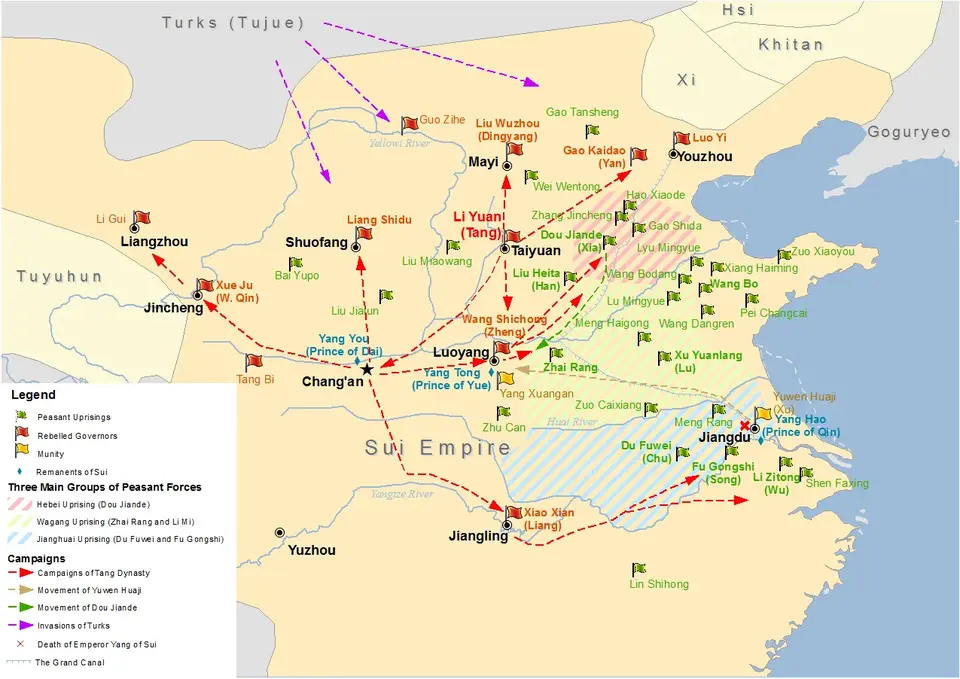
Overconfident in his aristocratic lineage, Yang Xuangan dismissed the northern plan and insisted that capturing Luoyang was essential since the families of high court officials resided there. Rejecting Li Mi's superior advice, Yang marched west with over 100,000 men toward the suburbs of Luoyang in June.
Arriving beneath the walls of Luoyang, Yang Xuangan threw open the imperial Huiluo Granary to relieve starving peasants, prompting widespread response across Henan. Crucially, his rebellion ignited long-simmering discontent among the Guanlong aristocracy. More than forty young scions of prominent aristocratic houses residing in Luoyang and Chang'an—including Xiao Huaijing, nephew of Chancellor Xiao Yu; Chen Zheng, son of Minister Chen Shuda; Han Minqing, son of General Han Qinhu; and Yang Gongdao, son of Prince Yang Xiong—fled the capital to join Yang's camp.
However, Luoyang's defense proved far sturdier than Yang anticipated. Though the nominal commander, Prince of Yue Yang Tong, was merely a child, ministers Fan Zigai and Pei Hongce implemented a ruthless scorched-earth policy, burning homes and trees outside the walls and deploying ballistas and flame siphons. While Yang Xuangan repeatedly defeated garrison sorties and slew Pei Hongce, he lacked siege engines. Suffering horrific casualties beneath torrential rains and arrow volleys, his forces battered fruitlessly against the massive stone ramparts for over a month.
Arriving outside Luoyang, Yang opened the Huiluo Granary to distribute grain, drawing immense popular support. More than forty young scions of top-ranking Guanlong and Guandong aristocratic families—including relatives of Grand Chancellor Xiao Yu, Han Qinhu, and Chen Shuda—escaped from the capital to enlist under Yang's banner. However, Luoyang's defense under the young Prince of Yue, Yang Tong, and Minister of Revenue Fan Zigai was formidable. Fan cleared the suburbs, deployed repeating catapults, and burned surrounding structures. Although Yang Xuangan routed imperial sorties outside the city walls, his forces lacked siege machinery and suffered thousands of casualties against the impregnable ramparts.
When news of the rebellion reached Manchuria on June 28, 613, Emperor Yang was terrified that his retreat would be cut off. Abandoning siege equipment and unburied dead, the emperor ordered an immediate, chaotic withdrawal from Liaodong. Veteran generals Yuwen Shu, Lai Hu'er, and Qutu Tong led hundreds of thousands of elite cavalry south to relieve Luoyang, while Wei Wensheng marched east from Guanzhong. Confronting imminent encirclement, Yang followed Li Mi's advice to abandon the siege and march west toward Guanzhong.
However, during the retreat through Huayin, Yang learned that the local prefect Yang Zhiji had fortified Hongnong Palace and boasted of his defiance. Incensed by personal spite, Yang ignored Li Mi's urgent pleas and halted his army for three days to assault Hongnong. This delay allowed the vanguard cavalry of Yuwen Shu and Qutu Tong to overtake the exhausted rebels. On August 18, 613, imperial forces caught the rebel army at Wenxiang and Panshi Pavilion. Overwhelmed by superior cavalry charges, Yang's army disintegrated into a rout.
Accompanied only by his younger brother Yang Jishan and a handful of retainers, Yang Xuangan fled into the dense mountain forests of Jiaqiao in Huayuan. Hearing imperial pursuit cavalry closing in from all directions, Yang realized that escape was impossible. Terrified of facing public torture and dismemberment in Luoyang, Yang handed his sword to his brother, weeping: "Our cause has failed! I cannot bear the humiliation of imperial executioners. Kill me now!" Jishan drew the sword and ran him through, subsequently attempting suicide before being captured alive by imperial soldiers.
Upon receiving confirmation of Yang's death, Emperor Yang ordered his remains transported to Luoyang, where the corpse was dismembered, displayed for three days, hacked into minced meat, and burned. The emperor decreed that the Yang family be stripped of their imperial surname and registered under the derogatory surname "Xiao" (meaning owl or rebel). In the ensuing retribution, Emperor Yang instituted a bloodbath in the eastern capital, executing all of Yang's surviving kin alongside tens of thousands of common citizens who had received grain from the rebel granaries. Although Yang Xuangan perished, his uprising permanently shattered the myth of Sui dynastic invulnerability, opening the floodgates of the late Sui civil wars that culminated in the foundation of the Tang dynasty.
Yang Xuangan's revolt was the first large-scale open rebellion launched from within the paramount leadership of the Sui ruling class. As the Duke of Chu, Minister of Rites, and son of the empire's greatest founding hero, Yang's decision to take up arms shattered the illusion of aristocratic solidarity behind Emperor Yang. His defiance legitimized armed resistance among the governing elite, prompting dozens of prominent aristocratic sons to abandon court appointments to join his camp. This internal fissure demonstrated that the Guanlong aristocracy had withdrawn its mandate from the house of Yang, setting the precedent for subsequent noble-led uprisings, including Li Mi's leadership of the Wagang Army and Li Yuan's insurrection at Taiyuan.
By seizing the vital Liyang logistical depot, Yang Xuangan struck an immediate blow against Emperor Yang's foreign expansionism. With millions of bushels of grain and transport fleets impounded in the central plains, the imperial field forces besieging Liaodong Fortress faced catastrophic starvation. The rebellion forced the emperor to lift the siege overnight, abandoning immense stores of heavy siege equipment and shattering imperial prestige across East Asia. The chaotic withdrawal degraded the combat effectiveness of the regular army and irreversibly crippled the central court's capacity to suppress concurrent domestic rebellions.
On the battlefield, Yang Xuangan exhibited legendary physical courage and frontline tactical leadership, routinely leading cavalry charges with lance in hand and routing enemy formations, earning contemporary comparison to Xiang Yu, the Hegemon-King of Western Chu. However, his operational brilliance was fatally undermined by strategic blindness. By rejecting Li Mi's far-sighted proposals to seal the northern passes or secure the natural redoubts of Guanzhong, he squandered his military superiority in an indecisive war of attrition beneath Luoyang's walls. His three-day delay to assault Hongnong Palace out of petty vengefulness serves as an enduring case study in military history regarding the catastrophic cost of subordinating grand strategy to personal pride.
Although Yang Xuangan's movement collapsed within months, it transformed the trajectory of the late Sui civil wars. His unprecedented opening of the Liyang and Huiluo granaries broke the state's monopoly over strategic food reserves, establishing grain redistribution as a primary recruitment tool for rebel movements. His chief strategist, Li Mi, escaped capture and brought his military and political doctrine to the Wagang Army, propelling it into the preeminent military force in the central plains. Furthermore, Emperor Yang's brutal reprisal purges following the rebellion alienated the entire populace of Henan and Shaanxi, driving provincial leaders such as Dou Jiande, Du Fuwei, and Xue Ju into permanent revolt and hastening the fall of the Sui dynasty.
FIGURES ASSOCIATED WITH THIS DYNASTY