Birth in Pingyuan
Born in Gaotang; studied classical philosophy alongside Guan Ning and Bing Yuan.
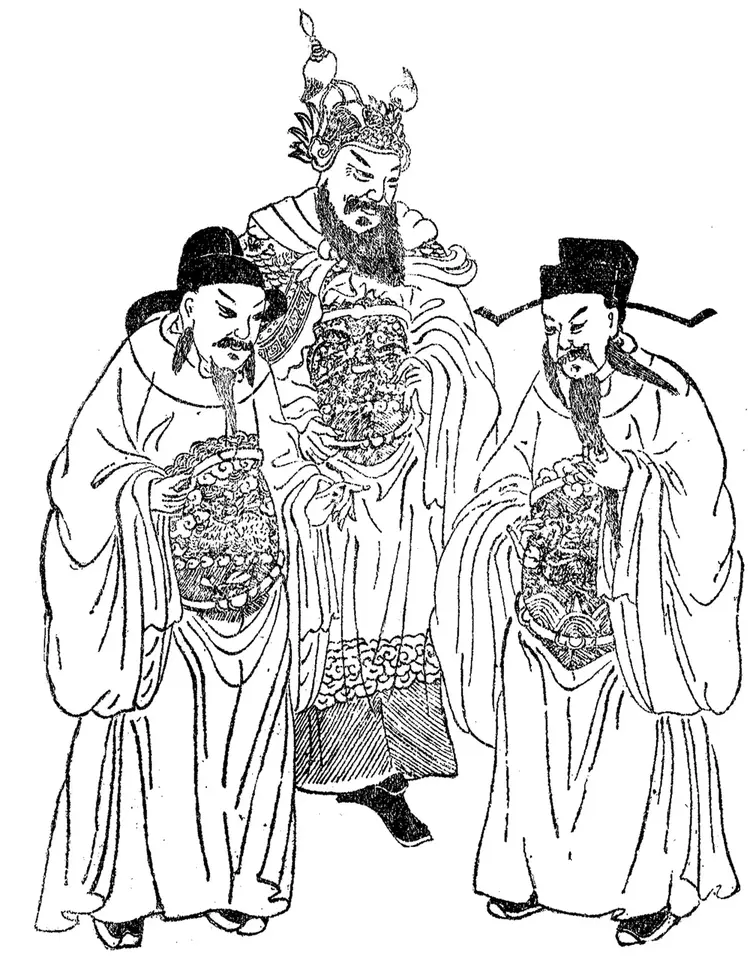
华歆
Hua Xin (华歆, 157–232), styled Ziyu, was a native of Gaotang County, Pingyuan Commandery (modern southwest of Yucheng, Dezhou, Shandong Province). He was an illustrious scholar, moral exemplar, and foundational statesman of the Eastern Han and Cao Wei during the Three Kingdoms period. In his youth, he studied alongside fellow scholars Guan Ning and Bing Yuan, acclaimed as the "Dragon," with Hua Xin honored as the "Head of the…
Hua Xin (华歆, 157–232), styled Ziyu, was a native of Gaotang County, Pingyuan Commandery (modern southwest of Yucheng, Dezhou, Shandong Province). He was an illustrious scholar, moral exemplar, and foundational statesman of the Eastern Han and Cao Wei during the Three Kingdoms period. In his youth, he studied alongside fellow scholars Guan Ning and Bing Yuan, acclaimed as the "Dragon," with Hua Xin honored as the "Head of the Dragon." Entering the imperial civil service as Filial and Incorrupt, he resigned during Dong Zhuo's usurpation, taking refuge south of the Yangtze. In 195, the Han court appointed him Administrator of Yuzhang, where he governed with benevolent moderation, earning universal acclaim. Following Sun Ce's pacification of the region, he was treated with supreme honors as an esteemed guest by Sun Ce and Sun Quan. In 200, Cao Cao summoned him to the imperial capital, appointing him Consultant and later Prefect of the Masters of Writing. When Cao Pi founded the state of Cao Wei, Hua Xin was invested as Minister over the Masses and created Marquis of Anlexiang. Under Emperor Ming (Cao Rui), he advanced to Grand Commandant and Marquis of Boping. Celebrated for incorruptible simplicity, Hua Xin distributed his stipends and royal gifts to impoverished kinsmen, accumulating no private fortune. In his twilight years, he successfully dissuaded Emperor Ming from launching an exhaustive invasion of Shu Han, urging agricultural rehabilitation instead. He died in 232 at the age of seventy-six, honored with the posthumous title Marquis Jing.
Born in Gaotang; studied classical philosophy alongside Guan Ning and Bing Yuan.
Served as Imperial Clerk; resigned due to Dong Zhuo's tyranny and took refuge south of the Huai River.
Appointed Administrator of Yuzhang by the Han court, cultivating peaceful governance.
Recruited by Cao Cao to Xuchang, appointed Consultant and Counselor to the Chancellery.
Succeeded Xun Yu and Xun You, directing central imperial secretariats with rigorous impartiality.
Created Minister over the Masses and Marquis of Anlexiang upon the founding of Cao Wei.
Promoted to Grand Commandant and Marquis of Boping by Emperor Ming.
Submitted a poignant memorial urging Emperor Ming to cancel the southern invasion of Shu Han.
Passed away in Luoyang at age seventy-six; posthumously canonized as Marquis Jing.
Hua Xin was born in the third year of the Yongshou era (157) in Gaotang, Pingyuan Commandery. From his youth, he distinguished himself through photographic recall, classical erudition, and moral poise. He formed a celebrated intellectual fellowship with fellow scholars Guan Ning and Bing Yuan. Contemporary literati revered the trio as the "Dragon": Hua Xin, gifted with pragmatic statecraft and keen intellect, was acclaimed as the "Head of the Dragon"; Bing Yuan was the "Body of the Dragon"; and Guan Ning, dedicated to austere hermit simplicity, was the "Tail of the Dragon."
During the Zhongping era of Emperor Ling, Hua was nominated Filial and Incorrupt, appointed Court Gentleman, and elevated to Imperial Clerk. When General-in-Chief He Jin was assassinated and Dong Zhuo seized control of Luoyang, terrorizing the court, Dong sought to legitimize his regime by enlisting virtuous scholars, retaining Hua Xin in the secretariat. Recognizing Dong Zhuo's monstrous cruelty, Hua plotted with Zheng Tai and Xun You to assassinate the tyrant. When the conspiracy faltered, Hua feigned illness, surrendered his office, and fled the capital, finding refuge in Nanyang and Xuzhou.
In 195, the Eastern Han court officially commissioned Hua Xin as Administrator of Yuzhang (modern Nanchang, Jiangxi Province). The region was plagued by Shanyue tribal uprisings and banditry. Upon assuming office, Hua abolished harsh penal codes, implementing a governance philosophy centered on Confucian moral persuasion and light taxation. He patronized rural academies, encouraged sericulture, and pardoned non-violent offenders. Under his administration, Yuzhang achieved stability, attracting thousands of refugee families from the ravaged north.
In 199, martial prodigy Sun Ce conquered the Jiangdong commanderies, advancing his armies against Yuzhang. Realizing that armed resistance would inflict devastating slaughter upon his citizens, Hua Xin donned simple scholar's garments and walked out of the city gates to greet Sun Ce. Deeply impressed by Hua Xin's moral stature, Sun Ce ordered his soldiers to refrain from looting and welcomed Hua into his headquarters as an honored mentor.
Following Sun Ce's death in 200, his successor Sun Quan treated Hua Xin with profound respect, seeking his counsel on administrative affairs. Meanwhile, locked in a climactic struggle with Yuan Shao at Guandu, Cao Cao recognized Hua Xin's immense prestige. He issued an imperial edict summoning Hua to Xuchang. Although Sun Quan was reluctant to part with him, Hua persuaded the warlord that having an advocate in the imperial chancellery served Jiangdong's diplomatic interests.
As Hua departed, over a thousand Jiangdong scholars and gentry presented farewell gifts worth hundreds of thousands in gold and silk. Hua quietly inscribed the donor's name on each gift. Boarding the boat, he smiled and returned the treasures, stating: "I cannot refuse your generous affection; yet traveling alone in times of war with vast fortunes invites robbery and ruin. I return these treasures with heartfelt gratitude." The literati admired his integrity and unblemished honor.
Reaching Xuchang, Hua Xin was warmly embraced by Cao Cao and appointed Consultant and Military Advisor to the Chancellery. Cao Cao relied heavily upon Hua Xin's administrative acumen, assigning him to supervise internal governance whenever military campaigns took the warlord afield. Following the deaths of Xun Yu and Xun You, Hua Xin succeeded to the post of Prefect of the Masters of Writing, directing central governmental affairs with unimpeachable justice. In 217, when Cao Cao was created King of Wei, Hua was appointed Censor-in-Chief.
In 220, Cao Cao died in Luoyang, and Cao Pi succeeded as King of Wei. As Censor-in-Chief, Hua Xin orchestrated the delicate constitutional transition from the Eastern Han to Cao Wei. Citing dynastic cycles and popular consensus, Hua led the civil and military bureaucracy in petitioning Emperor Xian to abdicate the imperial throne. Upon the inauguration of the Huangchu era, Emperor Wen (Cao Pi) appointed Hua Xin Minister over the Masses and created him Marquis of Anlexiang.
In 226, Emperor Ming (Cao Rui) ascended the throne. Revered as an elder statesman, Hua Xin was advanced to Grand Commandant, the supreme military-civil office of the realm, and created Marquis of Boping with a fief of twelve hundred households.
Despite occupying the pinnacle of imperial nobility, Hua Xin lived with astonishing simplicity. He regarded private wealth with utter indifference. Whenever emperors bestowed gold, brocades, and estates upon him, Hua immediately distributed them among impoverished relatives and widows in his clan, leaving his own household without surplus grain or silk garments. When Emperor Wen made an unannounced visit to Hua Xin's residence, he found the Grand Minister's household dining on coarse grains and sleeping beneath plain hemp blankets. Deeply touched, Cao Pi decreed that provincial authorities provide lifetime provisioning for Hua's family.
Throughout his career, Hua Xin actively promoted talented recluses, championing his old companion Guan Ning. When Guan Ning remained in Liaodong refusing all official appointments, Hua submitted an official memorial in 227 requesting to resign his supreme office of Grand Commandant so that Guan Ning might take his place. Although Guan Ning declined the imperial summons, Hua's willingness to yield his high office became an enduring emblem of virtue.
In 230, Grand Marshal Cao Zhen and General-in-Chief Sima Yi proposed a joint three-pronged invasion of Shu Han. Emperor Ming mobilized hundreds of thousands of troops, traveling to Chang'an to oversee the campaign. At that juncture, torrential rains washed away mountain gallery roads in the Qinling ranges, paralyzing the supply corridors.
Though over seventy years of age and ailing, Hua Xin submitted a blistering remonstrance from his sickbed: "Weapons are instruments of misfortune, deployed only when inevitable. The realm has newly achieved stability, and the Central Plains require healing. Shu's rugged mountain passes cannot be conquered by hasty violence. Rather than squandering our armies in barren southern defiles, Your Majesty should foster agriculture, relieve taxes, and cultivate moral governance. When the Central Plains flourish with wealth and virtue, Wu and Shu will dissolve from within!" Persuaded by his strategic wisdom, Emperor Ming cancelled the offensive and withdrew his legions to Luoyang.
In the winter of 232, Hua Xin passed away peacefully in Luoyang at the age of seventy-six. Emperor Ming mourned his passing with deep sorrow, suspending court audiences and conferring the posthumous name Marquis Jing (The Reverent Marquis).
The youthful anecdote of Hua Xin and Guan Ning "severing the mat" is celebrated in Chinese folklore. While reading together on a straw mat and hoeing weeds in a garden, the pair encountered gold in the dirt; Guan Ning disregarded it as rubble, whereas Hua Xin paused to inspect the metal before casting it aside. Later, when an aristocratic carriage passed by, Guan Ning continued reading, while Hua Xin laid down his scroll to observe the spectacle. Guan Ning drew a knife, split their shared mat, and proclaimed: "You are no friend of mine!"
While fictional accounts like Romance of the Three Kingdoms weaponized this anecdote to portray Hua Xin as a venal opportunist, formal dynastic histories demonstrate that Hua Xin's curiosity stemmed from his active desire for civic engagement, contrasting with Guan Ning's eremitic withdrawal. Throughout his life, Hua Xin demonstrated flawless incorruptibility, distributing his wealth to charity and repeatedly offering to yield his supreme ministerial post to Guan Ning, demonstrating genuine magnanimity.
A celebrated episode in the Shishuo Xinyu contrasts Hua Xin's steadfast honor with the opportunistic conduct of fellow minister Wang Lang. While fleeing south by boat, a solitary refugee pleaded to join their vessel. Hua hesitated, noting that their small craft could barely navigate the storms and that accepting a passenger required undertaking responsibility for their life. Wang Lang cavalierly permitted the passenger aboard.
Midway through the crossing, bandit horsemen approached the riverbank, and the overburdened boat slowed dangerously. In a panic, Wang Lang proposed pushing the refugee overboard to lighten the craft. Hua Xin sharply rebuked Wang: "I hesitated earlier precisely because I foresaw this mortal peril. Now that we have accepted him into our care, how could we abandon him to save our own skins?" Hua rallied the rowers and successfully delivered the refugee to safety, winning widespread acclaim for uncompromising fidelity.
Throughout his tenure as Prefect of the Masters of Writing, Censor-in-Chief, Minister over the Masses, and Grand Commandant, Hua Xin focused unceasing attention upon the physical welfare of common soldiers and impoverished war widows. During the Huangchu era, continuous military engagements against Wu and Shu drained the agricultural heartland, leaving veterans disabled and military households in destitution.
Hua Xin repeatedly petitioned Emperor Wen and Emperor Ming to establish regularized pensions and grain stipends for fallen soldiers' families. The imperial estates, draught cattle, and silk fabrics granted to Hua were consistently donated to wounded veterans and war orphans rather than hoarded. He actively reformed military logistics to prevent regional commanders from levying arbitrary corvée during crucial agricultural cycles, earning wide veneration among garrison troops as a benevolent protector.
FIGURES ASSOCIATED WITH THIS DYNASTY