Birth in Xunyang
Born into the gentry Zhou clan in Xunyang; relocated to Huangmei during childhood, exhibiting early detachment from worldly desires.
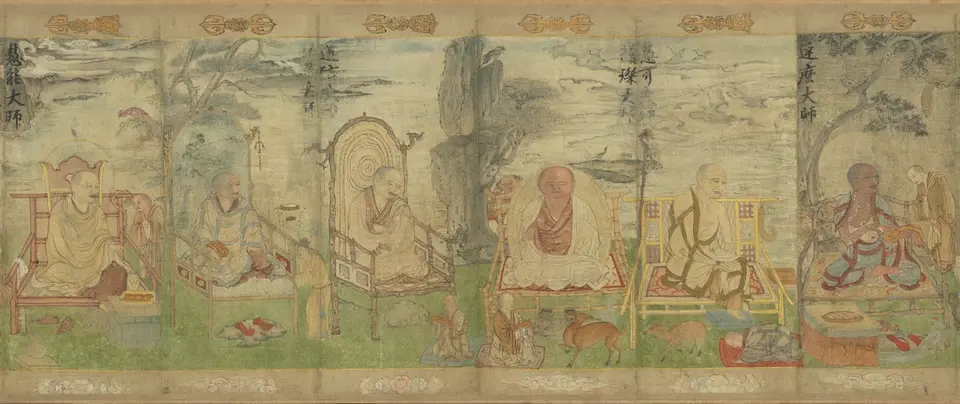
弘忍
Hongren (弘忍, 601 – 675), secular surname Zhou, originally from Xunyang (present-day Jiujiang, Jiangxi Province), later relocated to Huangmei in Qizhou (present-day Huangmei, Hubei Province). He was an eminent Buddhist monk of the Tang dynasty, the Fifth Patriarch of Chinese Chan Buddhism, and is revered in Buddhist tradition as the Fifth Patriarch of Huangmei or East Mountain. Displaying spiritual insight and calm gravity…
Hongren (弘忍, 601 – 675), secular surname Zhou, originally from Xunyang (present-day Jiujiang, Jiangxi Province), later relocated to Huangmei in Qizhou (present-day Huangmei, Hubei Province). He was an eminent Buddhist monk of the Tang dynasty, the Fifth Patriarch of Chinese Chan Buddhism, and is revered in Buddhist tradition as the Fifth Patriarch of Huangmei or East Mountain. Displaying spiritual insight and calm gravity from childhood, Hongren was recognized at age seven by the Fourth Patriarch Daoxin, formally received tonsure at thirteen, and served Daoxin at Shuangfeng Mountain for nearly three decades. Engaging in arduous physical labor such as carrying water and pounding rice during the day and meditating silently at night, he thoroughly mastered Daoxin's Chan doctrines of sudden and gradual awakening. In 651, prior to his death, Daoxin transmitted the patriarchal robe and dharma transmission to Hongren, who succeeded as abbot. As disciples multiplied, Hongren established a new monastery on Mount Fengmao east of Shuangfeng, founding Dongshan Monastery to instruct monks and lay practitioners. His teaching became celebrated as the East Mountain Teaching (Dongshan Famen), transitioning Chan Buddhism from itinerant asceticism into organized monasticism. Synthesizing the Diamond Sutra with the Lankavatara Sutra, he advocated preserving one's inherent true mind and championed the integration of agriculture with meditation, establishing economic self-reliance for monasteries. In his late years, testing his disciples' spiritual understanding, Hongren secretly transmitted the patriarchal robe and bowl to Huineng from Lingnan, establishing him as the Sixth Patriarch, while his senior disciple Shenxiu promulgated the gradual teaching in the north, creating the dual traditions of the Southern and Northern Chan schools. Hongren passed away peacefully at Dongshan in 675 at the age of seventy-five. Emperor Daizong posthumously honored him with the title Daman Chan Master.
Born into the gentry Zhou clan in Xunyang; relocated to Huangmei during childhood, exhibiting early detachment from worldly desires.
Met Fourth Patriarch Daoxin at age seven; his sharp replies on Buddha-nature astonished the master, who accepted him as an acolyte.
Formally ordained at age thirteen at Shuangfeng Mountain; served Daoxin with tireless physical labor while meditating through the night.
Received Bodhidharma's cotton robe and dharma seal from the dying Daoxin, assuming leadership over the Shuangfeng Mountain monastery.
Due to expanding monastic enrollment, founded a new monastic center at Mount Fengmao east of Shuangfeng, establishing the East Mountain Teaching.
Layman Huineng arrived from Lingnan; recognizing his extraordinary potential, Hongren assigned him to the millhouse to thresh rice.
Evaluated verse submissions from Shenxiu and Huineng; validated Huineng's realization and secretly bestowed the patriarchal robe and bowl at midnight.
Directed disciples to construct the Facquan Pagoda, gathered the community for final instructions, and entered nirvana at age seventy-five.
Emperor Daizong conferred the posthumous title Daman Chan Master and inscribed his reliquary pagoda as the Facquan Pagoda.
Master Hongren had the secular surname Zhou, with family origins in Xunyang, Jiangzhou (present-day Jiujiang, Jiangxi Province). His ancestors belonged to an educated gentry family, but to avoid regional warfare, the family relocated to Huangmei County in Qizhou (modern Huangmei, Hubei Province). In 601, Hongren was born in Huangmei. Tradition holds that his mother experienced auspicious signs prior to his birth. From infancy, Hongren was serene and unruffled, shunning trivial games and bowing respectfully whenever encountering Buddhist statues and scriptures, astonishing local elders.
In 608, Fourth Patriarch Daoxin traveled through Qichun and Huangmei, encountering the seven-year-old Hongren along the roadside. Struck by the child's majestic bone structure and luminous demeanor, Daoxin paused and inquired playfully about his family name. The boy clasped his hands and replied that he possessed a nature, yet it was no ordinary surname. When Daoxin pressed for the name, the child answered that it was Buddha-nature. When asked if he had no surname, the boy responded that since nature is empty, it does not exist. Deeply moved, Daoxin exclaimed to his attendants that the child was a rare vessel of the dharma who would perform magnificent Buddhist deeds two decades hence. Accompanying the child home, Daoxin earnestly pleaded with the parents to permit him to enter monastic life. Recognizing his profound spiritual affinity, the parents gladly entrusted their son to the patriarch.
In 614, at age thirteen, Hongren formally took the novice vows at Shuangfeng Mountain under Master Daoxin, receiving the monastic name Hongren. At the time, the Shuangfeng community practiced joint manual labor and seated meditation, clearing mountain tracts and weaving cloth to maintain collective self-sufficiency. Hongren volunteered for the most menial and strenuous duties, chopping firewood, carrying water, and pounding rice for the community. After a long day of physical toil, he refrained from reclining, sitting upright in silent contemplation until dawn.
Daoxin frequently tested Hongren with the profound doctrines of sudden and gradual realization in Bodhidharma's lineage. Hongren understood intuitively upon hearing a single word, outstripping all fellow disciples in clarity and depth of insight. Practicing in silence for nearly thirty years, he maintained humble modesty, enduring slights and slanders with placid equanimity and never engaging in debate. In 651, foreseeing his impending departure, Daoxin formally transmitted to Hongren the cotton robe and secret mind seal passed down from Bodhidharma, Huike, and Sengcan. Following Daoxin's parinirvana in the intercalary eighth month of that year, Hongren assumed the abbacy of Shuangfeng Mountain.
In 654, as Hongren's renown spread, monastics and laypersons from across the empire traveled thousands of li to seek his instruction. Shuangfeng's modest huts could no longer accommodate hundreds of practitioners. To expand the monastic community, Hongren led his disciples east across the river to Mount Fengmao (also known as East Mountain in Huangmei), clearing briars and leveling rocks to erect Youju Monastery (later celebrated as the Fifth Patriarch's Dongshan Monastery). Under his guidance, the monastic community flourished, with resident practitioners consistently exceeding a thousand.
During his tenure at Dongshan, Hongren implemented crucial transformations that sinicized Indian Chan Buddhism, establishing the system celebrated in Buddhist annals as the East Mountain Teaching. He moved away from the ascetic wanderings of early Chan hermits, creating permanent monastic centers with communal labor and collective meditation rules. Hongren integrated meditative awareness directly into everyday existence, teaching that walking, standing, sitting, and lying down are all manifestations of Chan. He placed guarding the original true mind at the heart of practice, emphasizing that all sentient beings inherently possess pure Buddha-nature, and that freedom is realized simply by relinquishing delusive attachments.
In 661, a young woodcutter named Huineng arrived from Xinzhou in Lingnan after traversing thousands of li to seek instruction. At their initial meeting, Hongren asked where he had come from and what he sought. Huineng replied that he came from Lingnan wishing only to attain Buddhahood and nothing else. Testing his resolve, Hongren remarked that as an unlettered barbarian from the south, he could hardly hope to achieve Buddhahood. Huineng boldly retorted that while humans might be northern or southern, Buddha-nature knows no north or south, and the body of a barbarian differs from that of a monk, but what difference exists in their Buddha-nature. Hongren recognized a rare spiritual prodigy, but fearing jealousy from senior monks, he sent Huineng to the rear millhouse to chop firewood and pound rice. Huineng tied heavy stones around his waist to increase his weight on the pestle, laboring diligently for eight months without complaint.
In 662, recognizing his advanced age, Hongren instructed his seven hundred disciples to compose a verse demonstrating their spiritual realization to determine the patriarchal succession. The monastic community looked to head monk Shenxiu, who was versed in Buddhist exegesis and classical philosophy. After prolonged contemplation, Shenxiu wrote anonymously on the corridor wall: "The body is the Bodhi tree; the mind is like a clear mirror stand. At all times diligently wipe it clean, never letting dust cling to it." Advocating gradual purification, Hongren publicly praised the verse, stating that practicing accordingly would prevent rebirth in lower realms, yet privately informed Shenxiu that he had not yet entered the gate or seen his true nature.
Working in the rear millhouse, Huineng heard of Shenxiu's verse and realized it lacked total understanding of the emptiness of dharmas. Because Huineng was illiterate, he asked official Zhang Riyong to inscribe a response on the wall: "Bodhi fundamentally has no tree; nor is the clear mirror a stand. Originally there is not a single thing; where could dust alight?" This verse directly pointed to original emptiness and natural purity, astounding the entire assembly.
Observing the monks' astonishment and fearing violence against Huineng, Hongren took off his straw sandal, wiped away the verse, and declared that this too had not seen true nature. The following afternoon, Hongren entered the millhouse alone, saw Huineng pounding rice with the stone bound to his waist, struck the pestle three times with his staff, and walked away with his hands clasped behind his back. Huineng understood the signal, discerning that he was summoned to the master's private quarters at the third watch of the night.
At midnight, Huineng slipped into Hongren's chambers. Hongren shielded the windows with his monastic robe and expounded the Diamond Sutra. When reaching the line instructing practitioners to give rise to a mind that dwells nowhere, Huineng experienced complete enlightenment, realizing that all dharmas never separate from self-nature. Hongren verified his profound awakening, formally bestowed Bodhidharma's ancestral robe and begging bowl upon him, and instructed him to preserve the dharma and ensure it never ceased. Hongren personally accompanied Huineng to the Jiujiang ferry at night, bidding him to remain in seclusion in Lingnan for over a decade to avoid harm before rowing back alone.
Following Huineng's departure, disciples discovered the robe was missing and launched pursuits without success. In subsequent years, Hongren continued guiding practitioners at Dongshan, while his senior disciples dispersed to teach across China. Huineng established the southern sudden teaching at Caoxi, while Shenxiu moved north to Yuquan Monastery on Dangyang Mountain in Jiangling, earning the reverence of Empress Wu Zetian and Emperor Zhongzong and founding the northern gradual school. Other prominent disciples such as Zhixian established Chan communities in Sichuan, and Hui'an taught in the Central Plains. Under Hongren's guidance, Chan Buddhism grew into the dominant intellectual force in Tang society.
In 674, Hongren directed his disciple Xuanze to build a brick pagoda on Mount Fengmao. On the sixteenth day of the second month in 675, Master Hongren convened his disciples, announced that his teaching duties were fulfilled, sat in the lotus posture, and peacefully entered nirvana at age seventy-five, having spent sixty-two years in monastic vows. His body was enshrined within the Facquan Pagoda. In 763, Emperor Daizong conferred the posthumous title Daman Chanshi (Great Fullness Chan Master) and granted the plaque Facquan Pagoda, ensuring everlasting veneration across subsequent dynasties.
Master Hongren's greatest contribution to Chinese intellectual history was founding the East Mountain Teaching, establishing an independent institutional and theoretical framework for Chan Buddhism. Prior to Hongren, Chan practitioners led itinerant, ascetic lives without permanent monasteries or stable lineages. Hongren established a fixed monastic complex on East Mountain, gathering over a thousand resident monastics and transforming complex Indian metaphysics into an accessible, direct path of spiritual insight. Elevating the Diamond Sutra and focusing on guarding the original mind, he allowed Chan to shed foreign intellectual constraints and catalyzed the complete sinicization of Chinese Buddhism.
Building upon Daoxin's practice of balancing labor and meditation, Hongren implemented agricultural self-sufficiency across Dongshan Monastery. Personally leading disciples in clearing hillsides, cultivating grain, cutting wood, and grinding flour, he elevated manual labor into an essential spiritual vehicle for realizing original nature. This revolutionary lifestyle transformed Buddhist monasteries from parasitic institutions dependent upon royal grants and secular patronage into resilient communal economies, ensuring Chan Buddhism survived recurring imperial persecutions such as the Huichang suppression.
At a defining crossroads in Chan history, Hongren demonstrated extraordinary spiritual discernment transcending conventional social rank and scholarly prejudice. Overlooking Huineng's illiteracy and humble origins as an uneducated laborer from Lingnan, Hongren recognized his innate capacity for sudden awakening. By secretly transmitting the robe and bowl at midnight behind shielded curtains, Hongren bypassed internal factional rivalries and passed the core teaching of sudden enlightenment to the Sixth Patriarch, laying the foundation for the historic Platform Sutra and exerting an immense influence on East Asian culture.
Hongren nurtured an extraordinary cohort of disciples, historically remembered as the ten great disciples or thirteen dharma successors, reflecting his broad pedagogical scope. Adapting his instruction to individual capacities, he transmitted the sudden realization of original nature to sharp minds like Huineng, while confirming the structured gradual discipline of stalwart scholars like Shenxiu. Shenxiu brought Chan to imperial prominence in Chang'an and Luoyang as national teacher, while Huineng established the orthodox Southern Chan tradition at Caoxi. Their complementary flourishing illuminated Chinese religious life throughout the Tang dynasty.
FIGURES ASSOCIATED WITH THIS DYNASTY