Strategic Capital Advocacy
Encountered Liu Bang in Luoyang while en route to border conscription; successfully advocated Guanzhong as the dynastic capital, receiving the imperial surname Liu and the title Lord of Fengchun.
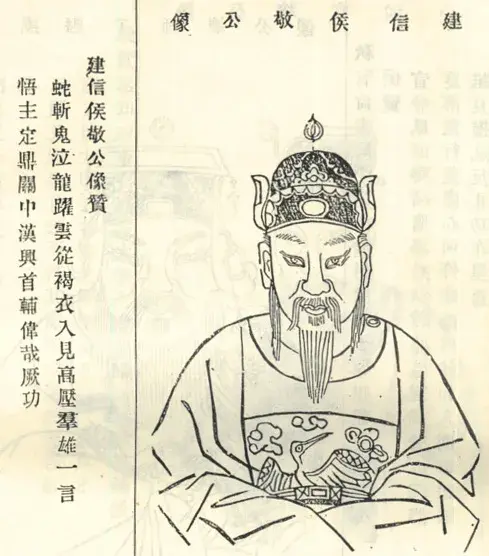
娄敬
Lou Jing (娄敬, fl. late 3rd – early 2nd century BCE), posthumously recorded primarily as Liu Jing (刘敬) after being granted the imperial surname by Emperor Gaozu of Han (Liu Bang), was a pivotal founding strategist and grand statesman of the Western Han Dynasty. Originating as an impoverished garrison conscript from the former state of Qi, Lou Jing gained an audience with Emperor Gaozu in 202 BCE while passing through Luoyang,…
Lou Jing (娄敬, fl. late 3rd – early 2nd century BCE), posthumously recorded primarily as Liu Jing (刘敬) after being granted the imperial surname by Emperor Gaozu of Han (Liu Bang), was a pivotal founding strategist and grand statesman of the Western Han Dynasty. Originating as an impoverished garrison conscript from the former state of Qi, Lou Jing gained an audience with Emperor Gaozu in 202 BCE while passing through Luoyang, successfully persuading the emperor to abandon Luoyang and establish the dynastic capital in Chang'an within the Guanzhong basin. This decisive geopolitical choice safeguarded the core of imperial authority behind natural mountain and river barriers. In subsequent years, Lou Jing demonstrated exceptional military acumen and statesmanship. Prior to the Battle of Baideng in 200 BCE, he alone discerned that Modu Chanyu of the Xiongnu was feigning weakness to spring an ambush, warning Gaozu against an ill-fated offensive. Following Gaozu's encirclement and retreat, the emperor acknowledged Lou Jing's foresight and ennobled him as Marquis of Jianxin. Confronting relentless northern nomadic incursions, Lou Jing pioneered the groundbreaking "heqin" (harmonious alliance) marriage policy, securing peace through marital alliances and annual tributary gifts to allow the infant Han economy to recover. He also spearheaded the mass relocation of over one hundred thousand members of the former Six States' aristocracy into Guanzhong, concurrently neutralizing regional rebellion risks and reinforcing imperial defenses.
Encountered Liu Bang in Luoyang while en route to border conscription; successfully advocated Guanzhong as the dynastic capital, receiving the imperial surname Liu and the title Lord of Fengchun.
Dispatched to inspect the Xiongnu; warned of an ambush prior to the Battle of Baideng; was imprisoned for dissent but later exonerated and created Marquis of Jianxin.
Formulated the grand strategy of marriage alliances and material pacification toward Modu Chanyu, inaugurating Han-Xiongnu diplomacy.
Proposed and oversaw the migration of over one hundred thousand prominent nobles and powerful clans from Qi, Chu, and the Central Plains into Guanzhong.
Defended the established dynastic succession of Crown Prince Liu Ying alongside veteran ministers, ensuring dynastic stability.
In 202 BCE, following the defeat of Xiang Yu, the nascent Han Dynasty stood at a critical juncture of state-building. Emperor Gaozu established his temporary court at Luoyang, intending to follow the venerable precedent of the Zhou Dynasty by establishing the permanent imperial capital there. Lou Jing, a native of the former state of Qi who had been conscripted to serve as a border guard in Longxi, passed through Luoyang dressed in a tattered sheepskin coat and pulling a conscript supply cart. Recognizing the historic opportunity, Lou Jing removed the cart harness and sought an audience through General Yu, a fellow Qi compatriot serving in Gaozu's retinue.
When General Yu offered to lend him refined court attire, Lou Jing adamantly refused, insisting that true counsel depended on intellectual merit rather than superficial clothing. Impressed by his unconventional determination, Emperor Gaozu summoned him to the palace and granted him a meal.
During their dialogue, Lou Jing directly challenged Gaozu's assumptions, asking whether the emperor intended to rival the Zhou Dynasty in virtue and prosperity. Gaozu affirmed this intent. Lou Jing methodically dismantled the comparison, explaining that the Zhou ancestors had accumulated moral virtue over a dozen generations from Houji and Duke Liu to King Wen and King Wu, allowing them to govern the Central Plains through ritual suasion from a centrally located capital. In contrast, Gaozu had arisen from humble origins in Pei, conquering the empire through fierce military struggle and leaving the realm impoverished and bleeding. Governing such a wounded realm from the exposed plains of Luoyang, Lou Jing argued, was inherently perilous.
Lou Jing then presented the overwhelming strategic advantages of the Guanzhong region. Fortified by mountain ranges and the Yellow River, and shielded by natural passes on all four sides, the old Qin territory constituted an impregnable natural fortress known as the "Land of Heaven's Abundance." By basing the Han court in Guanzhong, the sovereign would hold the throat of the empire while commanding its back, capable of mobilizing a million soldiers from behind secure frontiers. Even if disturbances broke out east of Mount Xiao, the core imperial seat would remain untouched.
Although eastern courtiers clung to their native regions and advocated Luoyang, Marquis of Liu Zhang Liang strongly endorsed Lou Jing's geopolitical vision. Convinced by their combined arguments, Emperor Gaozu immediately ordered his chariot westward to establish the capital at Chang'an. Declaring that Lou Jing had laid the foundation of imperial longevity, Gaozu bestowed upon him the imperial surname Liu, appointed him Gentleman of the Palace (Langzhong), and titled him Lord of Fengchun.
In 200 BCE, King Xin of Han rebelled in the north and allied with the northern nomadic Xiongnu confederation. Enraged by the betrayal, Emperor Gaozu personally commanded an army of over three hundred thousand troops on a northern punitive expedition. Upon arriving at Jinyang, Gaozu dispatched ten successive diplomatic missions to scrutinize the military capabilities of the Xiongnu under Modu Chanyu.
Anticipating Han reconnaissance, Modu Chanyu deliberately concealed his battle-hardened elite cavalry and robust steeds within hidden valleys, purposefully parading emaciated livestock, feeble elders, and infirm soldiers before the Han envoys. Deceived by this calculated display, the first ten envoys returned with unanimous reports that the Xiongnu were weak, demoralized, and ripe for an immediate Han assault.
To confirm the consensus, Gaozu dispatched Liu Jing on a final diplomatic mission. Upon his return, Liu Jing presented a radically contrary assessment: "When two sovereign nations engage in armed conflict, they invariably flaunt their martial might to intimidate the adversary. Yet during my mission, I observed only decrepit soldiers and starved herds. This is an obvious stratagem designed to feign vulnerability and lure our vanguard into a lethal trap. The enemy certainly conceals elite strike forces, and our army must not advance recklessly!"
By that time, Gaozu's vanguard had already crossed the Gouzhu mountains and reached Guangwu. Infuriated by Liu Jing's dissenting warning, Gaozu publicly berated him for dampening troop morale, chained him in shackles, and threw him into the dungeons of Guangwu, vowing to execute him upon total victory.
Emperor Gaozu subsequently advanced with an advance detachment of light cavalry toward Pingcheng, walking directly into Modu Chanyu's coordinated ambush. Four hundred thousand elite Xiongnu horsemen emerged from concealment, encircling Gaozu and his forces on the frozen slopes of Mount Baideng. Deprived of provisions and reinforcement for seven days, the imperial army faced imminent annihilation, only escaping catastrophe after Chen Ping executed a clandestine stratagem bribing Modu's principal consort.
Upon safely retreating to Guangwu, Gaozu's immediate act was to release Liu Jing from prison. Before the assembled ranks, Gaozu made a contrite apology: "Because I disregarded your upright counsel, I suffered grievous entrapment at Pingcheng. I have ordered the summary decapitation of the ten previous envoys who misled the court." Gaozu immediately elevated Liu Jing to Marquis of Guannei, granted him the noble title of Marquis of Jianxin, and bestowed an estate of two thousand households.
Following the ordeal at Mount Baideng, Modu Chanyu's military hegemony reached its zenith, commanding over three hundred thousand skilled mounted archers and continuously raiding the northern Han frontiers. Recognizing that the war-weary Han Dynasty lacked the logistical infrastructure and military endurance to defeat the mobile nomadic empire on the open steppe, Gaozu turned once more to Marquis of Jianxin Liu Jing for a long-term grand strategy.
Liu Jing presented the historic concept of "heqin" (harmonious matrimonial alliance). He analyzed that nomadic chieftains lived by martial force and could not be persuaded by Confucian moral maxims, but could be strategically bound through marital lineage, biological kinship, and substantial economic incentives.
Liu Jing proposed: "If Your Majesty can bear to marry the eldest imperial princess (Princess Luyuan, born of Empress Lü) to Modu Chanyu as his legal consort, accompanied by lavish annual gifts of silk, liquor, and grains, Modu will become Your Majesty's son-in-law. When your imperial grandson eventually succeeds as Chanyu, how could a maternal grandson ever wage war against his maternal grandfather's dynasty? Over generations, the nomadic realm will naturally become an affiliated dependency of our empire without shedding blood."
Gaozu readily approved the strategy, but Empress Lü wept bitterly day and night, refusing to send her only daughter into the northern wilderness. Adapting the plan, Gaozu selected a virtuous daughter from an imperial collateral lineage, bestowed upon her the rank of imperial princess, and sent Liu Jing to escort her to the Xiongnu court with extensive dowries. This diplomatic breakthrough established the foundation of the Han-Xiongnu peace agreements, providing decades of respite during which the Han Dynasty rebuilt its agrarian economy.
Following his return from the northern frontier, Liu Jing proposed an equally transformative internal policy to fortify the dynastic core. He observed that the Baiyang and Loufan nomadic tribes pasturing along the Yellow River loop were only seven hundred li from Chang'an, capable of reaching the capital within a single day and night. Meanwhile, the Guanzhong heartland was sparsely populated after prolonged warfare, while the aristocratic clans of the conquered Six States—particularly the Tian of Qi, the Zhaos, Qus, and Jings of Chu, alongside the powerful houses of Zhao, Wei, and Han—commanded vast regional followings capable of instigating revolts.
Liu Jing counseled the emperor to forcibly transplant over one hundred thousand members of these former aristocratic families and wealthy lineages into the Guanzhong plain around the capital. This measure achieved two decisive strategic goals: internally, it populated and cultivated the fertile soils around the capital while creating an inexhaustible reservoir of imperial recruits; externally, it completely severed regional magnates from their local power bases in the east, permanently eliminating the organizational seeds of feudal rebellion. Gaozu enthusiastically adopted the counsel and appointed Liu Jing to personally supervise the mass resettlement.
In Gaozu's final years, when internal court friction erupted over proposals to depose Crown Prince Liu Ying in favor of Prince Ruyi of Zhao, Liu Jing joined Shusun Tong in vigorously upholding the legitimacy of the eldest heir, ensuring an orderly transition of power. Through his four grand strategies, Liu Jing exerted an enduring influence on the institutional and territorial framework of the Han empire.
FIGURES ASSOCIATED WITH THIS DYNASTY