Birth into Rhenish Nobility
Born on May 1 into an aristocratic Catholic lineage in Cologne, later entering the Jesuit Roman College.
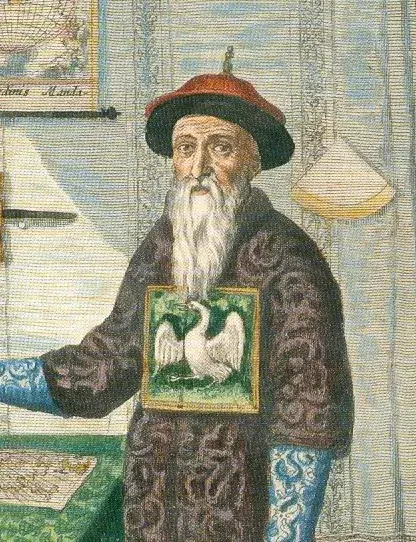
汤若望
Johann Adam Schall von Bell (汤若望; May 1, 1592 – August 15, 1666), courtesy name Daowei, was a native of Cologne in the Holy Roman Empire (modern Germany). He was a distinguished German Jesuit missionary, astronomer, mathematician, and statesman who served the late Ming and early Qing imperial courts, becoming the first Western scholar in Chinese history to be appointed Director of the Imperial Astronomical Bureau…
Johann Adam Schall von Bell (汤若望; May 1, 1592 – August 15, 1666), courtesy name Daowei, was a native of Cologne in the Holy Roman Empire (modern Germany). He was a distinguished German Jesuit missionary, astronomer, mathematician, and statesman who served the late Ming and early Qing imperial courts, becoming the first Western scholar in Chinese history to be appointed Director of the Imperial Astronomical Bureau (Qintianjian Jianzheng). Educated at the Roman College of the Society of Jesus in theology, Euclidean geometry, and Galilean astronomy, Schall arrived in China in 1619. Entering Beijing in 1623, he astonished the Ming court with his treatise Yuanjing Shuo on telescope optics and his precise predictions of eclipses. During the Chongzhen reign, he assisted Xu Guangqi and Li Tianjing in compiling the monumental 137-volume Chongzhen Calendar (Chongzhen Lishu), concurrently manufacturing more than twenty modern cannons and publishing China's premier early modern ballistics manual, All Essential Matters on Firearms (Huo Gong Qie Yao). Following the Manchu conquest of Beijing in 1644, Schall safeguarded imperial astronomical instruments, condensed the calendar into the 103-volume Xiyang Xinfa Lishu, and presented it to Prince Regent Dorgon. The Qing court adopted the system as the Shixian calendar (Shixian Li), commissioning Schall as Director of the Astronomical Bureau. Under Emperor Shunzhi, who affectionately addressed him as "Mafa" (Grandfather), Schall received unprecedented imperial favor, being titled Tongxuan Jiaoshi and elevated to Glorious Grand Master (Rank 1a), while constructing Beijing's first Catholic cathedral (the South Church). During the early Kangxi regency under Oboi, conservative official Yang Guangxian published Bixie Lun and Bude Yi Shu, orchestrating the Calendar Lawsuit of 1664 that condemned Schall to death for treason. After an earthquake struck the capital and Empress Dowager Xiaozhuang intervened, Schall was pardoned, passing away in 1666. Following Emperor Kangxi's assumption of direct rule, Schall was completely exonerated, and his Shixian calendar remains the mathematical bedrock for computing the traditional Chinese lunisolar calendar today.
Born on May 1 into an aristocratic Catholic lineage in Cologne, later entering the Jesuit Roman College.
Answered Father Nicolas Trigault's recruitment call, landing in Macau to study Chinese language and Confucian classics.
Arrived in Beijing, authoring Yuanjing Shuo to introduce Galilean telescope optics and calculating celestial eclipses.
Enrolled in the Imperial Calendar Bureau under Grand Secretary Xu Guangqi to compile the Chongzhen Calendar.
Cast over twenty European-style cannons for Emperor Chongzhen and authored All Essential Matters on Firearms.
Guarded astronomical instruments during the fall of Beijing, submitting Xiyang Xinfa Lishu to Prince Regent Dorgon.
The Qing court promulgated the Shixian calendar, appointing Schall Director of the Imperial Astronomical Bureau.
Received imperial land from Emperor Shunzhi inside the Xuanwumen Gate to construct Beijing's first Catholic cathedral.
Bestowed the title Tongxuan Jiaoshi by Emperor Shunzhi, eventually promoted to Glorious Grand Master of the First Rank.
Yang Guangxian submitted Bude Yi Shu, resulting in Schall being condemned to death by the Regents.
Spared from execution following a major Beijing earthquake and the personal intervention of Grand Empress Dowager Xiaozhuang.
Passed away on August 15 in Beijing; subsequently fully exonerated and honored with an imperial eulogy by Emperor Kangxi.
Johann Adam Schall von Bell was born on May 1, 1592, in the city of Cologne within the Holy Roman Empire, into an ancient and pious Rhenish noble family of substantial wealth and local distinction. He received an elite humanist education at the Jesuit Gymnasium of the Three Crowns in Cologne, demonstrating exceptional aptitude in Latin, Greek, mathematics, and philosophy.
In 1611, at age nineteen, Schall resolved to consecrate his life to the Society of Jesus, journeying to Rome to enter the Germanicum and the Roman College (Collegio Romano). In Rome, he studied advanced mathematics and astronomy under Christoph Grienberger, the foremost disciple of Christopher Clavius (architect of the Gregorian calendar reform). He mastered Euclidean geometry, Ptolemaic trigonometry, and the revolutionary telescope observations pioneered by Galileo Galilei.
In 1618, Father Nicolas Trigault returned to Europe from China seeking missionary recruits and scientific equipment. Inspired by Trigault's appeal, the twenty-six-year-old Schall volunteered for the China mission. In April 1618, he sailed from Lisbon aboard a Portuguese vessel, enduring eighteen months of typhoons, scurvy, and pestilence before anchoring in Macau in July 1619 (Wanli 47).
In Macau, Schall spent two secluded years mastering spoken Cantonese, Mandarin, and classical written Chinese, while immersing himself in the Confucian Four Books and Five Classics. Adopting the Chinese dress of scholar-officials, he selected the Chinese name Tang Ruowang and the courtesy name Daowei, drawing inspiration from Mencius's dictum regarding "gazing toward the Way without yet seeing it."
In 1623 (Tianqi 3), Schall received permission to travel to the imperial capital of Beijing, joining established Jesuit fathers Niccolo Longobardi and Johann Schreck. Following the anti-Christian persecutions of the Nanjing Incident, the Jesuits sought to secure their mission by demonstrating the superiority of Western astronomy, mathematics, and optics to high-ranking Ming mandarins.
On October 25, 1623, a lunar eclipse occurred over Beijing. While the traditional calculations of the Directorate of Astronomy and the Muslim Bureau deviated substantially in predicting the phases of the eclipse, Schall's predictions based on European trigonometric calculation matched observations with absolute precision. In 1626, Schall published Yuanjing Shuo (Explanation of the Far-Seeing Glass), the first Chinese treatise introducing the optical principles, convex and concave lens configurations, and celestial discoveries of the Galilean telescope, unveiling the craters of the moon, the phases of Venus, and the satellites of Jupiter to Chinese intellectuals.
By the late 1620s, official Ming calendar predictions suffered frequent embarrassments. In 1629, the Chongzhen Emperor authorized the creation of the Imperial Calendar Bureau under Minister of Rites Xu Guangqi. Xu insisted that surpassing existing methods required assimilation through systematic translation, requesting Western astronomers to join the bureau.
In 1630, Schall was summoned to Beijing to join the Calendar Bureau alongside Johann Schreck and Giacomo Rho. Under the direction of Xu Guangqi and his successor Li Tianjing, Schall translated and authored dozens of astronomical works, including Jiaoshi Shuo (Explanation of Eclipses), Hengxing Lishi, and Cetian Yueshu. By 1634 (Chongzhen 7), the bureau completed the monumental 137-volume Chongzhen Calendar (Chongzhen Lishu), integrating Tychonic cosmological models, spherical trigonometry, and planetary tables, aligning Chinese astronomy with modern world science.
Concurrently, as Manchu armies breached northern fortifications, the Chongzhen Emperor commanded Schall in 1636 to establish a foundry in the imperial arsenal to manufacture modern artillery. Overcoming deficiencies in local copper and iron smelting, Schall designed and cast over twenty bronze and iron cannons featuring superior mobility and range. He subsequently published All Essential Matters on Firearms (Huo Gong Qie Yao), summarizing European foundry techniques, gunpowder chemistry, and ballistic trajectory tables. He also translated Georgius Agricola's mining masterpiece De Re Metallica into Chinese under the title Kunyu Gezhi, presenting it to the imperial court.
In April 1644, Li Zicheng's rebel forces captured Beijing, and Emperor Chongzhen committed suicide. Less than two months later, Manchu armies commanded by Prince Regent Dorgon occupied the imperial capital. While high officials fled south, Schall chose to remain at the South Church in Beijing, risking his life to protect the printing blocks, astronomical instruments, and manuscript drafts of the Chongzhen Calendar.
Following the establishment of the Qing government, Schall submitted a memorial emphasizing that the calendar was the supreme symbol of sovereign legitimacy, offering to verify his Western method against traditional systems. In September 1644, during a solar eclipse, Schall's calculations proved correct to the minute, whereas traditional Islamic and Ming calculators failed completely.
Impressed by his accuracy, Dorgon adopted the Western system, commissioning Schall to compress the work into the 103-volume Xiyang Xinfa Lishu, which was promulgated empire-wide as the Shixian calendar (Shixian Li). In 1645 (Shunzhi 2), Schall was appointed Director of the Imperial Astronomical Bureau (Qintianjian Jianzheng), becoming the first Westerner to hold high imperial office and inaugurating a two-century tradition of Jesuit directorship of the Qing observatory.
During the reign of Emperor Shunzhi, Schall enjoyed unprecedented royal favor. The young emperor developed an affectionate relationship with the elderly Jesuit, addressing him with the Manchurian familial term "Mafa" (Respected Grandfather). Shunzhi dispensed with court protocol, allowing Schall to sit in his imperial presence.
Between 1650 and 1660, Shunzhi visited Schall's residence at the South Church twenty-four times, engaging in private conversations regarding governance, science, and morality. Schall utilized his influence to counsel the emperor against arbitrary executions, infatuation with Lamaist sorcery, and marital instability.
In 1650, Shunzhi granted Schall imperial land and funds inside the Xuanwumen Gate to construct Beijing's first Catholic cathedral (the South Church, or Nantang), an imposing Baroque structure incorporating Chinese architectural motifs. In 1653, the emperor conferred upon him the title Tongxuan Jiaoshi ("Master of Penetrating the Profound"), later elevating him to Glorious Grand Master of the First Rank (Rank 1a) and bestowing posthumous titles upon his European ancestors. Under Schall's protection, the Catholic Church was recognized as an imperial scholarly religion, and Chinese converts grew to over 150,000 nationwide.
The unexpected death of Emperor Shunzhi from smallpox in 1661 exposed the mission to political peril. During the regency of the young Kangxi Emperor, conservative official Yang Guangxian published virulent anti-Christian pamphlets including Bixie Lun and Bude Yi Shu, accusing Schall of treason.
Supported by Regent Oboi, who sought to purge Shunzhi's favorites, Yang accused Schall of three capital crimes: displaying the phrase "based on Western methods" on the calendar cover to humiliate the dynasty; selecting an inauspicious burial hour for Prince Rong that allegedly caused the deaths of Consort Donggo and Emperor Shunzhi; and conspiring with foreign powers through private chapels. In autumn 1664, the seventy-two-year-old Schall, partially paralyzed by a stroke, was arrested alongside Ferdinand Verbiest and imperial astronomical officials. Despite Verbiest's heroic defense and treatises like Tianxue Chuangai and Bude Yi Bian, the Board of Punishments sentenced Schall to death by dismemberment in early 1665.
However, in April 1665, a catastrophic earthquake rocked Beijing, destroying houses and setting portions of the Forbidden City ablaze. Interpreting the calamity as celestial wrath, Grand Empress Dowager Xiaozhuang intervened fiercely, reminding the Regents of Schall's faithful service to Emperor Shunzhi. Consequently, Emperor Kangxi issued an imperial pardon releasing Schall.
Physically broken by imprisonment, Schall passed away peacefully at the South Church on August 15, 1666, at age seventy-four. In 1669, upon toppling Oboi, Emperor Kangxi personally presided over astronomical shadow tests that exposed Yang Guangxian's total incompetence. The young emperor fully exonerated Schall, restoring his Rank 1a titles, conferring the title Tongwei Jiaoshi, and granting an imperial eulogy for his reburial beside Matteo Ricci outside Fuchengmen Gate.
Schall's supreme contribution to Chinese science was his leadership in compiling the Chongzhen Calendar (Chongzhen Lishu) and its Qing successor, the Shixian calendar (Shixian Li). This reform modernized Chinese astronomy by replacing empirical algebraic calculations with Western geometric and physical models.
He integrated the Tychonic hybrid cosmology, spherical trigonometry, table-based planetary motions, and the ecliptic coordinate system into Chinese calculations. By incorporating seconds-level precision into eclipse tracking, the Shixian calendar served as the empire's official temporal authority throughout the Qing Dynasty. Furthermore, the mathematical foundations established by Schall remain the exact scientific basis used today for computing the traditional Chinese agricultural calendar (Nongli).
During the late Ming border crises, Schall combined his mathematical erudition with mechanical engineering to construct modern artillery for the Ming state.
He established an imperial cannon foundry, designing over twenty heavy bronze and iron cannons featuring improved muzzle velocity, chamber integrity, and ballistic trajectory. He codified his findings in All Essential Matters on Firearms (Huo Gong Qie Yao), a comprehensive two-volume manual addressing metallurgy, alloy proportions, gun carriage design, gunpowder chemistry, and projectile range elevation tables. It stood as China's premier military ballistics treatise throughout the seventeenth and eighteenth centuries.
In 1626, Schall authored Yuanjing Shuo (Explanation of the Far-Seeing Glass), the first Chinese treatise introducing the design, optical physics, and observational achievements of the astronomical telescope.
The text expounded refraction through concave and convex lenses, provided manufacturing guidelines for grinding glass lenses and assembling brass barrels, and described Galileo's groundbreaking astronomical discoveries, including sunspots, the lunar terrain, the phases of Venus, and Jupiter's Galilean moons. This work expanded the intellectual horizons of late Ming scholars, challenging ancient celestial dogmas with empirical observation.
Schall was the first scholar to introduce European mining and metallurgical engineering to China through his translation of Georgius Agricola's classic De Re Metallica, published under the Chinese title Kunyu Gezhi (twelve volumes).
The work encompassed geological prospecting, underground shaft excavation, mine drainage hydraulics, ore processing, and the smelting and refining of precious and base metals. It represented the earliest technical encyclopedia of industrial mining in China, enriching the late Ming statecraft movement with modern engineering knowledge.
Schall advanced Sino-Western cross-cultural dialogue through exemplary diplomatic skill and scientific statesmanship. In 1650, he constructed Beijing's South Cathedral (Nantang), creating an architectural landmark blending European Baroque with Chinese palace techniques.
Adhering to the Ricci accommodation policy, he authored over twenty theological treatises in classical Chinese, including Jiaoshi Shuo, Zhu Zhi Qun Zheng, and Zhen Fu Xun Quan. By utilizing astronomy and practical sciences as intellectual bridges, he secured imperial patronage, elevating Western scholarship into an officially protected discipline and fostering a golden age of intellectual exchange between Europe and China.
FIGURES ASSOCIATED WITH THIS DYNASTY