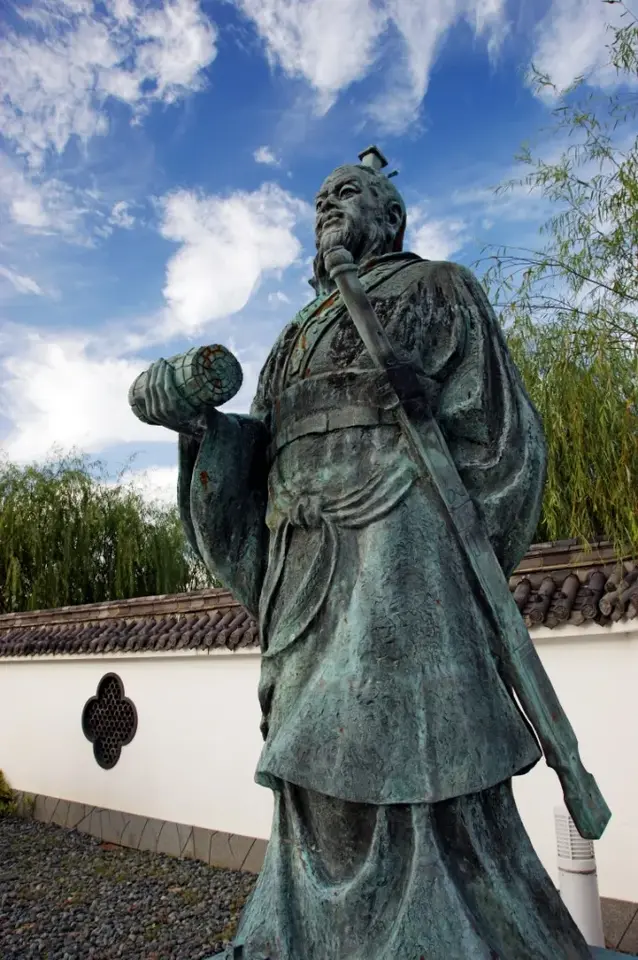
Life and Career
Noble Lineage in Qi and Seclusion at Mount Qionglong
Sun Wu was born around 545 BC in Le'an in the State of Qi. His lineage traced to Chen Wan (Tian Wan), a prince of the State of Chen who had sought sanctuary in Qi centuries earlier. His grandfather, Tian Shu, served as a general under Duke Jing of Qi; in recognition of his conquest of the state of Ju, the duke granted him estates at Le'an and conferred the hereditary surname Sun. Growing up in a prominent military household, Sun Wu received rigorous instruction in chariot tactics, bronze metallurgy, astronomical calculation, and classical treatises.
In the late sixth century BC, civil war fractured the State of Qi as the aristocratic lineages of Guo, Gao, Bao, and Yan engaged in purges against the ascendant Tian clan. Disillusioned by selfish aristocratic power struggles, Sun Wu renounced his feudal entitlements in 517 BC, leading his family south across the Yangtze River into the emerging southern kingdom of Wu.
Reaching Wu, Sun Wu chose not to solicit royal favors immediately, instead constructing a hermitage beneath Mount Qionglong, situated ten miles west of the capital of Gusu (modern Suzhou). Living as an agrarian recluse, he spent years studying regional marsh topography and observing the geopolitical struggles between Wu, Chu, and Yue. Synthesizing the historical lessons of over two hundred major battles from antiquity, he systematically formulated his military doctrines, writing the thirteen chapters of The Art of War: Initial Estimations, Waging War, Planning Offensives, Military Dispositions, Strategic Advantage, Emptiness and Fullness, Military Maneuver, Nine Variations, Moving the Army, Terrain, Nine Terrains, Attack by Fire, and Use of Spies.
The Concubines Drill and Royal Commission
In 515 BC, Prince Guang assassinated King Liao, ascending the throne as King Helu. Dedicated to regional hegemony, Helu welcomed talented foreign strategists, elevating Chu refugee Wu Zixu to chief counselor. Wu Zixu recognized Sun Wu strategic genius, submitting seven separate memorials urging the king to consult him.
King Helu summoned Sun Wu to the palace, reading the thirteen chapters with profound admiration. To test the practical application of his theoretical principles, Helu asked: "Can your principles be demonstrated through a minor drill? Can women be drilled?" Sun Wu replied: "They can."
Helu assembled one hundred and eighty palace concubines, placing his two favorite consorts as captains of two companies. Armed with shields and halberds, the concubines giggled when Sun Wu articulated drill orders. Sun Wu explained the commands patiently, stating: "If instructions are unclear, it is the general fault." When the drum sounded again, the concubines burst into laughter once more. Sun Wu said: "When instructions have been made clear yet orders are disobeyed, it is the fault of the officers." He ordered the immediate decapitation of the two royal favorites.
Horrified, Helu sent messengers pleading: "Without these two consorts, my food will have no flavor; I pray the general spare them!" Sun Wu replied firmly: "Having received royal commission as general in the field, there are imperial commands I cannot accept!" He executed the two favorites before the ranks. When the drum sounded again, the remaining concubines executed every maneuver in absolute silence with flawless precision. Convinced of his unbending authority, Helu confirmed Sun Wu as Senior General commanding the armed forces of Wu.
The Boju Campaign and the Capture of Ying
Over subsequent years, Sun Wu and Wu Zixu reorganized the military institutions of Wu, training combined infantry and amphibious formations. Facing the massive territorial empire of Chu, Sun Wu pursued an attrition strategy: dividing the army into three rotating columns, he launched incessant border raids that exhausted Chu military reserves over six years.
In 506 BC, Chu Chief Minister Nang Wa attacked the small allied state of Cai. Seizing the opening, Sun Wu persuaded Helu to mobilize the full national host. Leading thirty thousand elite troops, Sun Wu moved upstream along the Huai River, unexpectedly abandoned his naval transports, and marched on foot across the Dabie Mountains, emerging in the Chu heartland along the Han River.
Chu mobilized two hundred thousand troops under Nang Wa at Boju. Facing overwhelming odds, Sun Wu observed that the Chu coalition was divided by distrust. On November 18, 506 BC, Sun Wu launched the King brother Fugai in a ferocious assault against Nang Wa vanguard, throwing the Chu center into panic. Sun Wu committed his main force, winning five consecutive battles in rapid succession and destroying the Chu grand army.
Chu King Zhao fled into the wilderness. On November 28, Sun Wu led his troops into the Chu capital of Ying. The conquest of a continental superpower by thirty thousand amphibious troops stood as an unmatched military masterpiece, elevating King Helu to sovereign hegemony across China.
Strategic Retirement and Philosophical Legacy
Following the fall of Ying, King Helu became corrupted by triumph, indulging in territorial plunder and ignoring the growing threat posed by Yue in the rear. Recognizing that Helu was a sovereign with whom one could share hardship but not peace, and discerning the cosmological truth that zenith inevitably brings decline, Sun Wu resolved to retire.
Refusing land patents and ministerial titles, Sun Wu departed the court in quiet anonymity, living his remaining years in philosophical seclusion.
Sun Wu immortal legacy rests upon The Art of War. Comprising barely six thousand Chinese characters, it transcends tactical manual to articulate a holistic philosophy of conflict: "To know the enemy and know yourself guarantees victory in a hundred battles," "All warfare is based on deception," and "To subdue the enemy without fighting is the acme of skill." Translated into Latin, French, English, and dozens of modern languages, Sun Wu thoughts continue to guide generals, statesmen, and corporate leaders worldwide, securing his status as the eternal Sage of Martial Arts.