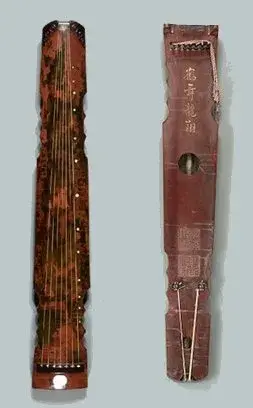
Life Story
Commoner Musician of Yongjia and Life in the Capital
Guo Mian was born into a commoner family in Yongjia County, Wenzhou. Throughout his life, he never sought an official career through the imperial examinations, dedicating his entire existence to the art of the guqin and traditional modal music. Gifted with quiet discernment and profound musical sensitivity, he visited prominent masters across southern China during his youth, synthesizing various regional techniques. He not only mastered virtuosic plucking, stopping, and vibrato methods, but thoroughly understood the subtle spiritual resonance of ancient modal tunings. During the Qingyuan and Jiatai eras (1195–1204), his serene, expressive style won widespread acclaim throughout Jiangnan. Leading masters such as Mao Xun, Xu Yu, and Vice Minister of Rites Yang Zuan regarded him as the foremost living authority on the guqin.
Around 1201, Guo Mian arrived in the southern capital of Lin'an (modern Hangzhou). Official Zhang Yan, a Grand Master for Splendid Happiness with an ardent passion for the guqin, had long admired Guo Mian's reputation. Zhang Yan welcomed him into his residence as an honored literati guest. In Zhang Yan's household, Guo Mian not only instructed scholar-officials in the subtle tablatures of timeless classics such as Crows Crying at Night, but gained unfettered access to Zhang's extensive library of rare musical manuscripts, elevating his artistic vision to full maturity.
Compiling the Qin Tablatures and the Kaixi Upheaval
While residing in the capital, Guo Mian accomplished a rescue of ancient musical heritage that proved monumental for Chinese musical history. Prime Minister Han Tuozhou, a direct descendant of Northern Song Chancellor Han Qi, held in his family archives an immense collection of ancestral guqin scores dating from the Tang and Northern Song imperial courts. As a close associate and relative of Han Tuozhou, Zhang Yan obtained permission to inspect these priceless records and entrusted Guo Mian with their thorough collation.
Over several years of painstaking labor, Guo Mian examined and corrected flawed notations, surveyed surviving melodies circulating among commoners, and systematized them in accordance with classical pentatonic modes. Together with Zhang Yan, he compiled the comprehensive fifteen-volume Handbook of Qin Melodies (also known as Qin Cao Pu). This compilation preserved ancient melodies dating from the Han, Wei, and Six Dynasties, becoming the fundamental source for later masterpieces such as Zhu Quan's Mysterious and Secret Handbook and the Zixiadong Qin Handbook. However, in the eleventh month of 1207, Han Tuozhou was assassinated following the failure of the northern expedition, and Zhang Yan was forced into retirement. Distressed by court factionalism and the dimming hope of national restoration, Guo Mian severed his ties with capital life and headed south into voluntary exile.
Grief on the Xiao and Xiang Rivers and Clouds over Water
Departing from Lin'an, Guo Mian traveled to the southern province of Hunan, finding refuge in Hengzhou (modern Hengyang) and the vicinity of Mount Heng. This period coincided with fierce warfare between northern Mongol forces and the Jin dynasty, which increasingly threatened the borders of the Southern Song. Guo Mian frequently drifted in a small skiff along the waters of the Xiao and Xiang rivers.
While navigating the river near Lingling, Guo Mian looked south toward Mount Jiuyi, whose peaks lay obscured by heavy mists and surging river clouds. Legend held that the sage Emperor Shun was buried at Mount Jiuyi, while north of the Yangtze, the ancestral territories of the Central Plains lay ravaged under foreign occupation. Stricken by sorrow over the fractured realm, Guo Mian channeled his grief and patriotic indignation into his zither. Floating upon the water, he composed the immortal classic Clouds over the Xiao and Xiang Rivers. The composition employed dynamic sliding tones and shifting harmonics to depict turbulent billows and swirling mist, expressing the agony of an exiled patriot and raising the expressive capabilities of Chinese instrumental music to an unprecedented zenith. In this fertile creative period, he also composed celebrated works including Autumn Swan, Cry of the Flying Birds, Floating on the Green Waves, and Spring Rain.
Founding the Zhe School and Enduring Musical Legacy
In his later years, Guo Mian returned to travel between eastern Zhejiang and Hunan, dedicating himself to educating a new generation of musicians. Breaking away from the restrictive secrecy typical of ancient musical guilds, he openly shared his compositions and restored tablatures with young scholars. His most brilliant disciple, fellow Yongjia native Liu Zhifang, mastered his complete repertoire and philosophical approach.
Liu Zhifang subsequently disseminated Guo Mian's artistic methods across Jiangnan, transmitting the tradition to Xu Tianmin and Mao Minzhong. Xu Tianmin established the celebrated Xu family lineage of the Zhe School, which produced four successive generations of national virtuosos. Mao Minzhong inherited Guo Mian's patriotic ethos, composing enduring pieces such as Song of the Recluse and Song of the Fisherman during the Song-Yuan transition. The musical aesthetics pioneered by Guo Mian—characterized by serene clarity balanced with deep emotional gravitas—defined the foundational canon of the Zhe School of Guqin. Guo Mian passed away in quiet retirement, but his compositions remain the bedrock of the classical guqin tradition.
Major Achievements
Founding the Zhe School of Guqin and Establishing Musical Paradigms
Guo Mian's most enduring accomplishment was the creation of the Zhe School of Guqin, which became the dominant aesthetic force in Chinese zither music for centuries. Prior to his work, Song dynasty qin playing lacked a unified stylistic school. Guo Mian synthesized the refined sensibility of Jiangnan literati with solemn, dignified patriotic expression, formulating a coherent system emphasizing fluid fingering, rounded tone quality, subtle dynamic contrast, and profound spiritual depth. Through his successors Liu Zhifang, the four generations of the Xu family, and Mao Minzhong, the Zhe School dominated the music of the Yuan and Ming dynasties, with major Ming anthologies such as the Mysterious and Secret Handbook and the Grand Collection of Qin Writings deriving directly from his tradition.
Rescuing Ancient Qin Literature from the Han Family Archives
During his stay in Lin'an, Guo Mian undertook a critical preservation effort by editing the inherited library of Grand Chancellor Han Tuozhou in collaboration with Zhang Yan. He standardized antiquated lettered notations, resolved complex melodic variants, and assembled the fifteen-volume Handbook of Qin Melodies. This monumental undertaking rescued dozens of ancient melodies from antiquity, including Crows Crying at Night and Ancient Resentment. His work directly inspired Yang Zuan's Zixiadong Qin Handbook and served as the foundational source material for the earliest extant printed collection, the Mysterious and Secret Handbook of 1425, securing an irreplaceable place in Chinese musicology.
Composing Clouds over the Xiao and Xiang Rivers as a Timeless Masterpiece
Guo Mian's composition Clouds over the Xiao and Xiang Rivers is universally recognized as one of the supreme summits of traditional Chinese instrumental composition. Breaking free from the structural confines of brief lyrical pieces, the work exhibits a multi-movement architectural scale with intricate development. By utilizing sliding tones and tremolo techniques to simulate cascading water and surging mist, the music evokes the melancholy of a patriot lamenting his divided country. Celebrated as one of the Ten Great Ancient Qin Melodies of China, it remains an iconic masterpiece representing the guqin art recognized on UNESCO's Representative List of the Intangible Cultural Heritage of Humanity.
Expressing Patriotic Integrity through Instrumental Artistry
Amid the existential crisis of the Song-Mongol conflict, Guo Mian transformed the zither into a medium of moral resistance. Beyond Clouds over the Xiao and Xiang Rivers, his composition Autumn Swan used the metaphor of a soaring wild swan evading hunters' arrows to symbolize the steadfast integrity of Song loyalists refusing subservience to conquering regimes. Similarly, Floating on the Green Waves and Cry of the Flying Birds gave voice to a yearning for pristine seclusion and uncompromised ethnic dignity. Living his life in principled poverty without serving two dynasties, Guo Mian established the supreme ideal that music must carry the moral Dao and reflect the soul of the literati.