Birth in Zhongdu
Born on April 18 in Zhongdu as the eldest concubine-born son of Crown Prince Wanyan Yungong.
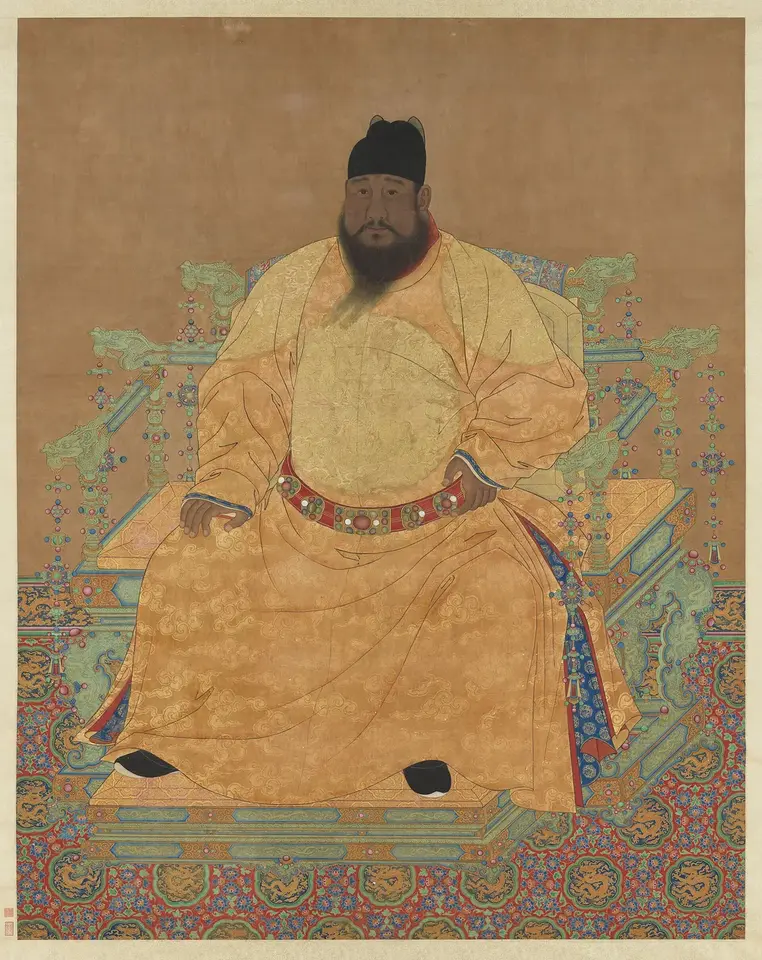
完颜珣
Emperor Xuanzong of Jin (金宣宗, April 18, 1163–January 14, 1224), personal name Wanyan Xun and Jurchen name Wudubu, was the eighth monarch of the Jurchen Jin dynasty, reigning from 1213 until his death in 1224. The eldest illegitimate grandson of Emperor Shizong and son of Crown Prince Wanyan Yungong, he lived prudently as a regional imperial prince before being placed upon the throne in 1213 following the assassination of…
Emperor Xuanzong of Jin (金宣宗, April 18, 1163–January 14, 1224), personal name Wanyan Xun and Jurchen name Wudubu, was the eighth monarch of the Jurchen Jin dynasty, reigning from 1213 until his death in 1224. The eldest illegitimate grandson of Emperor Shizong and son of Crown Prince Wanyan Yungong, he lived prudently as a regional imperial prince before being placed upon the throne in 1213 following the assassination of Prince Weishaowang by mutinous general Hushahu amidst the Mongol siege of Zhongdu (modern Beijing). Facing intense military pressure from Genghis Khan, Xuanzong made the catastrophic decision in May 1214 to abandon the northern capital of Zhongdu and relocate the court south to Nanjing (modern Kaifeng, Henan). This strategic abandonment provoked widespread revolt across Hebei and Shanxi, culminating in the fall of Zhongdu to the Mongols in 1215 and the permanent loss of all Jin territories north of the Yellow River. Hemmed in south of the river, Xuanzong adopted the reckless grand strategy of "compensating in the south for losses in the north," launching a destructive seven-year invasion against the Southern Song dynasty in 1217. The war exhausted the last elite Jurchen armies without securing territorial gains, while driving Southern Song into an alliance with the Mongol Empire. Trapped between Mongol incursions from the north, Song counteroffensives from the south, and Western Xia harassment from the west, Xuanzong died in Kaifeng in January 1224 at the age of sixty-one, leaving a dying state to his son, Emperor Aizong.
Born on April 18 in Zhongdu as the eldest concubine-born son of Crown Prince Wanyan Yungong.
Ennobled as Duke of Wen and later Prince of Sheng following the accession of his legitimate brother Zhangzong.
Appointed Commander of the Zhongdu Garrison and Prefect of Daxing, overseeing capital defense forces.
Assigned to administer Zhangde Prefecture in northern Henan following the accession of Prince Weishaowang.
Installed upon the throne in Zhongdu after general Hushahu murdered Prince Weishaowang; changed era to Zhenyou.
Concluded a humiliating peace with Genghis Khan and hastily relocated the capital south to Kaifeng.
Zhongdu fell to Mongol general Muqali, precipitating the total collapse of Jin governance north of the Yellow River.
Instigated by Shuhu Gaoqi, declared war on Southern Song to conquer territory, sparking seven years of warfare.
Jin armies suffered devastating casualties against Song commanders Meng Zongzheng and Zhao Fang along the Huai River.
Ennobled nine prominent northern Han militia leaders as hereditary dukes along the Yellow River to resist Muqali.
Issued an imperial edict terminating hostilities against Southern Song after national resources were exhausted.
Passed away on January 14 in Ningde Palace at Kaifeng at age sixty-one; succeeded by Emperor Aizong.
Wanyan Xun was born in 1163 during the Dading era of Emperor Shizong. Although his father, Wanyan Yungong, was the revered crown prince, Wanyan Xun was born to a low-ranking concubine, Lady Liu. Following Yungong's premature death, Emperor Shizong observed strict primogeniture by designating Yungong's legitimate son Wanyan Jing (the future Emperor Zhangzong) as imperial grandson and heir apparent. Throughout his youth, Wanyan Xun was treated with reserve, successively ennobled as Duke of Wen, Prince of Xing, and Prince of Sheng.
Endowed with a naturally suspicious, reserved demeanor, Wanyan Xun recognized his delicate position within the imperial lineage, maintaining meticulous obedience toward Emperor Zhangzong. He served quietly as Military Commissioner of Baoda and Prefect of Daming. In 1208, when his uncle Prince Weishaowang (Wanyan Yongji) took the throne, Wanyan Xun was dispatched to govern Zhangde Prefecture in northern Henan, sheltering him from the turbulent factional struggles in the capital.
In the autumn of 1213, Genghis Khan unleashed a three-pronged Mongol invasion across the North China plain, trapping the Jin capital at Zhongdu. General Hushahu (Heshelie Zhizhong), retreating in disgrace from northern frontier disasters and dreading court punishment, staged a bloody palace insurrection on September 11, murdering Prince Weishaowang. Believing Wanyan Xun to be pliable and compliant, Hushahu sent couriers with the imperial seals to fetch the fifty-one-year-old prince from Zhangde. On September 22, 1213, Wanyan Xun ascended the throne in the Da'an Palace in Zhongdu, initiating the Zhenyou era as Emperor Xuanzong. Shortly thereafter, subordinate commander Shuhu Gaoqi assassinated Hushahu in another violent coup, receiving an imperial pardon from Xuanzong and assuming supreme control of the military council.
Upon Xuanzong's accession, Zhongdu was surrounded by Mongol cavalry, and the capital faced starvation. In March 1214, facing imminent defeat, Xuanzong sent envoys to Genghis Khan pleading for terms, offering Princess Qiguo, five hundred royal youths, three thousand warhorses, and enormous tributes of gold and silk. In return, the Mongol forces withdrew beyond Juyong Pass to the northern steppe.
However, the retreat of the Mongol army left Xuanzong consumed by terror. Convinced that Zhongdu was indefensible due to the loss of natural mountain bastions, Xuanzong proposed moving the imperial court south to Nanjing (Kaifeng), protected behind the barrier of the Yellow River. Grand Councilor Tushan Yi and capital commanders adamantly objected: "Zhongdu has served as the sacred dynastic foundation for generations! If the court flees south, millions of subjects across Hebei will feel abandoned, and the regions north of the Yellow River will disintegrate immediately!"
Ignoring these warnings, Xuanzong abandoned his capital on June 27, 1214, leaving Crown Prince Wanyan Shouzhong behind and marching south with his imperial retinue and thirty thousand elite guards. This flight shattered the morale of northern forces. Along the retreat, Khitan cavalry escorts mutinied and defected to the Mongols. Interpreting the flight to Kaifeng as an act of bad faith, Genghis Khan dispatched Muqali to resume the siege. In May 1215, Zhongdu commander Wanyan Chenghui committed suicide, and Mongol forces sacked the magnificent capital, destroying its palaces and archives. The southern relocation cost the Jin dynasty all territories north of the Yellow River, reducing the once-vast empire to an isolated enclave in Henan and Shaanxi.
Having fled to Kaifeng, Xuanzong faced immediate financial bankruptcy. The loss of the North China plains stripped the court of agrarian tax revenues, while tens of thousands of relocated Jurchen banners and refugees demanded grain. Rather than seeking peace, Xuanzong accepted the reckless counsel of Chief Military Commissioner Shuhu Gaoqi, adopting the grand strategy of "compensating in the south for losses in the north." Xuanzong calculated that while Jin troops struggled against Mongol mobile cavalry, their heavy cavalry could easily overrun the agrarian borderlands of the Southern Song dynasty across the Huai River and Xiangyang.
In April 1217, using the Southern Song's suspension of annual tribute payments as a pretext, Xuanzong declared war on Southern Song, launching massive armies across the Huai and Han rivers. This unprovoked aggression provoked fierce patriotic resistance. Emperor Ningzong of Song terminated all diplomatic ties, ordering general mobilization. Over the next seven years, the Jin military fought brutal attritional campaigns around Zhenzhou, Yangzhou, Xiangyang, and Zaoyang. Song commanders Meng Zongzheng and Zhao Fang utilized dense river networks and repeating crossbows to inflict crushing defeats upon Jurchen assaults. The invasion achieved zero permanent territorial conquest, while squandering hundreds of thousands of veteran Jurchen troops who were desperately needed to defend the Yellow River line against the Mongols.
Concurrently, local Han Chinese in Shandong and Hebei organized autonomous "Red Coat" insurgencies under Yang An'er and Li Quan. Unable to send imperial relief, Xuanzong instituted the "Nine Dukes of the Yellow River" in 1220, granting hereditary ducal titles and independent fiscal powers to local Han warlords. However, Mongol commander Muqali systematically defeated or assimilated these warlords. Simultaneously, the Western Xia attacked Shaanxi and Gansu. Xuanzong found his battered realm engulfed in a three-front war against Mongols to the north, Song to the south, and Western Xia to the west.
As military catastrophes multiplied, Xuanzong's natural paranoia deepened. In November 1219, alarmed that the autocratic Shuhu Gaoqi was plotting a regicide coup, Xuanzong arranged an imperial ambush in Kaifeng Palace, executing Shuhu Gaoqi and purging his faction. Although this restored direct monarchical control, it came far too late to reverse the structural disintegration of the empire.
By 1223, the treasury was empty, the populace was reduced to starvation, and the army was depleted. Forced to recognize reality, Xuanzong issued an imperial edict terminating the war against Southern Song and seeking reconciliation with Western Xia. However, the damage was irrevocable: the Southern Song court had permanently resolved to ally with the Mongol Empire to extinguish the Jurchen regime.
In the freezing winter of 1223, the sixty-one-year-old monarch fell fatally ill in the Ningde Palace at Kaifeng. On January 14, 1224, surrounded by looming Mongol columns along the Yellow River, Xuanzong died in despair at the age of sixty-one. He was interred at Deling Mausoleum near Kaifeng and received the temple name Xuanzong. His third son, Wanyan Shouxu, ascended the throne as Emperor Aizong, doomed to preside over the total annihilation of the Jin dynasty a decade later.
Xuanzong's decision in 1214 to abandon the northern capital of Zhongdu stands as one of the most disastrous strategic errors in Chinese military history. By retreating south across the Yellow River, he surrendered the geographical buffer of the Taihang Mountains and Juyong Pass, creating a fatal power vacuum in the northern heartland. The abandonment destroyed the loyalty of millions of northern Han subjects, precipitated the sack of Zhongdu in 1215, and confined the Jin state within a narrow, defenseless enclave in Henan, setting the stage for total dynastic collapse.
Xuanzong's adoption of the "compensating in the south for losses in the north" strategy remains his most catastrophic policy failure. Initiating an unprovoked seven-year war against Southern Song in 1217, he squandered the empire's remaining veteran armies in the muddy trenches of the Huai River and Xiangyang. The conflict inflicted immense suffering upon the civilian population of Central China and destroyed any prospect of a defensive northern alliance between Song and Jin, driving Southern Song directly into an alliance with the Mongols that doomed the Jin dynasty.
In a desperate bid to preserve northern control following the loss of central army corps, Xuanzong promulgated an unprecedented feudal measure in 1220 by creating the "Nine Dukes of the Yellow River." He granted supreme hereditary regional titles, local tax retention rights, and independent military commissions to nine powerful northern Han militia commanders, including Wang Fu, Wu Xian, and Yila Zhongjianu. While this decentralized initiative temporarily delayed the Mongol southern advance, the lack of imperial coordination and financial aid caused the Nine Dukes to collapse under Muqali's pressure.
Within internal court politics, Xuanzong exhibited considerable tactical cunning. Having attained the throne through military mutiny, he navigated the overbearing dominance of warlord Hushahu and later Prime Minister Shuhu Gaoqi. In 1219, when Shuhu Gaoqi's arrogance threatened the throne, Xuanzong orchestrated a decisive palace ambush, executing the prime minister and dismantling his corrupt patronage network. This ruthless purge restored imperial authority over central government organs during the dynasty's final decade.
FIGURES ASSOCIATED WITH THIS DYNASTY