Serving the Court
Active in Chang'an court painting circles, serving as Administrator of the Right Guard.
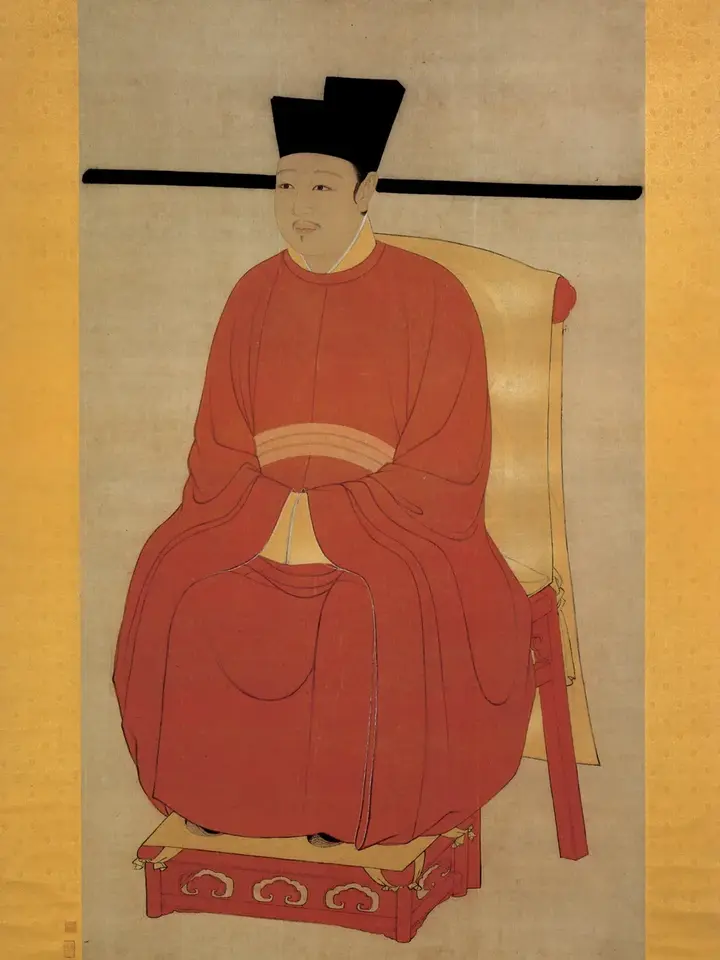
边鸾
Bian Luan (边鸾, dates unknown), a native of Chang'an in Jingzhao, was an eminent court painter of the mid-Tang Dynasty and a pioneering founding master of traditional Chinese flower-and-bird painting. Serving the imperial court as Administrator of the Right Guard, he dedicated his career to capturing flowers, birds, insects, and vegetation. Classical art chronicles praised his technique, noting that his brushwork was deft and…
Bian Luan (边鸾, dates unknown), a native of Chang'an in Jingzhao, was an eminent court painter of the mid-Tang Dynasty and a pioneering founding master of traditional Chinese flower-and-bird painting. Serving the imperial court as Administrator of the Right Guard, he dedicated his career to capturing flowers, birds, insects, and vegetation. Classical art chronicles praised his technique, noting that his brushwork was deft and lively, his coloring radiant and luminous, capturing the endless transformations of plumage and the blooming splendor of spring flora. He pioneered the broken-branch method, which focused closely on severed flowering branches rather than whole trees, liberating floral painting from its secondary status as background decoration for portraiture and landscapes and establishing it as an autonomous genre. During the Zhenyuan era, when the kingdom of Silla presented a pair of dancing peacocks, Emperor Dezong of Tang summoned Bian Luan to Xuanwu Gate to paint them from life; his dynamic depiction of one peacock facing forward and the other turned back, shimmering with emerald luster and golden highlights, won imperial acclaim. In his later years, he wandered through Ze and Lu Commanderies in poverty, continuing to teach students. Art critic Zhu Jingxuan ranked his work as Marvelous Class Upper, while Zhang Yanyuan praised him as the foremost painter of flowers and birds of his era.
Active in Chang'an court painting circles, serving as Administrator of the Right Guard.
Pioneered the broken-branch floral technique, winning high acclaim for his vibrant color application.
Summoned by Emperor Dezong to portray tribute dancing peacocks presented by Silla, producing an acclaimed masterpiece.
Due to regional instability, wandered through Ze and Lu Commanderies, painting the famous five-ginseng root mural.
Instructed disciples in northern garrisons; the date and place of his death remain unrecorded.
Bian Luan was born in the metropolitan heartland of Chang'an, capital of the Tang Dynasty, coming of age within the flourishing artistic culture of the imperial capital. Possessing natural talent and an observant eye for nature, he demonstrated early mastery in the pictorial arts. He entered imperial service, rising to the military post of Administrator of the Right Guard, where he supervised palace guard records, while dedicating his leisure hours to painting.
During the early and High Tang periods, pictorial art was dominated by narrative figure painting and equestrian subjects, with masters such as Yan Liben and Wu Daozi focusing on Buddhist murals, imperial portraits, and battle triumphs. Plants and birds were generally relegated to background roles in garden scenes or palace courtyards, lacking independent thematic standing. Bian Luan resolved to specialize exclusively in the natural beauty of avian and botanical life. He studied rare birds in imperial aviaries and spent extended periods in suburban meadows and forested valleys, mastering the skeletal structure, plumage patterns, and seasonal rhythms of blossoms. Through observational rigor and fluid brushwork, he emerged as the foremost flower-and-bird specialist in Chang'an.
Bian Luan's primary technical breakthrough was his formulation of the broken-branch composition. Prior to his innovations, painters depicted trees and plants in their entirety from roots to canopy, which often cluttered the picture plane with redundant trunks and distracted from the delicate textures of individual blossoms. Bian Luan discarded this panoramic convention, choosing instead to crop and frame a single branch bearing buds, blossoms, and leaves.
This novel close-up perspective allowed him to focus intimately on the delicate pistils, opening petals, and twisting leaves ruffled by gentle breezes. His brushwork was characterized by crisp, agile linework, while his mineral colors—vermilion, azurite, malachite, and gamboge—were applied with layered luminosity, combining royal opulence with natural vibrancy. Around these blossoming sprays, Bian Luan positioned hovering bees, fluttering butterflies, cicadas, and singing sparrows, establishing the aesthetic ideal of capturing the fleeting vitality of spring nature within a concentrated frame.
During the Zhenyuan era, Bian Luan's artistic reputation reached its zenith under Emperor Dezong of Tang. Silla, a tributary state in the Korean peninsula, dispatched an embassy to present a pair of dancing peacocks renowned for their iridescent beauty and ability to rhythmically fan their plumage to court music. Delighted by this auspicious omen, Emperor Dezong ordered the empire's finest artists to capture their likeness for the palace archives.
Emperor Dezong summoned Administrator Bian Luan to the strategic northern portal of Xuanwu Gate to execute the portrait from life. Bian Luan set up his easel and painted with swift, confident strokes, adopting a dynamic compositional pairing rather than a static parallel display: one peacock was depicted proudly facing forward with its full tail fan displayed, while the other was shown in three-quarters profile glancing back. Layering malachite green pigments with powdered gold leaf, he reproduced the metallic iridescence of the birds' plumage, rendering individual barbules with photographic precision. The finished work conveyed such lifelike animation that courtiers marveled that the birds appeared about to utter musical cries. Emperor Dezong praised the work warmly, cementing Bian Luan's preeminence within the palace painting academy.
During the late Zhenyuan era, regional warlord mutinies and political turbulence disrupted life in the capital, prompting Bian Luan to leave Chang'an and wander through the northern border prefectures of Ze and Lu (modern Changzhi and Jincheng in Shanxi). In his twilight years, his financial circumstances deteriorated severely, plunging him into poverty. Yet even amidst hardship, he pursued his art with undiminished devotion, executing commissions for local Buddhist shrines and gentry halls.
While residing in Ze Commandery, Bian Luan observed five wild ginseng roots that had grown intertwined in natural complexity. Fascinated by their organic harmony, he produced the celebrated Five Intertwined Ginseng Roots, a work praised by contemporary connoisseurs for its exquisite realism. In northern exile, he trained promising students, including his relative Bian Lu, Liang Guang, and Chen Shu, ensuring that his refined methods survived the collapse of the Tang Dynasty. Although the exact time and circumstances of his death are unrecorded, his aesthetic innovations shaped the evolution of Chinese painting through the Five Dynasties and Song periods.
Bian Luan's historic contribution to Chinese art was his successful emancipation of flower-and-bird painting from its traditional subservience to figure painting and landscape scenery. Before his emergence, early masters such as Cao Buxing and Gu Kaizhi had included floral motifs, but exclusively as symbolic ornaments or spatial fillers.
Bian Luan devoted his career to exploring the spiritual vitality and visual beauty of flora and fauna as self-sufficient aesthetic subjects. He established systematic canons for composition, line drawing, color layering, and atmospheric mood. Following his path, subsequent artists of the late Tang and Five Dynasties, notably Huang Quan and Xu Xi, expanded the genre into the twin orthodoxies of courtly richness and scholarly detachment. When the imperial Xuanhe Painting Manual codified painting into ten distinct genres during the Northern Song, flower-and-bird painting stood as an autonomous discipline whose foundational methodology derived from Bian Luan.
Bian Luan's creation of the broken-branch compositional mode marked a revolutionary conceptual transformation in traditional Chinese spatial aesthetics. Discarding mechanical whole-plant representation, he employed the artistic technique of cropping a single flowering branch to evoke the boundless abundance of nature, embodying the classical Daoist principle that the subtle part implies the vast whole.
Technically, he forged a synthesis of fine-line gongbi contouring and luminous mineral washes. He wielded elastic, resilient iron-wire line work to define petals and feathers, applying translucent washes of malachite, azurite, and cochineal in fine layers. His stylistic triad of agile line, radiant color, and broken-branch poise remained the enduring standard across court academies and literati circles throughout the Song, Yuan, Ming, and Qing dynasties.
FIGURES ASSOCIATED WITH THIS DYNASTY