Birth in Xiangyang
Born into a local gentry family in Nan Commandery; his unpretentious appearance masked his profound strategic intellect during his early youth.
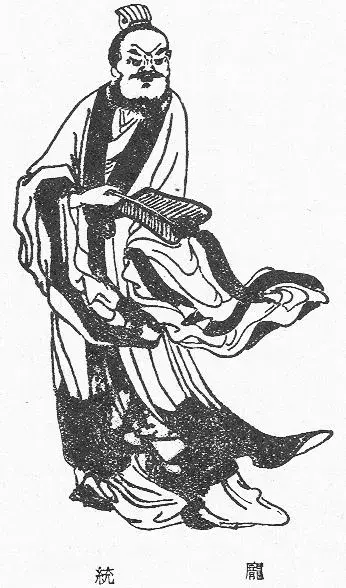
庞统
Pang Tong (179–214 CE), courtesy name Shiyuan and known by the sobriquet Fengchu (Fledgling Phoenix), was a native of Xiangyang County in Nan Commandery (modern Xiangyang, Hubei Province). A prominent strategist and statesman of the late Eastern Han dynasty, he was revered alongside Zhuge Liang as the primary intellectual pillar behind Liu Bei's enterprise to establish the state of Shu-Han. In his youth, Pang Tong maintained…
Pang Tong (179–214 CE), courtesy name Shiyuan and known by the sobriquet Fengchu (Fledgling Phoenix), was a native of Xiangyang County in Nan Commandery (modern Xiangyang, Hubei Province). A prominent strategist and statesman of the late Eastern Han dynasty, he was revered alongside Zhuge Liang as the primary intellectual pillar behind Liu Bei's enterprise to establish the state of Shu-Han. In his youth, Pang Tong maintained a plain, modest demeanor that eluded casual observers, until the esteemed scholar-critic Sima Hui recognized his deep talent and lauded him as the foremost scholar among the southern states. Following the Battle of Red Cliffs, Pang Tong initially served under the Eastern Wu general Zhou Yu, before entering the service of Liu Bei. Rising from the magistracy of Leiyang to Military Advisor and General of the Household, he became Liu Bei's principal military counselor. At a pivotal juncture in Liu Bei's political journey, Pang Tong provided far-reaching strategic vision. He urged Liu Bei to abandon over-reliance on the exposed and war-torn Jingzhou, advocating instead the conquest of the fertile and defensible Yizhou Basin under the pragmatic principle of seizing power through unorthodox means while maintaining governance through virtue. In 212 CE, Pang Tong accompanied Liu Bei on his westward campaign into Sichuan, presenting three strategic options at Fucheng that enabled Liu Bei to execute Gao Pei and Yang Huai, capture Baishui Pass, and advance toward Chengdu. In 214 CE, while directing the siege operations against the fortified stronghold of Luoxian, Pang Tong was fatally struck by a stray arrow and perished at the age of thirty-six. Liu Bei wept bitterly at his loss, posthumously granting him the title of Marquis of the Imperial Domain. In 260 CE, Emperor Liu Shan conferred upon him the posthumous title of Marquis Jing.
Born into a local gentry family in Nan Commandery; his unpretentious appearance masked his profound strategic intellect during his early youth.
Visited the renowned scholar Sima Hui in Yingchuan; after an exhaustive all-night discussion, Sima Hui acclaimed him as the crown of southern scholars, establishing his reputation.
Appointed Officer of Merit in Nan Commandery under Zhou Yu; upon Zhou Yu's death, escorted the funeral cortege to Eastern Wu and befriended leading Jiangdong luminaries.
Entered Liu Bei's administration as Magistrate of Leiyang; dismissed for neglecting routine administrative duties, but quickly reassigned after strong endorsements from Lu Su and Zhuge Liang.
Appointed Military Advisor and General of the Household alongside Zhuge Liang; articulated the grand strategy to conquer Yizhou and accompanied Liu Bei on the western campaign.
Formulated three operational plans to seize Yizhou; Liu Bei adopted the middle strategy, leading to the execution of Gao Pei and Yang Huai and the capture of strategic mountain passes.
Openly rebuked Liu Bei during a victory banquet in Fucheng for celebrating the conquest of a fraternal territory, demonstrating moral integrity.
Personally directed troops during the siege of Luoxian; fatally wounded by a stray arrow at age thirty-six, prompting deep mourning from Liu Bei, and posthumously honored as Marquis Jing in 260 CE.
Pang Tong was born in 179 CE in Xiangyang County, Nan Commandery, into a respected local lineage. In his early years, he was quiet, earnest, and completely devoid of ostentatious mannerisms. Casual acquaintances frequently misjudged him as slow-witted, and his extraordinary intellectual depth remained largely hidden from ordinary provincial society.
The notable exception was his uncle Pang Degong, an eminent hermit-scholar living south of Mount Xian. Renowned for his piercing insight into human character, Pang Degong held his nephew in the highest regard. He coined the sobriquets Wolong (Crouching Dragon) for Zhuge Liang, Shuijing (Water Mirror) for Sima Hui, and Fengchu (Fledgling Phoenix) for Pang Tong, laying the groundwork for Pang Tong's growing reputation among the intellectual elite of Jingzhou.
Around 198 CE, when Pang Tong was about twenty years old, he traveled to Yingchuan to seek an audience with Sima Hui. Sima Hui was gathering mulberry leaves in an orchard when Pang Tong arrived, and the two began conversing under the shade of the trees. The exchange continued uninterrupted from early morning until late into the night, covering statecraft, military strategy, classical texts, and contemporary political developments.
Deeply impressed by Pang Tong's keen perception and expansive intellect, Sima Hui marveled that Pang Degong's appraisal was entirely justified, formally designating Pang Tong as the crown of southern scholar-gentlemen. In an era where regional character evaluation determined career prospects, this endorsement catapulted Pang Tong into national prominence.
During this formative period, Pang Tong established enduring ties with talented contemporaries residing in Jingzhou, including Zhuge Liang, Xu Shu, Shi Tao, and Meng Jian. While Zhuge Liang frequently compared himself to ancient statesmen like Guan Zhong and Yue Yi, Pang Tong was characterized by his practical flexibility and profound strategic calculation, forming a complementary intellectual partnership.
In the aftermath of the pivotal Battle of Red Cliffs in 208 CE, the allied forces of Sun Quan and Liu Bei repelled the northern armies of Cao Cao. In 209 CE, Zhou Yu assumed concurrent duties as Administrator of Nan Commandery, headquartering his military command at Jiangling. Cognizant of Pang Tong's formidable reputation and thorough knowledge of local conditions, Zhou Yu recruited him as Officer of Merit (Gongcao).
In the administrative hierarchy of Han commanderies, the Officer of Merit oversaw official appointments, talent evaluation, and institutional governance. Pang Tong discharged his responsibilities with fairness and integrity, earning the genuine respect of both Zhou Yu and local scholars.
In 210 CE, while organizing an expedition to seize Yizhou, Zhou Yu died suddenly of illness at Baqiu. As a senior representative of Nan Commandery's administrative staff, Pang Tong personally accompanied the funeral procession back to Wu Commandery in Jiangdong. Learning of his arrival, prominent Jiangdong figures such as Lu Ji, Gu Shao, and Quan Cong gathered at Changting to converse with him.
Upon their departure, Pang Tong offered insightful critiques of each figure. He characterized Lu Ji as an enduring steed capable of carrying heavy burdens over vast distances, Gu Shao as a sturdy ox able to scale steep paths under immense weight, and Quan Cong as a generous and public-spirited patron akin to the late Han gentleman Fan Zizhao.
When questioned why his appraisals tended to emphasize virtues rather than shortcomings, Pang Tong explained that during times of widespread chaos, moral depravity flourished while upright men were scarce. Without generous encouragement and public acclaim for virtue, society could not be inspired toward moral regeneration. His lofty motivation won universal admiration from the intellectual elite of Jiangdong.
Following Zhou Yu's passing, Sun Quan leased southern Nan Commandery to Liu Bei in accordance with Lu Su's grand strategic vision. Liu Bei established his base in Jingzhou and incorporated former local officials into his administration. Unaware of the full extent of Pang Tong's strategic genius, Liu Bei assigned him to govern the minor outlying county of Leiyang (modern Leiyang, Hunan Province) as county magistrate.
Convinced that his talents were suited for overarching imperial strategy rather than clerical minutiae, Pang Tong neglected local administrative records and turned to wine. Consequently, Liu Bei removed him from his post for dereliction of duty.
Upon learning of this dismissal, the Eastern Wu military commander Lu Su wrote a passionate letter to Liu Bei, asserting that Pang Tong was not a minor talent meant to administer a small district of a hundred square li, but a premier statesman suited for top advisory councils. Simultaneously, Zhuge Liang vigorously recommended Pang Tong to Liu Bei, confirming his extraordinary caliber.
Liu Bei summoned Pang Tong for an extensive personal interview. During their discussions on imperial geopolitics and military campaigns, Pang Tong presented penetrating analyses that aligned perfectly with Liu Bei's ambitions. Profoundly remorseful for his initial negligence, Liu Bei offered a formal apology and appointed Pang Tong as Attendant Officer of the Central Section.
Shortly thereafter, Liu Bei promoted him to Military Advisor and General of the Household, placing him on equal footing with Zhuge Liang. The two shared central responsibility for military planning and grand strategy, and Liu Bei's trust in Pang Tong grew exceptionally close.
In 211 CE, the governor of Yizhou, Liu Zhang, grew alarmed by threats from Zhang Lu in Hanzhong. Persuaded by secret appeals from his advisors Zhang Song and Fa Zheng, Liu Zhang dispatched Fa Zheng to Jingzhou to invite Liu Bei into Sichuan to help defend against northern aggression. Liu Bei hesitated, fearing that taking advantage of a kinsman would damage his moral authority.
Pang Tong intervened with incisive geopolitical counsel, emphasizing that Jingzhou had suffered continuous devastation from civil warfare, had lost much of its population, and faced relentless pressure from Sun Quan in the east and Cao Cao in the north. He argued that it could not serve as a long-term foundation for supreme imperial authority.
By contrast, Pang Tong pointed out that the Yizhou Basin was naturally fortified, possessed hundreds of thousands of households, fertile agricultural soils, and abundant economic wealth. He declared that securing Yizhou was the only viable path to imperial dominance.
When Liu Bei expressed reservations about compromising his benevolent reputation, Pang Tong reasoned that extraordinary times required strategic flexibility. He maintained that absorbing weaker neighbors to build enduring strength was the proven method of ancient hegemons, and that after imperial victory was secured, Liu Zhang could be generously compensated with land and honors. Persuaded by this logic, Liu Bei left Zhuge Liang, Guan Yu, Zhang Fei, and Zhao Yun to safeguard Jingzhou, while he personally led an army into Sichuan with Pang Tong as his chief military advisor.
In 212 CE, Liu Bei established his headquarters at Jiameng Pass (modern Zhaohua District, Guangyuan, Sichuan). Relations between Liu Bei and Liu Zhang deteriorated rapidly as grain supplies dwindled and mutual suspicions escalated. Meanwhile, Cao Cao launched an attack against Sun Quan's positions at Ruxu, prompting Sun Quan to request urgent reinforcements from Liu Bei.
Recognizing that the stalemate was unsustainable, Pang Tong submitted three operational options to Liu Bei:
"The upper strategy: Select elite cavalry and infantry to make a secret, forced march night and day directly toward Chengdu. Liu Zhang is unprepared and indecisive; a sudden assault will capture him and take the provincial capital in a single stroke.
The middle strategy: Yang Huai and Gao Pei are Liu Zhang's trusted generals guarding the vital Baishui Pass with powerful garrisons. Learning of your purported departure for Jingzhou, they will come out to bid farewell. You can arrange an ambush, arrest and execute them, take control of their mountain passes and troops, and march south against Chengdu.
The lower strategy: Withdraw entirely to Baidicheng, unite with the forces in Jingzhou, and prepare an assault at a later date. To hesitate and linger at Jiameng is the most dangerous course."
Weighing the alternatives, Liu Bei deemed the upper strategy too reckless and the lower strategy too timid, ultimately adopting the middle strategy. In late 212 CE, Liu Bei announced his intention to return east. Gao Pei and Yang Huai came forward to offer farewells, intending to scout his positions.
Acting on Pang Tong's tactical plan, Liu Bei seized both generals, condemned them for sowing discord, and had them executed. Pang Tong assisted Liu Bei in assimilating their troops and securing the strategic supply stores at Baishui Pass. With the rear safeguarded, Liu Bei advanced rapidly, capturing Fucheng and sweeping toward the heart of Sichuan.
Following the capture of Fucheng, Liu Bei hosted an elaborate victory banquet for his officers and counselors. In a state of elation, Liu Bei turned to Pang Tong and exclaimed that the celebration was the finest joy of life. Pang Tong soberly countered that celebrating the conquest of another ruler's land with merrymaking was not the conduct of a truly benevolent army.
Stung by this public rebuke, an intoxicated Liu Bei reacted with anger, citing King Wu of Zhou's celebratory dancing after conquering the Shang dynasty, and ordered Pang Tong to leave the hall. Pang Tong bowed composedly and exited without protest.
Once sober, Liu Bei felt deep remorse for his harsh reaction and recalled Pang Tong to the banquet. Pang Tong resumed his seat naturally, eating and drinking without showing embarrassment or seeking favor. When Liu Bei asked who had been at fault during their earlier exchange, Pang Tong graciously replied that both lord and minister had erred: the lord in speaking inappropriately, and the minister in admonishing tactlessly. Delighted by this diplomatic reconciliation, Liu Bei restored their cordial rapport.
From late 213 CE to early 214 CE, Liu Bei laid siege to Luoxian (modern Guanghan, Sichuan), a vital northern defensive outpost shielding Chengdu. Liu Zhang's son Liu Xun mounted a fierce resistance, holding the fortress for nearly a full year.
In the summer of 214 CE, Pang Tong personally donned armor to direct the assault against the city ramparts, seeking to inspire the storming troops through personal bravery. During the intense fighting, he was struck in the chest by a sudden volley of arrows from the battlements, succumbing to his wounds at the age of thirty-six.
Liu Bei was inconsolable upon hearing of Pang Tong's demise, weeping openly before the funerary altar. Pang Tong was laid to rest at Luofengpo and granted the posthumous title of Marquis of the Imperial Domain. Whenever Liu Bei mentioned Pang Tong in later years, he wept with profound grief, mourning the loss of the brilliant mind that had secured Sichuan. In 260 CE, Emperor Liu Shan posthumously elevated him to Marquis Jing.
Pang Tong's early reputation stemmed from his exceptional discernment and modest temperament, which stood out amidst the superficial vanity of late Han gentry society. His extensive dialogue with Sima Hui under the mulberry trees demonstrated that true talent did not require flamboyance to achieve greatness.
Sima Hui's declaration that Pang Tong represented the crown of southern scholars dismantled provincial barriers, elevating his status to that of Zhuge Liang. This cultural prestige provided Liu Bei's fledgling faction with vital intellectual legitimacy when seeking to attract regional talent.
During his tenure as Officer of Merit in Nan Commandery and his journey to Eastern Wu, Pang Tong revealed profound understanding of administrative governance and personal character. His perceptive evaluations of figures such as Lu Ji, Gu Shao, and Quan Cong accurately foreshadowed their future historical achievements.
Moreover, his stated philosophy of using praise to inspire societal virtue during eras of moral collapse reflected an enlightened view of public responsibility. His diplomatic conduct fostered goodwill between the scholar-officials of Jingzhou and Jiangdong, laying a harmonious foundation for regional cooperation.
Pang Tong was the indispensable architect of Liu Bei's acquisition of Sichuan. While Zhuge Liang's Longzhong Plan envisioned the dual possession of Jingzhou and Yizhou, the tactical dilemma of when and how to seize Yizhou from a fellow member of the imperial clan remained unresolved until Pang Tong provided a coherent justification.
By explaining the doctrine of seizing opportunities through unorthodox tactics and maintaining order through benevolent rule, Pang Tong dismantled Liu Bei's moral hesitation. His formulation of the three strategies at Jiameng Pass ensured the rapid capture of Baishui Pass and Fucheng, securing the territorial foundation that enabled Liu Bei to proclaim the Han restoration and establish the Shu-Han dynasty.
Beyond military acumen, Pang Tong exemplified the moral fortitude of Confucian scholarship through his candid admonition of Liu Bei. At the Fucheng victory feast, he did not hesitate to risk royal disfavor to remind his leader of the ethical responsibilities of leadership and the sorrow inherent in conquest.
His composed demeanor following his dismissal, paired with his diplomatic resolution upon his return, balanced moral critique with political loyalty. This upright character cemented his enduring reputation as a premier scholar-advisor of late imperial antiquity.
FIGURES ASSOCIATED WITH THIS DYNASTY