Birth in Luling
Born into a scholar-gentry lineage in Luling, Jizhou, mastering classical canons and historical chronicles from childhood.
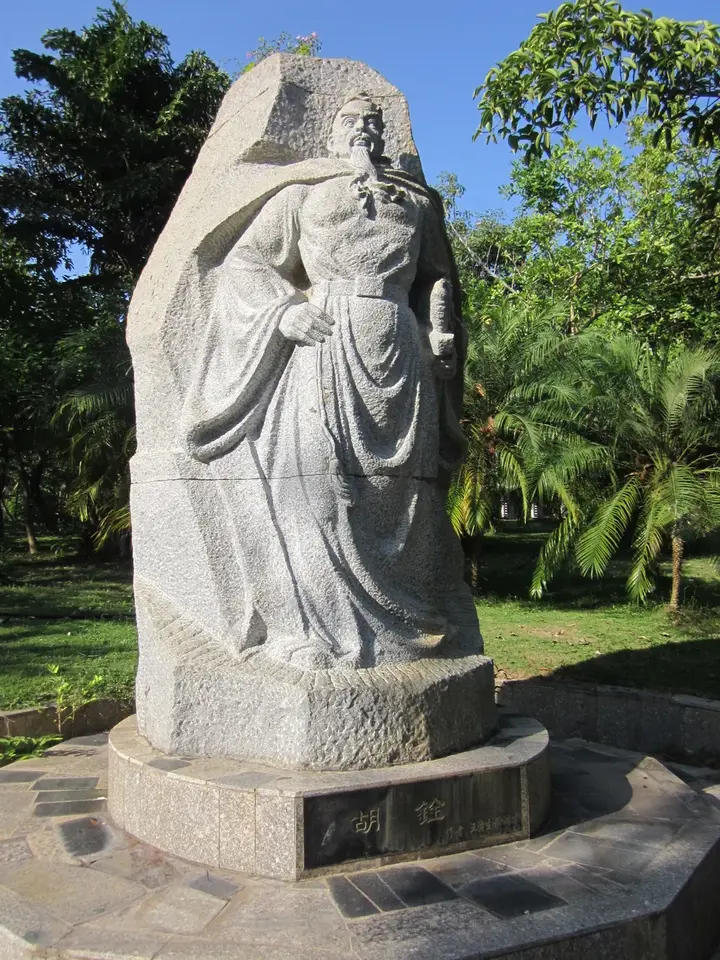
胡铨
Hu Quan (胡铨, 1102–1180), courtesy name Bangheng (邦衡), art name Dan'an (澹庵), was an eminent statesman, political thinker, staunch anti-Jin leader, and patriotic lyricist of the Southern Song dynasty, hailing from Luling in Jizhou (modern Qingyuan District, Ji'an, Jiangxi). Alongside Li Gang, Zhao Ding, and Li Guang, he was celebrated as one of the foremost unyielding pillars of the early Southern Song state. Achieving his…
Hu Quan (胡铨, 1102–1180), courtesy name Bangheng (邦衡), art name Dan'an (澹庵), was an eminent statesman, political thinker, staunch anti-Jin leader, and patriotic lyricist of the Southern Song dynasty, hailing from Luling in Jizhou (modern Qingyuan District, Ji'an, Jiangxi). Alongside Li Gang, Zhao Ding, and Li Guang, he was celebrated as one of the foremost unyielding pillars of the early Southern Song state. Achieving his Jinshi degree in 1128 through a brilliant ten-thousand-word examination essay that prioritized the welfare of the people over abstract heavenly mandates, he won immediate national acclaim for his unbending moral integrity. In 1138, during the humiliating peace negotiations orchestrated by Emperor Gaozong and Chancellor Qin Hui to surrender imperial sovereignty to the Jurchen Jin dynasty, Hu Quan, then serving as a compiler in the Bureau of Military Affairs, submitted his epoch-making memorial Sealed Memorial to Emperor Gaozong in the Wuwu Year. In thunderous prose, he demanded the public execution of Qin Hui, Wang Lun, and Sun Jin, famously declaring that he would rather drown himself in the Eastern Sea than live dishonorably under a subservient puppet court. This courageous act provoked fierce retaliation from Qin Hui, who stripped him of office and banished him to the tropical wilderness of southern China and Hainan Island for twenty-three years. Reinstated by Emperor Xiaozong in 1162, Hu Quan served as Vice Minister of War and Secretariat Drafter, personally leading troops with sledgehammers to smash river ice and defeating Jin invasion forces at Lake Sheyang. Retiring as Academician of the Zizheng Hall, he was posthumously granted Grand Master for Thorough Counsel and bestowed the posthumous name Zhongjian. His literary legacy, collected in the Collected Works of Dan'an, remains an enduring monument to Chinese patriotic literature.
Born into a scholar-gentry lineage in Luling, Jizhou, mastering classical canons and historical chronicles from childhood.
Passed the palace examination with an outspoken ten-thousand-word essay advocating governance for the people, placed fifth by intimidated examiners.
Recruited rural militia in Jiangxi to protect Empress Dowager Longyou against pursuing Jin cavalry, promoted to Gentleman for Good Faith.
Recommended for extraordinary moral integrity by Minister of War Lu Zhi, appointed Compiler in the Bureau of Military Affairs by Emperor Gaozong.
Submitted his famous memorial demanding the execution of Chancellor Qin Hui and fellow appeasers; the memorial circulated widely across China and the Jin empire.
Slandered by Qin Hui's henchman Luo Ruji, stripped of official titles, and placed under strict penal surveillance in Xinzhou, Guangdong.
Accused of composing subversive verses, banished to Jiyang Commandery on Hainan Island, where he continued lecturing and classical scholarship.
Transferred to Hengzhou following Qin Hui's death; formally released from surveillance and granted personal freedom in 1161.
Summoned to court by the newly enthroned Emperor Xiaozong, presenting four strategic pillars for national restoration, appointed Section Chief in the Ministry of Personnel.
Directed maritime and coastal defense in Huaidong, personally wielding a sledgehammer into freezing waters to lead troops and rout Jin forces at Lake Sheyang.
Served as Vice Minister of Works and Attendant in the Baowen Pavilion; Emperor Xiaozong awarded him the rare Rhinoceros-Horn Girdle of imperial honor.
Retired as Academician of the Zizheng Hall, dictating his dying memorial pledging to kill invaders even as a ghost, passed away in the fifth month at age seventy-eight.
Hu Quan was born in 1102 in Luling, Jizhou, into an established family of Confucian scholars. Possessing photographic memory and an unquenchable passion for classical texts, he devoted his early youth to mastering the Spring and Autumn Annals. Following the catastrophic Jingkang Incident of 1127, wherein Northern Song emperors Huizong and Qinzong were captured by the Jurchen Jin army and northern China was devastated, the young Hu Quan resolved to dedicate his life to resisting foreign aggression and restoring Chinese sovereignty.
In 1128, during the second year of the Jianyan era, Emperor Gaozong held the palace examination at the temporary imperial seat in Yangzhou, setting the examination topic: "The Dao of Governance is rooted in Heaven; the Dao of Heaven is rooted in the People." The twenty-seven-year-old Hu Quan drafted an outspoken ten-thousand-word policy paper. He wrote with fearless clarity: "Kings Tang and Wu arose by conforming to the hearts of the people, while tyrants Jie and Zhou perished despite claiming the mandate of Heaven. Today, Your Majesty resides amidst battlefield arrows, with barbarian invasions abroad and mutinies within; yet Your Majesty's questions inquire solely into abstract celestial portents while remaining deaf to the agony of the people!" He added that none of the reigning grand chancellors matched the stature of Fan Zhongyan or Han Qi. Emperor Gaozong was astonished by his boldness and intended to rank him first, but senior examiners, fearful of his biting candor, relegated him to fifth place.
Shortly after his graduation, Hu Quan was appointed Military Judge in Fuzhou. Before he could assume his post, Jin cavalry under Prince Wuzhu invaded Jiangxi, pursuing Empress Dowager Meng (Longyou) toward Ganzhou. Displaying exceptional martial resourcefulness, Hu Quan mobilized thousands of local volunteers and coordinated regional militia to construct defensive redoubts and conduct guerrilla strikes, successfully protecting the Empress Dowager's temporary quarters until regular imperial forces arrived. For these meritorious actions, he was rewarded with promotion to Gentleman for Good Faith. Following this service, he observed mourning for his father and studied canonical history under scholar Xiao Chu.
In 1135, Chancellor Zhang Jun established the military supreme command in Jiangxi and sought to recruit Hu Quan, who politely declined. In the same year, Minister of War Lu Zhi recommended him as a scholar of exceptional uprightness, and Emperor Gaozong appointed him Compiler in the Bureau of Military Affairs, placing him at the center of imperial strategic deliberations.
In the autumn of 1138, the Jin empire dispatched ambassadors Zhang Tonggu and Xiao Zhe as "Imperial Envoys to Instruct Jiangnan." Accompanied by the appeasement advocate Wang Lun, the Jurchen envoys entered the southern capital of Lin'an with supreme arrogance, treating the Southern Song court as a vassal state and demanding that Emperor Gaozong kneel in submission to receive their imperial decree. Desperate for personal preservation, Emperor Gaozong and Chancellor Qin Hui agreed to submit completely to the Jurchen terms, preparing to surrender territory and pay annual tribute.
Outraged by this national humiliation, Hu Quan submitted his historic Sealed Memorial to Emperor Gaozong in the Wuwu Year. In words that reverberated throughout the empire, he exposed the treacherous intentions behind the Jin peace overtures, directly demanding: "I beseech Your Majesty to execute Qin Hui, Wang Lun, and Sun Jin, and expose their heads upon the imperial gates; then detain the barbarian envoys, reproach them for their insolence, and launch a punitive expedition to recover our northern lands! If this is not done, your servant will cast himself into the Eastern Sea to die, for he cannot bear to seek survival under a cowardly, subservient court!"
When the memorial was leaked to the public, patriotic excitement swept across China. Scholar Wu Shigu of Yixing immediately funded the carving of printing blocks, distributing thousands of copies across the Lower Yangtze. The text inspired widespread military resistance. When the Jin court learned of the memorial, they offered a thousand ounces of gold to procure a copy; upon reading Hu Quan's blistering rhetoric, the Jurchen emperor and ministers gasped in alarm, remarking: "The Southern Court still possesses true men; China cannot be treated lightly!"
Furious at being publicly denounced as a traitor, Qin Hui denounced Hu Quan as a dangerous demagogue attempting to hijack the court. He issued an imperial decree stripping Hu Quan of his office and banishing him under armed escort to Zhaozhou in Guangxi. The severity of the punishment sparked fierce protests from high-ranking ministers, including Li Mixun, the Minister of Revenue, who courageously intervened on his behalf. Yielding temporarily to public outrage, Qin Hui altered the destination, reassigning Hu Quan to supervise salt warehouses in Guangzhou.
In 1139, Hu Quan was reassigned as Staff Judge in Fujian. However, Qin Hui never abandoned his desire for vengeance. In 1142, following the judicial murder of General Yue Fei, Qin Hui's sycophant Luo Ruji impeached Hu Quan for alleged seditious opinions, resulting in his complete erasure from the official registry and banishment under penal surveillance to Xinzhou, Guangdong. In Xinzhou, living in an unpainted thatched hut amidst poverty and illness, Hu Quan maintained absolute dignity, teaching classical canons to local youths.
In 1148, Zhang Di, the Prefect of Xinzhou, sought advancement by collecting verses exchanged between Hu Quan and visiting scholars, accusing him of harboring subversive resentment against the court. Qin Hui seized the pretext to banish Hu Quan to Jiyang Commandery on Hainan Island, then considered an inhospitable, fever-ridden frontier from which few exiled officials returned alive. Confronted with the boundless southern seas, Hu Quan remained serene. He established schools among indigenous Li and Miao villages, cultivated herbal gardens, and authored voluminous commentaries on the Book of Changes, the Spring and Autumn Annals, and the Rites of Zhou. His unyielding spirit transformed an isolated penal colony into a beacon of classical scholarship.
In the tenth month of 1155, Chancellor Qin Hui died, breaking the suffocating grip of the appeasement faction. In 1156, Emperor Gaozong transferred Hu Quan from Hainan to Hengzhou in Hunan, and in 1161, Hu Quan was finally granted unconditional personal liberty. He had endured twenty-three years of continuous penal exile without once recanting his principles.
In 1162, Emperor Xiaozong ascended the throne, determined to reverse past capitulations and recover the central plains. The Emperor immediately recalled Hu Quan to Lin'an, granting him an extended palace audience. Hu Quan presented a comprehensive four-point recovery strategy: cultivating imperial virtue, bonding with commoners, training military forces, and exploiting strategic vulnerabilities. Emperor Xiaozong praised him warmly: "I have long known your unbending rectitude; without you, I would never hear such candid truths!" He was appointed Section Chief in the Ministry of Personnel, promoted to Vice Director of the Palace Library, and named Secretariat Drafter. During the Longxing Northern Expedition of 1163, when conservative ministers demanded renewed peace talks, Hu Quan stood as the sole cabinet official who openly opposed appeasement.
In 1164, Jin armies breached the Huai River defenses, capturing Chuzhou and threatening Yangzhou. Only General Chen Min held out at Lake Sheyang in modern eastern Jiangsu. The court appointed Hu Quan, then serving as Vice Minister of War, to supervise military operations in eastern Huai. Arriving at the frozen front during midwinter, Hu Quan discovered that Chinese naval vessels were immobilized by thick ice while Jin cavalry prepared to sweep across the frozen lakes. Disregarding his age and aristocratic status, the sixty-two-year-old minister leaped into the freezing waters wielding a heavy iron sledgehammer, personally smashing the ice to clear channels for the warships. Inspired by their minister's raw heroism, Chinese soldiers surged into the water to break the ice. The Song navy launched a devastating counterattack with shipborne catapults and crossbows, crushing the Jin vanguard at Lake Sheyang and saving the Huai River defense line.
Following his military triumphs, Hu Quan served as Prefect of Zhangzhou and Quanzhou, subsequently promoted to Vice Minister of Works and Attendant in the Baowen Pavilion. In 1171, when he petitioned to retire to his ancestral home in Luling to complete his canonical writings, Emperor Xiaozong conferred upon him the precious Rhinoceros-Horn Girdle as a supreme token of imperial veneration. Upon his return to Jiangxi, Hu Quan presented his completed multi-volume commentaries on the Book of Changes, the Rites of Zhou, the Book of Rites, and the Spring and Autumn Annals, which Emperor Xiaozong ordered preserved within the imperial archives. He was subsequently elevated to Academician of the Longtu Pavilion and Academician of the Duanming Hall.
In the spring of 1180, Hu Quan was permitted to retire with the prestigious title of Academician of the Zizheng Hall. In the fifth month of that year, critically ill at age seventy-eight, he summoned his family to dictate his final memorial to the Emperor. Even in his dying moments, he urged Emperor Xiaozong never to forget the national humiliation of the northern territories, concluding with the fiery declaration: "Your servant has received boundless favor from the dynasty and dies with unfulfilled longing; I resolve to follow the example of Master Zhang Xun of the Tang, becoming a fierce ghost to slay the barbarian invaders, never forgetting my duty even in death!"
Emperor Xiaozong wept upon receiving his final memorial, posthumously promoting him to Grand Master for Thorough Counsel and awarding him the posthumous name Zhongjian ("Loyal and Unbending"). Revered alongside Wen Tianxiang and Yang Wanli as one of the Five Loyal Worthies of Luling, Hu Quan's unbending patriotism remains an immortal archetype of Chinese moral fortitude.
Hu Quan's supreme historical achievement was his authoring of the Sealed Memorial to Emperor Gaozong in the Wuwu Year in 1138. At a catastrophic moment when the southern monarchy prepared to capitulate unconditionally to the Jurchen invader, Hu Quan stood forth as the uncompromising voice of national resistance.
Serving merely as an unranked compiler in the Bureau of Military Affairs, Hu Quan defied imperial terror by directly naming the reigning chancellor as a traitor who deserved death. He dismantled the illusion of appeasement, demonstrating that surrender would destroy troop morale, dishonor the imperial ancestors, and guarantee ultimate annihilation. His demand to execute Qin Hui and display his head upon the gates became a rallying cry for patriotic intellectuals throughout the empire.
By galvanizing popular resistance and demonstrating to the Jin invaders that China possessed fearless statesmen who preferred death to subjugation, Hu Quan's memorial saved the spiritual foundation of the Southern Song dynasty. Classical historians recognized that the state survived for over a century largely because Hu Quan's moral defiance established an unyielding standard of patriotism that prevented complete capitulation.
Hu Quan's resilience during twenty-three years of penal banishment stands as an extraordinary triumph of moral willpower over political tyranny. From the age of thirty-seven to sixty, he was systematically persecuted by Qin Hui's regime, exiled successively to Guangxi, Guangdong, and the tropical frontier of Hainan Island.
Rather than succumbing to despair, bitterness, or physical degradation, Hu Quan transformed his places of exile into centers of intellectual enlightenment. In Xinzhou and Hainan, he established classical academies, educated local tribal populations, and composed millions of words of rigorous scriptural exegesis. His fortitude dismantled Qin Hui's apparatus of political terror, proving that moral truth transcends imperial tyranny. His contemporary Wang Tinggui celebrated him in verse: "A foolish child understands nothing of official affairs; a true man must stand as an extraordinary marvel under Heaven."
Hu Quan's dramatic military intervention at Lake Sheyang in 1164 revealed his consummate capacity as an inspirational military commander. When professional generals hesitated to engage the advancing Jin armies during a severe winter freeze, Hu Quan led by personal physical example.
By entering freezing waters with a sledgehammer to shatter river ice, he transformed a demoralized garrison into a ferocious fighting force. His tactical utilization of naval vessels to outmaneuver icebound cavalry demonstrated exceptional operational acumen. His leadership saved the coastal flank of the Southern Song empire, proving that the Confucian civil scholar was fully capable of martial valor when defending the realm.
In his later political career under Emperor Xiaozong, Hu Quan served as the foremost intellectual architect of the anti-appeasement faction. In his celebrated Memorial of Ten Laments and Ten Celebrations, submitted in 1164, he systematically refuted the defeatist rhetoric that claimed peaceful coexistence with the Jin was possible.
Hu Quan argued that appeasement produced ten profound national tragedies: degrading imperial honor, corrupting civic virtue, enriching the enemy, and abandoning millions of loyal subjects in the northern territories. Conversely, he demonstrated that a resolute military stance yielded ten supreme benefits, uniting the populace and safeguarding the dynasty. His strategic writings provided Emperor Xiaozong with the theoretical foundation for maintaining strong border defenses throughout the Southern Song.
FIGURES ASSOCIATED WITH THIS DYNASTY