Appointed Magistrate of Xindu
Following the fall of Wang Mang, Wan Xiu was appointed Magistrate of Xindu under the Gengshi regime.
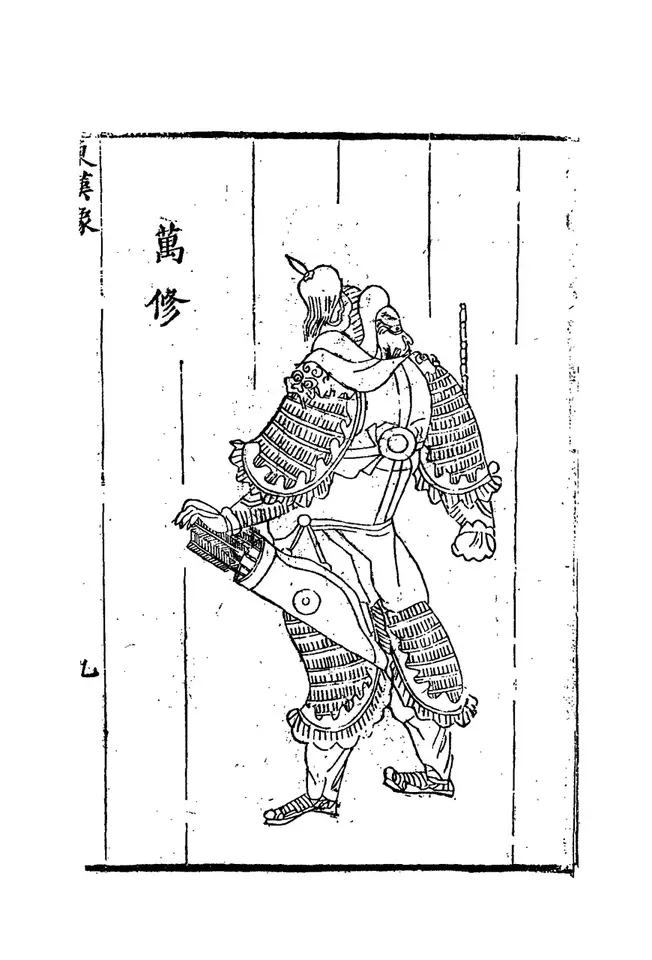
万脩
Wan Xiu (died 26 CE), styled Junyou, a native of Maoling in Youfufeng, was an eminent founding general of the Eastern Han dynasty, ranked twenty-sixth among the celebrated "Twenty-Eight Generals of Yuntai." Under the Gengshi regime, Wan Xiu was appointed Magistrate of Xindu. In late 23 CE, when Liu Xiu (the future Emperor Guangwu) crossed the Yellow River as Grand Minister of War to pacify Hebei, the soothsayer Wang Lang…
Wan Xiu (died 26 CE), styled Junyou, a native of Maoling in Youfufeng, was an eminent founding general of the Eastern Han dynasty, ranked twenty-sixth among the celebrated "Twenty-Eight Generals of Yuntai." Under the Gengshi regime, Wan Xiu was appointed Magistrate of Xindu. In late 23 CE, when Liu Xiu (the future Emperor Guangwu) crossed the Yellow River as Grand Minister of War to pacify Hebei, the soothsayer Wang Lang usurped the imperial title at Handan, issuing an empire-wide bounty of one hundred thousand households for Liu Xiu's head. As commanderies across Hebei defected to Wang Lang, Wan Xiu allied with Grand Administrator Ren Guang and Military Commandant Li Zhong, resolutely refusing to surrender and fortifying Xindu as an isolated loyalist bastion. In early 24 CE, when Liu Xiu fled south in desperate straits, Wan Xiu and his colleagues opened the gates to welcome him, providing the vital territorial and military base that enabled Liu Xiu's counteroffensive. Appointed Major General and created Marquis of Zaoyi, Wan Xiu joined the assault on Handan that crushed Wang Lang, earning promotion to General of the Right. Following Liu Xiu's imperial accession in 25 CE, Wan Xiu commanded divisions in the prolonged siege of Luoyang that compelled Gengshi commander Zhu Wei to surrender. In 26 CE, he was created Marquis of Huaili, participated in the northern defeat of the Wuxiao insurgent army, and was dispatched south to suppress Dong Xin's uprising in Nanyang, where he succumbed to illness in camp.
Following the fall of Wang Mang, Wan Xiu was appointed Magistrate of Xindu under the Gengshi regime.
Wang Lang proclaimed himself emperor at Handan and placed a massive bounty on Liu Xiu; Wan Xiu, Ren Guang, and Li Zhong held Xindu as an isolated Han stronghold.
Liu Xiu reached Xindu in desperate retreat; Wan Xiu opened the city gates to welcome him, receiving appointment as Major General and the title Marquis of Zaoyi.
Following the storming of Handan and the execution of Wang Lang, Wan Xiu was promoted to General of the Right, campaigning across northern China.
Liu Xiu ascended the throne as Emperor Guangwu; Wan Xiu joined Wu Han and senior generals in besieging Luoyang, forcing the surrender of Zhu Wei.
Created Marquis of Huaili, he accompanied Emperor Guangwu to crush the Wuxiao insurgents, accepting the surrender of fifty thousand rebels.
Dispatched to Nanyang with Jian Tan to suppress Dong Xin's rebellion, Wan Xiu fell severely ill and died in his command tent, receiving imperial mourning honors.
Wan Xiu came from a respected gentry family in Maoling within Youfufeng. During the chaotic final years of the Wang Mang interregnum, insurgent armies seized Chang'an in 23 CE, establishing Liu Xuan as the Gengshi Emperor. The newly established regime sent commissioners across the empire to confirm provincial administrators, appointing Wan Xiu as Magistrate of Xindu County (modern Jizhou, Hebei).
In late 23 CE, the Gengshi Emperor dispatched Liu Xiu as Grand Minister of War to pacify the turbulent commanderies north of the Yellow River. Shortly after Liu Xiu's arrival, Liu Lin, son of a former Western Han prince, allied with the Handan fortune-teller Wang Lang, who falsely claimed to be Prince Liu Ziyu, a hidden son of Emperor Cheng. Wang Lang proclaimed himself emperor at Handan and issued imperial decrees across northern China, offering an enormous fief of one hundred thousand households for Liu Xiu's head. Intimidated by his rising power, almost every commandery in Hebei defected to Wang Lang. Liu Xiu was ambushed at Ji County and fled south through blizzards, pursued by hostile forces and reduced to utter destitution.
Amidst this collapse, Xindu Commandery stood firm. Wang Lang repeatedly sent envoys carrying imperial warrants demanding Xindu's surrender. Wan Xiu demonstrated unshakeable moral clarity, recognizing that Wang Lang was a fraudulent charlatan. Wan Xiu formed an alliance with Grand Administrator Ren Guang and Military Commandant Li Zhong, executing Wang Lang's envoys, closing the gates, strengthening ramparts, and mobilizing county troops to hold the fortress in loyalty to the Han cause.
In early 24 CE, Liu Xiu and his small retinue of companions arrived outside Xindu, exhausted and uncertain of their fate. Receiving reports that Xindu remained loyal, Liu Xiu hurried to the city gates.
Inside the walls, Wan Xiu, Ren Guang, and Li Zhong were terrified that their isolated garrison would be overwhelmed by Wang Lang's advancing legions. When they learned that Grand Minister of War Liu Xiu was at the gates, the entire city erupted in celebration. Wan Xiu and the officials opened the gates, dressed in formal robes, and prostrated themselves to welcome Liu Xiu into the citadel. The acquisition of Xindu provided Liu Xiu with his first secure operational base, abundant supplies, and an army of ten thousand veteran soldiers, transforming a desperate retreat into an imperial restoration. Liu Xiu immediately commissioned Wan Xiu as Major General (Pian Jiangjun) and created him Marquis of Zaoyi.
Leaving Zong Guang to defend Xindu, Liu Xiu led Wan Xiu, Ren Guang, and Li Zhong on offensive sweeps against recalcitrant counties. In the climactic campaign against Handan in May 24 CE, Wan Xiu commanded assault divisions that breached the fortress walls, capturing and executing Wang Lang. In recognition of his decisive contributions, Liu Xiu promoted Wan Xiu to General of the Right (You Jiangjun). Over the following year, Wan Xiu campaigned across Youzhou and Jizhou, defeating the Tongma and Chimei insurgent confederations.
In June 25 CE, Liu Xiu proclaimed himself emperor at Hao, inaugurating the Eastern Han dynasty as Emperor Guangwu. The emperor immediately prioritized the capture of the imperial capital of Luoyang, then held by the Gengshi regime.
In the autumn of 25 CE, Han forces laid siege to Luoyang. While Geng Yan and Chen Jun secured the Yellow River crossings at Wushejin, Grand Minister of War Wu Han directed General of the Right Wan Xiu, Jia Fu, Feng Yi, Cen Peng, and other commanders in a tight encirclement of Luoyang. The city was defended by Gengshi Grand Minister of War Zhu Wei, who had been implicated in the murder of Liu Xiu's elder brother Liu Yan and feared execution. Wan Xiu directed relentless assaults against the city gates for months. Eventually, Cen Peng conveyed Emperor Guangwu's solemn pledge of clemency, prompting Zhu Wei to surrender Luoyang.
In the spring of 26 CE, Emperor Guangwu conducted a general enfeoffment of his meritorious generals, elevating Wan Xiu to Marquis of Huaili with an extensive noble estate. In August of that year, the Wuxiao peasant army rebelled in Hebei. Emperor Guangwu personally commanded Wan Xiu, Wu Han, Geng Yan, and Feng Yi to launch a multi-pronged offensive, shattering the insurgent lines and accepting the surrender of more than fifty thousand rebels.
Just as northern China was secured, crisis erupted in Emperor Guangwu's ancestral homeland of Nanyang. Dong Xin, a powerful clan leader from Duxiang, took advantage of the northern deployment of the main army to seize Wan County and take Grand Administrator Liu Lin hostage. Concurrently, imperial general Deng Feng rebelled at Yuyang, threatening the entire southern corridor.
Emperor Guangwu dispatched General of the Right Wan Xiu and General Who Manifests Transformation Jian Tan south to restore order. Arriving in Nanyang, Wan Xiu coordinated with Jian Tan to assault Dong Xin's strongholds around Wan County, winning repeated tactical victories. However, prolonged autumn rains and epidemic disease swept the camp, and Wan Xiu fell gravely ill. Refusing to abandon his command, he directed operations from his sickbed until he succumbed to exhaustion and died in his command tent in late 26 CE. Emperor Guangwu mourned his loss deeply, granting him an imperial state funeral, and confirming the succession of his son Wan Pu.
In 60 CE, Emperor Ming of Han commemorated the twenty-eight founding heroes of the restoration, commissioning their portraits in the Yuntai Pavilion of the Southern Palace in Luoyang. Wan Xiu was honored as the twenty-sixth general among the "Twenty-Eight Generals of Yuntai."
Wan Xiu's steadfast refusal to surrender Xindu to Wang Lang represents one of the decisive turning points of the Eastern Han restoration. By holding an isolated fortress in a hostile province and opening its gates to Liu Xiu, he provided the military and logistical platform that enabled the destruction of Wang Lang and the rebirth of the Han dynasty.
From the capture of Handan and the pacification of Hebei to the siege of Luoyang and the defeat of the Wuxiao rebels, Wan Xiu served as an indispensable commander of the early Han armies. His death in his command tent during the Nanyang expedition epitomized the sacrificial devotion of the founding generation, earning him eternal honor in the Yuntai Pavilion.
FIGURES ASSOCIATED WITH THIS DYNASTY