Birth into Bannerman Nobility
Born into the Shumulu clan of the Manchu Plain White Banner, grandson of Vice Minister Xu Yuanmeng.
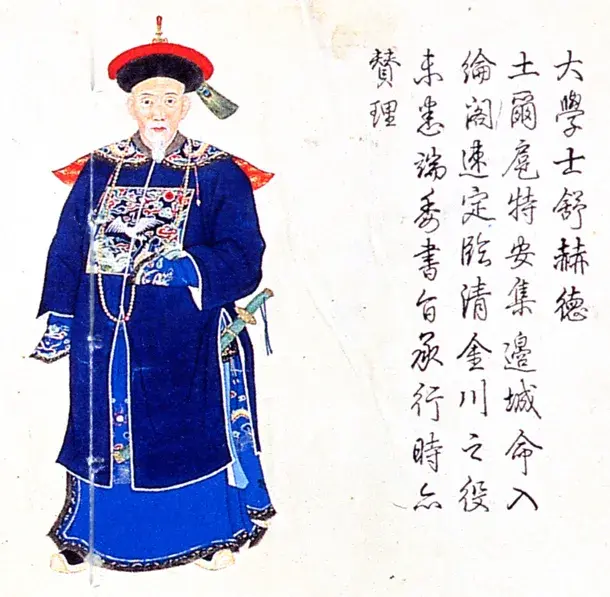
舒赫德
Shuhede (舒赫德, 1710–1777), courtesy name Borong and pseudonym Mingting, was a member of the Shumulu clan of the Manchu Plain White Banner and a grandson of the celebrated scholar-official Xu Yuanmeng. Rising through the civil ranks from a clerk, he held high ministerial offices including Minister of War, Minister of Revenue, and Minister of Works, and governed frontier regions as Governor-General of Shaan-Gan and General…
Shuhede (舒赫德, 1710–1777), courtesy name Borong and pseudonym Mingting, was a member of the Shumulu clan of the Manchu Plain White Banner and a grandson of the celebrated scholar-official Xu Yuanmeng. Rising through the civil ranks from a clerk, he held high ministerial offices including Minister of War, Minister of Revenue, and Minister of Works, and governed frontier regions as Governor-General of Shaan-Gan and General of Ili, eventually culminating in his appointment as Grand Secretary of Wuying Palace and Grand Councilor. Characterized by strategic foresight and outspoken loyalty, Shuhede participated extensively in the major military enterprises of the Qianlong reign. He served as an assistant military commander in the pacification of the Greater Jinchuan native chieftains, the campaigns against the Dzungars, and operations in Altishahr. In his later years, he swiftly crushed the Wang Lun uprising in Shandong and oversaw the settlement of the returning Torghut Mongols, standing as one of the premier statesmen of the High Qing era.
Born into the Shumulu clan of the Manchu Plain White Banner, grandson of Vice Minister Xu Yuanmeng.
Began his career as a clerk (bithesi) and was promoted to Central Drafter in the Grand Secretariat.
Appointed Investigating Censor and assigned to serve on probation in the Grand Council.
Proposed resettling idle Bannermen in Manchuria and redeeming pawned Banner lands, which was approved by the emperor.
Elevated to Minister of War, Grand Councilor, and Chief Director of the Collected Statutes Bureau.
Participated in the Jinchuan campaigns and western military operations; appointed Vice Commander with the title Grand Guardian of the Heir Apparent.
Appointed General of Ili and subsequently Minister of Revenue, supervising the reception and settlement of the returned Torghuts.
Promoted to Grand Secretary of Wuying Palace, overseer of the Ministry of Justice, and Chief Director of the Siku Quanshu Bureau.
Commanded imperial guards in crushing the Wang Lun insurrection at Linqing, granted the hereditary rank of Commandant of Fleet Cavalry.
Appointed Chief Director of official chronicles; died at his residence in the fourth lunar month, awarded the posthumous name Wenxiang.
Shuhede was born in 1710 into the prominent Shumulu clan of the Manchu Plain White Banner, inheriting the intellectual and political legacy of his grandfather, Xu Yuanmeng. Commencing his administrative path in 1728 as a clerk in the imperial bureaucracy, he gained promotion to Central Drafter within the Grand Secretariat. In 1735, the final year of the Yongzheng reign, he was elevated to Investigating Censor and summoned to serve as an assistant clerk in the Grand Council.
In August 1737, early in the Qianlong reign, Shuhede submitted a memorial addressing the economic hardship and surplus population among the Eight Banners in the capital region. He advocated that the imperial court allocate treasury funds to redeem ancestral Banner estate lands pawned to civilian farmers, and organize unassigned Bannermen to reclaim frontier wasteland in Northeast China. The proposal aligned closely with the emperor's intention to strengthen Banner discipline and self-sufficiency, receiving imperial assent and implementation.
Promoted successively to Reader of the Grand Secretariat, Junior Vice Censor-in-Chief, and Vice Minister of Justice, Shuhede concurrently oversaw the Gendarmerie Command in 1741, enforcing strict urban discipline. In 1747, he was appointed Vice Minister of Revenue, and the following year commanded the Plain Yellow Banner and Bordered Red Banner Han troops before receiving promotion to Minister of War and Grand Councilor in October 1748.
In 1749, as the first campaign against the native chieftains of Greater Jinchuan faced formidable stone towers and logistical impasses, Shuhede accompanied Grand Secretary Fuheng as an assistant military commissioner and was awarded the honorary rank of Junior Guardian of the Heir Apparent. Over the following two decades, he participated in the decisive western operations to pacify the Dzungar Khanate and the Tarim Basin.
Throughout these prolonged desert and highland campaigns, he served as military adviser alongside General Zhaohui against Oirat tribal forces, joined General Senggunzab in hunting down the rebellious chieftain Amursana, and reinforced Deputy General Fude during the siege operations against the Khoja leaders in Altishahr. Known for his candid and stubborn strategic assessments, Shuhede frequently clashed with the imperial strategic decrees, suffering multiple demotions and removals from ministerial rank, yet his irreplaceable logistical and tactical acumen invariably led to his reinstatement during acute crises.
In 1766, Shuhede served as acting Governor-General of Shaanxi and Gansu, maintaining frontier stability. During the Sino-Burmese War in 1768, he was recalled to service as an assistant military commissioner in Yunnan. In 1771, he was elevated to General of Ili. When the Torghut Mongol confederation undertook their arduous eastward migration back from the Volga River to Qing territory, Shuhede coordinated emergency grain distributions, delineated pasturage allotments, and settled the returning populace under imperial protection.
In late 1771, Shuhede returned to the capital as Minister of Revenue. In 1773, he reached the pinnacle of civil administrative power with his appointment as Grand Secretary of Wuying Palace, concurrently managing the affairs of the Ministry of Justice and leading the editorial boards of the State History Bureau and the Siku Quanshu (Complete Library in Four Sections). The following year, he was also named Chancellor of the Hanlin Academy.
In autumn 1774, Wang Lun, leader of the millenarian Pure Water Sect, rallied rebel forces in Shouzhang, quickly seizing Yanggu and Tangyi before besieging the strategic canal hub of Linqing in Shandong province, directly threatening grain transport to Beijing. Qianlong dispatched Shuhede as Imperial Commissioner at the head of elite troops from the Jianrui and Firearm battalions to eliminate the rebellion.
Upon arriving at Linqing, Shuhede executed a swift encirclement, coordinating heavy artillery bombardments against the insurgent fortress while sending vanguard units under the imperial son-in-law Lavangdorji to breach the fortifications. The rebel strongholds were stormed, Wang Lun perished in flames, and order was restored along the Grand Canal. Delighted by the rapid resolution, Qianlong awarded Shuhede three honorary promotions, the double-eyed peacock feather, and the hereditary rank of Commandant of Fleet Cavalry.
In July 1776, following the completion of the Wenyuan Chamber within the imperial palace, Shuhede was appointed Overseer of the Imperial Library. In 1777, he was appointed Chief Director for the imperial compilation of the Menggu Yuanliu (Origin of the Mongols) and the military chronicle Linqing Jilüe.
Throughout his career, Shuhede demonstrated an unyielding and pragmatic approach to statecraft, maintaining strict organizational discipline in civil administration and army coordination. In the fourth lunar month of 1777, he passed away from illness at his Beijing residence at the age of sixty-eight. Qianlong expressed profound sorrow, granting generous funerary stipends, posthumously conferring the honor of Grand Tutor, and decreeing the posthumous title Wenxiang.
FIGURES ASSOCIATED WITH THIS DYNASTY