Displaced in Upheaval
Displaced during regional conflicts, taken in by Minister over the Masses Wang Yun as a talented singing girl in his household.
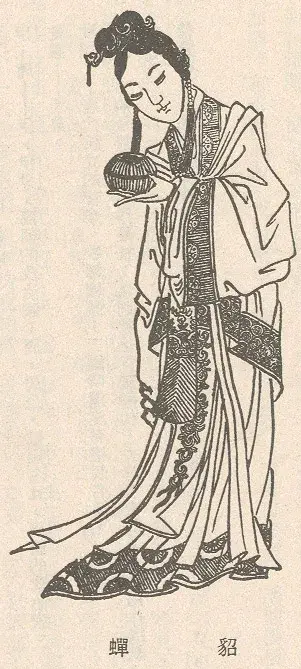
貂蝉
Diaochan (貂蝉, c. late 2nd century), also recorded in popular tradition as Ren Hongchang and celebrated as the Moon-Eclipsing Beauty, is a prominent historical and literary figure from the late Eastern Han dynasty and one of the Four Great Beauties of ancient China. Her historical prototype originated from accounts in the Records of the Three Kingdoms and Book of the Later Han, which record that warlord Lü Bu maintained an…
Diaochan (貂蝉, c. late 2nd century), also recorded in popular tradition as Ren Hongchang and celebrated as the Moon-Eclipsing Beauty, is a prominent historical and literary figure from the late Eastern Han dynasty and one of the Four Great Beauties of ancient China. Her historical prototype originated from accounts in the Records of the Three Kingdoms and Book of the Later Han, which record that warlord Lü Bu maintained an illicit affair with a maidservant of Chancellor Dong Zhuo and feared discovery. During the Song and Yuan dynasties, popular storytelling and Zaju drama such as The Interlocking Stratagem developed her into a full-fledged heroine, a tradition immortalized by Luo Guanzhong in the fourteenth-century novel Romance of the Three Kingdoms. In this narrative, Minister over the Masses Wang Yun sought desperately to rid the Han empire of the despotic warlord Dong Zhuo. Recognizing the crisis threatening the dynasty, Diaochan volunteered to serve as the pivotal instrument in Wang Yun's Interlocking Stratagem (Beauty Trap). By skillfully maneuvering between Dong Zhuo and his formidable adopted son Lü Bu, she provoked fatal jealousy between the two at Fengyi Pavilion, ultimately leading Lü Bu to assassinate Dong Zhuo in the imperial palace. Following Dong Zhuo's death, she accompanied Lü Bu through chaotic regional campaigns until his defeat at Xiapi. Combining legendary beauty, extraordinary political resolve, and psychological courage, Diaochan stands as a timeless cultural emblem of female devotion and heroic sacrifice in Chinese literature.
Displaced during regional conflicts, taken in by Minister over the Masses Wang Yun as a talented singing girl in his household.
Dong Zhuo deposed the emperor, burned Luoyang, and forcibly moved the court to Chang'an, while Wang Yun secretly plotted his removal.
Overhearing Wang Yun's distress, Diaochan burned incense beneath the moon and pledged to sacrifice herself to relieve his burdens and save the dynasty.
Betrothed secretly to Lü Bu by Wang Yun, then formally presented to Dong Zhuo, sparking intense jealousy between father and adopted son.
Met Lü Bu at Fengyi Pavilion while Dong Zhuo was away, provoking an altercation where Dong Zhuo hurled a halberd at Lü Bu.
Lured Dong Zhuo to the Weiyang Palace where Lü Bu slew him, successfully concluding the stratagem and taking Diaochan as his concubine.
Accompanied Lü Bu through military campaigns across Nanyang, Yanzhou, and Xuzhou following the sack of Chang'an by Dong Zhuo's remnants.
Trapped in the flooded citadel of Xiapi by Cao Cao's army; following Lü Bu's execution at White Gate Tower, her subsequent fate faded into legend.
The historical and literary origins of Diaochan encompass both recorded fact and rich folk embellishment. In official dynastic records, including the Book of the Later Han and Records of the Three Kingdoms, her ultimate historical prototype was an unnamed maidservant in the household of Chancellor Dong Zhuo. Dong Zhuo frequently commanded his trusted warrior and adopted son Lü Bu to guard his private quarters. Lü Bu engaged in a clandestine affair with this maidservant and lived in perpetual dread that Dong Zhuo would discover the liaison, a psychological estrangement that laid the foundation for Lü Bu's eventual treason. Over subsequent centuries, oral storytelling, Song-dynasty prompt-books, and Yuan-dynasty Zaju dramas elaborated this figure, giving her the personal name Ren Hongchang. Scholars observe that the name signifies an entertainer from the Ren settlement, aligning closely with her depiction as an accomplished singing girl.
Folklore also preserved imaginative tales of an elderly woodcutter finding an abandoned infant girl in a mountain cavern, where a mysterious crane-haired immortal bestowed upon her the name Diaochan. In literary tradition, she was orphaned during the Yellow Turban Rebellion and fled to Luoyang, where she was sheltered in the mansion of Minister over the Masses Wang Yun. Recognizing her celestial beauty, natural grace, and quick wit, Wang Yun raised her as a favored singing girl, educating her in courtly etiquette, musical performance, and articulate speech. Diaochan was deeply devoted to Wang Yun, viewing him as both benefactor and foster father.
During the late 180s and early 190s, the Han dynasty collapsed into unprecedented chaos. Following the slaughter of palace eunuchs by military factions, the frontier warlord Dong Zhuo seized control of the capital, deposed Emperor Shao, and placed the child Emperor Xian on the throne. Dong Zhuo subsequently torched the imperial palaces of Luoyang, forcibly marched millions of residents westward to Chang'an, and ruled with unbridled tyranny. High ministers and Confucian scholars were utterly powerless before Dong Zhuo's western cavalry and Lü Bu's martial ferocity, weeping in secret over the impending ruin of the dynasty.
One late autumn night in 191, the second year of the Chuping era, Wang Yun wandered sleepless through his garden in Chang'an, weeping over the misery of the realm. Pausing near the peony pavilion, he heard soft, sorrowful sighs coming from the shadows. Approaching quietly, he found Diaochan kneeling before an incense burner beneath the full moon, praying earnestly for the welfare of the state. When Wang Yun questioned her, Diaochan kowtowed and stated that having received his immense benevolence, she could not bear to see him consumed by grief while the state stood on the brink of total destruction, expressing readiness to lay down her life to alleviate his burdens.
Struck by her profound moral courage and breathtaking beauty, Wang Yun observed a cloud drifting across the night sky, temporarily obscuring the moon. In wonder, he remarked that her radiant elegance was sufficient to make the moon itself retreat in modesty, giving rise to the epithet Moon-Eclipsing Beauty. Realizing that military force had repeatedly failed against Dong Zhuo, Wang Yun knelt before Diaochan, proposing a dangerous covert operation: employing her beauty and intelligence to drive a fatal wedge between Dong Zhuo and Lü Bu. Diaochan unhesitatingly accepted the perilous assignment, vowing to execute the plan regardless of personal peril.
In early 192, Wang Yun initiated the Interlocking Stratagem. He first invited the valiant but impulsive general Lü Bu to his residence for an intimate banquet, presenting Diaochan in splendid robes. Captivated by her charm, Lü Bu was ecstatic when Wang Yun promised her to him in marriage. Days later, taking advantage of Lü Bu's absence on patrol, Wang Yun hosted a lavish feast for Dong Zhuo and commanded Diaochan to perform dances. Entranced by her elegance, the aging warlord took her into his carriage and installed her in his harem that very evening. When Lü Bu discovered this betrayal the following morning, he rushed to the chancellor's residence, where Diaochan feigned immense sorrow through veiled glances and tears, signaling that she had been coerced against her will.
Diaochan executed her role with consummate psychological precision, displaying tender submission before Dong Zhuo while revealing heartbreaking sorrow to Lü Bu. In March 192, while Dong Zhuo was attending imperial court, Lü Bu slipped into the chancellor's garden to meet Diaochan at Fengyi Pavilion. Diaochan wept piteously, describing her anguish under Dong Zhuo's unwanted advances and pretending to throw herself into the lotus pond to prove her devotion. Overcome with fury and passion, Lü Bu embraced her, only to be discovered by Dong Zhuo returning unexpectedly from the palace. Enraged at the apparent treason, Dong Zhuo seized Lü Bu's halberd and hurled it at his fleeing foster son. The violent confrontation at Fengyi Pavilion permanently shattered all mutual trust between the two warlords.
Capitalizing on Lü Bu's profound fear of Dong Zhuo's retribution, Wang Yun and his confederates persuaded Lü Bu to join their conspiracy. On the twenty-third day of the fourth month in 192, Dong Zhuo was summoned to the Weiyang Palace under the false pretense of receiving the imperial abdication. As Dong Zhuo entered the palace gates, imperial loyalists ambushed his carriage, and Lü Bu slew him with his halberd. The populace of Chang'an erupted in jubilation, celebrating the death of the tyrant, while Diaochan successfully accomplished her mission to deliver the Han dynasty from immediate extinction.
However, the political triumph was short-lived. Dong Zhuo's surviving generals, Li Jue and Guo Si, counterattacked Chang'an, killing Wang Yun and forcing Lü Bu to flee with Diaochan and his retainers. Over the next six years, Diaochan accompanied Lü Bu through chaotic warfare across central China, staying beside him in Nanyang, Yanzhou, and finally Xuzhou. In late 198, Cao Cao besieged Lü Bu in Xiapi, flooding the city. When strategist Chen Gong proposed that Lü Bu lead a force outside the walls to set up a coordinated defense, Lü Bu's wives and Diaochan pleaded with him not to abandon them to potential capture. Hesitating out of personal attachment, Lü Bu missed his military opportunity and was executed at White Gate Tower. Following Lü Bu's death, historical and literary accounts of Diaochan's fate diverged into numerous folk legends, including tales of her martyrdom, her retirement to a Buddhist nunnery, or her return to rural anonymity, leaving her ultimate end an eternal romantic mystery.
During the tyrannical rule of Dong Zhuo, traditional political and military resistance by imperial loyalists repeatedly collapsed against Western Liang military might. The Interlocking Stratagem devised by Wang Yun depended entirely upon Diaochan's singular bravery, composure, and emotional intelligence. Operating alone within the heavily guarded inner quarters of a ruthless warlord, Diaochan navigated lethal scrutiny, projecting seductive submissiveness to captivate Dong Zhuo while conveying tragic devotion to inflame Lü Bu. Her psychological dexterity transformed an unbreakable martial alliance into fatal personal enmity, achieving an outcome that thousands of armed soldiers had failed to accomplish.
The clandestine encounter at Fengyi Pavilion served as the decisive tipping point of the late Han dynastic crisis. Diaochan carefully calculated the timing of the rendezvous, using emotional appeals and theatrical despair to ignite Lü Bu's uncontrollable rage. When Dong Zhuo hurled the halberd, Diaochan solidified the breach by lamenting to Dong Zhuo that Lü Bu had forced his way into her quarters, thereby ensuring that Dong Zhuo regarded Lü Bu as a domestic traitor. Her calculated maneuvering pushed Lü Bu past the point of reconciliation, compelling him to commit fully to Wang Yun's assassination plot.
Throughout traditional Chinese historical writing, women were often relegated to secondary status or disparaged as dynastic downfalls. The characterization of Diaochan in storytelling, Yuan drama, and Romance of the Three Kingdoms fundamentally subverted this convention. Stepping forward when high ministers wept in despair, Diaochan staked her honor and life to preserve the empire, earning the enduring title of Pink Hero. Her epithet as the Moon-Eclipsing Beauty transcended superficial physical praise to celebrate the moral heroism and intelligence of a woman who shaped the destiny of an empire.
From the Song and Yuan eras through the Ming and Qing dynasties, Diaochan's narrative inspired an extensive corpus of theatrical masterpieces. Yuan-dynasty Zaju dramatists composed classic plays centered around her exploits, including The Interlocking Stratagem, Seizing the Halberd, and Lord Guan Slaying Diaochan beneath the Moon. In Romance of the Three Kingdoms, Luo Guanzhong elevated her story to an enduring peak of classical Chinese vernacular fiction. Through continuous theatrical performance and cultural retelling, Diaochan became universally renowned across China, firmly cementing her status as an immortal cultural archetype of Chinese dramatic literature.
FIGURES ASSOCIATED WITH THIS DYNASTY