袁恕己
Mausoleum / epitaph / stele (Yuan Shuji)
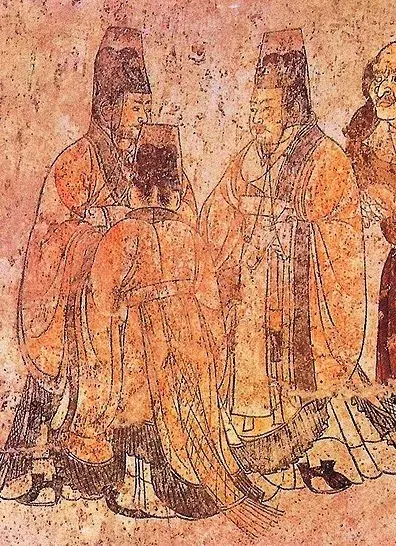
Image creditsUnknown Tang-era tomb artist · Public domainImage source

Historical figure

Yuan Shuji (袁恕己)

袁恕己

Yuan Shuji (袁恕己, ?–706) was a native of Dongguang in Cangzhou. He was an eminent statesman, grand chancellor, and principal leader of the Shenlong Coup during the Tang Dynasty, renowned in historical records as one of the celebrated "Five Princes." Endowed with exceptional talent for statecraft, legal administration, and government accounting, Yuan began his career as Storehouse Overseer in the Court of the National…

Era not stated

PROFILE

Yuan Shuji (袁恕己, ?–706) was a native of Dongguang in Cangzhou. He was an eminent statesman, grand chancellor, and principal leader of the Shenlong Coup during the Tang Dynasty, renowned in historical records as one of the celebrated "Five Princes." Endowed with exceptional talent for statecraft, legal administration, and government accounting, Yuan began his career as Storehouse Overseer in the Court of the National Granaries, steadily rising through diligent execution of duty to become Vice Minister of the Court of Judicial Review. During the Chang'an era, when the Prince of Xiang, Li Dan (the future Emperor Ruizong), opened his princely household, the imperial court selected resolute and strategic officials to staff it, appointing Yuan as Marshal of the Princely Mansion, where he won deep trust among imperial kinsmen. Near the close of the Chang'an era of the Wu Zhou Dynasty, as Empress Wu Zetian lay ill in the Yingxian Palace, her favored courtiers Zhang Yizhi and Zhang Changzong usurped authority and imperiled the dynastic succession. In the first month of the first year of the Shenlong era (705), five resolute officials—Secretariat Directors Zhang Jianzhi, Cui Xuanwei, Huan Yanfan, Jing Hui, and Yuan Shuji—formed a secret covenant and coordinated with Left Militant Guard Grand General Li Duozuo to stage the Shenlong Coup. Assigned to command elite troops guarding the Prince of Xiang's residence, Yuan secured Li Dan's safety and oversaw the southern palace garrison, enabling northern imperial guards to storm the Yingxian Palace, execute the Zhang brothers, and force Wu Zetian to yield the throne. Following the restoration of Emperor Zhongzong of Tang, Yuan was rewarded for his monumental service with appointment as Vice Director of the Secretariat and Joint Manager of Affairs, soon advancing to Director of the Secretariat and being enfeoffed as Prince of Nanyang Commandery. Yuan possessed acute political foresight, repeatedly counseling Emperor Zhongzong in secret memorials to eradicate Wu Sansi and the remnants of the Wu clan to prevent future subversion. However, the Emperor neglected his warnings. Colluding with Empress Wei, Prince of Liang Wu Sansi orchestrated a counter-offensive to frame the Five Princes. In the fifth month of Shenlong, Emperor Zhongzong stripped the five leaders of real power, demoting them to honorary titles. In 706, Wu Sansi fabricated treason charges, banishing Yuan to Douzhou and subsequently exiling him to the disease-ridden outpost of Huanzhou. Wu Sansi dispatched the ruthless executioner Zhou Lizhen to his place of exile, where Yuan was forced to consume multiple pints of lethal wild kudzu vine juice, suffering an agonized death as his organs ruptured. During the Jingyun era under Emperor Ruizong, he was completely posthumously rehabilitated, awarded the posthumous title of Grand Protector of the Crown Prince, and granted the posthumous name Zhenlie.

Posthumous Name
Zhenlie (贞烈)
Peerage
Prince of Nanyang Commandery (南阳郡王)
Native Place
Dongguang, Cangzhou (present-day Dongguang County, Hebei Province)
Date of Death
706 (2nd Year of the Shenlong Era, Tang Dynasty)
Highest Office
Director of the Secretariat, Joint Manager of Affairs with the Secretariat-Chancellery, Vice Minister of the Court of Judicial Review, Marshal of the Prince of Xiang's Princely Mansion
Historical Role
Core architect of the Shenlong Coup and Grand Chancellor assisting the restoration of Emperor Zhongzong of Tang

LIFE TIMELINE

Relationship graph

BIOGRAPHY

Chronology

  • 695 (1st Year of the Zhengsheng Era, Zhou) | Early Administrative Service | Served as Storehouse Overseer of the Court of the National Granaries and Vice Minister of the Court of Judicial Review, earning acclaim for strict judicial integrity.
  • 703 (3rd Year of the Chang'an Era, Zhou) | Marshal of the Prince of Xiang | Appointed Marshal of the Prince of Xiang's Princely Mansion under Li Dan, winning the trust of Tang loyalists.
  • 705 (1st Year of the Shenlong Era, Tang) | Executing the Shenlong Coup | Collaborated with Zhang Jianzhi to launch the palace coup, securing the Prince of Xiang and eliminating the Zhang brothers.
  • 705 (1st Year of the Shenlong Era, Tang) | Elevation to Grand Chancellor | Assumed office as Vice Director of the Secretariat and Joint Manager of Affairs upon Zhongzong's restoration, advancing to Director of the Secretariat and Prince of Nanyang.
  • 705 (1st Year of the Shenlong Era, Tang) | Warning Against Wu Sansi | Repeatedly advised Emperor Zhongzong to purge the treacherous Wu clan, but his counsel was ignored by the throne.
  • 705 (1st Year of the Shenlong Era, Tang) | Stripped of Administrative Power | Ousted from ministerial office along with the other Four Princes due to Wu Sansi and Empress Wei's political maneuvers.
  • 706 (2nd Year of the Shenlong Era, Tang) | Political Persecution | Falsely accused of treason by Wu Sansi's partisans and demoted to Administrative Assistant of Douzhou.
  • 706 (2nd Year of the Shenlong Era, Tang) | Banishment to Huanzhou | Exiled further to the remote southern post of Huanzhou, with his family members stripped of rank and property.
  • 706 (2nd Year of the Shenlong Era, Tang) | Martyrdom in Lingnan | Forced by imperial envoy Zhou Lizhen to drink lethal wild kudzu toxin, dying an agonizing death in exile.
  • 710 (1st Year of the Jingyun Era, Tang) | Posthumous Rehabilitation | Posthumously exonerated by Emperor Ruizong, granted the rank of Grand Protector of the Crown Prince, and bestowed the posthumous name Zhenlie.

Life and Career

Administrative Service and Association with the Prince of Xiang

Yuan Shuji was born into an established family of Dongguang in Cangzhou, exhibiting early ambitions to restore order and justice to the empire. Entering government service through his administrative competence, he was initially assigned as Storehouse Overseer in the Court of the National Granaries, managing agricultural distribution and state revenues. His meticulous accounting and upright administration attracted the notice of senior officials. He subsequently transferred to the Court of Judicial Review as Vice Minister. Operating during the height of the Wu Zhou era, when cruel officials manufactured extensive purges and wrongful imprisonments, Yuan steadfastly upheld legal standards, exonerated innocent victims, and protected upright officials, earning widespread respect in Chang'an.

In the third year of Chang'an (703), as the aging Empress Wu Zetian approached her final years, tensions between the Wu clan princes and the imperial Li family over the succession reached an acute crisis. Imperial Heir Li Dan, Prince of Xiang, maintained a discreet and cautious posture within his residence to avert danger. Recognizing the need for trustworthy and steadfast counselors to safeguard the prince, the court selected Yuan Shuji to serve as Marshal of the Prince of Xiang's Princely Mansion. In this sensitive capacity, Yuan served Li Dan with absolute devotion while quietly fostering ties with loyalist generals and ministers, including Secretariat Director Zhang Jianzhi and Vice Minister Jing Hui, methodically laying the groundwork for restoring the Tang Dynasty.

The Shenlong Coup and Imperial Restoration

By the fourth year of Chang'an (704), Empress Wu Zetian had fallen gravely ill and resided in seclusion within the Yingxian Palace. Her favorites, Zhang Yizhi and Zhang Changzong, controlled imperial access, dominated state affairs, and plotted to seize power. Faced with imminent crisis, Zhang Jianzhi, Cui Xuanwei, Huan Yanfan, Jing Hui, and Yuan Shuji resolved to take decisive action.

On the twenty-second day of the first month of the first year of Shenlong (705), the Five Princes launched their synchronized coup. Because the Prince of Xiang commanded the Southern Garrison Guards and was revered as the senior prince of the Li dynasty, his security was paramount. Yuan Shuji was entrusted with commanding crack troops to guard Li Dan's residence, maintain order over the southern palace guards, and ensure stability throughout the capital. Simultaneously, Zhang Jianzhi and Left Militant Guard Grand General Li Duozuo led five hundred palace guards through the Xuanwu Gate, stormed the Yingxian Palace, and summarily executed the Zhang brothers before the bedchamber of Wu Zetian.

The following day, Wu Zetian issued an imperial edict transferring power, and on the twenty-fifth day, Crown Prince Li Xian formally reassumed the throne as Emperor Zhongzong. The Tang dynastic title and ancestral institutions were fully restored. For his decisive contributions, Yuan Shuji was appointed Vice Director of the Secretariat and Joint Manager of Affairs with the Secretariat-Chancellery, rapidly promoted to Director of the Secretariat, and enfeoffed as Prince of Nanyang Commandery. Alongside Zhang Jianzhi, Cui Xuanwei, Huan Yanfan, and Jing Hui, he was celebrated as one of the "Five Princes" who restored the dynasty.

Chancellorship and Warnings Against the Wu Remnants

Upon ascending to the chancellorship, Yuan Shuji applied his administrative precision to reorganizing national revenues and clearing backlogged legal cases, winning high acclaim. However, he remained acutely vigilant regarding the lingering political threat posed by the Wu family. Wu Sansi, Prince of Liang, maintained intimate ties with Empress Wei, frequented the inner palace, and manipulated state affairs behind the scenes.

Yuan Shuji and Huan Yanfan repeatedly submitted confidential memorials to Emperor Zhongzong, urging: "Wu Sansi and his kinsmen were accomplices in the former tyranny; if they are not completely eliminated, the imperial altars of the Li family will never know peace." However, Emperor Zhongzong, blinded by familial ties and Empress Wei's persuasion, disregarded these warnings. Wu Sansi grew profoundly alarmed by the Five Princes' persistence and actively plotted their destruction.

In the fifth month of the first year of Shenlong, Wu Sansi persuaded the emperor that ministers of such supreme merit should be spared mundane administrative labor and elevated to exalted advisory status. Emperor Zhongzong accordingly stripped the Five Princes of their chancellorships and control over the imperial guard armies, conferring upon them the honorary rank of Grand Master of Special Advancement.

Banishment and Agonizing Martyrdom in Exile

In the second year of Shenlong (706), Wu Sansi seized control of the government and systematically retaliated against the Five Princes. He orchestrated false accusations that the Five Princes were conspiring to depose Empress Wei and overthrow the throne. Emperor Zhongzong issued an imperial edict demoting Yuan Shuji to Administrative Assistant of Douzhou and stripping him of his princely title. Shortly thereafter, an edict banished him to Huanzhou in the far south, ordering his family estates confiscated and his relatives exiled.

Determined to eliminate any possibility of their return, Wu Sansi dispatched his cruel subordinate, Zhou Lizhen, as Imperial Censor to oversee their execution in exile. Upon arriving in Lingnan, Zhou Lizhen executed Cui Xuanwei, Huan Yanfan, and Jing Hui through horrific tortures. Arriving at Yuan Shuji's place of banishment in Huanzhou, Zhou Lizhen forced Yuan to consume several pints of raw poisonous wild kudzu vine juice. The lethal poison caused severe internal hemorrhaging, yet when the poison did not induce immediate death, Zhou Lizhen dragged Yuan across rough ground until his flesh was torn to shreds, and he perished in excruciating agony.

Following the accession of Emperor Ruizong in the first year of Jingyun (710), the court officially overturned the false charges against the Five Princes. Yuan Shuji was posthumously restored to all honors, granted the title of Grand Protector of the Crown Prince, and bestowed the posthumous name Zhenlie.
Major Achievements

Masterminding the Shenlong Coup to Restore Tang Sovereignty

Yuan Shuji's paramount historical achievement was his central role in the Shenlong Coup of 705. Serving as the primary military coordinator in securing the Prince of Xiang and the southern garrison defenses, he ensured that the coup proceeded without triggering broader civil conflict in the capital. His steadfast leadership neutralized the Zhang brothers' cabal, ended fifteen years of the Wu Zhou regime, and successfully restored the legitimate Tang dynastic lineage, securing his place as a foundational restoration statesman.

Unflinching Loyalty and Principled Resistance Against Tyranny

Throughout his political career, Yuan demonstrated exceptional moral rectitude and administrative brilliance. He consistently refused to compromise with corrupt factions, accurately recognizing that leaving Wu Sansi unpunished would imperil the empire. Even when confronted with imminent demise and terrible physical torture in exile, he maintained unyielding fidelity to the Tang royal house, exemplifying the highest ideals of Confucian ministerial martyrdom.

Personal Relationships

  • Coup Colleague: Zhang Jianzhi (Director of the Secretariat, primary organizer of the Shenlong Coup, and Prince of Hanyang)
  • Coup Colleague: Cui Xuanwei (Grand Chancellor, member of the Five Princes, and Prince of Boling)
  • Coup Colleague: Huan Yanfan (Grand Chancellor, member of the Five Princes, and Prince of Qiaoguo)
  • Coup Colleague: Jing Hui (Grand Chancellor, member of the Five Princes, and Prince of Pingyang)
  • Protected Sovereign: Emperor Ruizong of Tang (Prince of Xiang whose residence Yuan defended during the coup, who later posthumously exonerated him)
  • Restored Sovereign: Emperor Zhongzong of Tang (Emperor restored by the coup who later failed to heed Yuan's warnings)
  • Mortal Adversary: Wu Sansi (Prince of Liang whose destruction Yuan urged, who ultimately orchestrated Yuan's murder)
  • Murderous Executioner: Zhou Lizhen (Cruel censor dispatched by Wu Sansi to force Yuan to ingest lethal poison)

Historical Evaluation

  • The Old Book of Tang (Volume 91) records: "Yuan Shuji and the Five Princes united their resolve to purge evil, taking control of the palace gates to restore the imperial lineage. Their contributions shook heaven and earth! However, when the sinister faction revived and plotted their demise, they were unable to protect themselves, meeting tragic ends in distant southern lands. How lamentable indeed! Yet their glorious loyalty shines perpetually across ten thousand generations."
  • The New Book of Tang (Volume 120) assesses: "When Zhang Jianzhi, Yuan Shuji, and their colleagues orchestrated the restoration, they acted with the swiftness of thunder. Had they successfully eradicated the Wu clan at that very moment, how could calamity have returned? Shuji fell victim to treacherous slander and endured gruesome destruction, yet his righteous martyrdom established an unblemished standard for loyal subjects."
  • Song Dynasty historian Sima Guang wrote in the Zizhi Tongjian: "The Five Princes possessed the grand merit of restoring the ancestral shrines, yet they failed to sever evil at its root, permitting Wu Sansi to manipulate the inner court and engineer their destruction. Nevertheless, Yuan Shuji's courage to speak truth without fear of death marks him as an exemplar of ministerial devotion."

Related Entries

  • Shenlong Coup
  • Five Princes
  • Zhang Jianzhi
  • Emperor Zhongzong of Tang
  • Emperor Ruizong of Tang
  • Wu Sansi
  • Zhou Lizhen

FIGURES ASSOCIATED WITH THIS DYNASTY

Bibliography

  • Old Book of Tang, Volume 91, Liezhuan 41 (Biography of Yuan Shuji)
  • New Book of Tang, Volume 120, Liezhuan 45 (Biography of Yuan Shuji)