Birth in Qingzhou
Born into a prominent aristocratic clan as the sixth son of founding general Shi Bao.
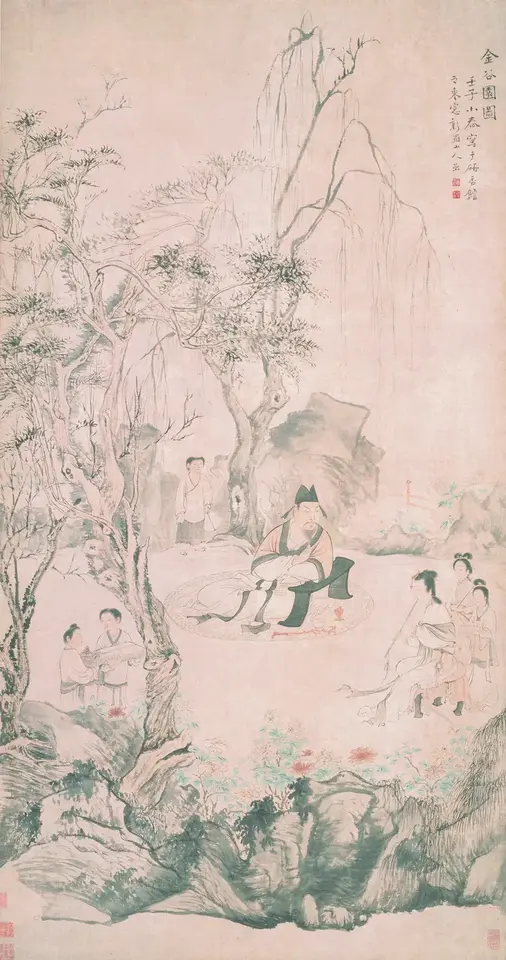
石崇
Shi Chong (石崇, 249–300), courtesy name Jilun (季伦) and childhood name Qinu (齐奴), was a prominent Western Jin minister, man of letters, and the quintessential symbol of exorbitant aristocratic wealth in medieval Chinese history. Originating from Nanpi in Bohai, he was the sixth son of Shi Bao, a founding grand marshal and meritorious noble of the Western Jin Dynasty. Endowed with sharp intellect, ambition, and political…
Shi Chong (石崇, 249–300), courtesy name Jilun (季伦) and childhood name Qinu (齐奴), was a prominent Western Jin minister, man of letters, and the quintessential symbol of exorbitant aristocratic wealth in medieval Chinese history. Originating from Nanpi in Bohai, he was the sixth son of Shi Bao, a founding grand marshal and meritorious noble of the Western Jin Dynasty. Endowed with sharp intellect, ambition, and political adaptability from his youth, Shi Chong governed Xiuwu as magistrate at twenty, served in the imperial conquest of Eastern Wu in 280 CE, and was ennobled as Marquis of Anyang Township. While serving as Inspector of Jingzhou, he amassed colossal wealth by violently plundering commercial caravans and merchant ships, eventually rising to nine-minister ministerial posts such as Grand Minister of Agriculture and Chamberlain for the Palace Garrison. Shi Chong achieved legendary notoriety through his public ostentation, engaging in an extravagant contest of riches against imperial uncle Wang Kai that captivated the capital of Luoyang. He constructed the luxurious Jingu Garden estate, gathering foremost literary luminaries such as Pan Yue, Zuo Si, Lu Ji, and Liu Kun into the celebrated literary salon known as the Twenty-Four Friends of Jingu. Following the outbreak of the War of the Eight Princes, Shi Chong's political alignment with the fallen empress Jia Nanfeng's nephew Jia Mi brought fatal retribution. When Prince of Zhao Sima Lun and his confidant Sun Xiu seized supreme power in 300 CE, Sun Xiu demanded Shi Chong's cherished concubine Lüzhu. Upon Shi Chong's refusal, Sun Xiu engineered treason charges against him; Lüzhu leapt from a tower to her death, and Shi Chong was executed at the Luoyang eastern market alongside his entire clan, his astronomical fortune confiscated by the state.
Born into a prominent aristocratic clan as the sixth son of founding general Shi Bao.
Shi Bao divided his ancestral estate among his sons on his deathbed but excluded Shi Chong, predicting the youth would accumulate immense riches independently.
Participated in the pacification of Eastern Wu, receiving enfeoffment as Marquis of Anyang Township.
Appointed Inspector of Jingzhou; amassed extraordinary riches through the armed interception and taxation of maritime merchant caravans.
Hosted thirty eminent literati at his Jingu Garden estate and authored the Preface to the Jingu Poems, coalescing the Twenty-Four Friends of Jingu.
Refused to surrender his beloved concubine Lüzhu to Sun Xiu; Lüzhu jumped from the tower when imperial guards arrived.
Decapitated alongside Pan Yue at the eastern marketplace of Luoyang at age fifty-two; his three familial clans were exterminated.
Shi Chong was born in 249 CE during the reign of the Duke of Qi (Cao Fang) in Cao Wei. His ancestral home was Nanpi in Bohai, an eminent aristocratic lineage. His father, Shi Bao, navigated the transition from Wei to Jin, attaining the supreme military rank of Grand Marshal (Dasima) and Duke of Leling as a core architect of the Western Jin Dynasty. Because Shi Chong was born while his father served as Inspector of Qingzhou, he was given the childhood pet name "Qinu" (Son of Qi). Even in early adolescence, Shi Chong exhibited exceptional intellectual sharpness, strategic foresight, and an assertive, daring character.
In 273 CE (Taishi 9), as Grand Marshal Shi Bao lay dying, the patriarch summoned his sons to distribute his vast lands, estates, and family wealth. When the division was concluded, Shi Bao intentionally omitted young Shi Chong from the inheritance. Deeply dismayed, Shi Chong's mother remonstrated with her dying husband. Shi Bao replied with prescient certainty: "Although this child is young, his wit, cunning, and resourcefulness far surpass those of his elder brothers; he will inevitably amass immense riches on his own."
At the age of twenty, Shi Chong was appointed Magistrate of Xiuwu. In local administration, he displayed formidable executive competence, rooting out bandits and enforcing judicial orders with uncompromising efficiency. He was subsequently summoned to the imperial capital to serve as Cavalier Attendant Gentleman (Sanqi Shilang) before being transferred to govern as Administrator of Chengyang. Throughout his official tenures, Shi Chong pursued classical scholarship alongside administrative responsibilities.
In 280 CE (Taikang 1), Emperor Wu of Jin (Sima Yan) launched a six-pronged invasion to pacify Eastern Wu. Shi Chong participated actively in naval and land campaigns along the middle reaches of the Yangtze River. Following the subjugation of Wu, Shi Chong was rewarded with the noble title of Marquis of Anyang Township. He briefly retired citing poor health, but the throne promptly recalled him to serve as Gentleman Attendant at the Palace Gate and Cavalier Regular Attendant.
During the late reign of Emperor Wu and the accession of Emperor Hui of Jin, Shi Chong received the critical military and administrative appointment of Colonel of the Southern Barbarians and Inspector of Jingzhou, backed by the credentials of Imperial Commissioner Bearing Credentials. This strategic post proved to be the golden opportunity that transformed Shi Chong into the wealthiest magnate of his era.
Jingzhou occupied a pivotal geostrategic bottleneck along the middle reaches of the Yangtze River, linking Sichuan, Yunnan, Lingnan, and foreign maritime trade routes directly to the Central Plains. Prosperous maritime merchants and wealthy traders from Southeast Asia, South China, and the inland routes frequently traversed the riverways carrying exotic cargoes of pearls, jade, ivory, tortoiseshell, and precious spices. Utilizing his supreme civil and military jurisdiction, Shi Chong imposed arbitrary levies and extorted vast sums from merchants. Worse, he dispatched provincial armed cavalry to ambush wealthy mercantile caravans along secluded mountain passes and river gorges, butchering travelers and plundering their entire vessels of bullion and luxury goods.
Through this calculated state-sponsored banditry, Shi Chong amassed colossal, unprecedented private fortunes within a few years. His private estates outside Luoyang spanned hundreds of hectares, containing thirty hydraulic mill stations, thousands of indentured servants and armed retainers, and vaults overflowing with mountains of gold, silver, silk, and precious gemstones. Within his luxurious mansion, hundreds of concubines and singing maidens were cloaked in intricate brocades and adorned with glittering jewelry, undergoing daily musical training. His lifestyle eclipsed even that of imperial princes, elevating him to legendary status in the capital.
Upon completing mourning rites for his mother, Shi Chong reentered the central government, successively serving as Grand Minister of Agriculture (Dasinong), Master of the Stud (Taipu), and Chamberlain for the Palace Garrison (Weiwei), reaching the apex of nine-minister rank. Known for his haughty and condescending temperament, he moved comfortably among top grandees like Situ Wang Rong, commanding enormous social influence.
During the Taikang and Yuankang eras, the Western Jin aristocratic elite sank into rampant decadence, openly competing in displays of private wealth. The most celebrated spectacle of this era was the lavish rivalry between Shi Chong and Wang Kai, the maternal uncle of Emperor Wu. Relying upon his imperial kinship, Wang Kai sought to publicly outshine Shi Chong.
When Wang Kai had his kitchen staff wash cooking cauldrons with sweet maltose syrup, Shi Chong retaliated by commanding his estate cooks to burn costly tallow candles as everyday firewood. When Wang Kai lined forty li of public avenues with purple silk cloth to shield his entourage, Shi Chong constructed a fifty-li avenue barrier using far more expensive patterned brocades, completely dwarfing his rival's display. While Wang Kai plastered his mansion walls with precious red mineral powder, Shi Chong coated his interior walls with fragrant Sichuan peppercorn paste, creating rooms filled with exotic aromas and opulent warmth.
Attempting to aid his uncle in the competition, Emperor Wu bestowed upon Wang Kai an extraordinary two-foot-tall branching coral tree from the imperial treasury, boasting rare density and luster. Wang Kai invited Shi Chong to a private banquet to boast of this royal treasure. After viewing the specimen, Shi Chong picked up an iron ruyi scepter and shattered the imperial coral tree with a single strike. When the enraged Wang Kai accused him of destructive jealousy, Shi Chong laughed heartily: "There is no reason to be distressed over such a trifle; I shall repay you immediately." He commanded his servants to retrieve coral trees from his personal treasury; they presented six or seven pristine specimens measuring three to four feet in height, each with dazzling branching stems, alongside dozens of two-foot trees. Wang Kai stood stunned and humiliated, conceding total defeat.
Shi Chong's ostentation extended even to his domestic restrooms. According to contemporary accounts, his latrine was styled like an opulent bedchamber, attended by a dozen elaborately attired handmaids holding scented incense and cosmetics. Guests were required to discard their garments and don brand-new silk robes upon exiting. When grandee Liu Shi visited, he mistook the restroom for Shi Chong's inner chamber and fled in embarrassment.
Despite his grotesque extravagance, Shi Chong was also a gifted writer and patron of arts. In the Jingu ravine northeast of Luoyang, he constructed the famed Jingu Garden estate. The retreat featured winding brooks, tiered pavilions, terraced balconies, exotic flora, and private menageries. In 296 CE (Yuankang 6), Shi Chong hosted thirty prominent dignitaries and poets at a farewell banquet for Wang Xu, penning the celebrated Preface to the Jingu Poems reflecting on the transient beauty of existence. Within this elite circle, twenty-four leading figures—including Shi Chong, Pan Yue, Zuo Si, Lu Ji, Lu Yun, and Liu Kun—formed the literary fraternity known as the Twenty-Four Friends of Jingu, who also aligned politically behind imperial favorite Jia Mi. Shi Chong's favorite concubine, Lüzhu, renowned for her supreme beauty and virtuoso flute performances of southern melancholy airs, served as the crowning artistic muse of the Jingu feasts.
Shi Chong's ostentatious prominence and unbridled wealth sowed the seeds of his inevitable destruction. Politically, he tethered his fortunes to Empress Jia Nanfeng's powerful consort clan, prostrating himself before her influential nephew Jia Mi. Observers noted with disgust that whenever Jia Mi's carriage passed on the road, Shi Chong and Pan Yue would halt their vehicles and bow down into the dust behind his wheels.
In April 300 CE, the War of the Eight Princes claimed its first major victim when Sima Lun, Prince of Zhao, launched a palace coup. Sima Lun executed Empress Jia, slaughtered Jia Mi and his faction, and seized autocratic control over the central administration, with his calculating adviser Sun Xiu managing judicial crackdowns.
Sun Xiu had long lusted after Shi Chong's prized concubine, Lüzhu. Leveraging his newfound power, Sun Xiu dispatched a confidant to Jingu Garden to demand her surrender. Entertaining guests on a high pavilion, Shi Chong paraded dozens of resplendently adorned concubines, inviting the envoy to select anyone except Lüzhu, whom he declared his sole irreplaceable treasure. The envoy warned him of Sun Xiu's vindictive nature, but Shi Chong roared that he would rather perish than surrender her.
Recognizing that Sima Lun and Sun Xiu were bringing tyranny to the court, Shi Chong, Pan Yue, and imperial relative Ouyang Jian secretly coordinated with Sima Yun, Prince of Huainan, to stage a counter-coup. Sun Xiu discovered the conspiracy and preemptively moved against them, securing a death warrant from Prince of Zhao Sima Lun.
Over one hundred armed shock troops encircled Jingu Garden. As soldiers scaled the pavilion steps with bared blades, Shi Chong turned to Lüzhu and lamented: "Today I am doomed to disaster for your sake!" Weeping bitterly, Lüzhu bowed and cried: "I shall die before my lord rather than suffer humiliation!" She hurled herself from the high pavilion, dying instantly on the stones below.
Arrested and placed in a prisoner cart, Shi Chong initially presumed he would merely suffer demotion and exile to Guangzhou. Only when the carriage pulled into the bloodstained eastern execution grounds of Luoyang did he realize his fate. Gazing upward, he bitterly cursed: "These wretches merely covet the astronomical wealth of my estate!" The supervising magistrate replied: "If you understood so well that extreme wealth brings lethal disaster, why did you not distribute your fortune earlier to save your life?" Shi Chong could offer no answer.
At the execution grounds, Shi Chong was beheaded alongside his mother, brothers, wife, and children, exterminating his lineage. The legendary fortune of the Jingu magnate was dissolved into state coffers, leaving behind an enduring cautionary tale of greed, hubris, and transient glory.
FIGURES ASSOCIATED WITH THIS DYNASTY