Inheriting the Princedom of Qi
Following the death of his father Sima You, Sima Jiong boldly accused court doctors of malpractice; Emperor Wu executed the physicians and confirmed his succession as Prince of Qi.
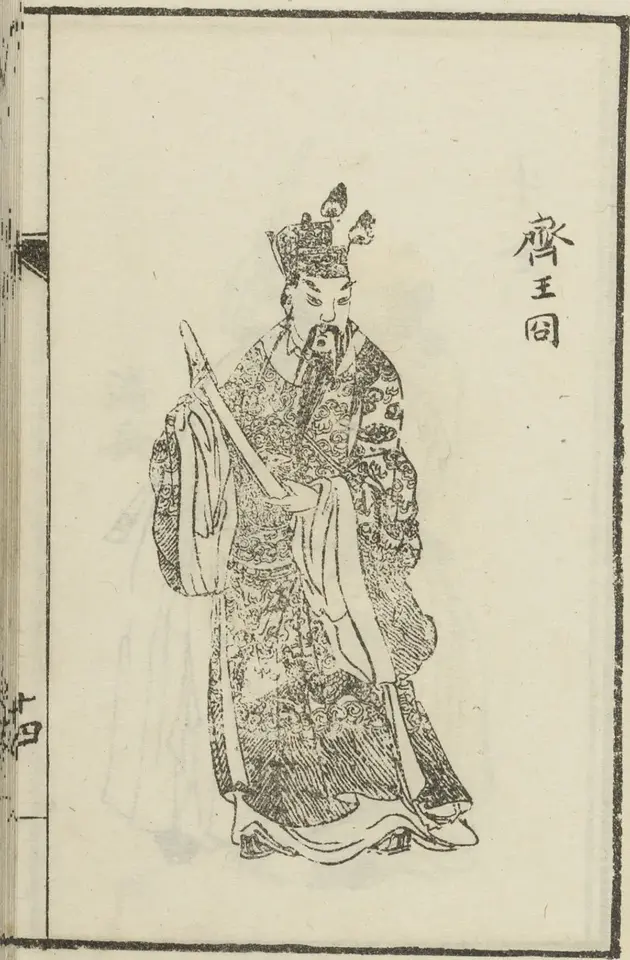
司马冏
Sima Jiong (司马冏, ? – January 27, 303), courtesy name Jingdu, was a native of Wen County in Henei (present-day Wen County, Henan Province). He was a prominent imperial prince and regent of the Western Jin dynasty, a grandson of Emperor Xuan (Sima Yi), adoptive grandson of Emperor Jing (Sima Shi), second son of Prince Xian of Qi (Sima You), and a pivotal commander during the War of the Eight Princes. Renowned in his youth for…
Sima Jiong (司马冏, ? – January 27, 303), courtesy name Jingdu, was a native of Wen County in Henei (present-day Wen County, Henan Province). He was a prominent imperial prince and regent of the Western Jin dynasty, a grandson of Emperor Xuan (Sima Yi), adoptive grandson of Emperor Jing (Sima Shi), second son of Prince Xian of Qi (Sima You), and a pivotal commander during the War of the Eight Princes. Renowned in his youth for filial piety, benevolence, and generous charity toward the poor, Sima Jiong inherited his father's refined reputation. Following Sima You's death from illness, Sima Jiong openly grieved and accused the imperial physicians of concealing his father's worsening condition. Moved by his filial anguish, Emperor Wu ordered the physicians executed and permitted Sima Jiong to inherit the princely title of Qi. During the late Yuankang era, Sima Jiong served in key military posts, including Gentleman Attendant at the Yellow Gate, Commander of the Left Army, and Colonel of the Winged Army. When Prince of Zhao Sima Lun launched a coup to purge Empress Jia Nanfeng and subsequently usurped the imperial throne, Sima Jiong was dispatched to garrison Xuchang as General Pacifying the East. Recognizing the mortal danger facing the dynastic house, Sima Jiong secretly formed an alliance with Prince of Chengdu Sima Ying, Prince of Hejian Sima Yong, and Prince of Changsha Sima Ai, issuing a fiery manifesto across China summoning all loyalists to overthrow the usurper. After months of grueling warfare, Sima Jiong crushed Sima Lun's forces, restored Emperor Hui to the throne, and was elevated to Grand Marshall, Manager of the Affairs of the Masters of Writing, and recipient of the Nine Bestowals. However, once in power, Sima Jiong succumbed to extreme arrogance, building ostentatious mansions, indulging in wine and women, and purging critics. In the winter of 302, allied princes denounced him, and Sima Ai launched an assault in Luoyang. Sima Jiong was captured after three days of urban fighting, executed outside Changhe Gate, and later posthumously honored as Prince Wumin.
Following the death of his father Sima You, Sima Jiong boldly accused court doctors of malpractice; Emperor Wu executed the physicians and confirmed his succession as Prince of Qi.
Promoted to Gentleman Attendant at the Yellow Gate, Commander of the Left Army, and Colonel of the Winged Army, gaining substantial influence among palace guards.
Allied with Prince of Zhao Sima Lun to depose Empress Jia Nanfeng; dissatisfied with his appointment as Guerrilla General, he was transferred to garrison Xuchang.
Sima Lun seized the imperial throne; seeking to placate Sima Jiong, the usurper elevated him to Grand General Guarding the East, but Sima Jiong secretly plotted rebellion.
Held a solemn ceremony in Xuchang, issuing a nationwide call to arms against Sima Lun; Prince of Chengdu Sima Ying and Prince of Hejian Sima Yong rallied to his cause.
Commanded loyalist armies to rout the usurper's vanguard at Yingchuan, liberated Luoyang, executed Sima Lun and Sun Xiu, and restored Emperor Hui to the throne.
Elevated to Grand Marshall and Manager of the Affairs of the Masters of Writing with the Nine Bestowals; grew increasingly despotic, constructing lavish palaces and alienating provincial princes.
Denounced by Sima Yong and Sima Ying, Sima Jiong was besieged in his palace by Prince of Changsha Sima Ai; after three days of fierce street combat, he was captured and beheaded.
Sima Yue, Prince of Donghai, rehabilitated Sima Jiong's status, repatriated his three sons, restored his princely honors, and conferred the posthumous title Prince Wumin.
Sima Jiong belonged to the most prestigious core of the Western Jin imperial house. His father was Prince Xian of Qi, Sima You (the second son of Sima Zhao, who had been adopted into the lineage of Sima Shi to preserve the senior branch), and his mother was the daughter of prominent Cao Wei statesman Jia Chong. Sima You had enjoyed immense public admiration and was once regarded as the natural heir to the Jin throne. From childhood, Sima Jiong exhibited gentle benevolence, distributed wealth to the impoverished, and reflected the virtuous demeanor of his father, winning wide praise among high gentry clans.
In 282, Emperor Wu ordered Sima You to leave the capital for his fief to secure the succession of Crown Prince Sima Zhong. Consumed by grief and political rejection, Sima You fell severely ill. Suspecting deception, Emperor Wu sent court physicians, who dishonestly reported that Sima You was healthy. In 283, Sima You died vomiting blood. When Emperor Wu attended the funeral, the young Sima Jiong threw himself on the ground, weeping bitterly and denouncing the physicians for sycophancy and false reporting. Stunned and remorseful, Emperor Wu ordered the physicians executed and permitted Sima Jiong to inherit the princely dignity of Qi.
During the Yuankang era, as the in-law clan of Empress Jia Nanfeng dominated the court and administrative order deteriorated, the adult Sima Jiong was summoned to central service. He held consecutive posts as Gentleman Attendant at the Yellow Gate, Commander of the Left Army, and Colonel of the Winged Army, commanding vital contingents of the Luoyang palace guards. In April 300, Empress Jia poisoned Crown Prince Sima Yu, sparking outrage across the imperial house. Prince of Zhao Sima Lun and his confidant Sun Xiu covertly allied with Sima Jiong, utilizing his military units to storm the inner palace and arrest Empress Jia.
However, after securing supreme power, Sima Lun distributed meager rewards, appointing Sima Jiong merely as Guerrilla General. Proud of his noble descent, Sima Jiong visibly displayed deep dissatisfaction. The astute Sun Xiu perceived Sima Jiong's resentment and feared his presence in the capital. In early 301, Sun Xiu petitioned the emperor to appoint Sima Jiong General Pacifying the East with special powers, posting him away to the military depot of Xuchang. Soon afterward, Sima Lun dethroned Emperor Hui, usurping the imperial dignity for himself. To soothe the alienated prince, Sima Lun promoted Sima Jiong to Grand General Guarding the East with extraordinary ministerial privileges.
Sima Jiong recognized that Sima Lun's usurpation offended both heaven and the public, resolving to raise arms to restore the Jin dynasty. In March 301, Sima Jiong gathered civil and military officers in Xuchang, established an altar, swore a blood oath, and launched a righteous campaign. He drafted a rousing manifesto that was carried across China by couriers, urging provincial princes and commanderies to join him in sweeping away the traitors and liberating the true emperor.
The manifesto transformed the political landscape. Sima Ying at Ye, Sima Yong in Guanzhong, Sima Ai at Changshan, and Sima Xin at Nanyang all mobilized their armies in response, amassing hundreds of thousands of troops. Terrified, Sima Lun dispatched veteran generals Zhang Hong and Sun Hui with sixty thousand imperial troops to crush Xuchang. Sima Jiong confronted them in Yingchuan and Yangdi, engaging in bloody struggles at Huangqiao. Though suffering an initial tactical check, Sima Jiong maintained defensive discipline, holding Sima Lun's main force in place.
Meanwhile, Sima Ying crossed the Yellow River and advanced toward Luoyang, while palace guards in the capital rose in rebellion. In April 301, loyalist armies stormed the palace, executing Sima Lun and Sun Xiu and reinstating Emperor Hui. Sima Jiong marched his triumphant forces into Luoyang, acclaimed nationwide for having rescued the imperial house from ruin.
Upon Emperor Hui's restoration, Sima Jiong was universally recognized as the foremost hero of the empire. He was appointed Grand Marshall, Manager of the Affairs of the Masters of Writing, and recipient of the Nine Bestowals, with extensive bodyguard privileges. Sima Jiong established a grand administration in Luoyang, assuming absolute command over civil and military matters, while Sima Ying declined central office and returned to Ye, leaving Sima Jiong in sole control of the government.
Initially, Sima Jiong redressed wrongful convictions and employed respected scholars like Ji Shao, raising popular hopes. However, absolute power swiftly bred arrogance and decadence. Viewing himself as the savior of the state, he built a massive Grand Marshall Palace that surpassed the imperial compounds in scale. He seldom attended court sessions, requiring state ministers to submit memorials directly to his private residence. He spent days indulging in feasts, banquets, and music, delegating critical decisions to corrupt cronies such as Dong Ai and Han Xian, who extorted bribes and persecuted rivals.
Furthermore, Sima Jiong treated Emperor Hui with open disrespect, nurturing dynastic ambitions of his own. He unilaterally created his eldest son Sima Bing heir of Qi and garrisoned his private troops within palace compounds. The regional princes who had fought beside him realized that Sima Jiong was simply another Sima Lun, igniting simmering resentment across the provinces.
In the winter of 302, Prince of Hejian Sima Yong, observing Sima Jiong's total loss of popularity, allied secretly with Sima Ying. Sima Yong submitted a memorial denouncing Sima Jiong's crimes and dispatched generals Li Han and Zhang Fang eastward with thousands of troops; simultaneously, he secretly urged Prince of Changsha Sima Ai in Luoyang to launch an internal strike.
In December 302, Sima Ai led imperial guards and palace retainers in a surprise night raid on Sima Jiong's headquarters. Sima Jiong mobilized thousands of armed retainers, engaging Sima Ai in vicious street combat across Luoyang. Fires consumed palaces and civilian quarters as arrows rained through the streets for three consecutive days. After general Dong Ai was killed, Sima Jiong's defense disintegrated. Sima Ai breached the final perimeter and captured Sima Jiong.
Sima Ai dragged Sima Jiong before Emperor Hui. The emperor displayed pity and wished to spare his life. Sima Ai sternly declared that Sima Jiong's treason could not be pardoned, dragged him outside Changhe Gate, and beheaded him on the spot. Sima Jiong was only in his thirties. His severed head was displayed in the public marketplace, over two thousand retainers were executed, and his three sons were imprisoned. Not until 306, under the regency of Sima Yue, was Sima Jiong rehabilitated, his sons repatriated, and his memory honored with the title Prince Wumin.
In 283, when his father Sima You succumbed to political persecution and wrongful diagnosis, the adolescent Sima Jiong showed extraordinary courage. Throwing himself before Emperor Wu, he openly denounced the imperial physicians for falsifying reports, compelling the emperor to execute the malpractice culprits and secure his succession to the Princedom of Qi. This resolute filial stand won widespread admiration across the empire and demonstrated early political courage.
In 301, faced with Sima Lun's usurpation, Sima Jiong took the bold step of raising the standard of dynastic restoration in Xuchang. By issuing a powerful manifesto invoking ancestral legitimacy and imperial righteousness, he shattered the atmosphere of terror established by Sima Lun, rallying key regional princes into a formidable coalition. His decisive leadership at this critical juncture preserved the Western Jin dynasty from immediate extinction.
During the campaigns against Sima Lun, Sima Jiong demonstrated exceptional military leadership. Leading his army against superior imperial guards in Yingchuan, he held firm during defensive struggles at Huangqiao, fixing the enemy's main divisions and enabling allied forces under Sima Ying to strike the capital. His subsequent capture of Luoyang and restoration of Emperor Hui stood as one of the most prominent military achievements of the Jin dynasty.
Sima Jiong's career illustrates the tragic descent from dynastic savior to self-serving despot. Upon seizing power, he failed to learn from the falls of Sima Liang and Sima Lun, repeating their abuses by constructing ostentatious palaces, sidelining the emperor, and empowering sycophants. His downfall plunged the Western Jin into the second, even more catastrophic phase of the War of the Eight Princes, accelerating the total collapse of the imperial order.
FIGURES ASSOCIATED WITH THIS DYNASTY